2026.09.22 | Substack | Agents | Stratechery: Amazon Blocks Muse
原标题:Amazon Blocks Muse, Amazon’s Moat, Aggregator v Aggregator (Stratechery Update 9-22-2026)

Tuesday, September 22, 2026
Good morning,
On Thursday’s episode of Sharp Tech, we discussed Andrew’s article on Sharp Text about the AI doom debate, why China risks falling into a familiar trap with distillation, and Walmart’s Apple Pay capitulation.
One bit of clarity on yesterday’s Article Frontier Overhangs: I heard from a trusted source that if you do incorporate past training (i.e. the training that created models that are being served for revenue) into Anthropic’s financials via depreciation, they are definitely still profitable (setting aside stock-based compensation) and healthily so. That is clarifying, although it doesn’t change the overall takeaway about the need for continued revenue growth to pay for future training.
On to the Update:
Amazon Blocks Muse
From GeekWire:
Amazon says it has cut off Meta’s new Muse personal AI agent from shopping on Amazon.com on behalf of customers, after attempting unsuccessfully to get the Facebook parent company to voluntarily exclude the e-commerce site from the experience. The problem, Amazon says, is that it never agreed to any of it. Meta didn’t tell Amazon that Muse would access its store, the agent doesn’t identify itself when it browses, and it appears to capture and store customer credentials, which the company says could create privacy and security risks.
As of Sunday night, people trying to use Muse to shop on Amazon were seeing the popup, “Continued access by an unauthorized AI agent violates Amazon’s Conditions of Use, to which our customers have agreed.” “We think it’s fairly straightforward that third-party applications that offer to make purchases on behalf of customers from other businesses should operate openly and respect service provider decisions about whether or not to participate,” an Amazon spokesperson said in a statement.
This was a very predictable outcome; Amazon started blocking agents over a year ago, and is suing Perplexity to stop the service from circumventing its `robots.txt` file. The company also never signed up for OpenAI’s Instant Checkout initiative, which was eventually canceled; instead the companies just last week agreed to a deal in which OpenAI will serve ads from Amazon’s demand-side platform.
Amazon’s Moat
One of the reasons why tech became fairly boring by the time the 2020s rolled around is not only were we firmly in the age of Aggregators, but the biggest Aggregators had by-and-large come to a detente around who owned what. Apple shared devices and App Stores with Google, Google had search (which it shared with Apple), Meta had social, Microsoft had enterprise (including the cloud), and Amazon had e-commerce. The latter two competed for the cloud, but that is a platform competition; Aggregation is about owning demand, i.e. the consumer touchpoints in their respective domains.
It’s interesting in retrospect to see what each company was doing with their advantage in terms of preparing for the future; Apple invested in its own chips, Google in its own cloud service, Meta in the Metaverse, Microsoft in its cloud (and OpenAI), and Amazon in logistics. This tells its own story about the companies’ positions in AI: Apple is focused on its advantage in edge inference, Google is leaning into the cloud, and Microsoft is doing the same while repositioning itself as a neutral harness provider after its relationship with OpenAI fell apart. Meta, meanwhile, had to pivot and spent a lot of money to do so, but the early success of Muse suggests it just might work.
And yet, of all of these companies, you could make the case that Amazon made the most important investments for an AI world, counterintuitive though it may seem. The reality is that everything that is digital is up for grabs; Muse is impressive and getting early traction, but it’s easy enough to envision a world where the entire personal-agent-in-an-app concept feels quaint.
What will endure far longer is anything touching the physical world, and that is exactly where Amazon has spent a tremendous amount of time and money. It’s hard to believe, but it’s only been 10 years since I wrote The Amazon Tax; that is of course a long time in terms of blog years, but it’s a very short amount of time in terms of one of the key predictions in that Article:
It seems increasingly clear that Amazon intends to repeat the model when it comes to logistics: after experimenting with six planes last year the company recently leased 20 more to flesh out its private logistics network; this is on top of registering its China subsidiary as an ocean freight forwarder. No surprise that, as the Wall Street Journal noted:
In a securities filing, Amazon for the first time identified “companies that provide fulfillment and logistics services for themselves or for third parties, whether online or offline” as competition. And it referred to itself as a “transportation service provider.” In both cases, it marked the first time Amazon included such language in its annual report, known as a 10-K.
So how might this play out? Well, start with the fact that Amazon itself would be this logistics network’s first-and-best customer, just as was the case with AWS. This justifies the massive expenditure necessary to build out a logistics network that competes with UPS, Fedex, et al, and most outlets are framing these moves as a way for Amazon to rein in shipping costs and improve reliability, especially around the holidays.
However, I think it is a mistake to think that Amazon will stop there: just as they have with AWS and e-commerce distribution I expect the company to offer its logistics network to third parties, which will increase the returns to scale, and, by extension, deepen Amazon’s eventual moat.
That moat has been built, and this is its biggest test yet; one way to think about Muse is that it is Meta’s play for a new Aggregation service. In this case, however, the company isn’t looking to own a user’s social network, or entertainment more broadly; Muse is seeking to be the user’s interaction layer for the entire Internet, including e-commerce.
Amazon, needless to say, has no desire to give up its position as the primary user interface for e-commerce. That privileged position has all of the advantages that accrue to an Aggregator:
- Amazon gets a huge amount of data about users and what they want.
- Amazon gets the opportunity to recommend things to users, increasing cart size.
- Amazon gains power over suppliers who have no choice but to accede to Amazon’s terms of business in order to reach demand, i.e. Amazon’s users.
And, most critically, Amazon has the surface to advertise to end users. Advertising is the most natural Aggregator business model, and is the key to being a Super-Aggregator; when I defined that term in 2017 the only two companies I mentioned were Google and Facebook, but now there is very clearly a triumvirate. After all, it’s not just that Amazon’s ad business is large; it’s also critical to Amazon’s profitability. Last year Amazon sold $68 billion worth of ads, almost exactly double the $34 billion in profit that Amazon made from its e-commerce business; without ads Amazon’s retail business would run at a loss.
Aggregator v Aggregator
This is all essential context for understanding this dispute, and gives hints as to how it will play out.
First, Amazon is not moved by appeals to the customer experience. The reality of Amazon’s ads is that they are a skim; indeed, while I put Google in this category — most monetized searches have what you are looking for at the top of the search results — Amazon is worse, given the fact that not only search results but also product pages are overwhelmingly filled with ads. In other words, the entire ad experience on Amazon is detrimental to the customer experience; the motivation here is making money, not making customers happy.
Second, Amazon has a business imperative to protect its ad business. Sure, agents are cool and all, but Amazon isn’t in a position to cater to them without carefully considering the impact on its bottom line. That means the company is not going to easily fold on this question.
Third, it’s worth pointing out that all available evidence is that for large retailers, agentic shopping doesn’t just mean no ads to show, but also smaller cart sizes that are less likely to convert. Walmart, Amazon’s most direct competitor in terms of both catalog size and delivery speed (the hour delivery times if you live relatively close to a Walmart store are amazing), jumped in feet first to OpenAI’s Instant Checkout program, only to bail a few months later when Instant Checkout converted at 1/3 the rate of customers on Walmart’s site or app, and with materially smaller cart sizes as well. Now it’s possible that is an implementation issue, but I wouldn’t necessarily expect Walmart to pick up the slack here.
Fourth, Amazon still has a trump card: at the end of the day your purchase needs to make it to your house, and ideally make it to your house the same day or the next day, or at worst in two days. Amazon can credibly make the promise that they will do just that thanks to the last decade of investment; that’s why I find myself regularly ignoring ChatGPT or Claude’s e-commerce links, and instead simply searching for the item in question on Amazon. Yeah, having to be a copy-and-paste bot is annoying, but what is really annoying is not getting my package in a prompt manner.
Now it is true that Shopify is leaning in. However, read this tweet from CEO Tobi Lütke carefully:
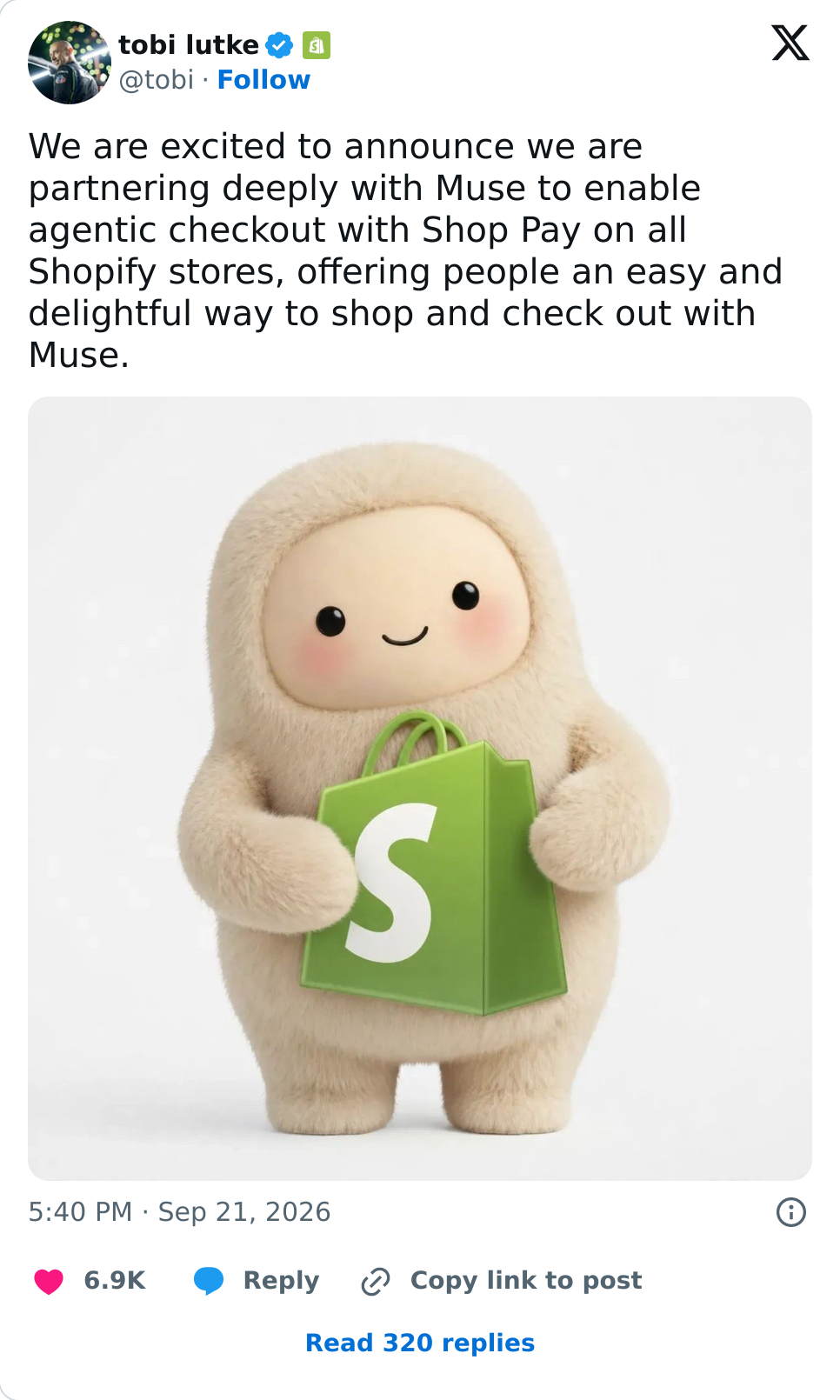
Shopify does not have an ad business to protect; what they do care about is owning the transaction, which is why this integration is about preserving Shop Pay’s position. And, while Shopify does own the long tail — I’ve been consistently optimistic about Shopify’s prospects in the AI era — it’s not an Amazon or Walmart replacement.
All of that noted, Meta does care very much about the user experience, and if a user can’t shop for anything and everything, the experience is worse, so there is a high level of motivation to figure this out. Moreover, Meta might be willing to give more than you might think at this specific moment in time. First, Muse is the company’s highest priority, particularly since it already has the makings of a hit. Second, I didn’t highlight it at launch, but Meta is taking a pretty restrained approach to the data you put into Muse. From the announcement post:
Muse doesn’t share a person’s conversations or the data in their VM with Meta’s ad systems.
That Meta made this promise speaks to how important Muse usage is to the company: Muse data is obviously going to be a goldmine, and because of that Meta potentially using it is a reason for end users to be wary — thus the promise not to. What is interesting is that very few people seem to have picked up on this promise — I’m not sure how much slower Muse’s takeoff would have been without it — but the fact of the matter is that it exists.
To that end, is there room to extend the deal that Meta already has with Amazon? Back in 2023 Meta and Amazon agreed to allow users to link their Meta and Amazon accounts and make purchases directly from Amazon ads in Facebook and Instagram; I actually don’t really remember hearing much about this deal since then — Meta moved away from in-app checkout last year, which may or may not be related — but it’s interesting to consider how the general outline might apply here.
Specifically, is it possible that the first way that Meta monetizes Muse is not through its own data, but through Amazon’s? You can see how that solves a bunch of problems. From Amazon’s perspective, they get to expand their ad surface, instead of losing it; from Meta’s perspective, they not only get to deliver on the agentic shopping experience, but they can also monetize Muse immediately with explicit user permission (because they linked their Amazon account). Meta making money via Amazon ads would be a weird outcome, but it makes sense — and it’s a reminder that Amazon’s investments in the real world are the ultimate advantage in AI.
This Update is also available as a podcast. To receive it in your podcast player, visit Stratechery.
The Stratechery Update is intended for a single recipient, but occasional forwarding is totally fine! If you would like to order multiple subscriptions for your team with a group discount (minimum 5), please contact me directly.
Thanks for being a subscriber, and have a great day!