2026.09.22 | Substack | Markets | TMTB EOD Wrap
原标题:TMTB EOD Wrap
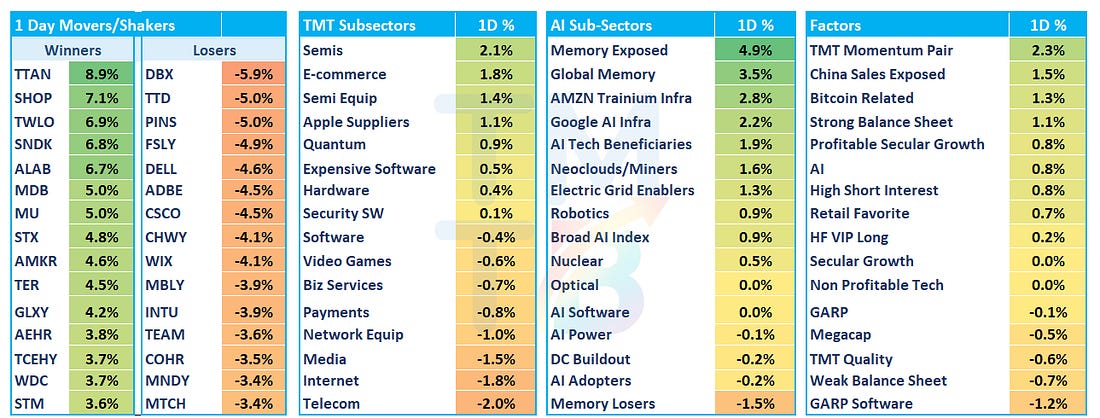
Good afternoon/evening. A little late today as we were running around near the close. QQQs +80bps with nice follow through on yesterday’s strength although a lot more red on my screen today. Semis +2% led the way higher again, with memory and HDDs joining the party while CPUs continued to show strength.
The price action in the Consumer Agentic winners vs. losers trade wasn’t as extreme as yesterday, but flows are still going into the former and out of the latter. Outside CPUs, perceived winners such as TWLO +7%, SHOP +7%, & OKTA +3% outperformed, while losers fell, with OTAs down 2-3% and DASH/CART/AMZN/GOOGL down 1-2%. We discussed the bull/bear read-throughs on all of these in more detail yesterday in our EOD wrap.
The agentic consumer loser trade expanded outside of Tech today, following the typical pattern of a theme’s impact making its way through the market. Insurers (Progressive -2.5%; Allstate -6%), read-through being agents can silently scan rates, re-shop at renewal, and switch policies with little user effort, threatening retention and pricing power that rely on people not bothering to compare. Same worry around how insurance gets sold (BRO -3.4%, WTW -1.8%). Telecom and cable same story: CHTR -6.9%, CMCSA -2.9%, VZ -2.8%, TMUS -2.2%, T -1.8%, as X is full of people posting about Muse getting their Verizon/AT&T bills cut. Throw in “consumer inertia” names like PLNT -9% and NYT -7% where Muse can dump whatever subscription you aren’t using.
Some were even saying the weakness in banks and wealth/brokerage (JPM -3%, WFC -3%, MS -2.9%, SCHW -6%) was due to the read-through from Muse: it can handle bill negotiation, account shopping, financial tasks, and potentially wealth advice or switching. That seems like a bit of a stretch, though (the sector also underperformed bc of the flattening 2s-10s yield curve and fears around peak trading volumes/a Dem sweep).
Regardless, the broader point is that agents don’t need to replace these businesses to pressure their economics. Muse is like having someone work full-time to get you, the consumer a better deal. Some of what investors have called pricing power and customer loyalty may simply have been people having better things to do; Muse removes a lot of that friction with just a quick text. We wanted flying cars and got Twitter; now we want superintelligence and apparently get $17 off our wireless bill first.
Outside of that, the bifurcation between winners and losers that we’ve been seeing over the past months has become even more pronounced this week, particularly in internet and software. In internet, the dynamic has been driven by the consumer agentic trade. In software, it’s more of the same we’ve seen all year: perceived AI losers continue to underperform (ADBE, HUBS, MNDY, INTU, PATH), names like NOW/WDAY/CRM hover in no man’s land, and AI winners (Tier 1: SNOW, NET, TWLO, PLTR; Tier 2: U, DDOG, MDB) and cyber outperform. Saw more of that today as people position themselves ahead of the OAI Dev Day. In theory, Muse adds urgency for frontier labs to move up the stack into software: if a MUSE-like product can deliver what users need without a clear frontier-model advantage, the labs have more incentive to own the software and workflows rather than just supply the intelligence underneath. For example, someone in Slack said “So I find MUSE incredible. I had a server running 24/7 with Claude before that this replaces a lot of use cases for.”
In semis, it’s more nuanced than just AI winners vs. losers because most names are perceived winners, but the outperformance since the Leopold lows has been centered on CPUs and on-prem/enterprise. The SOX is ~14% below its June highs, yet just a few names in thematically strong parts of the broader AI infrastructure trade sit near highs: DELL/HPE (enterprise/on-prem) & AMD (CPUs). NVDA not too far behind. Memory is doing its best to join that club ahead of MU EPS on Sept 30th, with charts looking better and a name like SNDK already up 85% from the Leopold lows:
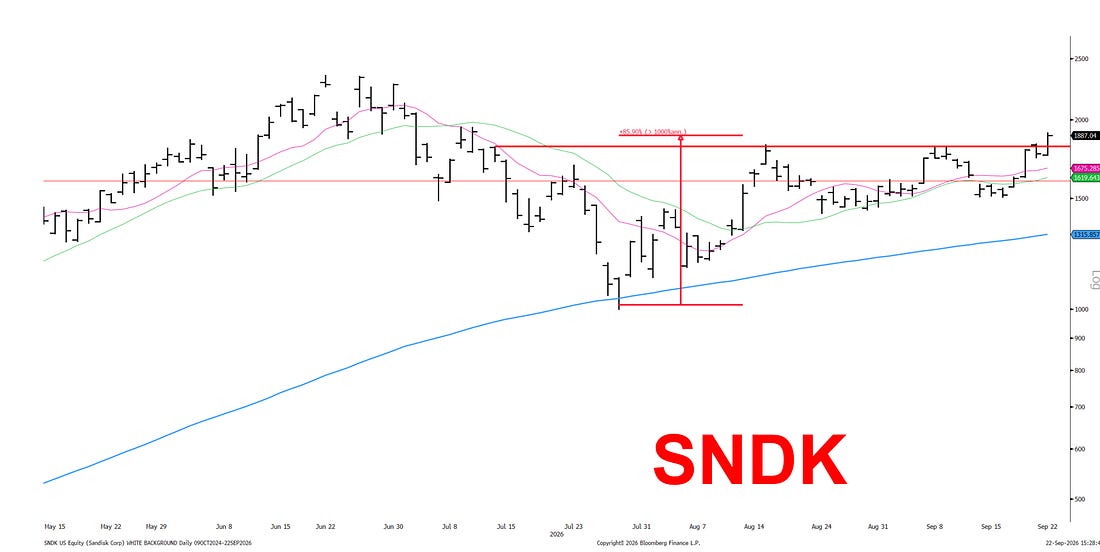
Sector was the standout today playing catch up to CPU names. Rosenblatt had a bullish initiation on SNDK, while Funda.AI was out on MU ahead of EPS on the 30th, saying memory pricing is more likely to settle into a higher, longer plateau than roll over sharply, with tight supply/low inventories supporting 20–30% AI DRAM hikes through 2H26 and potentially 27Q1. They still expect Micron HBM pricing +70–80% next year and now models CY27 EPS of ~$205, implying just ~5x P/E. Investors hoping MU eps focuses investors on capital return, although they have said they likely will hold off from scaling up buybacks until Dec 9th, on expiration of MU CHIPS Act funding agreements.
Back to semis: about 1/3 of the names in the SOX are still 30% or more off their 52-week highs, and the average name is off 25% (h/t Krinsky, who also pointed out that we saw a similar situation back in ’00 after the initial break, when a few names went on to make new highs while the SOX didn’t).

While consumer agentic has seemingly answered the question of the next big use case after coding, it hasn’t resolved 3 other big questions plaguing the semi trade: 1) the trajectory of lab ARR; 2) how quickly open source catches up to the frontier; and 3) the power supply gap between planned and powered DCs in ’27/’28. Muse has added some questions around
1 (see what Ben Thompson said yesterday, which we flagged in our EOD wrap). Lots of dispersion in the SPX as well, with
five straight days of more 52-week lows than highs. All of this supports our “choppy & upwards trending with dispersion” view.
There are a lot of minefields in this narrative heavy winners vs. losers environment, which means there is an increasing scarcity value to clean longs right now. It’s why we’ve seen such an intense move in the agentic theme over the last two days. And the velocity of investors re-pricing these winners vs. losers has only continued to increase, a trend we’ve observed throughout most of this year. That has accelerated even further over the last few months as smarter, better models and agentic harnesses have put significantly more information & intelligence at every investor’s fingertips, including retail. It’s why you can see a name like SHOP move 15% in a day and a half as the narrative flips from agentic loser to perceived agentic winner.
Should be a fun final few months to what has already been a pretty wild year.
BULLISH AND BEARISH WEEKLY OPTION FLOW
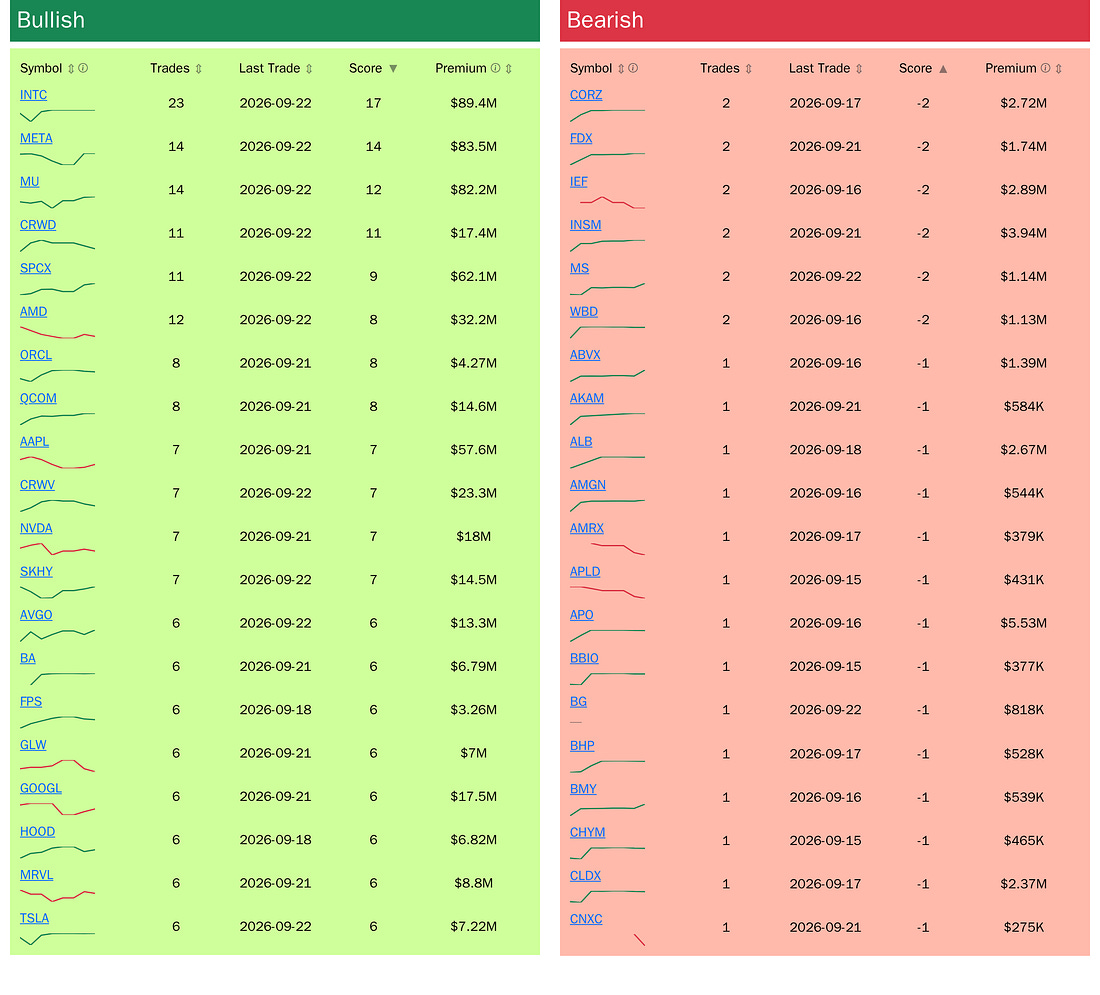
Source: RunningoftheBulltards