2026.09.23 | Substack | Agents | Stratechery: Muse, Amazon & Walmart
原标题:More on Muse, Amazon, and Walmart; Muse and Expedia; Whither Google? (Stratechery Update 9-23-2026)

Wednesday, September 23, 2026
Good morning,
On yesterday’s episode of Sharp China, Bill and Andrew preview Xi Jinping’s visit to Washington D.C., happening this week.
On to the Update:
More on Muse, Amazon, and Walmart
Yesterday’s Update about Muse and Amazon was already quite long; it could have been longer. At the end I proposed what could be a fast solution to this problem: Amazon and Meta building on their 2023 ad deal to flip Muse from an Amazon ad avoider to an Amazon ad surface. This would be fairly radical in some respects, given that Meta is an advertising company, but if it thinks Amazon purchases are that important to the Muse experience it is one route.
The other route is the long road, and here Walmart looms large. This is what I said about Walmart yesterday:
It’s worth pointing out that all available evidence is that for large retailers, agentic shopping doesn’t just mean no ads to show, but also smaller cart sizes that are less likely to convert. Walmart, Amazon’s most direct competitor in terms of both catalog size and delivery speed (the hour delivery times if you live relatively close to a Walmart store are amazing), jumped in feet first to OpenAI’s Instant Checkout program, only to bail a few months later when Instant Checkout converted at 1/3 the rate of customers on Walmart’s site or app, and with materially smaller cart sizes as well. Now it’s possible that is an implementation issue, but I wouldn’t necessarily expect Walmart to pick up the slack here.
I was focused on the disappointing end to Instant Checkout, but the fact remains that Walmart was on-board nearly immediately. This is what I wrote at the time:
Walmart fits into this story more than you might think: yes, there are the products sold by Walmart directly, which are by-and-large anything-but-niche, but Walmart.com has a huge third-party marketplace a la Amazon; a lot of those merchants you discover via Instagram ads or whatnot also have their products on Amazon, and a good number have them on Walmart too…At the same time, the consumer staples that Walmart is known for are not necessarily found on Shopify sites: that’s a big opportunity for Walmart to consistently be the recommended link for products that yes, are available elsewhere (like Amazon), but as long as elsewhere isn’t a part of Instant Checkout than Walmart is going to get the links for those recommendations…
While Walmart is a solid number two in e-commerce, they are a distant second to Amazon. That behooves jumping on new market opportunities, even if that new opportunity means giving up a bit of control. We’ve seen this before, with the iPhone, and how Apple would regularly launch with a second or third place carrier in a country — starting with AT&T née Cingular — because the leading carrier didn’t want to give up the amount of control that Apple demanded; eventually, however, so many consumers ended up switching that Apple eventually got the iPhone everywhere.
Muse almost certainly is a more attractive proposition for Walmart than Instant Checkout was, given that Meta won’t be charging them a fee per transaction; Meta doesn’t want to bring checkout into Muse, but rather let Muse do checkouts on Walmart. At the same time, Walmart does have a growing advertising business, and as I noted yesterday, is (understandably) focused on things like cart size and conversion rates. That noted, I think it is meaningful that Walmart jumped at the ChatGPT opportunity; there’s a good chance they sign on with Muse.
If they do, then Meta is in place to play the long game with Amazon: slowly but surely, with new user after new user, strip purchase after purchase away from the e-commerce leader. Yes, Amazon has the physical moat I wrote about yesterday; at the same time, the trouble with physical assets is that profitability depends on utilizing those assets to the maximum extent possible. Every purchase that isn’t made at Amazon makes the depreciation costs of every other Amazon purchase fractionally higher, because fixed costs are spread ever so slightly thinner. Sure, Amazon doesn’t want to give up its privileged Aggregator position and the advertising that goes with it; their business is also, at a very fundamental level, predicated on making it up in volume.
Muse and Expedia
From Expedia on X:

First off, it should be pointed out what a home run the Muse mascot is. Not only is it adorable, with its cute working animations, but it is extremely memeable:

A further distinction to point out is that Muse is extremely memeable with AI, at least for now: the character is very distinct, easily reproducible, and, perhaps because it is new, willingly reproduced by the AI image makers:
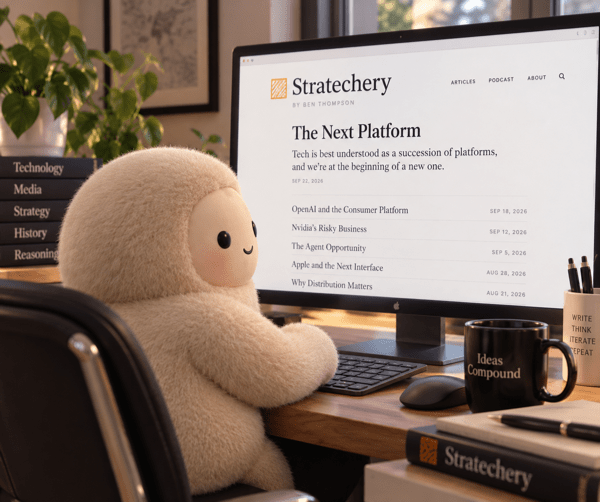
Anyhow, this Expedia image is adorable, but can you say the same for Expedia’s prospects with this deal? On one hand, there is an obvious analogy to Expedia and the other travel aggregators’ relationship with Google. For years there was an assumption that Google would disintermediate Expedia and Booking, but in fact both thrived.
- First, both companies make the lion’s share of their revenue from lodging, not advertising; this means they don’t necessarily have to own the front-end of the customer journey, as long as the reservation finishes on their platform.
- Second, actually doing the grunt work of getting lodging onto a platform, managing payments, collecting fees, dealing with fraud, etc. is difficult, and not something Google is well suited to do — that’s the physical world angle that remains an important differentiator. Moreover, Expedia and Booking provided a familiar customer experience, which made it more likely that a reservation was actually made; conversion is, I would bet, lower on hotel websites.
- Third, both companies actually ended up being some of Google’s largest customers. It turned out that, per point two, their capabilities were complementary to Google, and, per point one, their business model perfectly accommodated buying leads (and, to go back to point two, they were very good at conversion).
Some of these principles hold true for Muse and agents generally:
- The business model of taking a fee from downstream supply lends itself to cooperation with a demand aggregator.
- It’s a bit of a shortcut for Muse to gain access to huge amounts of supply simply by going to one website. Yes, Muse can in theory surf the entire web, and thus go to individual hotel websites, no matter how arcane they might be, but that costs time and compute, both of which are scarce; why not just go to Expedia?
- Expedia is signaling they are happy to accept demand wherever it may come from, so no wonder they’re jumping on board.
That noted, there are important differences as well.
- It’s not clear what Muse’s business model will be. Advertising is the safest bet, but given that Muse really could just go directly to hotel websites, could it actually deal with all of the grunt work Expedia does in a much more cost-effective manner than Google ever could?
- Compute won’t always be expensive (probably), and Meta can and almost certainly will build an index for Muse that makes exploring the wider reaches of the web cheap enough that it is easy to go around the Aggregator.
- There was a time where Expedia and Booking’s supply was meaningfully different, and while that is still the case in the long tail, at this point there are multiple sites with the same hotels — and the hotels themselves. Google sorted this out by making them bid to be on the top of search results; Meta could do the same, or make the Aggregators bid to be Muse’s target. In this case, however, you don’t get the benefit of getting a user on your site, and potentially bringing them back in the future outside of an ad; Muse won’t be loyal or care about familiarity the way a human might.
In short, these middleware Aggregators do have utility for agents today; their position does seem fundamentally more fragile going forward, however.
Whither Google?
Speaking of Google, M.G. Siegler asks on SpyGlass:
The number one response I’ve gotten to my thoughts on Meta’s Muse personal assistant agent is some variation of “I will never trust Meta with my data.” But the number two response is arguably more interesting (and related): “Why didn’t Google build this?”
The short answer to this is undoubtedly: they’re working on it. But the longer answer is probably more interesting here too. Unlike Meta, Google runs the biggest email service in the world – an email service which contains the most valuable trove of personal information (not to mention communication capabilities) for a personal assistant AI. And what is probably the biggest calendaring system in the world. They also run the largest search engine in the world. Oh yes, and the largest smartphone platform in the world. Sure, Meta has Facebook, Instagram, and WhatsApp, but Muse can’t really work without access to any of these Google services. Depending on where you live, it could probably work as a sort of WhatsApp personal assistant AI, but Muse would be a shell of what it currently is – again, thanks to the hooks into Gmail, Google Calendar, etc.
So yes, Google obviously should have built this! And again, they’re undoubtedly working on it – a big part of I/O this year was talking up ‘Gemini Spark’ Google’s agentic tool (not to be confused with ‘Muse Spark’, which is the AI model that powers Muse – which really is just an incredibly confusing branding twist), which has been in testing for several weeks now. And yes, it hooks into most of the various Google tools. The problem, as I see it, is three-fold…
First off, as an aside, I love that the model powering Muse is “Muse Spark”; it’s the spark that makes Muse possible!
Second, the three reasons Siegler lists are the fact that Spark isn’t fully released yet, the company has competing products, and that Muse is a better product. All true!
The elephant in the room, however, is business model. Yes, there is a boy who cried wolf aspect to raising this, given that everyone — including yours truly — raised the prospect of chatbots disrupting Google’s advertising business, which hasn’t happened; to Google’s credit the company has radically overhauled search to basically be the largest chatbot in the world, and monetized it all along the way.
The thing with chatbots, however, is that a human is still in the loop, which at the end of the day means that there is someone to advertise to; it’s just the surface that has to be figured out. The challenge with agents is that the entire point is to take the human out of the loop, and that’s not very good for Google’s business! This, by extension, inevitably creates the conditions for indecision and the dragging of feet by Google’s management, which leads to all of the problems Siegler highlighted, including slow releases, competing products, and the products simply not being good enough.
I am, famously, terrible at forecasting Google, but this dilemma seems pretty fundamental. The chatbot issues were real, just early; now all of the questions raised then are reappearing with significantly more urgency. Remember, however, that we may be witnessing a transformation of the search giant into The Google Capital Company. That strategy also explains what is happening: protect search for as long as possible until providing the world’s compute dwarfs everything else.
Still, that doesn’t make search unimportant, and this is where it’s worth going back to Expedia: Google never got into Expedia’s business because Expedia did real world grunt work that Google didn’t want to bother with; today, however, that means that when it comes to being an Aggregator, Google has no physical anchor at all, and that’s a precarious position to be in.
This Update is also available as a podcast. To receive it in your podcast player, visit Stratechery.
The Stratechery Update is intended for a single recipient, but occasional forwarding is totally fine! If you would like to order multiple subscriptions for your team with a group discount (minimum 5), please contact me directly.
Thanks for being a subscriber, and have a great day!