2026.09.23 | Substack | Markets | TMTB Morning Wrap
原标题:TMTB Morning Wrap
Good morning. QQQs -25bps to start the day as things were quiet on the macro front overnight ahead of Trump’s meeting with Xi tomorrow.
We get analyst days from OKTA & P today, alongside META’s Connect, where Zuck kicks things off with the keynote at 7pm ET.

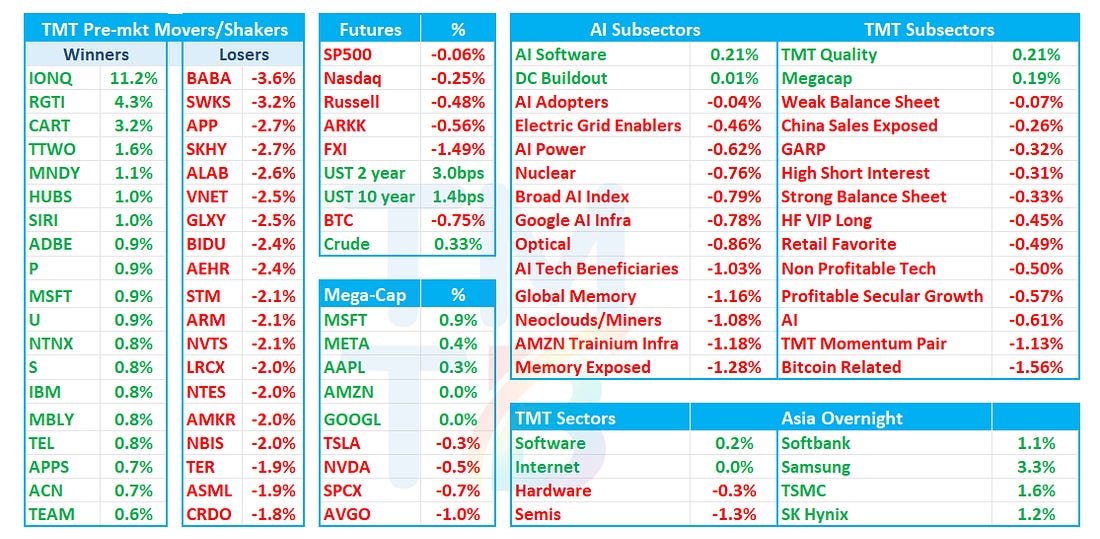
In Tech, main focus continues to be impact of Muse and agentic consumer harnesses and what that means for names across the sector. Semis -1.3% early while Software/Internet flat today. Overnight, Asia mixed: Hang Seng -1.01%, HSCEI -1.06%, SHCOMP -0.39%, Shenzhen -0.5%, Taiwan TAIEX +0.75%, Korea KOSPI +0.9%.
Let’s right to it…
MSFT: Stifel upgrades to Buy/$575, sees Azure + M365 AI monetization reaccelerating as capacity efficiency improves
Stifel says Azure upside should increasingly come from better infrastructure efficiency, new capacity coming online and rising OpenAI-related revenue, with demand still outstripping supply and recent dock-to-live improvements freeing capacity faster. Stifel also highlights M365 Copilot seats at ~30M in 4Q, +10M q/q, plus growing GitHub consumption as support for sustained mid/high-teens M365 growth. Stifel upgrades to Buy from Hold and raises PT to $575 from $530.
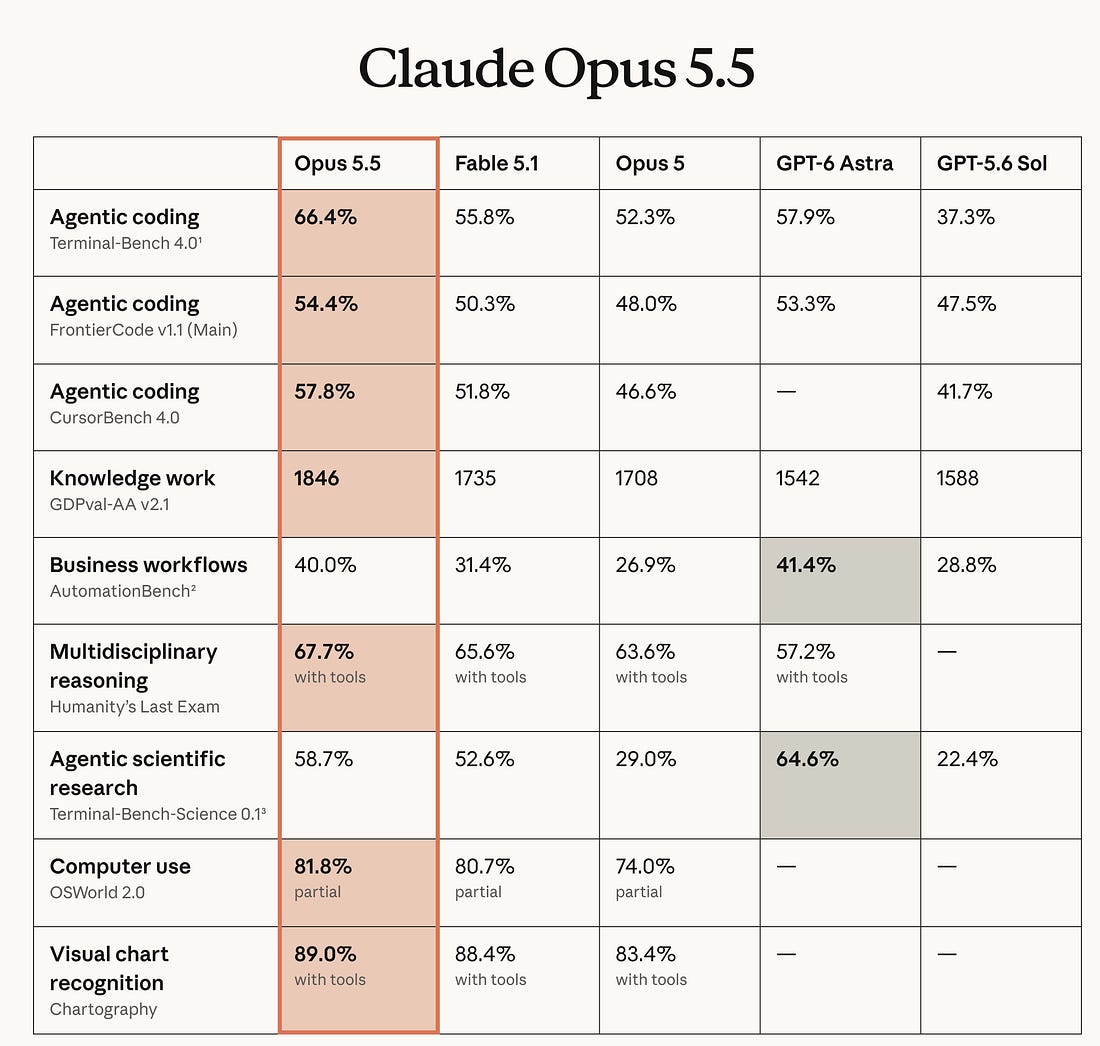
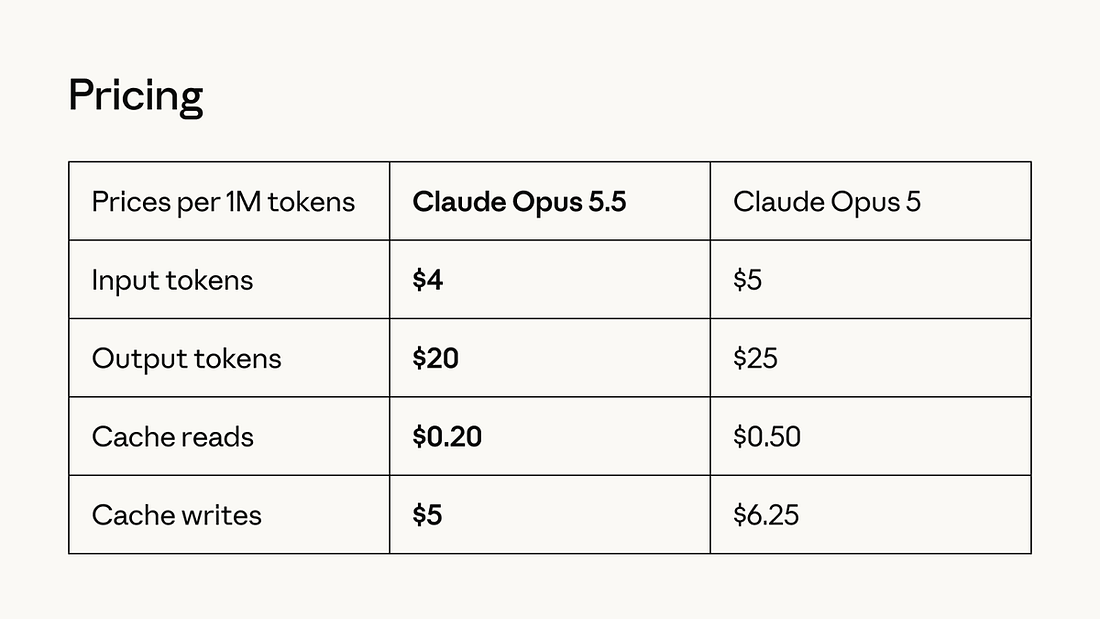
Anthropic: Released Opus 5.5 yesterday, cheaper and better than Fable

Data Center Power: GS raises BTM outlook to 67GW by 2030, sees fuel cells emerging as fastest-to-power solution
GS raises its 2030 behind-the-meter power forecast to 67GW from 40GW, with gas BTM + fuel cells supplying ~28% of U.S. and ~25% of global data-center power demand. GS says fuel cells screen best on execution despite higher LCOE, with ~6–12 month deployment, high reliability, low emissions and direct compatibility with emerging 800V DC architectures; it now sees ~12GW of U.S. and ~18GW of global fuel-cell capacity by 2030, a ~$35B/$55B equipment opportunity
GEV: Jefferies says long-term services opportunity could exceed current $500M/GW framework
Jefferies says recent investor feedback remains too cautious on GEV’s 2035+ services opportunity, arguing peak backlog matters more than peak orders given multi-year visibility and five-year lead times. Jefferies sees management’s ~$500M/GW lifetime services framework as potentially conservative, with refurbishment/process efficiencies creating additional margin upside not fully captured in estimates. Jefferies maintains Buy/$1,185 and Franchise Pick.
META/MUSE
EXPE/BKNG/ABNB/CART/META: MS says Muse partnerships show agentic commerce moving from discovery toward transaction capture
MS says EXPE becoming Muse’s first major OTA partner and CART integrating grocery checkout show META pushing Muse further down the commerce funnel, potentially opening a path to transaction economics as agents increasingly control the customer interface. For travel, MS sees BKNG best positioned given differentiated supply and stronger direct execution, while ABNB has more to lose given ~90% direct traffic; EXPE could benefit from incremental traffic/lower acquisition costs if the partnership scales. CART similarly gains a new discovery/share channel, though the longer-term risk for all intermediaries is Muse increasingly sitting between the platform and the end customer.
Agentic AI/META: Citrini says Muse marks the consumer-agent inflection, shifting value from friction-based intermediaries toward infrastructure + transaction rails
Citrini argues Muse is the first consumer agent to achieve real mass-market product fit, making agentic disintermediation less theoretical as consumers outsource shopping, negotiating, cancelling and switching decisions. Its framework favors META, SHOP, TWLO/BAND/RNG, cybersecurity/identity, NET, V/MA and underlying data/transaction infrastructure, while seeing growing pressure on OTAs, aggregators, subscription businesses and other models that monetize consumer inertia, information asymmetry or switching friction.
INOD: Citrini/Hunterbrook see Innodata as an underappreciated upstream Muse beneficiary
Citrini says interviews and company disclosures point to META as INOD’s largest customer and notes Innodata recently disclosed a new program with that customer focused on “personalization of long-horizon agents,” which closely resembles Muse work, though neither company has confirmed the linkage. Citrini argues INOD is expanding beyond traditional labeling into agentic RL environments, computer-use training and human-judgment datasets, while highlighting both the upside from deeper META engagement and the concentration risk.
META: Cantor raises PT to $860, sees Muse as a potential third AI S-curve with $1T+ TAM
Cantor says personal agents could become the third major AI S-curve, with META well positioned through Muse’s model/harness/UX, distribution and massive compute footprint; Cantor sizes the broader personal-agent TAM at potentially >$1T. While Muse currently requires heavily subsidized inference, Cantor expects cost/task to fall >80% over 18–24 months and believes META can support rapid adoption using only ~5–10% of its projected 14GW FY27 compute footprint. Cantor reiterates OW and raises PT to $860 from $680.

CVNA: 3p saying units tracking close to dd above street so far QTD
MSFT: Plans 30–50% Copilot discounts tied to seat and usage commitments – The Information
> The Information reports Microsoft plans Copilot discounts of roughly 30% for customers buying more than 1,000 seats and up to 50% above 10,000 seats, alongside commitments to usage-based payments. The information reprots discounts could begin in October as a revamped Copilot app combines coding tools and autonomous-agent features, some with additional usage charges. The move expands earlier discounts of about 10% for 2,000-seat commitments.
AVGO: China reviews Broadcom switch dependence at state-backed data centers – FT
> The FT reports China’s state-assets regulator is surveying Broadcom switch use at state-backed data centers, potentially leading to informal guidance to reduce purchases. One source puts Broadcom’s penetration among state-owned companies as high as 90%. FT says a supplier representative expects any restrictions to exclude private facilities such as Alibaba’s and ByteDance’s, with existing equipment left in place.
Anthropic / GOOGL / AVGO: Talks for up to 1GW of directly leased data-center capacity – The Information
> The Information reports Anthropic is in early talks to lease up to 1GW from Apollo-backed Stream Data Centers, with Google potentially guaranteeing part of the financing. Discussions include Google/Broadcom TPUs and possibly Nvidia GPUs. TheInformation reports evelopers estimate at least $40B of capital spending for 1GW, rather than a committed deal value. An agreement remains months away and could fall apart.
IONQ: Demonstrates real-time quantum error decoding on a standard CPU – IonQ
Has IONQ +11% and other quantum stocks higher
> IonQ says it demonstrated end-to-end, real-time quantum error correction decoding on an off-the-shelf CPU, using simulated circuits with up to 408 logical qubits and as little as 0.02% added execution time. The research used 12 cores of an Apple M4 Max to process the error information needed to guide corrections. The result addresses a potential classical-computing bottleneck in fault-tolerant quantum systems. These are simulated quantum workloads with a working classical decoder; the benchmark does not establish operation of a 408-logical-qubit quantum computer.
TTWO: Citi says GTA Online timing remains unconfirmed while mobile/NBA2K trends stay healthy after meeting with CEO/CFO/IR
Citi says after meeting with CEO Strauss Zelnick, CFO Lainie Goldstein and IR Nicole Shevins, management declined to confirm reports that GTA Online launches in CY27 but reiterated focus on both new-franchise development and GTA Online. Management said it sees no weakness in mobile or NBA 2K, while streaming remains ~2–5 years away given latency/network constraints and AI is currently more of an efficiency tool than a headcount reducer.
Enterprise AI: FUNDA says spending keeps rising despite optimization, with growth shifting from seats toward APIs + production applications
FUNDA’s latest 10-company enterprise survey finds AI spending still increasing at 9 of 10 companies, even as model switching, caching and procurement negotiations lower unit costs; once employee seats mature, incremental growth increasingly shifts toward APIs, agents and deeper workflow usage. Companies are also becoming more ROI-driven, with proven applications continuing to receive funding while new projects increasingly need to show cost savings, revenue uplift or capacity gains. FUNDA also sees growing use of open-weight/smaller models for routine and private-data workloads, while Fable/Astra-class frontier models remain concentrated in complex R&D, planning and reasoning rather than broad production
AAPL: Apple’s annual flagship iPhone 18 Pro series is the first to deliver strong sales momentum in Taiwan. On the 22nd, Taiwan Mobile and FarEasTone announced their cumulative sales over the first three days of sales, both up more than 70% compared to the same period last year - CommercialTimes
SMTC: Seaport initiates Buy/$200, sees reinvention around data-center optical positioning it for 2027–28 AI ramp
Seaport says Semtech has moved beyond its troubled connectivity past and increasingly repositioned around data-center optical. The firm sees SMTC well positioned to benefit as AI optical demand accelerates through 2027–28 and initiates Buy with a $200 PT.
HUT/WULF/APLD/CORZ/CIFR: UBS initiates Buy on Miners, sees time-to-power driving multi-year contracted growth
UBS says the five AI-colocation names already control ~50GW of leased capacity representing ~$125B of contracted revenue, with another ~12GW of expansion opportunity as power remains the gating factor. UBS models ~80% average EBITDA growth from 2027–29, with 2029 estimates ~10% above Street, and sees ~36% average upside as companies convert power pipelines into long-term contracted cash flows.
CRWV: UBS initiates Buy/$120, says strong AI demand + rising GPU economics outweigh credit/leverage concerns
UBS argues Street is underestimating the durability of AI compute demand and CRWV’s economics, with revenue per GW potentially rising from roughly ~$11B today toward $15B+ as GPU pricing improves. UBS acknowledges leverage, 72% revenue concentration among three customers and new competition, but believes these risks are more than reflected at ~3x 2027 revenue; launches Buy/$120.
LITE: Stifel says UHP demand is outrunning supply and NPO opportunity is larger than CPO after meeting with CEO at ECOC
Stifel says after meeting with CEO Michael Hurlston, NVDA-driven UHP laser demand has accelerated enough that LITE cannot fully meet incremental December-quarter demand, with management looking to accelerate shipments through CY27. Stifel says NPO looks larger than CPO, with five NPO engagements split between external- and integrated-laser architectures, while multi-wavelength designs lift ASPs. Greensboro remains on track for early 2028, with substrate availability rather than laser technology the gating factor for the 6-inch transition.
CRM: JPM says core CRM spend is coming off the sidelines, but Agentforce adoption remains early after Dreamforce SI/customer checks
JPM says SI checks at Dreamforce showed Salesforce pipelines accelerating over the last 3–4 months as customers conclude the “SaaSpocalypse” is not materializing and re-engage on core CRM/Data Cloud projects. Partners were notably positive on the Anthropic/Claudeforce direction and headless architecture, but said Agentforce remains mostly early-stage experimentation, with data readiness, pricing/credit complexity and governance still the key bottlenecks.
HUBS: JPM says partner pipelines remain healthy but sales cycles are lengthening; AI credit usage is highly bifurcated after UNBOUND checks
JPM says HubSpot partner checks showed generally solid pipelines, but EMEA partners in particular cited macro uncertainty, AI confusion and GDPR/data-sovereignty concerns as reasons deals are taking longer to close. AI credit usage is concentrated among power users/enterprise customers, with one partner estimating only ~10% materially exceed initial capacity while most use <5%; ease of use remains a key competitive advantage, though product depth versus Salesforce is still a constraint upmarket.
BABA: Barclays says Apsara reinforced accelerating AI Cloud demand, 20GW ambition and rapidly scaling Qwen/T-Head stack
Barclays says Alibaba management at Apsara laid out a path to >20GW of global data-center capacity by 2032, with AI Cloud revenue accelerating, MaaS customers rising from ~1M to >6M y/y and MaaS ARR reaching ~RMB20B. Barclays also highlights Qwen moving toward 5–10T parameter models and recursive self-improvement, while new Zhenwu V900 infrastructure delivers ~3x M890 performance and next-gen Yitian CPUs are being redesigned specifically for agentic workloads. Barclays reiterates OW/$200.
W: Truist says growth/share gains remain intact and AI traffic is converting better after meeting with Head of Accounting & Tax + Head of IR
Truist says after meeting with IR, management remains confident W can sustain a high-single-digit growth spread versus the home furnishings category, with 3Q U.S. revenue tracking roughly in line to slightly above Street. Truist says contribution margins remain the focus, with a path to >10% adjusted EBITDA margins over time, while agentic traffic from ChatGPT/Perplexity is still small but is converting at higher rates; W is actively working to make its catalog discoverable across AI platforms. Truist reiterates Buy/$135.
FSLY: William Blair says Analyst Day frames a realistic 14–21% 2029 growth target, with AI/security upside still early
William Blair says Fastly’s Analyst Day laid out a 2029 framework of $1.1–1.3B revenue, 67–71% GM, 20–22% operating margin and 12–15% FCF margin, with AI, cybersecurity and cross-sell as the main growth vectors. Blair highlights that ~30% of large customers now use 4+ products, up 16% y/y, while three new AI-security products and a broader platform-selling motion could improve wallet share. Blair reiterates Outperform, though it notes AI contribution remains difficult to quantify and the move to consolidated revenue reporting reduces segment visibility.
HOOD: MS sees Active Trader Summit as potential catalyst for agentic trading + U.S. perps
MS says HOOD’s Sept. 29–30 Summit should focus on making agentic trading more seamless, potentially embedding natural-language strategy creation, risk limits and agent execution directly into Robinhood/Cortex after ~100K customers opened agentic accounts with >$100M AUC by 2Q. MS sees U.S. perpetual futures as the key potential new product, and a possible update on U.S. tokenized equities following the SEC Innovation Exemption.
TTAN: MS says consumer agents could drive incremental local-services demand and GTV
MS says ServiceTitan could be a direct beneficiary as consumer agents make it easier to find, compare and book local services such as HVAC without consumers having to search or call providers themselves. Given the fragmentation of local services, MS thinks lower booking friction could increase job volumes for trades businesses, translating directly into higher GTV for TTAN. MS reiterates OW/$92.
PATH: UBS says ~10% FY28 ARR setup looks intact, with Coding Agents a potential reacceleration lever after Investor Day + reception
UBS says management did not formally guide FY28 ARR but indicated ~10% growth as a reasonable “projection of confidence,” broadly in line with Street. UBS says early renewals and intra-contract upsell are improving, while Coding Agents could accelerate conversion of existing automation backlogs into production and potentially reaccelerate revenue/ARR growth, though still early. UBS remains Neutral and cuts PT to $15 from $19 on a lower peer-group multiple.
APH: Evercore ISI says more bits + more watts expand Amphenol content across next-gen AI racks
Evercore ISI says APH’s new 448G/XtremePass CPC/Zetamax products broaden its exposure across scale-up/scale-out connectivity as higher signaling speeds push more links off PCB traces and into high-speed cable assemblies. ISI says APH is also well positioned as optics move closer to compute, with C-LINK/CPO-related products alongside copper solutions, while power content is rising through 400VDC, busbars and liquid-cooling integration. ISI views APH as increasingly architecture-agnostic across copper, optics, power and thermal as AI infrastructure shifts from server-scale toward rack- and pod-scale designs.
NEWS:
META / AMZN: Muse adoption meets access barriers and human-support concerns – WSJ / Reuters
> The WSJ reports Muse has exceeded 2.5 million downloads and reached No. 1 on Apple’s US App Store, but Amazon has blocked its shopping access. An Oppenheimer survey found 8% of consumers would trust Meta with passwords, versus 30% for Google, highlighting a hurdle to deeper account integration. Separately, Reuters reports Meta rolled back an internal trial that let human contractors handle Muse calls after privacy and disclosure concerns. Humans achieved 95–98% call success in internal tests, above the undisclosed AI rate. The rollback concerned employee testing of human handoffs, not the public AI calling feature.
AAPL / MSFT / NVDA: New Macs target enterprise AI workloads and cloud costs – Reuters
> Reuters reports Apple is pitching new Mac mini and Mac Studio systems for local enterprise AI, aiming to reduce recurring cloud-token charges for coding and business workflows. Apple demonstrated four connected Mac Studios running a trillion-parameter model from a single wall outlet, using unified memory and RDMA over Thunderbolt.
Samsung: Brings hybrid bonding forward in next-generation DRAM roadmap – ZDNet Korea
> ZDNet Korea reports Samsung has brought its B1b hybrid-bonding project into the formal DRAM roadmap as D0a, while continuing vertical-channel transistor development on a separate D0a-V track. The approach bonds separately manufactured memory-cell and peripheral-circuit wafers, improving density while avoiding some of the transistor redesign’s manufacturing hurdles. Industry sources expect commercialization no earlier than around 2028, with investment timing potentially set in mid-2027. Samsung is also considering the technology for HBM5, expected in 2029, making this an important process and equipment roadmap update rather than an immediate capacity increase.
QCOM / GOOGL: Expand agentic AI partnership across phones, PCs and vehicles – DigiTimes
> DigiTimes reports Qualcomm and Google are expanding agentic AI integration across phones, Googlebooks and vehicles, with Gemini Intelligence set to accompany new smartphones in 2026. A separate DigiTimes report says Qualcomm is developing a Snapdragon-specific high bandwidth compute (HBC) coprocessor that brings memory and AI processing closer together to improve efficiency. Qualcomm plans to extend HBC to notebooks, glasses and vehicles, with further details due at MWC 2027.
LG Electronics / MSFT: Partner on data-center infrastructure, cooling and physical AI – DigiTimes
> DigiTimes reports LG and Microsoft agreed to explore LG power, cooling and infrastructure support for Microsoft’s near-term data-center expansion, with prefabricated data centers a longer-term opportunity. LG will also adopt Microsoft AI and cloud tools internally, including Microsoft 365 E7 and Copilot, and use Microsoft’s cloud to train physical AI models for logistics, mobility and manufacturing. The agreement broadens LG’s potential hyperscaler relationships as it expands liquid-cooling products.
Samsung / QCOM: LPDDR6 passes Snapdragon validation at 10.7Gbps – TrendForce / DigiTimes
> TrendForce and DigiTimes report Samsung became the first supplier to validate LPDDR6 on Qualcomm’s latest Snapdragon platform, with its 16GB memory reaching 10.7Gbps. DigiTimes cites bandwidth of up to 114GB/s and Samsung’s claim of up to 21% better power efficiency than LPDDR5X, supporting demanding on-device AI workloads. TrendForce suggests Galaxy S27 Pro and Ultra models could adopt LPDDR6 while other variants may retain LPDDR5X to manage costs. The validation strengthens Samsung’s position for premium handset designs, although the proposed Galaxy memory split remains unconfirmed.
GOOGL / GRAB: Waymo targets Singapore launch in 2028 as local trials expand – Nikkei Asia
> Nikkei Asia reports Waymo plans manual operations in Singapore in 2027 before fully autonomous public rides through its own app in 2028, subject to approval. Fleet size remains undisclosed. The report adds competitive context to last week’s announcement: Grab’s WeRide-backed public trial had carried more than 12,000 passengers by September 14, while ComfortDelGro’s Pony.ai-powered service began public rides in June.
CME / NVDA: GPU-rental futures delayed as CFTC extends review – The Information
> The Information reports CME’s planned October launch of H100 and B200 GPU-rental futures is delayed, with the CFTC extending its review by 45 days through November 9. . The CFTC’s consultation highlights opaque, fragmented rental pricing and potential market manipulation, complicating the development of a liquid compute-hedging market.
OpenAI: Altman to outline common AI safety standards at the UN – Bloomberg
> Bloomberg reports Sam Altman is scheduled to address the UN Security Council in person on Wednesday, with Anthropic’s Dario Amodei participating remotely. OpenAI plans to advocate common AI safety standards and democratic oversight while avoiding excessive concentration of power.
US–China: Discuss AI incident safeguards ahead of the summit – Bloomberg
> Bloomberg reports US and Chinese officials are discussing AI safety measures ahead of Thursday’s Trump–Xi summit while both governments continue pursuing AI development. Treasury Secretary Scott Bessent said Washington proposed an emergency hotline for AI incidents and discussed a dialogue mechanism. US Trade Representative Jamieson Greer said chip export controls were not on the agenda at Sunday’s preparatory meeting.