2026.09.24 | Substack | LLM | FUNDA: Tiered Model Pricing
原标题:Deep|LLM: Tiered Model Pricing Is Broadening AI Adoption; Limited Impact by Jev
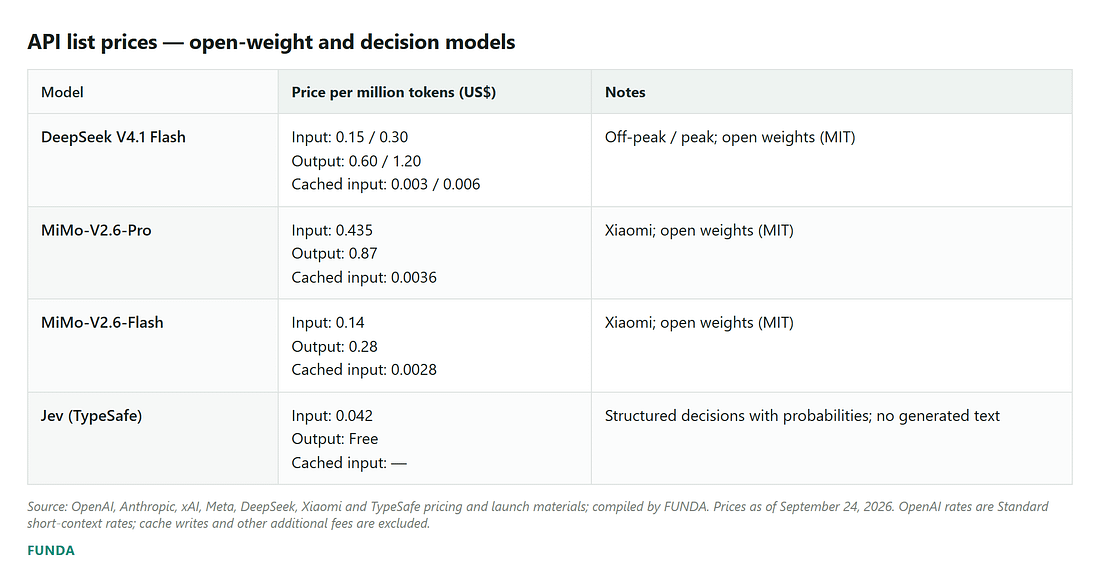
On September 22, Anthropic launched Claude Opus 5.5 at $4 per million input tokens and $20 per million output tokens, 20% below Opus 5. Anthropic estimates that a typical customer workload costs 40% less to run. OpenAI launched GPT-6 Sol ($2/$10) and GPT-6 Luna ($0.10/$0.50) the same day, at prices 50–58% below the prevailing rates for the corresponding GPT-5.6 models and 60–92% below their July 9 launch prices. GPT-6 Luna is the first U.S. model since DeepSeek launched its V4 series to undercut DeepSeek’s cheapest model on both input and output list prices: DeepSeek V4.1 Flash costs $0.15/$0.60 even at off-peak rates. In the text, paired prices such as $4/$20 denote input/output charges per million tokens.
We remain positive on the outlook for AI adoption. Frontier models still carry premium prices, while cheaper models make more everyday tasks economical to automate. Offering models at different price and capability tiers lets developers match the model to the task and their budget. Applications that were previously too expensive to run can now be deployed. As more applications enter production and existing users do more with them, we expect both AI usage and compute demand to keep growing.
API list prices for the models discussed (US$ per million tokens)

1. Inference costs have further to fall
Anthropic and OpenAI both attribute their price cuts to more efficient inference. DeepSeek’s latest model also owes its low prices to efficiency gains. Anthropic says Opus 5.5 needs less compute to serve the same request, generates tokens more than 30% faster, and uses fewer tokens per task at default settings, helping reduce the customer’s cost of a typical workload by 40%. OpenAI cites improvements in caching and inference: cached input is now billed at 10% of the standard input price, and switching reasoning levels or tools no longer invalidates the cache, increasing the savings on multi-step agent workflows. DeepSeek’s V4.1 Flash, released September 10, shrinks the KV cache to a quarter of the previous generation’s size, activates only 16 billion of its 552 billion parameters during generation, and charges $0.003 per million cached input tokens during off-peak hours.
Independent testing by Artificial Analysis (AA) also shows lower costs per task. Cost per task fell from $1.99 to $1.06 for Sol and from $0.18 to $0.07 for Luna, with composite scores unchanged from the prior generation. With token volumes and the mix of input, cached input and output unchanged, switching to GPT-6 Sol roughly halves the model API bill.
We expect further cost reductions. Work on caching, KV-cache compression, MoE and kernel optimization continues, and we expect TPU v8 and Vera Rubin, once they ship in volume, to bring unit inference costs down further. AI-assisted model development is another area to watch: kernels, caching strategies and harnesses can all be optimized with model assistance, as discussed in our report on recursive self-improvement (RSI).
Luna illustrates the pace of price reductions. GPT-5.6 Luna launched on July 9 at $1/$6, was cut to $0.20/$1.20 three weeks later, and GPT-6 Luna arrived at $0.10/$0.50 on September 22. In just over two months, input pricing is down 90% and output pricing about 92%, while both generations score 37 on the AA Intelligence Index. Shorter gaps between launches and price cuts do not tell us how much RSI is contributing, but the steady decline in the price of a given level of capability is becoming a routine consideration in application budgets. We expect it to continue.
2. Tiered pricing brings more use cases within reach
Customers tackling complex tasks are still willing to pay for stronger models. Astra and Fable 5.1 remain at $10/$50, while Opus 5.5 at max reasoning effort scores 58 on the AA Intelligence Index and costs $5.98 per task, roughly the same as Opus 5 at max. YipitData’s June report also shows effective enterprise prices broadly unchanged, with usage shifting toward higher-end models. The latest releases give customers more options across price, capability and speed. In our view, tiered pricing is expanding the market. We do not see these price cuts as evidence that the AI industry is entering deflation. Frontier capability remains expensive; lower-cost models make a wider range of tasks commercially viable. Falling prices for a given level of capability can go hand in hand with growing demand.
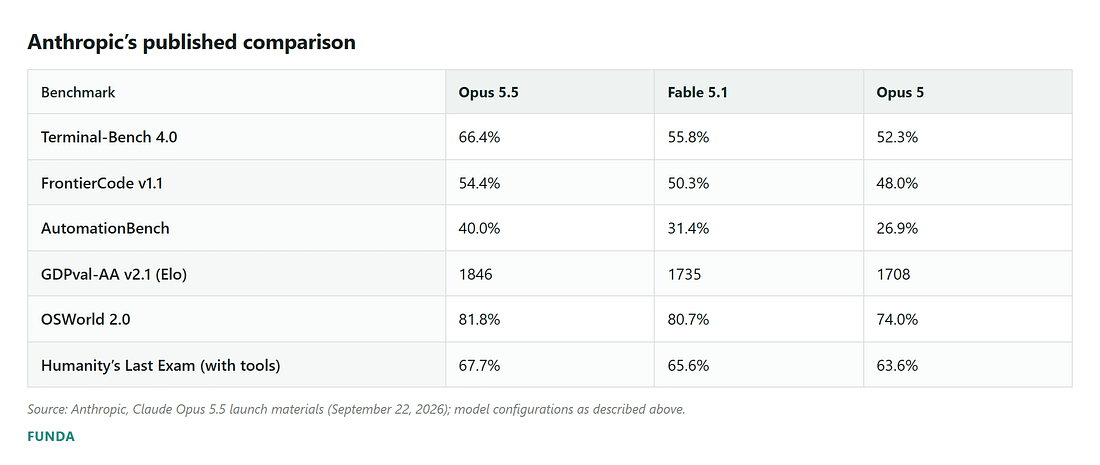
Capability gains matter just as much. Opus 5.5 scores 40.0% on AutomationBench, up from 26.9% for Opus 5, and 58.7% on Terminal-Bench-Science, up from 29.0%. GitHub says it solves more terminal tasks in fewer than half as many steps. The cheaper models make these workflows easier to scale: Luna averages $0.07 per task in AA’s evaluation and is available to Free and Go users in the ChatGPT desktop app; Anthropic raised subscribers’ five-hour usage limits the same day; and in TypeSafe’s own testing, Jev averages $0.0004 per call with 0.4-second latency.
Developers can choose a model for each step: Jev for simple decisions, Luna for extraction and routing, Sol for routine coding, and Astra or Opus 5.5 for the hardest problems. As long as each step is reliable enough, developers do not need to use a flagship model throughout the workflow. Projects shelved because of cost can go live. The same budget can support more users or allow agents to tackle longer, more complex tasks.
Inference costs matter especially for consumer agents. An agent may run dozens or hundreds of steps a day for a user; most of them do not need flagship capability, but every one of them costs money. Meta’s Muse competes here: Muse Spark 1.3 is priced at $1.25/$4.25 via API and scores 48 on the AA Intelligence Index, level with GPT-6 Sol. Lower API prices for mid-tier models make it more affordable to expand consumer agent services. How much Meta saves on its own products will depend on its internal inference costs.
3. Jev has useful applications but limited implications for frontier models
 Subscribed
TypeSafe AI emerged from stealth on September 15 with a $40m seed round led by DCVC, at a post-money valuation of about $200m. Its CEO previously worked on OpenAI’s RLHF and ChatGPT teams, and its CTO created Flask. Jev takes unstructured input and returns structured decisions with associated probabilities: yes/no, a choice among up to 255 options, or a rating on a scale with two to ten levels. A single call can include several questions, with all answers returned in parallel. It does not generate text autoregressively or use additional inference-time reasoning. Input costs $0.042 per million tokens, output is free, and end-to-end latency ranges from 70 to 500 milliseconds. The name comes from the Jevons paradox.
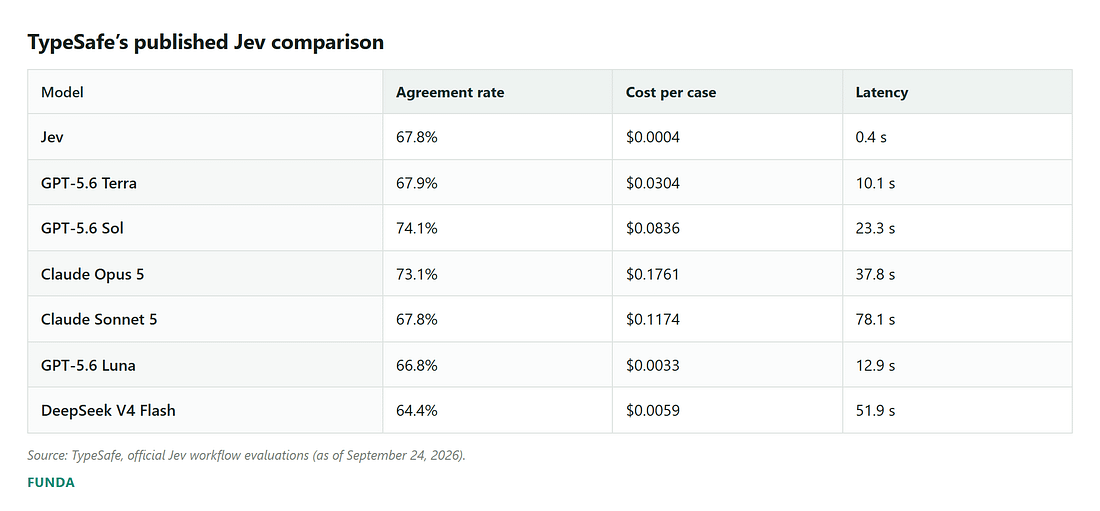
TypeSafe’s evaluation combines results from four real-world workflows. Jev agrees with the reference answers in 67.8% of cases, averaging $0.0004 and 0.4 seconds per case. GPT-5.6 Terra has a 67.9% agreement rate at $0.0304 and 10.1 seconds. With nearly identical agreement rates, Jev is about 25 times as fast and costs roughly 1/76 as much. These are agreement rates with model-generated reference answers, not accuracy scores against human-labeled ground truth. GPT-5.6 Sol and Opus 5 have higher agreement rates of 74.1% and 73.1%, respectively, but cost $0.0836 and $0.1761 per case, with latencies of 23.3 and 37.8 seconds. GPT-5.6 Luna achieves 66.8% at $0.0033 and 12.9 seconds.
Within three days of launch, Vercel AI Gateway, Cloudflare, LangChain and Langfuse had all added support. Vercel says replacing GPT-5.6 Luna with Jev for safety classification improved accuracy and delivered a five- to eighteenfold speedup. Third-party results are mixed. On Banking77, Jev’s zero-shot accuracy is 83.2%, ahead of GPT-5.4 nano (79.3%) but behind GPT-5.6 Terra (87.5%). On phishing emails, a single classification achieves 62.6% accuracy, versus 81.3% for Haiku 4.5, though combining five model-generated signals in a logistic regression classifier raises accuracy to 95.1%. Where labeled data is available, traditional ML is still competitive: on email classification, Jev scores 95.4% against
- 3% for TF-IDF plus logistic regression.
Products like this can take over some of the classification work now done by nano-, Flash- and Haiku-class models, and may encourage developers to add checks they would otherwise skip, such as a guardrail before every tool call, a score for every execution trace, or routing at every agent step. For systems making ten decisions a second, latency matters too. Based on the average cost per call in TypeSafe’s evaluation, 10,000 decisions a day would cost about $120 over a 30-day month with Jev versus roughly $35,000 on Sonnet 5, though actual costs depend on input length and workflow.
We see Jev as a useful tool with limited implications for demand for frontier models. It retains pretrained knowledge but does not do long-chain reasoning, and it trails GPT-5.6 Sol and Opus 5 in the evaluation above; complex tasks still need stronger models. It mainly replaces some of the classification calls that currently go to lower-cost models, and runs a forward pass without autoregressive decoding. Given this narrower role, we expect its overall impact on training and inference compute demand to be limited.
For developers, Jev makes it inexpensive to break a workflow into smaller decisions. In TypeSafe’s evaluation, combining programmatic rules with individual model decisions produced higher agreement rates, lower costs and lower latency than a single long prompt across all models tested. Routers, guardrails and validators can therefore be used much more often.
Whether TypeSafe can capture that value is less clear. Calibration is the main selling point, yet the evidence is limited: one independent test found an out-of-distribution calibration error of 0.107, with overconfidence particularly evident on rating tasks. Its competitive moat is also uncertain, since open-source replicas and decision APIs from the frontier labs could both compete. Demand for low-cost decisions can grow even if Jev loses its lead.
4. Flagship research can benefit the whole product line
Some of the return on flagship research comes from the cheaper models that follow. At $4/$20, less than half Fable 5.1’s list price, Opus 5.5 scores 66.4% on Terminal-Bench 4.0, versus 55.8% for Fable 5.1. On the AA Intelligence Index, Opus 5.5 at max scores 58, versus 53 for Fable. OpenAI says Sol and Luna were trained using methods similar to Astra’s; Luna’s price has fallen sharply while its overall capability remains on par with the previous generation. Leading labs can apply advances in training and engineering across products at several price points, extending the potential return on flagship research beyond sales of the flagship API.
Internal access matters. A lab has direct access to its training data and evaluation sets and can use larger, unreleased models as teachers. During distillation, it can access more complete probability distributions and reasoning traces, coordinate compute allocation, and reuse the flagship’s engineering infrastructure. Google’s Gemma 2 report provides a comparison: with the same 500-billion-token training budget, a 2B model averaged 60.3 across three benchmarks when trained from scratch, versus 67.7 when distilled using the output distributions of a 7B teacher.
Replicating those conditions through a public API is much harder. How much probability and reasoning data you can get depends on the interface, and external users generally face API charges and rate limits. Some reasoning APIs return only summaries, and Anthropic has added anti-distillation measures that withhold reasoning content from new accounts. These access advantages favor labs with strong in-house teacher models, although how large that edge is still depends on training and deployment capabilities. Part of what enterprises pay for also comes from the harness and from workflows tailored to the customer’s operations, which are hard to reproduce from API outputs alone.
5. Greater pricing pressure on standalone Chinese model developers
GPT-6 Luna’s $0.10/$0.50 list price now undercuts DeepSeek V4.1 Flash’s off-peak price of $0.15/$0.60. Once caching is factored in, the cheaper option depends on the workload: for input-heavy jobs with high cache-hit rates, DeepSeek still comes out ahead, while Luna is cheaper when output makes up a larger share. DeepSeek reports a DeepSWE 1.1 score of
- 2, above GPT-6 Luna’s 66.6 and GPT-6 Sol’s 68.8. Outside China, DeepSeek can still attract customers by offering open
weights, self-hosting and better performance per dollar on certain workloads, but competing on price alone has become harder. In China, the direct impact of OpenAI’s price cuts is limited: OpenAI’s services are not officially available in mainland China, and compliance and data-localization requirements remain in place.
Price competition in China is intensifying. Xiaomi open-sourced MiMo-V2.6 on September 22; the Pro version ranks first among open-weight models on the AA Intelligence Index, and the Flash version is priced at $0.14/$0.28, below DeepSeek V4.1 Flash. With DeepSeek, Alibaba’s Qwen, Moonshot’s Kimi, Zhipu’s GLM and Xiaomi’s MiMo all offering open-weight models, third-party model hosting providers in China will find it hard to charge a premium for the model itself, and API margins across the sector will stay under pressure.
China’s large tech companies have other ways to earn a return on their models. Xiaomi can integrate them into phones, cars and HyperOS; Alibaba can support its cloud business; ByteDance can improve advertising. They do not have to recover the full investment through API fees alone. Standalone Chinese model developers have fewer options. Outside China, they face tougher competition from global model providers; in China, they face sustained price cuts by large tech companies. Developers that rely on low prices and offer little differentiation are particularly exposed.
Our view
Application companies are the most direct beneficiaries. Lower spending on model APIs improves gross margins if application prices hold. How much of the savings a company retains depends on its distribution, workflow integration, data and customer relationships. Tools like Jev also make it cheaper to add routing, guardrails and validation. Application companies can use those savings to improve reliability or serve more users and workloads.
Over the next 6–12 months, we expect broader AI deployment to increase both usage and compute demand. Tiered pricing makes AI affordable for more businesses and consumers, while allowing existing applications to make more model calls and handle more complex tasks. We expect the resulting growth in workloads to outweigh the compute saved through efficiency gains, supporting continued demand for compute and networking infrastructure. We will track order fulfillment, capacity utilization and enterprise AI deployment budgets to assess the pace of that growth.
The implications for model developers’ profitability are less uniform. Anthropic has disclosed a 40% reduction in the cost of typical customer workloads and said that serving the model uses less compute, but has not quantified the latter. It remains unclear how much additional usage OpenAI will gain from its price cuts and whether that will translate into higher profits. Labs that can apply flagship research across multiple products and have strong in-house teacher models are better positioned. We are far more cautious on developers that compete mainly on low API prices.
Appendix: Vendor benchmarks and independent evaluations
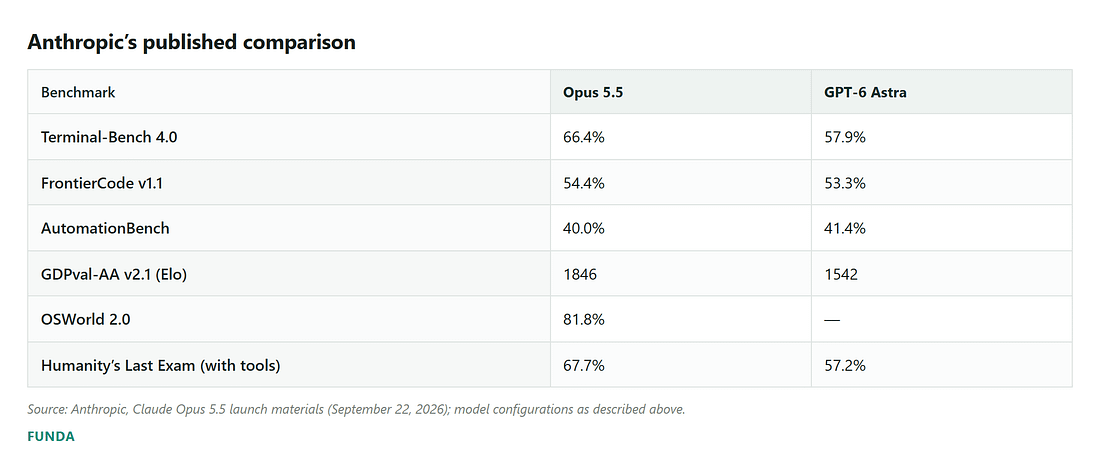
Anthropic’s published comparison. Results are vendor-reported, using the configurations disclosed by each source. On Terminal-Bench 4.0, Opus 5.5 uses xhigh and GPT-6 Astra uses high; configurations vary across the other benchmarks. See the footnotes to Anthropic’s comparison.
OpenAI’s published GPT-6 comparison. Results are vendor-reported, using the highest reasoning-effort settings disclosed for each test; Sol uses xhigh on AutomationBench. OpenAI’s reported cost per task appears in parentheses.

TypeSafe’s published Jev comparison. Results are vendor-reported and aggregated across four real-world workflows. Reference judgments combine outputs from GPT-6 Astra and Fable 5.1 at high reasoning effort; they are not human-labeled ground truth.
Artificial Analysis Intelligence Index v4.3 (effort setting and cost per task in parentheses): Opus 5.5 58 (max, $5.98) and 51 (medium, $1.34); GPT-6 Astra 53; Fable 5.1 53; GPT-6 Sol 48 (max, $1.06); Muse Spark 1.3 48 (max, $1.60); MiMo-V2.6-Pro 46 ($0.13); Grok 4.7 46 (xhigh, $3.74); GLM-5.3 and Kimi K3 44 (Kimi K3 $2.00); Qwen3.8 40; DeepSeek V4.1 Flash 39 ($0.27); DeepSeek V4 Pro 36; GPT-6 Luna 37 (max, $0.07). Vendor-reported DeepSWE 1.1 scores: DeepSeek V4.1 Flash 74.2, MiMo-V2.6-Pro 71.9.
Selected customer and third-party observations: Box’s product lead reports that Opus 5.5 produces answers that are 40% shorter without sacrificing accuracy, while GitHub’s CPO reports that it solves more terminal tasks in fewer than half as many steps. Both testimonials were selected by Anthropic for its launch page. Artificial Analysis notes that Opus 5.5 at max costs $5.98 per task, roughly the same as Opus 5, as substantially higher token usage offsets the lower token price. According to media reports, OpenDesign found that DeepSeek V4.1 Flash reached 98% of Astra’s quality score at
- 4% of the cost. Vercel reports that replacing GPT-5.6 Luna with Jev for safety classification delivered both higher
accuracy and a five- to eighteenfold speedup.