2026.09.24 | Substack | Optical | Gaetano: ECOC Takeaways
原标题:Major Optical Updates. Main Takeaways From ECOC
Several of the optical companies we follow have an opportunity to sell customers a lot more than they sell them today.
ECOC (European Conference on Optical Communication) gave us a clearer look at that expansion, from suppliers taking on more of the finished optical system to businesses entering new parts of the AI network.
There was a ton of commercial detail behind the products.
Customer commitments, production schedules and manufacturing progress give us more to work with when thinking about future earnings.
Some of these opportunities already have contracts behind them. Others are still working through demonstrations and customer qualification, with revenue further out.
My overall takeaway is incrementally bullish, although the investment implications vary considerably by company. I am looking for where these updates strengthen the case for owning the business. More revenue per connection, a stronger competitive position, better profitability or greater confidence in the next production ramp.
Below, I go company by company through what changed, why I care as an investor and when the opportunity could start showing up in the numbers.
I have also pulled in the relevant management commentary from before ECOC to put the announcements in context.
I will be covering the following companies:
- Coherent
- Ciena
- Lumentum
- Qualcomm
- Corning
- Nokia
- Credo
- Marvell
- Macom
- Semtech
- Viavi
- FormFactor
- Keysight
- TowerSemi
- GlobalFoundries
COHR / PhotonLink
PhotonLink is basically Coherent’s attempt to turn a broad collection of photonics assets into one integrated platform.
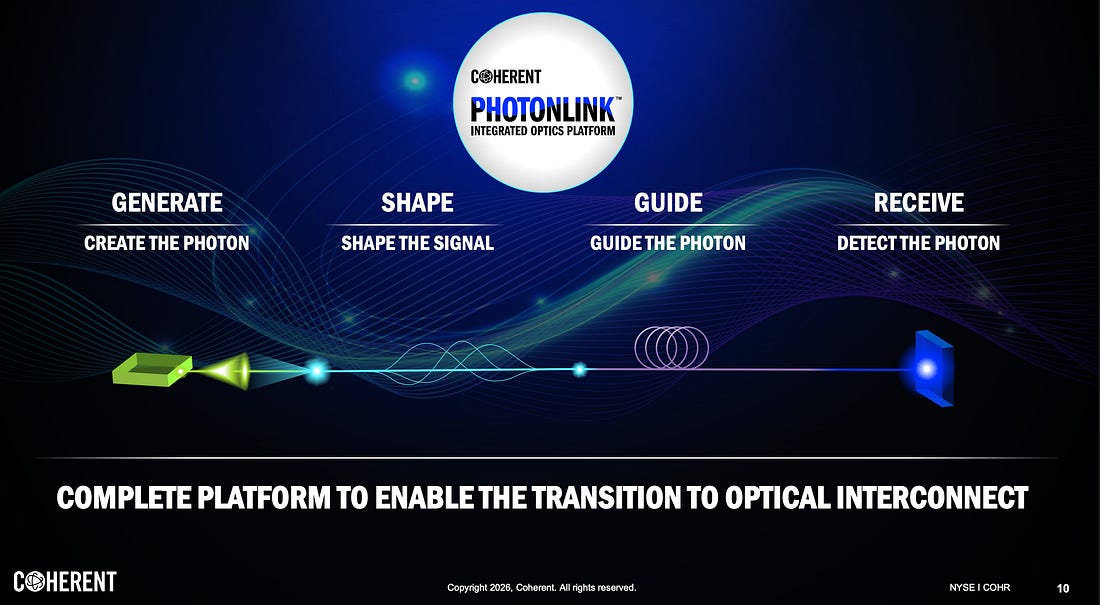
I believe that ECOC strengthens the investment case because we got more info on customers, timing, and content detail around all of it.
They disclosed more than 10 active CPO engagements, more than 10 NPO engagements, and more than five chip-to-chip engagements, with anchor customers and LTAs for both CPO and NPO.
Julie identified NVIDIA as the CPO anchor customer. The NPO customer remains unnamed. Jim also said the number and intensity of customer engagements have increased significantly over the last six to 12 months.
I like the combination here. More customers are working through designs with COHR, while some have already committed through LTAs. The broader engagement count tells us how many opportunities they are working on. The agreements give us more confidence that part of that activity is turning into business.
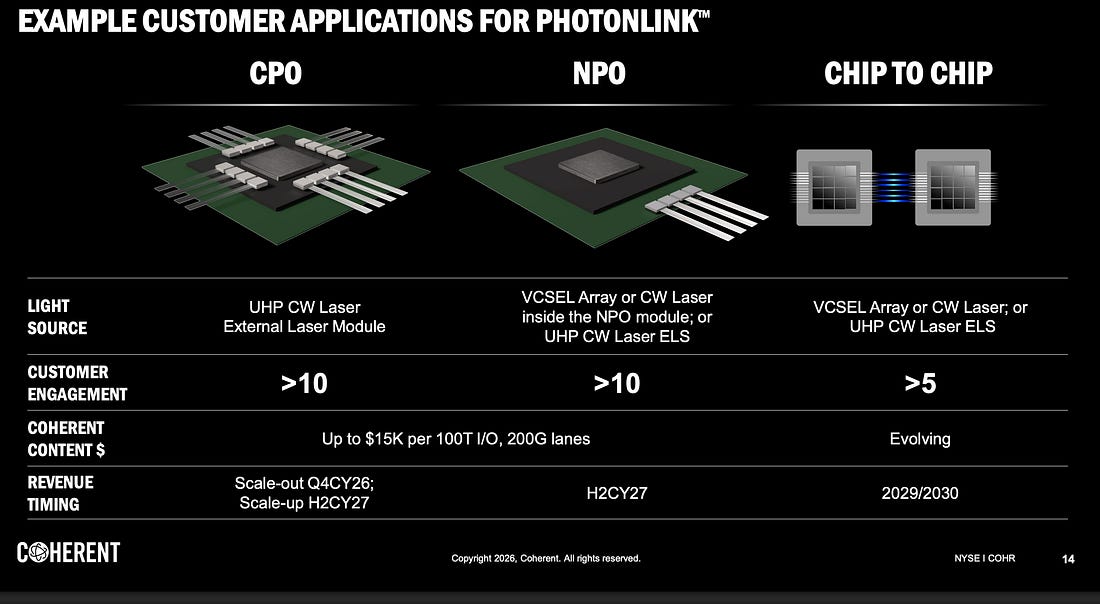
But the comment from Jim that I really liked was customers asking Coherent to bring them the complete optical assembly because pulling all these technologies together themselves was getting difficult.
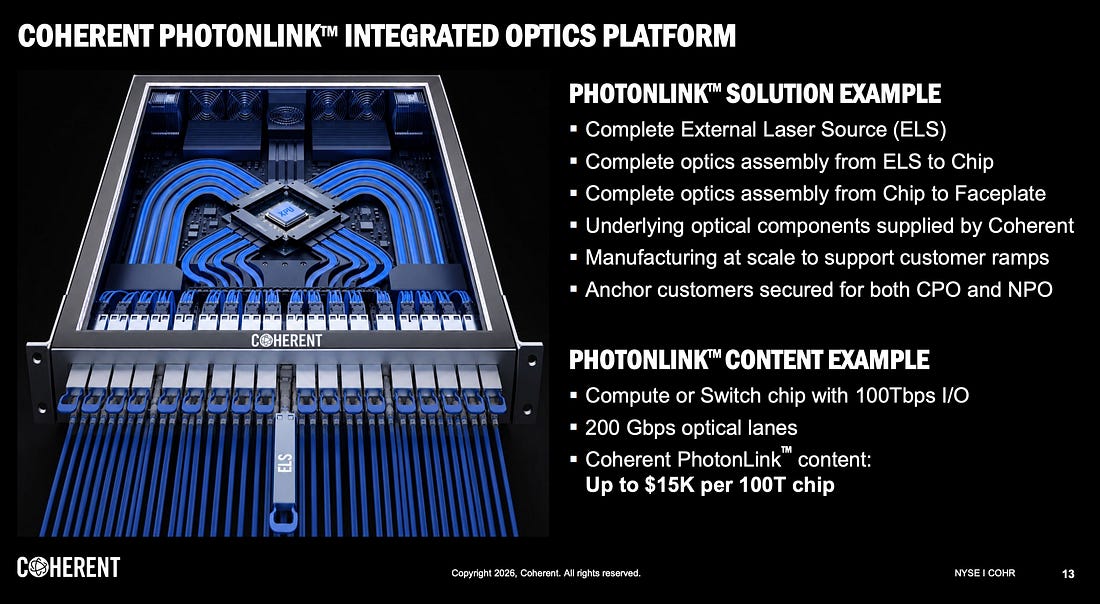
Think about what that means for COHR. The customer is effectively asking them to take on more of the system. That creates an opportunity to sell more content, but also to become more involved in how the customer designs and builds its optical connections. Coherent describes PhotonLink as a way to simplify that integration and qualification work.
That gives the up to $15,000 of content around a chip with 100Tbps of optical I/O a lot more context (see below image). The example assumes COHR supplies the full PhotonLink solution. I think about that number as a way to understand how much optical content can build up around one high-bandwidth chip. PhotonLink gives Coherent a way to capture more of that surrounding content, including the work required to put it together.
Management also put the additional PhotonLink opportunity at $30B+ by 2030, on top of $60B+ for its existing portfolio.
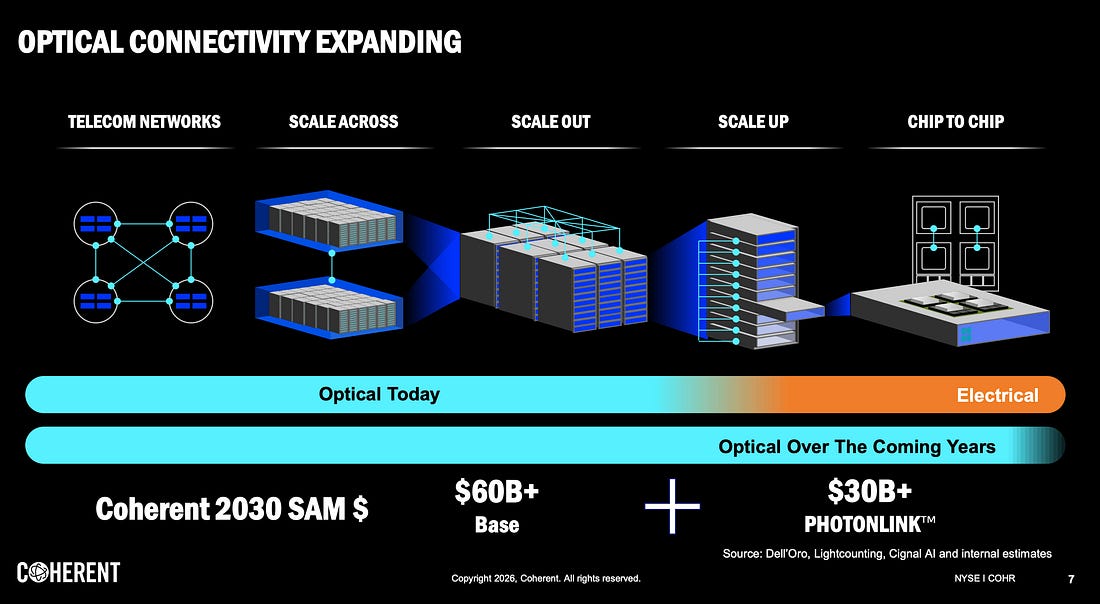
There is more business available when connections that were electrical become optical. Then there is potentially more COHR content within those connections when customers buy a larger assembly.
Those are two different ways to grow. One expands the market. The other increases how much of the customer’s spending COHR captures.
There were also a couple of manufacturing details in the spoken remarks that gave me more confidence in the execution. Julie said external laser source (ELS) assembly and testing uses COHR’s existing transceiver manufacturing line, with samples already delivered. Beck said the smaller CW laser suited to integrated NPO already ships in the millions monthly for pluggables.
So some of the ingredients and production processes behind these new systems already have volume experience. I think that’s great. There is still work involved in qualifying the finished assemblies, but COHR can carry existing manufacturing experience into a new product category.
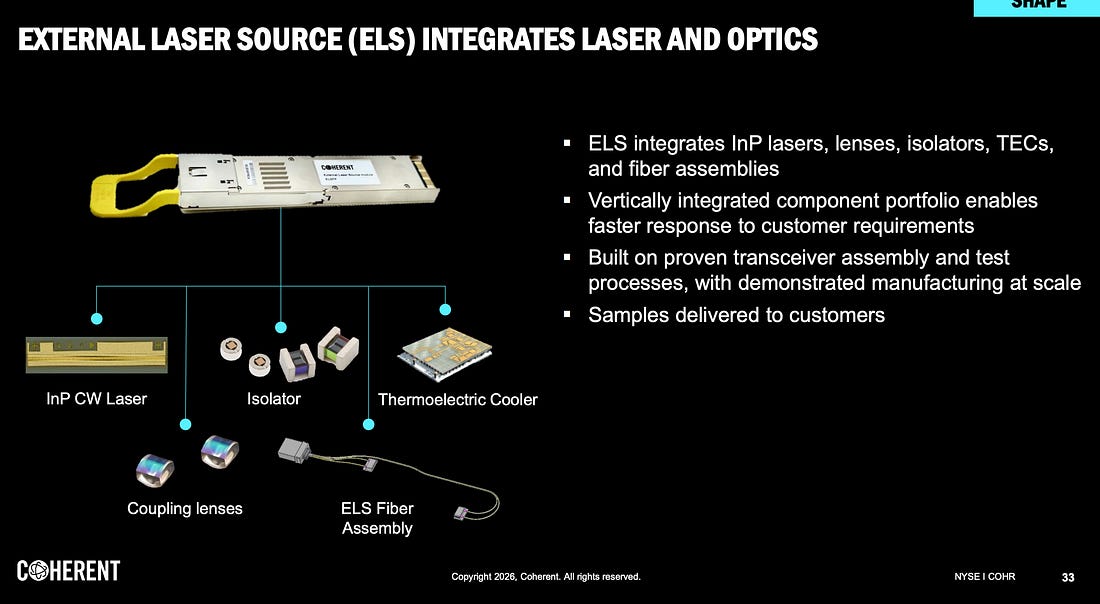
There is also a direct manufacturing milestone for the ultra-high-power lasers. Coherent says these are ramping on its six-inch indium phosphide (InP) platform with high yield, with volume shipments targeted for Q4 calendar 2026. The commercial opportunity depends on producing these lasers consistently at scale, although the presentation does not disclose a numerical yield or establish the profitability of the complete PhotonLink assembly.

On margins, selling more of the assembly creates more revenue per system. Reusing production processes and internally supplied components could help COHR keep more of the gross profit from that sale. How efficiently they put it all together will determine the benefit. People really want to see margin expansion from Coherent, so this might be one of the ways they see that.
Then there was the isolator disclosure where customers have signed LTAs specifically to reserve isolator capacity for CPO/NPO. These small components protect lasers from reflected light, and COHR controls the process from growing the garnet material through making the finished isolator.

I found that really interesting because it shows the capacity commitments extending further into the system. We spend so much time on the lasers, but customers also need the surrounding pieces available when their products are ready to ramp.
They also introduced a detachable fiber-attach connector and new fiber designed to improve the connection into silicon photonics. These address some of the actual deployment work like getting light into the chip efficiently, making the connections repeatable, and making assembly and maintenance easier.
This is where I think the integration argument becomes pretty tangible. Every difficult connection the customer has to engineer creates work. If COHR can deliver more of that work inside a tested assembly, there is a reason for the customer to buy more from them. Julie explained that moving the optical engine away from the package can improve serviceability, but adds electrical power and socket-related signal challenges. COHR can address different requirements with silicon-photonics or VCSEL-based solutions.
The VCSEL work is already part of their roadmap. What the presentation helps us evaluate is how competitive that option could be. Coherent reported 1.2 pJ/bit for its demonstrated NPO solution, including lasers, drivers, photodetectors and receive amplifiers. That measures energy per bit across those components.
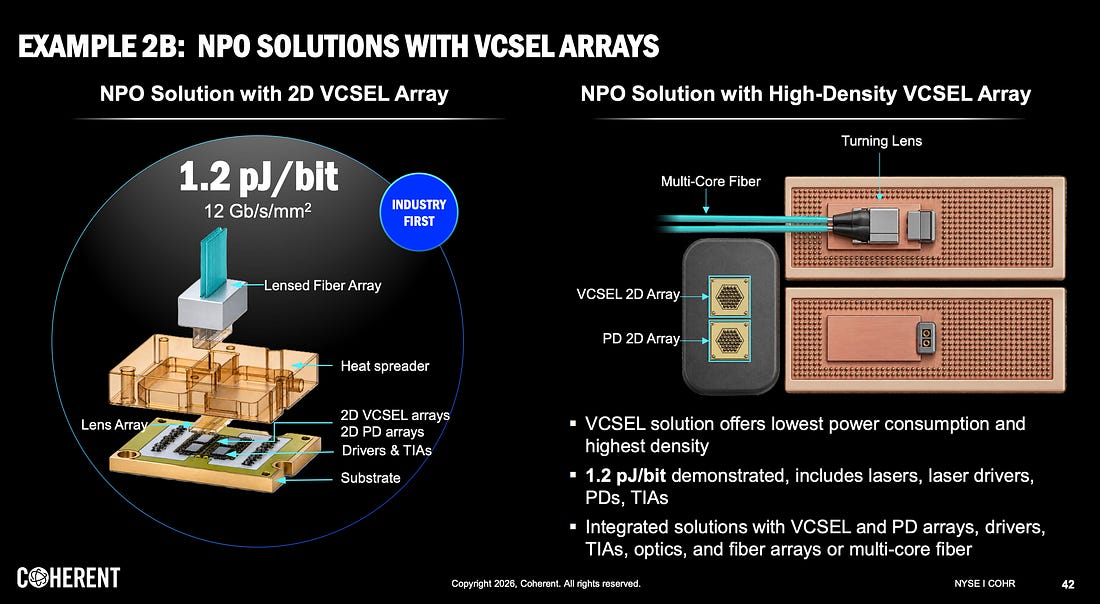
The investment point is that COHR has different tools for different customer requirements. A customer prioritizing power, density or serviceability may arrive at a different architecture, and COHR can still compete for the optical content around it. That is potentially a valuable position early in the design process. Helping the customer choose and integrate the architecture can put COHR into the conversation before the individual component orders are being placed.
Finally, Julie said chip-to-chip interest has picked up in the last three to nine months. These engagements involve optical connections moving farther inside the chip package as bandwidth requirements between compute and memory increase.
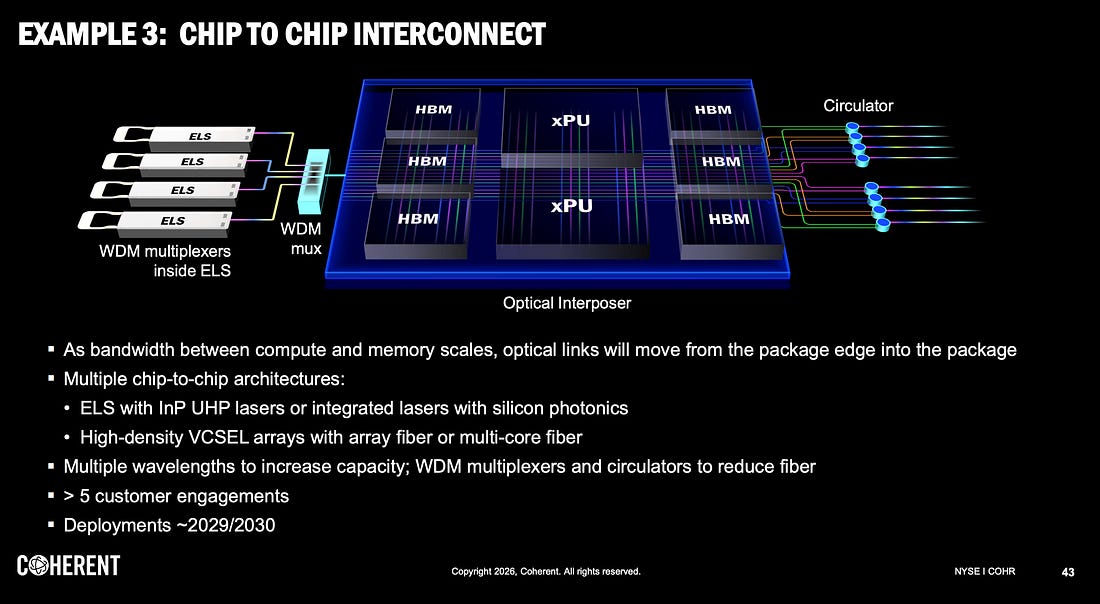
The timing remains around 2029/2030, versus Q4 2026 for scale-out CPO and H2 2027 for scale-up CPO and NPO.
I view chip-to-chip as longer-term optionality that I haven’t really discussed. The nearer investment opportunity is customers asking COHR to supply more of the finished optical system, with contractual commitments and established manufacturing capabilities behind parts of that ramp.
All in all, very happy with what COHR has delivered.
Paid Subs continue on for CIEN, LITE, QCOM, GLW, NOK, TSEM, MTSI, MRVL, SMTC, CRDO, VIAV, FORM, KEYS, TSEM, GFS breakdowns
Now that we are past the paywall, this is going to be a very long report and will be quite dry. I’ve tried to make it straight forward and simple. But it’s still very long.
So here is a TLDR summary on whether or not things materially changed from ECOC for me.
COHR: Meaningful improvement. Customer commitments strengthen confidence in the ramp. Customers asking for complete optical assemblies also give COHR a clearer opportunity to earn more per connection.
CIEN: Meaningful improvement, largely from the Investor Forum. Better pricing on existing business strengthens the earnings case before the new optical products become major contributors. Those newer opportunities are only modestly reflected in management’s targets, leaving room for upside if adoption is faster.
LITE: Incrementally stronger. The new assembled laser source broadens how much LITE can sell customers, with an earlier customer win providing commercial backing. The joint demonstration also validates another way for LITE to participate in optical scale-up.
QCOM: Mostly validation. The demonstration supports Qualcomm’s role in optical scale-up and its broader data-center ambitions. There is no new quantified revenue opportunity or production commitment in this update.
GLW: Mostly validation, with broader positioning. Corning showed another route into optical scale-up and demonstrated more of the finished connectivity system. That reinforces the existing opportunity to serve multiple optical designs and capture more spending per installation.
CRDO: Mostly validation of the optical expansion already underway. The 1.6T ZeroFlap launch extends its finished-module offering into the next upgrade cycle, supporting more revenue per connection. The optical revenue outlook and NPO design wins were already disclosed before ECOC.
MRVL: Meaningful supply progress, with more technical validation at ECOC. The expanded GFS agreement supports manufacturing for a growing optical-component business. The higher scale-up revenue outlook was already in place before the conference, so the demonstrations reinforce that opportunity rather than establish a new financial upgrade.
MTSI: Incrementally stronger positioning. MACOM can now supply more of the components inside a next-generation optical module, increasing what it could earn from each design win. The new products are available for customer development, so the bigger production opportunity is still ahead.
SMTC: Mostly validation. Supporting XPO gives its existing optical chips another potential application. The much larger content-per-module opportunity was outlined before ECOC and still depends on winning more components inside future modules.
NOK: Validation of a meaningful expansion opportunity. Nokia demonstrated products for optical connections inside data centers, extending beyond its traditional transport business. That opens another potential revenue stream.
TSEM: Meaningful commercial progress. A customer reported high-volume shipments of more integrated optical engines built on Tower’s platform. That is tangible production evidence, alongside a further NPO product scheduled for volume shipments in H1 2027.
GFS: Meaningful improvement. The expanded Marvell agreement adds commercial backing to its optical-component manufacturing business. The new integrated-laser service broadens what GFS can manufacture for customers, although availability is targeted for H2 2027.
FORM: Mostly validation of a ramp already happening. ECOC reinforced its position testing optical chips before expensive packaging, where catching defects early saves customers money. Management had already raised its CPO revenue expectations before the conference.
VIAV: Incrementally stronger. A lower-priced, factory-focused 1.6T tester and additional CPO testing tools give VIAVI more products to sell into customer production ramps. These are useful additions to an established customer base, strengthening the existing manufacturing-test thesis.
KEYS: Mostly validation. ECOC showed Keysight serving today’s 1.6T production upgrades while supplying the development work for 3.2T. The shift toward manufacturing revenue was already happening, so this reinforces a growth opportunity already showing up in the business.
All right, with that lets dive in.
I couldn’t be there in person. So this article is a result of me pulling as much info as possible from transcripts, presentations, fireside notes, talking to people that were there. Then I plugged all the individual company resources into my individual project folders in my NotebookLM that I have for each company. Then spend a couple hours chatting with it about some of the major takeaways and what is genuinely new or not (I have over 100 sources for my main companies at this point so my NoteBookLM has a really good source pack to know whats new or not). Then I synthesize it into each company section. This took a long time. I’ve been workin on this over the past 3 days. Enjoy!
CIEN / Vesta and Open CPX
A lot of the commercial detail that is to follow came from their September 16 Investor Forum. Then Open CPX released its first specification on September 17, ahead of the Vesta demonstrations at ECOC.
The comment I really liked came from CFO Marc Graff. He said Ciena’s roughly $14B revenue target for fiscal 2029 takes a relatively modest approach to revenue from CPO, NPO and Coherent-Lite.
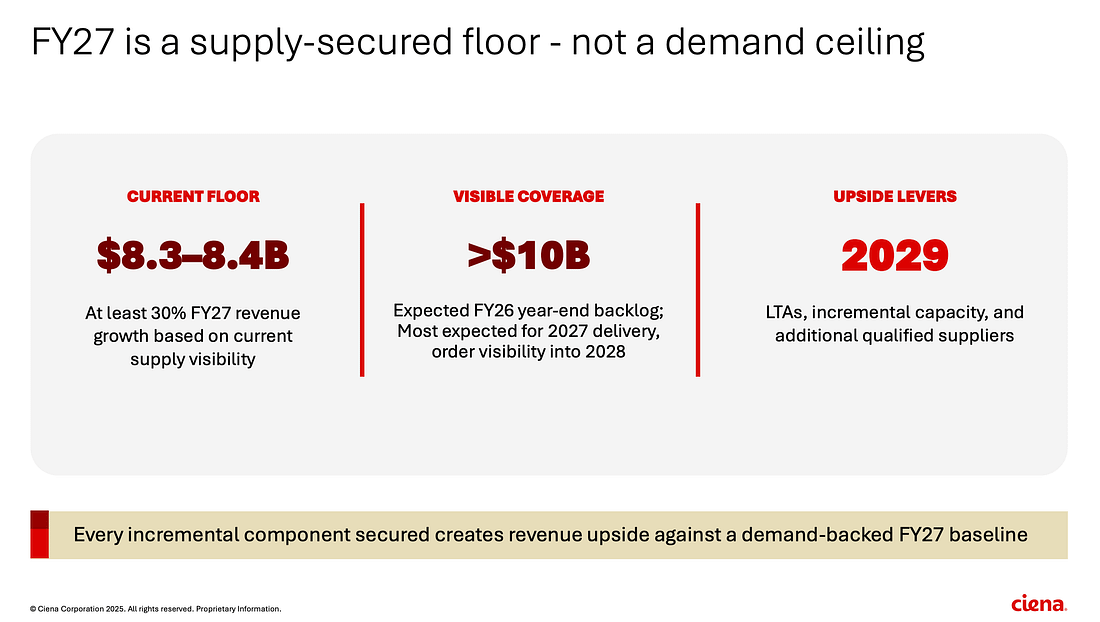
Some contribution is included, while faster adoption could provide upside to those assumptions. My base case is that we will see faster adoption and greater upside of course. I would rather they be conservative than over deliver.
We already know the power argument for bringing optics closer to the chip. Ciena’s approach removes the local retiming electronics and claims up to 70% lower optical-interconnect power compared with traditional retimed alternatives. But the part Dino DiPerna emphasized was keeping the switch and optics on separate purchasing and upgrade cycles. Customers can retain more choice over who supplies their optical engines even as those engines move right beside the switch chip.
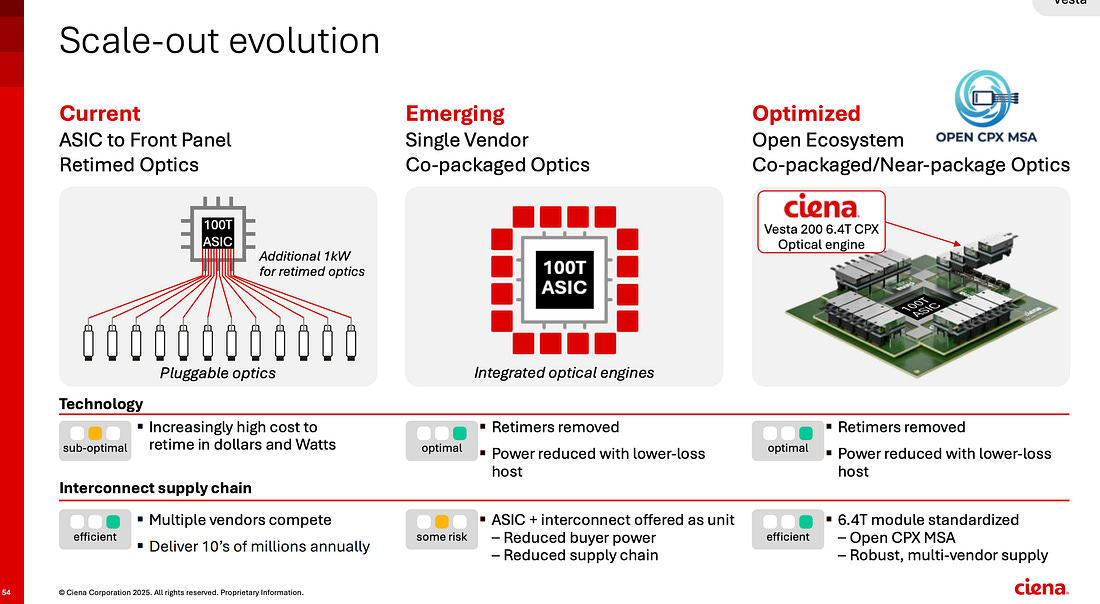
Think about that from the customer’s perspective. You want the power and density benefits of integrated optics, but you also want suppliers competing for your business. You want flexibility when one supplier has a better product, more available capacity or better pricing. That is the purchasing model Open CPX is trying to preserve.
Dino also highlighted that each optical engine is tested individually before it is attached to the larger assembly. Remember how often we discuss how important testing is going to become the more integrated and advanced these systems become? Which is one of the difficulties with NPO and CPO. Finding a problem earlier can avoid putting more expensive assembly work into a bad part. It also gives the customer a smaller, replaceable piece to deal with when servicing the system. The appeal extends into how the equipment gets built and maintained.
Ciena describes Vesta as sampling with multiple hyperscalers and switching equipment manufacturers. Its reference design uses 16 engines around a roughly 100T switch, with the next 200T generation requiring 32 at the same engine bandwidth.

That gives us some perspective on the unit opportunity. One successful platform can require a meaningful number of optical engines, and higher switch bandwidth can increase that requirement.
There is an important distinction around the initial application too. Ciena’s own Investor Forum summary describes Vesta as initially suited to scale-out, with potential scale-up applications over time.
So the first opportunity is improving the optical connections around the switch. The deeper scale-up opportunity can develop from there. What’s nice for Ciena vs some other companies we talk about is that scale-out is incremental TAM for Ciena. When we talk about Lumentum or Coherent’s CPO opportunity, we are mostly excited about scale-up applications because lots of scale-out is already optical so it’s somewhat cannabilistic. But for Ciena, both scale-out and scale-up are incremental.
Open CPX now gives customers a published specification to design around, including support for internal or external lasers, liquid cooling and compatible copper implementations. Ciena holds the group’s chair and editor roles, putting it directly into the work of developing the interface. Helping establish the interface could get them involved earlier in customer designs.
There is also more technology inside Vesta than the socket itself. Ciena combines its own high-speed drivers and receive amplifiers with the photonic chip. That gives it control over how those pieces work together and an opportunity to capture more of the engine’s economics.
Ciena also has a product for connections that remain copper. Its Nitro 2004 chip goes inside active copper cables, and management described it as being in qualification with multiple hyperscalers and equipment design partners. Nitro and Vesta both feature in the ECOC demonstrations.
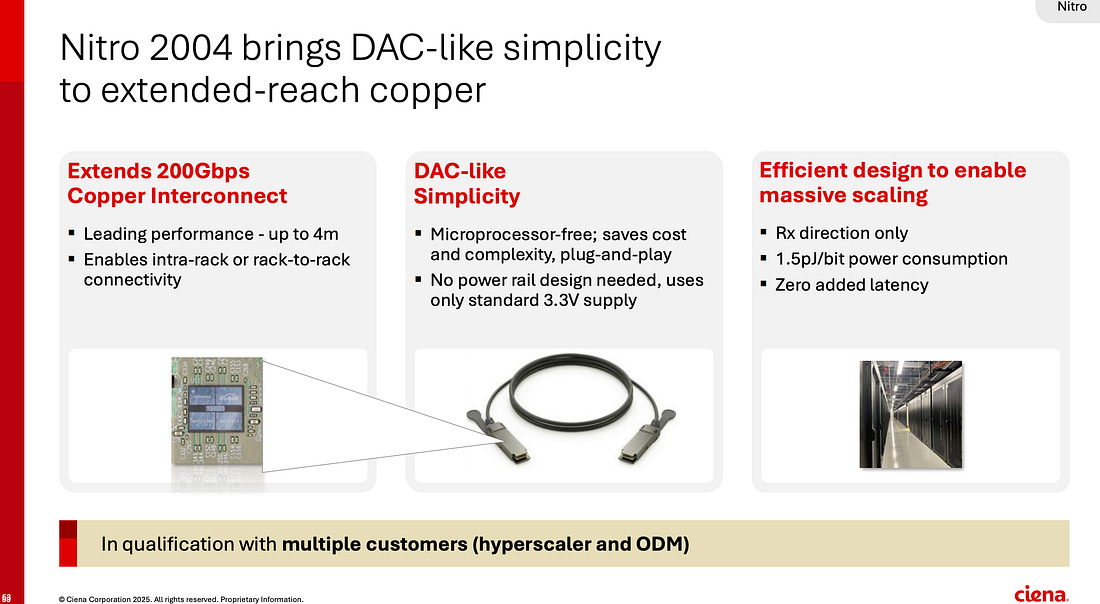
This gives CIEN another way to participate inside the system. Copper can remain the better choice for certain short connections, while optics becomes more attractive as reach and bandwidth requirements change. The products serve different parts of that decision.
Then there is another opportunity I think deserves attention alongside CPX that we haven’t spoken too much about. Coherent-Lite.
Ciena is targeting connections that need more reach or optical capability than conventional short-reach optics, with cost and power tailored to the application. Its examples include connections across a 1–20 km campus, carrying more wavelengths over existing fiber, and links passing through optical circuit switches.
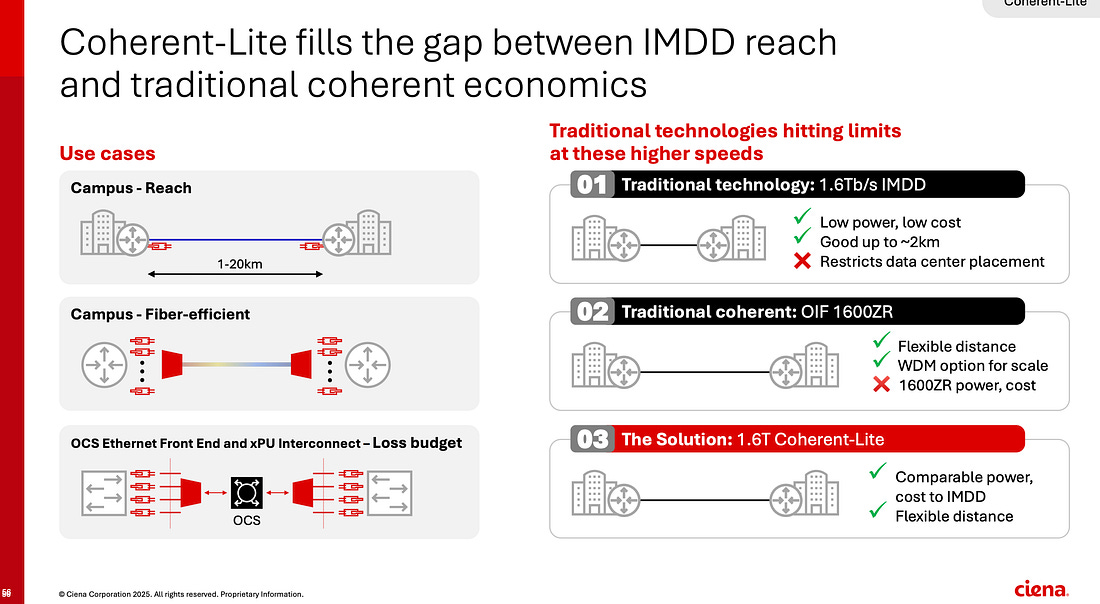
What was interesting to hear them discuss is that adding an OCS also adds optical loss that the connection has to tolerate. That can change the requirements for the optics on either side. Ciena identifies this as one of the applications for Coherent-Lite.
So there can be an opportunity around optical switching even for a supplier selling the interconnect rather than the switch itself.
Ciena is developing a dedicated 2nm DSP for this product family and plans to sell both complete pluggables and standalone DSPs to module makers. That gives it different ways to reach customers depending on how much of the finished product they want to source from Ciena.
Now let’s connect those products back to the financial opportunity.
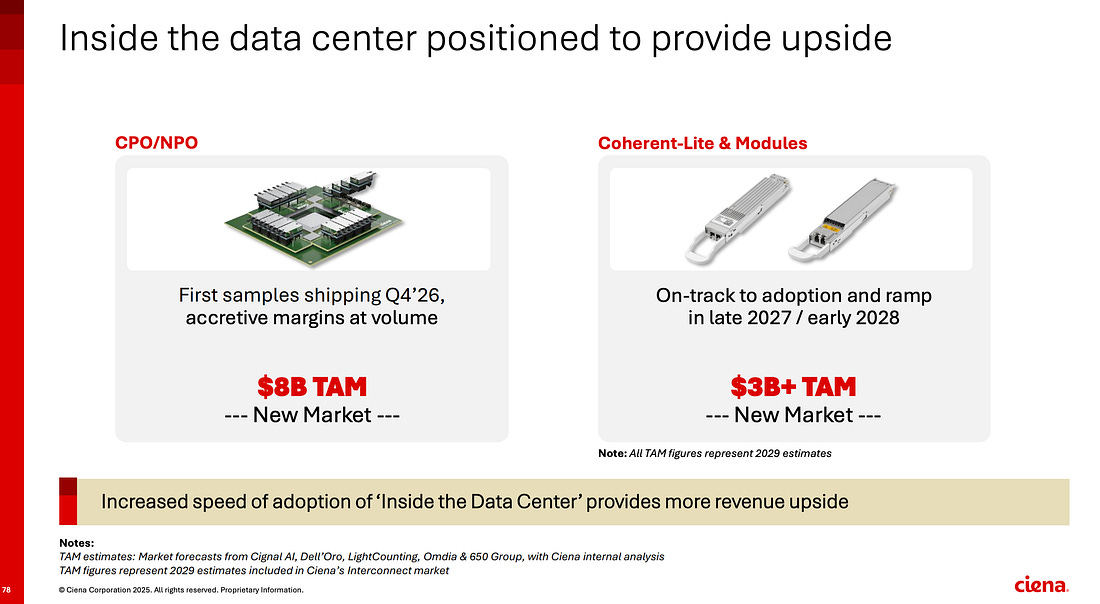
Ciena estimates a 2029 addressable market of roughly $8B for CPO/NPO and another $3B+ for Coherent-Lite and related modules. The Coherent-Lite adoption and ramp window is shown as late 2027 into early 2028.
There is a more immediate earnings benefit here too. Ciena’s Investor Forum presentation showed pricing and commercial-term actions ranging from high-single digits to roughly 20%, including existing backlog, with benefits beginning in fiscal 2027.
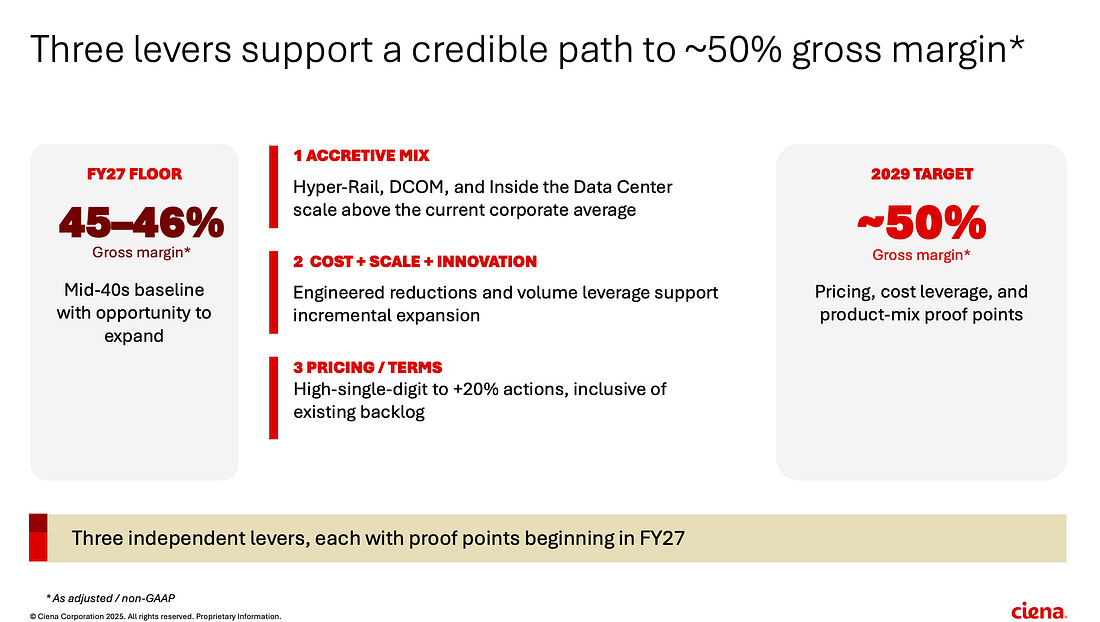
Alongside lower product costs and a better revenue mix, those actions support management’s target of roughly 50% adjusted gross margins in 2029. So part of the earnings case comes from improving the profitability of business already booked, rather than waiting for Vesta and Coherent-Lite to become large contributors.

All in all I am much more bullish Cien these past two weeks between managements upgraded guidance and their ECOC demos. I think that this is one company that is being under-appreciated for their late 2027/early 2028 time frame.
LITE / ELS
There’s going to be 2 different updates on LITE here.
The first is their 8-wavelength external laser module (ELS) introduced at ECOC. It delivers multiple wavelengths simultaneously and is designed around applicable OCI requirements. Initial availability targeted for H1 2027. Builds on LITE’s UHP laser platform which is already in production.

Thanks to JasonsChips for the photo. I couldn’t find a full presentation online.
There are a couple important takeaways here.
They expanding the ELS architecture from a high-power external laser source into a multi-wavelength, standards-oriented product that can feed much denser optical systems. The 8-wavelength design lets one serviceable module provide several optical carriers into CPO/NPO systems, which can increase bandwidth density while reducing the number of separate laser modules and fiber connections required around the package. For me, that is incrementally positive because it broadens how Lumentum’s existing UHP laser platform can be used as scale-up architectures become denser.
This is hard to do. Customers need high power, low noise, a narrow and stable wavelength, and freedom from sudden changes in the laser’s operating mode. All of these have to hold at the same time, at manufacturing yield, and after the device goes through packaging. So this is a competitive advantage for LITE here. Also if one laser supplies light into multiple channels, reliable operation also becomes more consequential. Because a problem at the source can affect more of the connection.
Kathy Ta said at Citi that customers evaluating external-light-source designs increasingly want Lumentum to supply the assembled source, alongside the laser chips. That predates ECOC, but it gives the new module a useful commercial context. I like the opportunity to sell a larger finished product when the customer is asking for it.
Lumentum has already won some of this business. At Citi in September, Kathy Ta said its first ELS win was with an existing CPO customer, with initial shipments expected in H2 calendar 2027 and an estimated 15–20% share of that customer’s ELS fleet. That gives us a more concrete opportunity to sell the finished laser source rather than only the chips inside it, although Lumentum would still be a minority supplier.
LITE / QCOM / GLW
Lumentum already demonstrated its 1060nm VCSEL-based “slow and wide” scale-up architecture at OFC. That architecture uses lots of relatively slow optical channels in parallel rather than pushing every lane toward 200G or 400G. ECOC adds a more complete ecosystem around it.
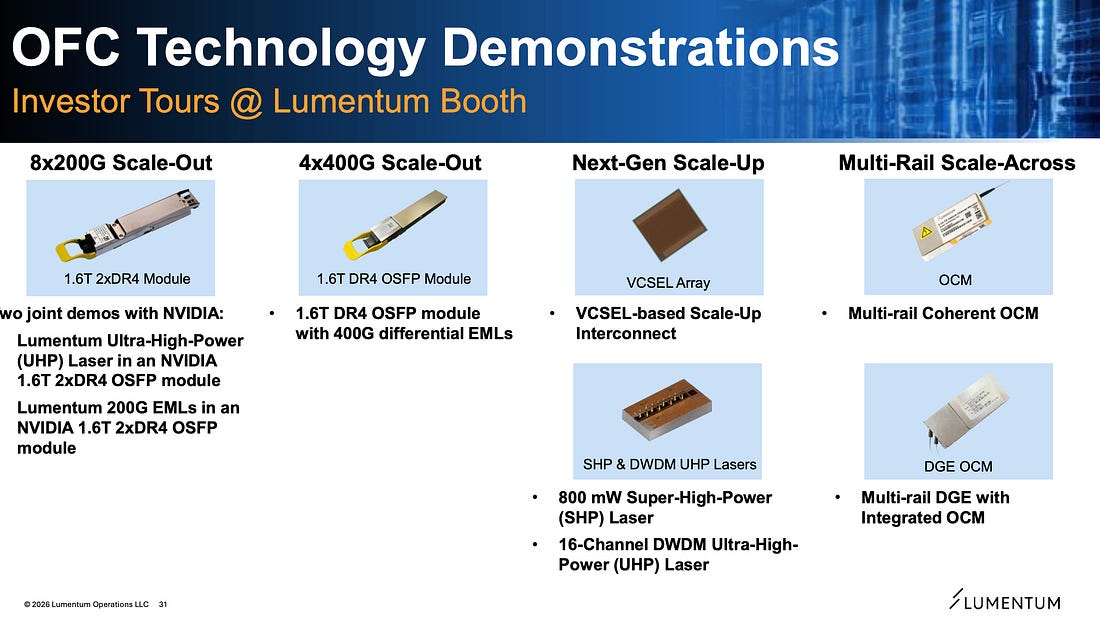
Qualcomm is supplying the electrical die-to-die interface, Lumentum supplies the VCSEL optical engine, and Corning supplies the multimode fiber connectivity and precision glass ferrules. The board-level system demonstrates roughly 10Tbps of combined transmit and receive capacity, using 32Gbps optical channels, with the architecture targeting future CPO and NPO implementations.
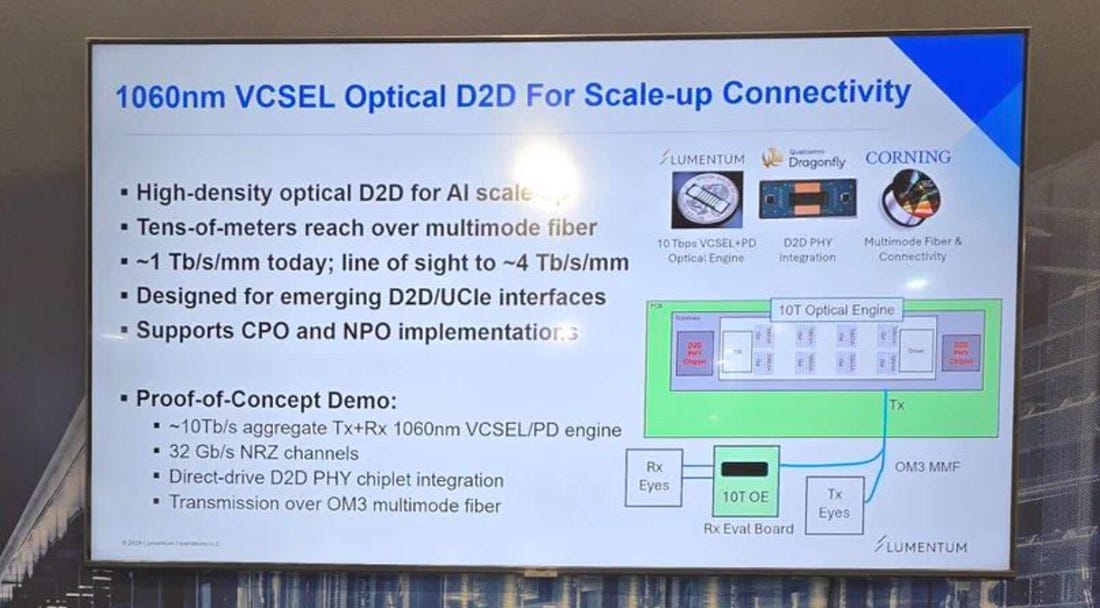
One of the big questions around optical scale-up is whether these architectures can become actual multi-vendor systems.
Lumentum proving a VCSEL engine by itself is one step. Showing that engine working with another company’s electrical interface and another company’s physical fiber connectivity gets us a little closer to seeing what the finished ecosystem could look like.
So I come away more bullish on LITE’s scale-up optionality. They have their high-power CW laser path for silicon-photonics-based CPO/NPO and another path through massively parallel VCSELs for shorter-reach scale-up.
QCOM
Its die-to-die interface technology is being used to connect the compute side directly into Lumentum’s VCSEL optical engine. Qualcomm handles the high-speed electrical handoff from the compute silicon, then Lumentum’s engine converts that data into light for the fiber connection.
Outisde of this announcement Qualcomm is building out a much broader data-center platform around CPUs, AI accelerators, custom silicon and connectivity. Its connectivity roadmap already stretches from die-to-die and copper into optical DSPs, optical chiplets and CPO, and Qualcomm recently announced that it is working with AWS on optical connectivity up to 1.6T.
So this Lumentum demonstration fits pretty naturally into what QCOM is trying to build. If more scale-up connections move to optics, Qualcomm wants its interface and connectivity IP sitting close to the compute silicon and feeding those optical systems.
GLW
The Lumentum demonstration gives GLW another route into optical scale-up. Corning supplies the fiber connectivity around Lumentum’s optical engine, alongside its existing work supplying the connections inside Broadcom’s silicon-photonics-based CPO switch. I like that positioning because Corning can compete for business across different optical designs. It has several ways to participate as customers choose their next generation of equipment.

The bigger revenue opportunity is supplying more of the finished connectivity system. Corning’s own ECOC rack demonstration showed optical connections built into the equipment, with a system for organizing the growing amount of cabling. Its broader offering already includes preassembled optical trays. That creates an opportunity to sell a larger assembly and take a bigger share of the customer’s connectivity budget.
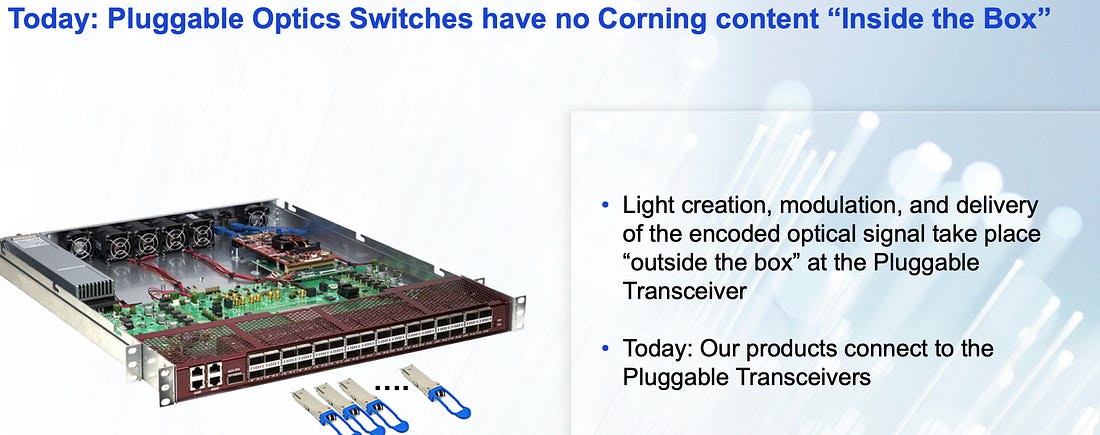
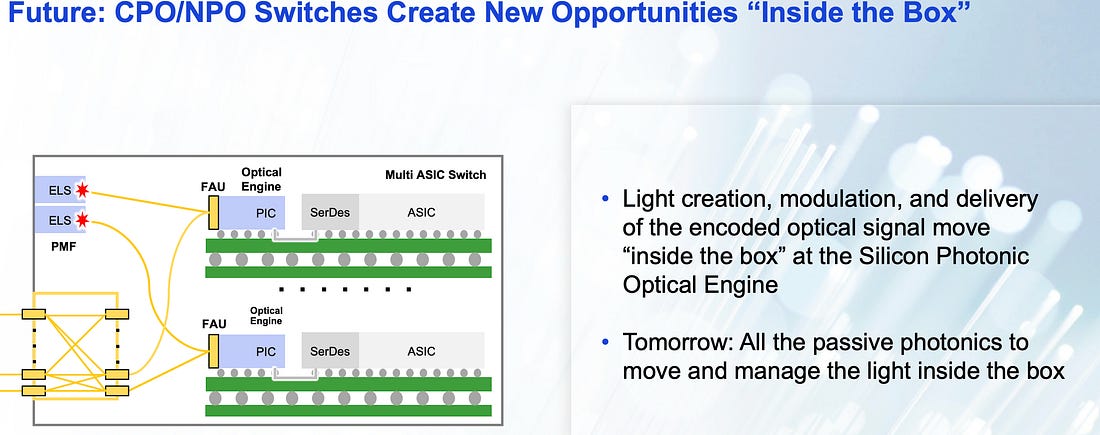
There is a competitive advantage to build around here too. Connecting fiber right beside a chip requires very precise alignment, and customers need that precision to hold up in production. Corning already supplies these connections for Broadcom. I see that engineering and manufacturing experience as a useful advantage when customers qualify suppliers for future systems.
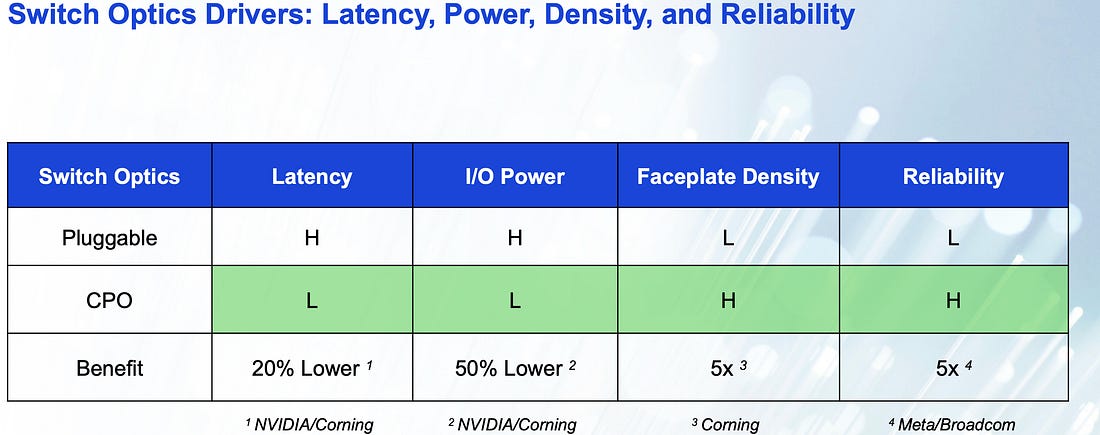
The connector technology shown at ECOC adds a practical selling point. Corning says it supports faster installation and is less sensitive to dust and handling. Customers can evaluate the savings in installation and maintenance alongside the purchase price. That could help GLW defend pricing where its products reduce the total cost of deploying the network.
Multicore fiber also took a step toward broader adoption. It fits four optical paths into a single fiber strand, allowing customers to fit more connectivity into the same space. On September 17, Corning and three industry partners released a shared specification for the fiber. That gives suppliers common requirements to build around and customers a clearer path toward compatible products from multiple vendors.
For GLW, I view this as an upgrade opportunity. Corning already offers the associated cables and connectors, so it can compete for more of the installation. The financial benefit will depend on adoption, pricing and market share, particularly because the denser design reduces the number of physical connections customers need.
CRDO / ZeroFlap Optics
Credo introduced its 1.6T ZeroFlap optical transceivers on September 15 and brought them to ECOC. The useful development is that these modules bring Credo’s own electrical and optical chips together inside a finished product. That gives Credo more control over how the connection performs as customers move to higher network speeds.
The opportunity is to earn more from each optical connection. Credo can supply individual chips to other module makers, or sell customers the complete ZeroFlap transceiver. Selling the finished product gives it a larger share of the spending on that connection. Customers get the hardware and monitoring software designed to work together, with Credo responsible for how the solution performs.
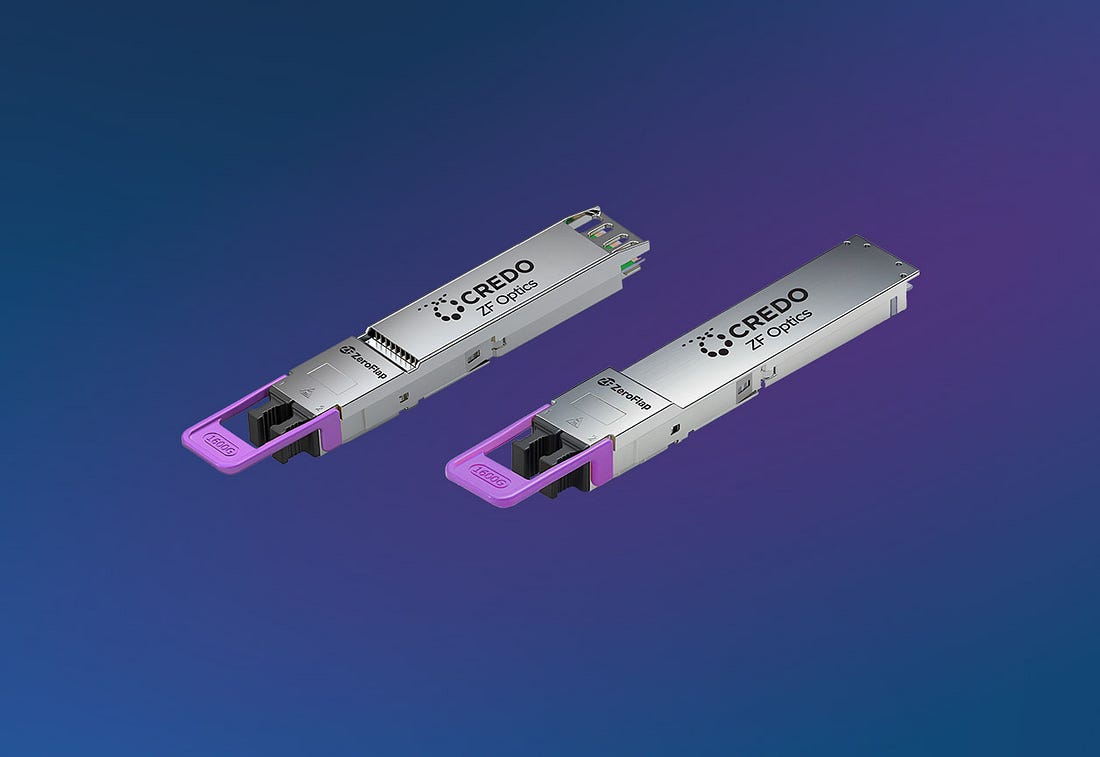
The selling point is reliability. A connection that repeatedly drops and reconnects can interrupt work across an AI cluster. ZeroFlap monitors the connection for signs of trouble so operators can investigate and address weak links. The customer benefit is spending less time troubleshooting and more time using the GPUs they have already paid for.
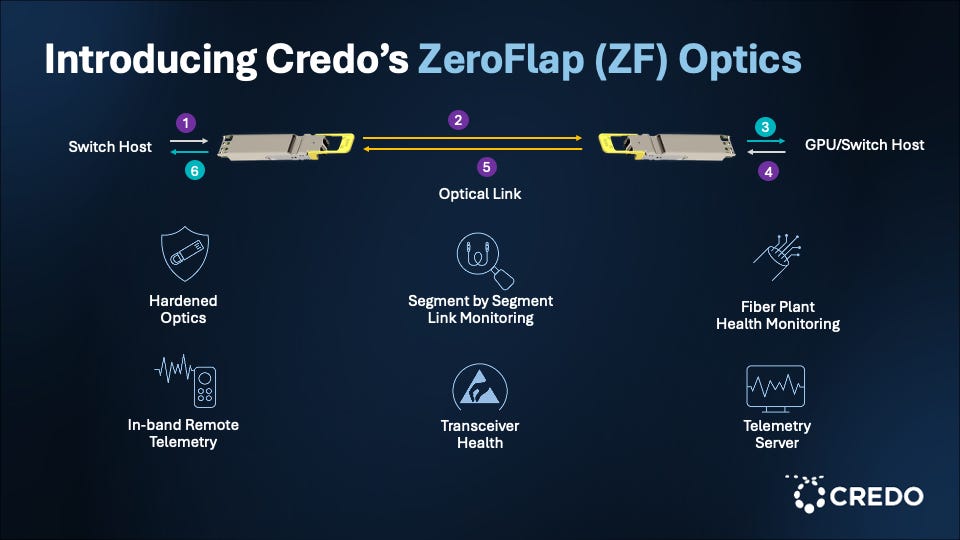
Management explained the economics at Goldman’s September 10 conference. The aim is to charge a premium for reliability while using internally designed chips to control product costs. They expect the overall business to maintain adjusted gross margins around 68% as optics ramps. Holding that margin profile would allow the optical expansion to add substantial gross profit as revenue scales.
The positioning is broader too. Credo’s AECs serve shorter connections, while optical transceivers let it compete for longer ones. The 1.6T launch extends its finished-module offering into the next bandwidth upgrade. I like having both routes into customer spending as clusters expand and their connectivity requirements change.
There is also a scale-up opportunity behind this. Before ECOC, management disclosed confirmed NPO design wins expected to begin ramping in fiscal 2028. That creates a path into optical connections closer to the compute package, alongside the pluggable scale-out products shown at this conference.
Credo’s existing fiscal 2027 outlook calls for more than $600M of optical revenue, with ZeroFlap transceivers, silicon-photonics chips and optical DSPs each expected to contribute more than $100M. Management expects the business to accelerate in the fiscal second half.
MRVL
Marvell’s ECOC showcase moves its optical DSP roadmap another generation forward. They demonstrated 2nm 400G-per-lane PAM4 technology, alongside new coherent DSPs for 800G and 1.6T connections. The 400G-per-lane work is particularly important because it provides a path toward 3.2T optical modules, while Marvell’s 102.4T CPO platform shows the same broader roadmap moving optics closer to the switch and accelerator.
Matt Murphy explained at Citi that third-party NPO modules can use Marvell’s SiGe TIAs and drivers. The driver controls the optical modulator on the transmit side, while the TIA amplifies the electrical signal coming from the photodetector on the receive side. These are already meaningful businesses for Marvell. Murphy described the broadband analog business as roughly a $1B business, with NPO creating another growth leg for those components.
Marvell can then move further up the stack. It has its own silicon-photonics NPO light engine, and through Celestial AI it also has the Photonic Fabric CPO platform. So Marvell can make money even when another vendor builds the optical module through TIAs and drivers, sell the optical engine itself in NPO, or participate in a more integrated CPO system.
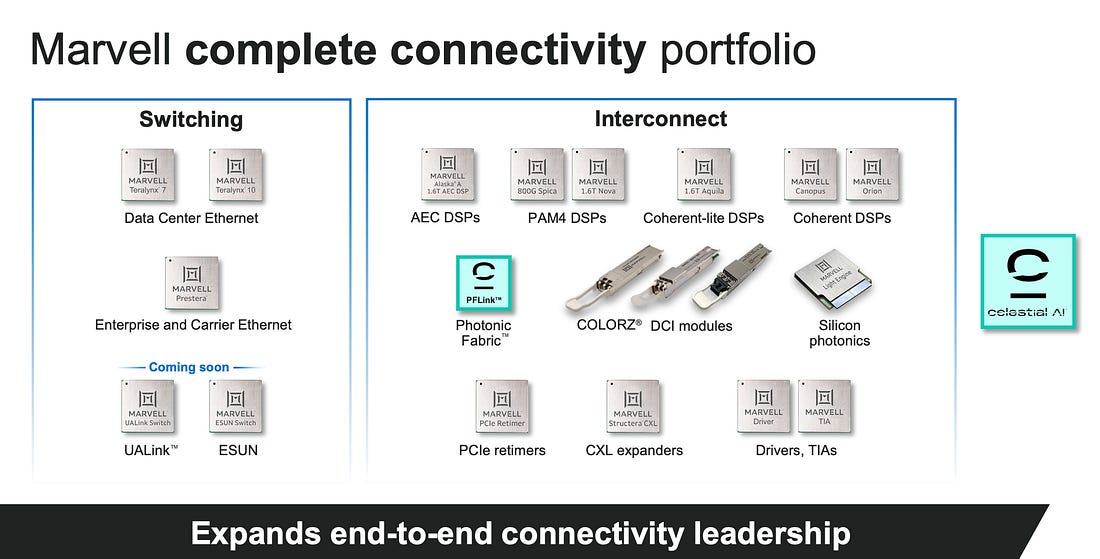
There was also a practical supply development just ahead of ECOC that I covered. On September 17, Marvell expanded its multi-year agreement with GlobalFoundries for additional SiGe capacity. That technology is specifically used for the high-speed analog components, including the TIAs and drivers, going into pluggables, NPO and CPO. I like seeing Marvell secure manufacturing capacity for a component business that management already expects to grow materially.
The financial opportunity has also moved higher. Earlier this year, Marvell framed fiscal 2028 scale-up optics at roughly $300M, including NPO and the Celestial AI CPO business. On the August earnings call, management said that outlook had increased meaningfully and identified scale-up optics as a significant contributor to the company’s broader $1.5B increase in fiscal 2028 revenue expectations. Murphy then said at Citi that he expects a much larger NPO ramp in calendar 2028 and 2029, with CPO layering in alongside it.
MTSI
MACOM’s September 17 announcement adds 448G PAM4 TIAs and PIN photodiodes on the receive side of its 3.2T chipset, complementing the 448G PAM4 modulator drivers it had already introduced on the transmit side. The complete front-end solution supports eight 448G PAM4 lanes for an aggregate 3.2T connection.
MACOM can now compete for the driver on the transmit side and the photodiode and TIA on the receive side. Winning several of those positions in the same module increases MACOM’s content per transceiver.
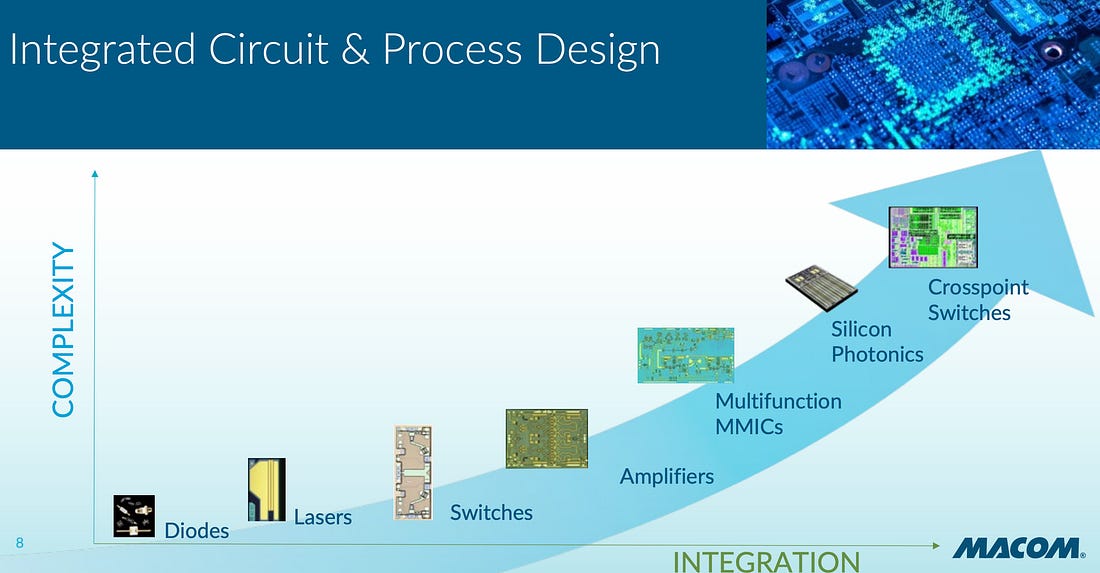
MACOM is also designing these components as a matched platform rather than leaving the module maker to optimize each piece independently. Management says that can reduce development and qualification work and improve overall link performance. As optical speeds increase, getting the driver, photodiode and TIA to work properly together becomes increasingly difficult. That gives MACOM another way to compete beyond the performance of an individual chip.
There is a manufacturing angle here too since MACOM produces its photonic semiconductors internally, including its high-speed photodetectors. On the August earnings call, management said its 200G photodetectors were already ramping in volume production and becoming a meaningful contributor to data-center growth, while its next-generation 400G photodetectors were already with customers for evaluation.
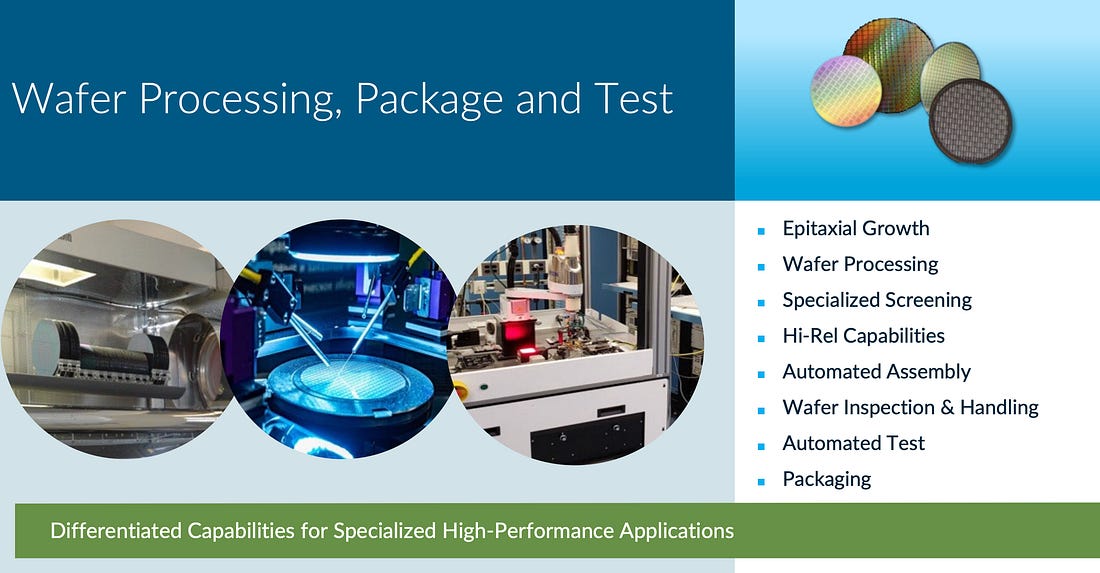
That internal manufacturing is increasingly relevant financially. Higher utilization at MACOM’s fabs has been contributing to gross-margin expansion, and management specifically pointed to growing indium-phosphide production for data-center products. Adjusted gross margin reached 59.7% in fiscal Q3, with management expecting further improvement as utilization rises and higher-value products ramp.
The new 3.2T TIAs, photodiodes and drivers are available for customer development now. MACOM’s ECOC demonstrations also span 1.6T pluggables, NPO and next-generation 448G-per-lane optics, giving it exposure to the current upgrade cycle while customers begin developing what comes after it.
SMTC
On September 21, Semtech joined the XPO MSA and said its 200G/lane modulator drivers and TIAs are designed to support the 12.8T XPO form factor. That extends the same high-speed analog content Semtech already sells into conventional pluggable optics into another architecture for dense AI interconnects.
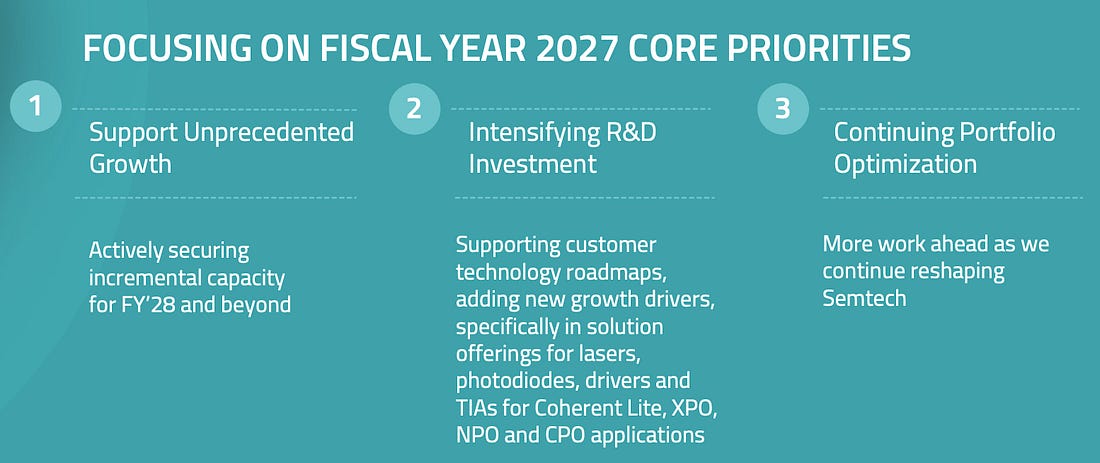
In addition to XPO, management is building toward a larger optical-content stack that includes drivers, TIAs, gain chips, high-power CW lasers, SOAs and high-speed photodiodes. The more of those sockets Semtech wins in the same transceiver, the more revenue it can capture per module.
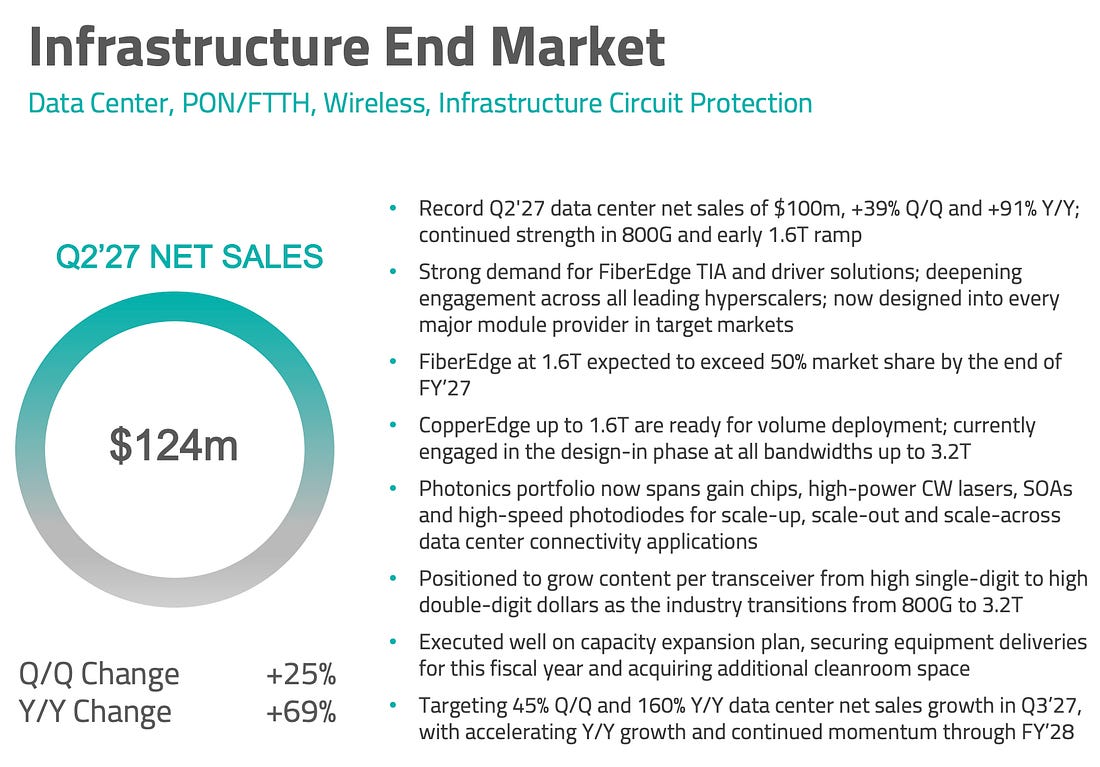
That is where the bigger financial opportunity sits. Management clarified on the August earnings call that it sees content per optical transceiver increasing from high-single-digit dollars today to roughly $80–$90 at 3.2T. That assumes Semtech wins a much broader mix of analog and photonic content as customers move into the next generation.
NOK
I usually talk about NOK through optical transport, DCI and ICE-X. ICE-D moves them into the short-reach optical connections between switches, servers and accelerators inside the data center. This is what I want to focus on today.

At ECOC, Nokia showed its 1.6T ICE-D LPO transceiver and previewed 448G-per-lane transmission on the path to 3.2T optics. The underlying ICE-D platform uses Nokia’s own InP PIC, integrating DFB lasers, modulators and photodiodes, paired with a SiGe driver. Nokia is taking optical technology that historically lived deeper in the transport network and building products specifically for intra-data-center connectivity. That’s the main takeaway.

I like this slide here because it shows how big the expansion can become. Nokia’s serviceable optical market grows from $13.1B in 2025 to $24B in 2030, with 1.6T+ intra-data-center connectivity appearing as a new category. Nokia also shows annual intra-DC optical interfaces growing from roughly 50M in 2025 to 215M by 2030.
Nokia can sell a complete transceiver, but it can also sell the PIC and optical components into modules built by other vendors. Management has previously framed individual intra-DC applications as opportunities involving millions of units and potentially hundreds of millions in annual revenue. One large design win can therefore become meaningful without Nokia supplying the surrounding switch.
Nokia has been talking about the progression toward LPO, NPO and CPO, and its ECOC commentary specifically called out NPO/CPO as part of the industry’s move toward denser, lower-power optical systems. The actual Nokia hardware highlighted publicly at ECOC centered on the 1.6T LPO module and 448G-per-lane technology, so I am still treating NPO/CPO as roadmap exposure here rather than a new production product announcement.
And like we have spoken about before they are massively expanding their capacity, aiming to become a major domestic manufacturer. They are bringing a new InP fab in San Jose into production toward year-end, increasing Advanced Test and Packaging capacity in Pennsylvania by 10x, and acquiring additional semiconductor capacity in Arizona that will eventually be converted to InP production for optical components.
These investments are aimed at the 2027 and 2028 demand environment.
TSEM
Tower came to ECOC highlighting both its SiPh and SiGe platforms. The SiPho roadmap now spans conventional transceivers through NPO and CPO, while SiGe supports the drivers, TIAs and other high-speed analog content around those optical engines. Tower also highlighted applications including DWDM lasers and OCS.
The strongest evidence came from NewPhotonics. Just ahead of ECOC, they announced high-volume shipments of 800G and 1.6T laser-integrated PICs built on Towers platform. These devices heterogeneously integrate InP lasers and SOAs with silicon-photonics modulators and photodetectors on the same optical engine. NewPhotonics is already using them across FRO, LRO, LPO and XPO architectures.

At ECOC NewPhotonics showcased a 3.2T PIC running at 448G per lane and its 6.4T NPO chipset aligned with the Open CPX MSA. The 6.4T product is scheduled for volume shipments in H1 2027. That puts Tower’s foundry technology directly behind both the move to 448G-per-lane optics and the socketed NPO architecture we discussed with Ciena.
So, Tower already manufactures SiPho at volume for 800G and 1.6T. One customer is now taking integrated lasers into high-volume production, showing 3.2T at 448G per lane, and preparing a 6.4T CPX-compatible NPO product for volume next year. That gives TSEM exposure as optical engines become faster, more integrated and physically closer to the switch ASIC.
Tower’s broader ECOC positioning also reduces its dependence on one architecture. Its SiPho platform supports the optical PIC, while its SiGe processes support linear drivers, TIAs and analog retimers/redrivers around the optical connection.
Tower can therefore participate across pluggables, NPO and CPO as customers settle on different implementations.
GFS
At ECOC, GlobalFoundries and SMART Photonics announced a new foundry service combining GFS silicon photonics with SMART’s InP lasers and SOAs. The InP devices are integrated into a cavity on GFS’s silicon-photonics platform using flip-chip assembly, giving customers a path to combine the strengths of both material systems in one manufacturing flow. General availability is targeted for H2 2027.
That fits directly into the CPO platform GFS has already been building. Its SCALE solution combines the photonic IC, electronic IC and fiber attach around an OCI-compatible optical engine. Adding an open route to integrated InP lasers expands what customers can build on top of that platform.

The other piece came just ahead of ECOC. Marvell expanded its multi-year agreement with GFS for additional SiGe capacity. Marvell uses those SiGe processes for its broadband analog TIAs and drivers, which are increasingly important across pluggable optics, NPO and CPO. So GFS can participate through both the silicon-photonics PIC and the high-speed analog ICs surrounding it.
GFS is also pushing further into packaging and test. Its photonics roadmap covers PIC fabrication, optical I/O integration, wafer-level optical test, EIC/PIC assembly and final module test. That becomes increasingly valuable as the optical engine itself gets more integrated and harder to manufacture like we talk about!

The near-term business is still mostly pluggables. Management says those products can support the bulk of its path toward a $1B+ annualized silicon-photonics revenue run rate by 2028, while NPO and CPO add another leg as adoption grows.
For ECOC, the important update is that GFS is adding another piece it previously had to source around. Between SiPho, SiGe, advanced packaging and SCALE, GFS is building a much broader manufacturing position around the optical engine.
I have become increasingly bullish GFS over the past week.
FORM / Silicon Photonics Test
FormFactor came to ECOC with essentially its full lab-to-fab silicon-photonics test stack. It ran a live 200mm SiPho demo, while also showing automated 300mm wafer test, high-volume manufacturing and optical probes. The common thread is wafer-level optical and electrical test before these PICs move further into packaging. Bullish testing!
That production step is where FORM has started making real money from CPO. Management calls it Insertion 1: testing the photonic integrated circuit at wafer level before it is combined with the EIC and the rest of the optical assembly. FORM has focused here because it catches bad PICs before substantially more value is added through advanced packaging.
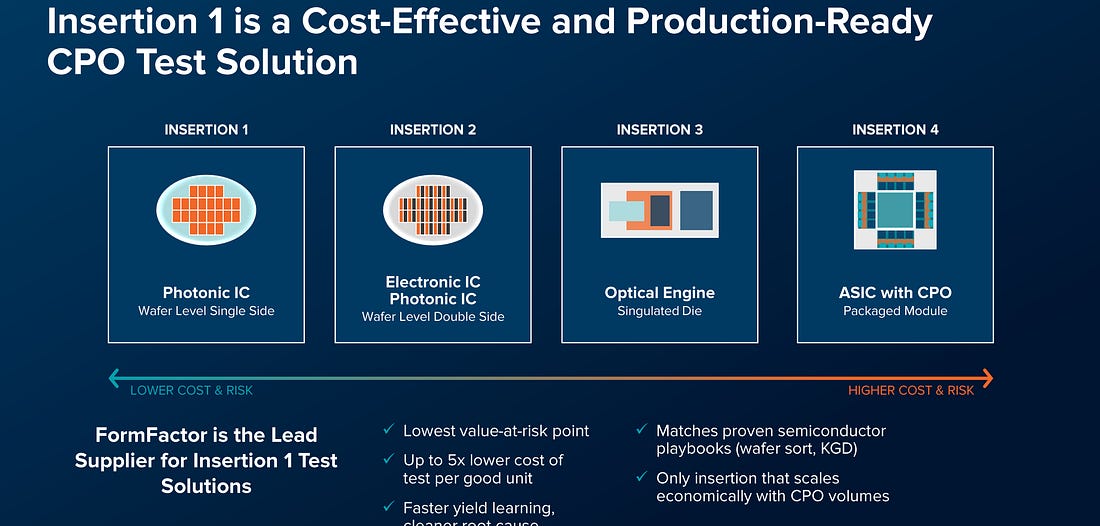
I really like that slide for this section. It lays out the four CPO test insertions and shows exactly where FORM is currently strongest. FormFactor describes itself as the lead supplier for Insertion 1, with the lowest value at risk and as much as a 5x lower test cost per good unit versus later insertions.
ECOC also showed how broad the platform has become. TRITON combines automated optical alignment with wafer-level optical/electrical measurements and fab automation for high-volume production. Pharos handles the optical coupling into the PIC. CM300xi and SUMMIT200 cover development and lower-volume wafer testing. FORM can therefore work with a customer while the PIC is being developed and carry that test methodology into production rather than entering only when volume starts.
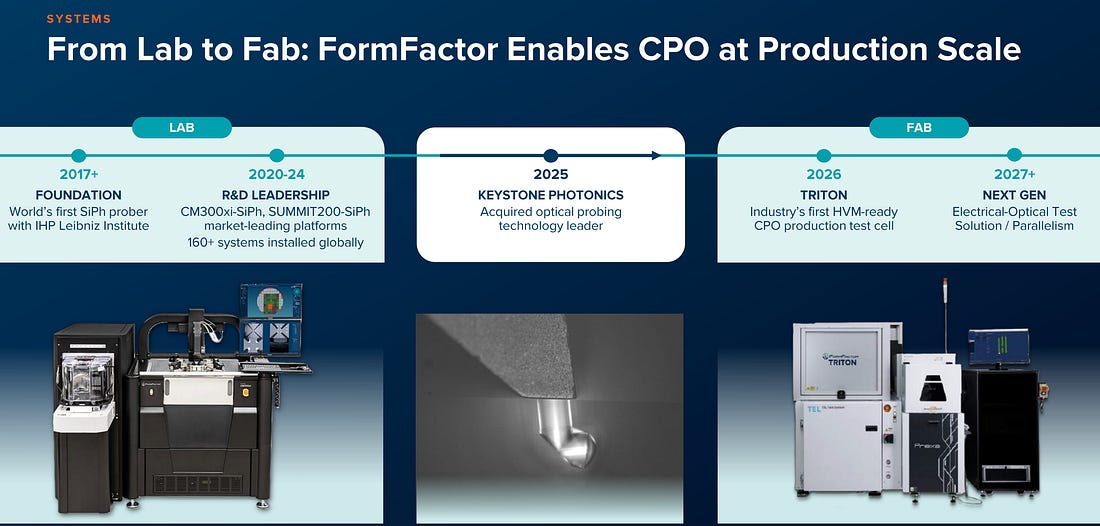
That slide shows the progression really well. First SiPho prober in 2017, more than 160 installed SiPho systems, the Keystone Photonics acquisition, TRITON moving into high-volume CPO production in 2026, and electrical-optical test with greater parallelism coming next.
FORM began 2026 expecting $10M–$20M of CPO revenue. By July, management expected to exceed the original range by the end of Q3 and finish the year significantly above $20M, driven by higher CPO chip volumes and its position at Insertion 1.
At Citi earlier this month, Mike Slessor said the same optical-probing technology gives FORM exposure across CPO, NPO and pluggables. FORM is building the optical probes, probe cards and automated test systems required as silicon photonics moves into more architectures and much higher production volumes.
VIAV
The clearest update was that they have a new 1.6T configuration built specifically for network-equipment manufacturers and production environments. VIAVI stripped it down to the core features needed on the factory floor and brought the price point down versus its broader development system.
Management said in August that 1.6T production was still only in roughly the second or third inning. Moving from 800G to the higher-performance 1.6T tester has generally increased the box ASP by around 50%. The economics are a little different from transceiver volumes because a single 1.6T tester can also test multiple 800G or 400G devices and can service several production lines. I would think about this as higher test content and higher-value equipment as factories upgrade.
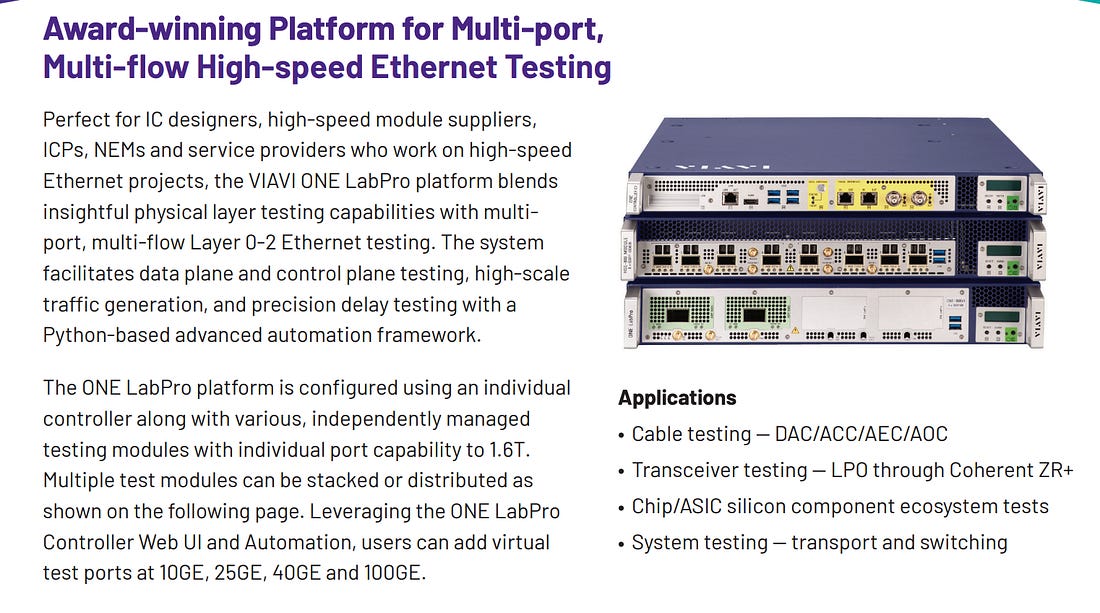
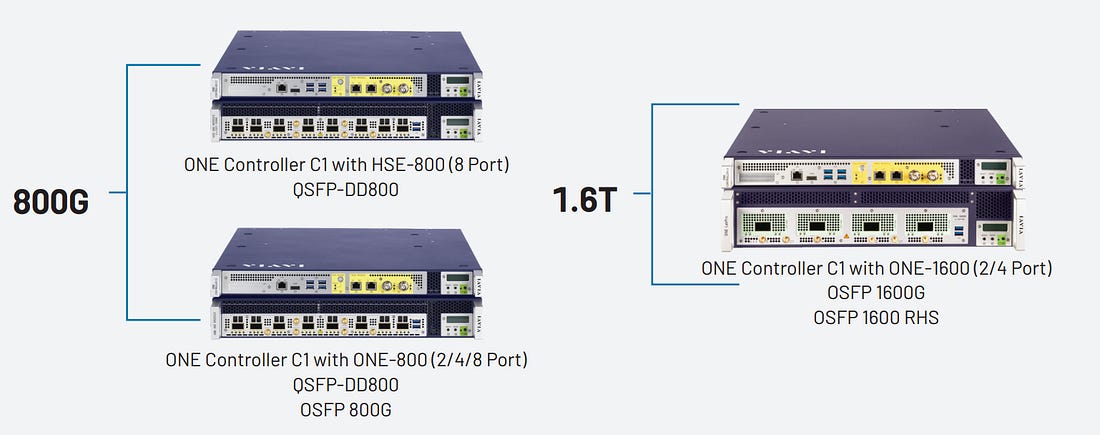
That graphic shows the progression from 800G to 1.6T, along with VIAVI’s exposure across ICs, transceivers and complete systems. VIAVI ONE LabPro brochure
CPO was the other important piece at ECOC. VIAVI added several high-density modules to MAP-300 for CPO and silicon-photonics manufacturing, including a new high-density VOA, optical power meter, in-line optical power meter and remote-head polarity mapper. Those additions are aimed at the much larger number of optical channels and test points created as photonics becomes more integrated.
VIAVI already works with the five largest transceiver manufacturers, with management describing particularly deep engagement at four of them. So these are additions to a test platform that is already sitting inside many of the customers moving from 800G into 1.6T.
For me, ECOC strengthens two parts of the VIAV thesis at once.
1- 1.6T is moving deeper into factory production, where the test equipment carries higher content
2 - CPO and SiPh are creating new high-density optical test requirements that did not exist in the traditional pluggable production flow.
KEYS
Keysight had a full 1.6T manufacturing workflow running at ECOC, combining optical sampling oscilloscopes with automated interconnect validation. At 1.6T, manufacturers are testing eight 224G PAM4 optical lanes across temperature and operating conditions, so moving a transceiver from the lab into volume production requires more test capacity and automation than prior generations.
That transition is already showing up in Keysight’s business. Wireline historically ran at roughly 80% R&D / 20% manufacturing. Over the last couple of quarters, management said the mix has moved closer to two-thirds R&D / one-third manufacturing, driven by AI data-center buildouts and the 1.6T production ramp. Management also said that manufacturing could move even higher in individual quarters as customers add production lines.
At ECOC Keysight demonstrated 3.2T optical research using 448G-class PAM4, along with automated PIC characterization extending to 220 GHz. So while 1.6T equipment is moving deeper into factories, Keysight is already selling into the engineering work required for the next optical generation.
I like the setup because the upgrade cycles overlap. 1.6T is generating higher-value manufacturing demand today, 3.2T is already creating R&D demand, and cluster-level emulation gives Keysight another opportunity after the individual components have been built. That is very broader AI-optics exposure.
Financial Disclaimer
This publication is for informational and educational purposes only. Nothing contained herein should be construed as investment advice, financial advice, legal advice, tax advice, or a recommendation to buy, sell, or hold any security.
The author may hold positions in securities discussed in this publication and may buy or sell those securities at any time, including before or after publication, without providing an update. Any positions, portfolio weights, entry prices, price targets, valuation estimates, or investment views discussed reflect the author’s views at the time of publication and may change as new information becomes available.
Any forward-looking statements, projections, financial models, valuation ranges, price targets, market-size estimates, revenue estimates, margin assumptions, earnings expectations, or other forecasts involve significant uncertainty. Actual results may differ materially from the assumptions and scenarios presented. Bull, base, and bear cases are illustrative frameworks rather than predictions of future performance.
Information used in this publication may come from company filings, earnings calls, investor presentations, industry conferences, press releases, management commentary, third-party research, news reports, and other sources believed to be reliable. Accuracy, completeness, and timeliness cannot be guaranteed. Errors, omissions, or changes in publicly available information may affect the analysis.
References to management guidance, customer relationships, design wins, long-term agreements, production schedules, market opportunities, technology roadmaps, or future product ramps should be evaluated with appropriate caution. Announced products, demonstrations, customer engagements, sampling programs, qualification activity, or partnerships may fail to translate into material revenue or profits.
Investing in public securities involves substantial risk, including the possible loss of principal. Technology, semiconductor, networking, optical, and AI-related companies can experience significant volatility driven by valuation changes, customer concentration, competitive developments, product transitions, manufacturing execution, supply constraints, capital spending cycles, regulation, macroeconomic conditions, and changes in investor expectations.
Readers should conduct their own research and consider their individual financial circumstances, investment objectives, risk tolerance, and time horizon before making any investment decision. Consultation with a qualified financial, tax, or legal professional may be appropriate.
Past performance provides no assurance of future results. References to prior investments, returns, entry prices, or successful investment outcomes should never be interpreted as an indication that similar results will occur in the future.
Unless specifically disclosed, discussion of a company or security does not imply sponsorship, endorsement, compensation, or a commercial relationship with that company.
All opinions expressed are solely those of the author as of the publication date and are subject to change without notice.