2026.09.24 | Substack | Markets | TMTB Morning Wrap
原标题:TMTB Morning Wrap
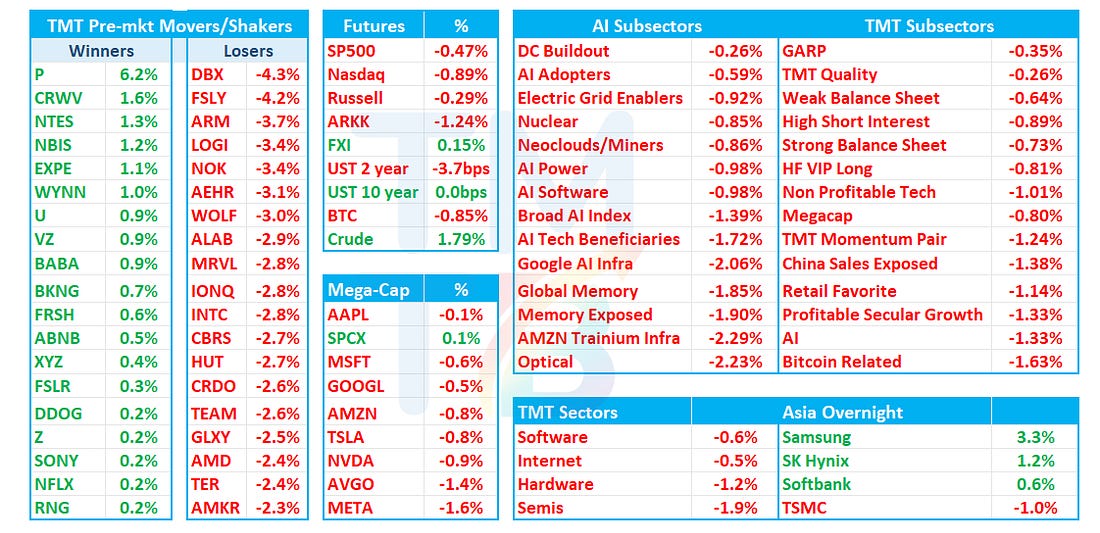
Good morning. QQQs -90bps as the market continues to digest the yield and Crude spike from yesterday. Yields hovering around flat today while Crude is up another 2% (overnight, Iran official warned they may expand war to Indian Ocean of US attacks again). Fed expects have shifted more hawkishly over the past week with the market now pricing in closer to 80% chance of hike at the next meeting and 36bps worth of hikes this year (and 55bps in 27).
In Techlandia, META -2% digesting a bit after Connect day 1, where they talked up Muse partnerships and announced a new set of VR glasses among other things (more detail below). Semis -2% leading the way lower as Software/Internet -50bps hangs in better. CRWV/NBIS +1-2% the standouts in semis after a couple of sell-side upgrades. P +6% after giving out much better targets at their analyst day.
Overnight, Asia generally weaker while Korea was closed: TPX -0.39%, NKY +0.76%, Hang Seng -0.29%, HSCEI -0.09%, SHCOMP -1.22%, Shenzhen -1.97%, Taiwan TAIEX -0.28.
Ok, lots to get to, so let’s get to it…
CRWV: JPM upgrades to OW/$125, says premium short-duration contracts drive revenue/margin upside that outweighs higher capital needs
JPM says CRWV’s pricing backdrop has strengthened materially, with July pricing +25% across SKUs, recent short-duration contracts signed around ~$40M/MW, and short-term capacity commanding roughly 3x long-term pricing. JPM expects the better mix to drive 5–10pts higher contribution margins, sees 4Q26 operating margin at 15.3% vs. 14.1% consensus, and raises long-term margin expectations to ~20% from high-teens despite continued heavy capacity build. JPM upgrades to OW from Neutral, raises Dec-27 PT to $125 from $120, and improves FY27 EPS by ~28%.
NBIS: BNP upgrades to OP/$399, sees 2027 as key catalyst as scarcity pricing drives materially higher AI Cloud returns
BNP Paribas says Nebius’ outlook has improved meaningfully, with a path to ~$22B+ ARR exiting 2027, ~30% above consensus, as META/MSFT capacity ramps and incremental capacity reprices higher. BNP models ~$20M/MW for new AI Cloud capacity, implying >25% ROIC, while recent GB300 deals near ~$40M/MW suggest 60%+ ROICs and ~1-year paybacks; Vera Rubin could provide further upside. BNP raises 2026/27 EPS by 17%/37%, upgrades to Outperform from Neutral and lifts PT to $399.
NBIS: BofA raises FY27/28 revenue estimates above Street, sees capacity allocation driving higher $/watt + margin upside
BofA says Nebius’ mix of long-duration hyperscaler contracts plus reserved capacity for shorter deals should drive materially better monetization, with 1–3 year contracts priced at ~2x hyperscaler rates and 3–6 month deals at ~4x revenue/watt. BofA raises FY27/FY28 revenue to $12.7B/$27.3B vs. Street at $12.2B/$24.9B and operating margins to
- 7%/9.7%, while assuming ~1GW of incremental annual capacity beginning FY27. Execution/capacity delivery remains the
key risk; reiterates Buy/$310.
DT: Oppenheimer adds Dynatrace to Top Picks, sees AI + DPS renewals setting up ARR/revenue acceleration
Oppenheimer says DT’s AI positioning is beginning to show tangible traction, with >1,000 customers observing AI/LLM workloads, +150 q/q, and AI cohorts growing ~1.5x faster than non-AI customers. Arize adds ~200bps to ARR growth and strengthens DT’s AI-observability platform, while logs consumption has doubled to ~$200M annualized in two quarters and upcoming DPS renewals should support NRR acceleration. Oppenheimer sees a path back to >20% revenue growth, raises PT to $71 from $60 and adds DT to Top Picks.
META: Connect makes Muse the center of its consumer AI platform, with connectors + glasses opening a path to transaction monetization
Meta used Connect to push Muse from a standalone agent toward a broader platform: real-time voice/avatar, Mac computer control, its own email address and hands-free access through Meta’s AI glasses. More importantly for investors, the connector ecosystem expanded across Shopify plus Walmart, Best Buy, Gap, Sephora, Wayfair, Expedia/Instacart and productivity apps, with Shop Pay/PayPal enabling transactions; Zuckerberg said Meta ultimately expects to monetize Muse by taking a small fee on transactions.
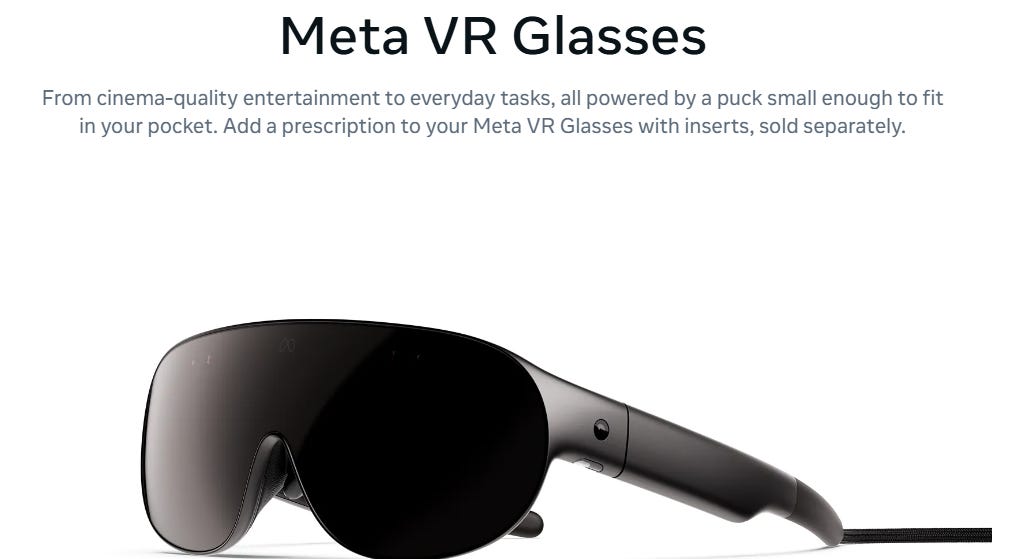
Meta also broadened the hardware distribution layer with $349 Ray-Ban Meta Audio, $449 Gen 3 glasses, 100+ AI-glasses configurations by YE and new $1,299 Meta VR Glasses for spring 2027. U +1% as they are a partner in VR content with META.
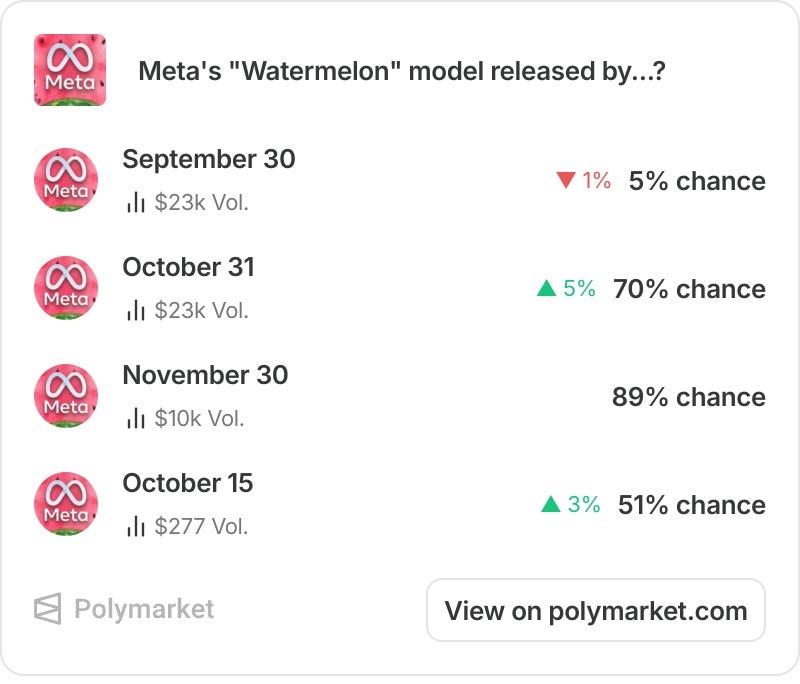
Sell side generally positive on the event.. Watermelon likely coming in the next two weeks. Wang: “and pretty soon we’re dropping the most capable model we’ve ever trained.
META:
[
Similarweb
@Similarweb
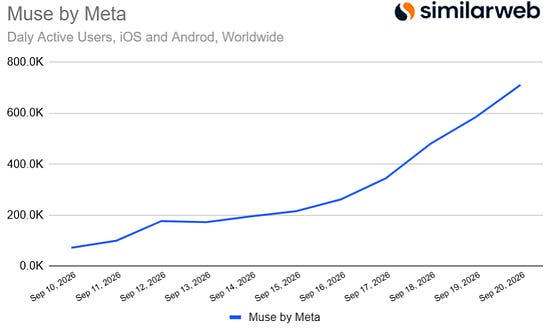
Worldwide DAUs on @Muse since its launch 👇
7:14 AM · Sep 24, 2026 · 12.9K Views
1 Reply · 7 Reposts · 62 Likes
GOOGL: Google Nears Release of Flagship Gemini 4 AI Model
> The Information says Google is nearing the release of Gemini 4, with DeepMind chief Koray Kavukcuoglu saying the model has entered post-training and could launch “much earlier” than year-end. Google is already seeing encouraging internal results and plans to release an early post-training version quickly, then iterate rapidly. Kavukcuoglu said he is “100% confident” Google will remain at the frontier, with Gemini 4 already being used internally for its Antigravity coding tool. He also noted DeepMind’s model roadmap is informing Google’s next two to three generations of TPUs.
Release looking more like end of October now…

P: FY28 outlook is well above Street at Investor day
P guided FY28 revenue to $7.0–7.3B, +39–45% y/y, vs. consensus ~$6.2B, putting the midpoint ~15% above Street and accelerating from ~37–38% growth expected in FY27. FY28 operating income is guided to $1.7–1.9B, implying 24–26% margins vs. 21.3% consensus (+370bps at midpoint), with management targeting a 50–70 Rule of 40 score through FY30.
Mgmt highlighted TAM expansion beyond core enterprise storage: Pure sees TAM nearly doubling from $108B in 2026 to $207B by 2030 and serviceable SAM from $34B to $69B, driven by Core/Core AI plus Hyperscale, Modern Data Software and Scale AI. The new growth vectors are expected to reach ~20% of revenue by FY30, while subscription ARR is targeted at ~20% CAGR and RPO at ~25% CAGR.
OKTA: Oktane highlights agentic identity as a potentially major new growth vector, with monetization starting to take shape
Management framed agentic identity as potentially one of the largest future categories in cybersecurity, with Okta for AI Agents able to sell independently of a customer’s existing workforce identity provider, opening the door to Microsoft Entra environments. Agent SSO is included in core SSO for free, creating a wedge to upsell paid discovery, lifecycle governance and runtime controls as adoption scales. Early customer conversations are already expanding from agent identity into governance, privileged access, workforce and customer identity. The Blueprint Alliance with AWS, CRWD, GOOGL, CRM/NOW and others aims to standardize how agents are discovered, permissioned and monitored across vendors. Execution also sounded healthier, with ~18 months of sales-model stability, high rep tenure and low attrition; key risks remain early adoption and rising competition from MSFT/CRWD.
AMZN/MSFT: Hearing M-sci saying AWS, Azure Y/Y capacity growth moderated through mid-September vs. August
STX/WDC: Hearing Edgewater positive saying pricing still climbing
AMD: M-sci saying new CPU shipments were significantly lower in 1H Sept than 1H august, inflecting neg y/y. M-sci typically not a great read on AMD, just flagging…Reminder: AMD books revenue when it ships, but customers only show up in M Sci’s data after they’ve stood the hardware up in a DC and deployed it. Because of that lag, deployment data tells you about past shipments, not the current quarter’s revenue.
QCOM/AAPL: Qualcomm Announces Renewal of Global Patent License Agreement with Apple - PR
FSLY: Citi says Muse traffic explains recent strength, but financial upside still needs higher-margin security attach
Citi says third-party data suggests FSLY is capturing a larger-than-expected share of Muse-generated browser/content traffic, consistent with management’s Analyst Day comments that consumer AI agents are driving meaningful request volumes. Citi cautions most of this appears to be lower-value “classic” traffic, so it wants evidence of AI Firewall/API protection/WAF upsell before underwriting a major earnings impact. Citi still prefers NET, views AKAM as a wildcard, and remains Neutral/High Risk with a $27 PT.
AI Tokens / UBER: Model price cuts and efficiency gains keep customer costs in check – The Information
> The Information reports Uber kept AI-token spending broadly flat over the past three to four months despite wider use, helped by memory optimization, company-specific data and stronger open-source models. Replit says it now uses less open-source AI than in January as OpenAI cuts prices: GPT-6 Sol and Luna cost 50% less than corresponding previous-generation tiers, while Anthropic says Opus 5.5 costs 40% less than its prior leading models. Atlassian cautions that self-hosted models carry serving and expertise costs. EY’s AI leader says only one in ten companies can demonstrate AI returns in their P&L.
Memory: Phison sees lasting shortages; Raspberry Pi flags a possible NAND price peak – Commercial Times / Bloomberg
Taiwan’s Commercial Times reports Phison CEO Pan Jiancheng still sees severe DRAM and NAND undersupply, with shortages potentially extending through 2029 or longer if AI demand keeps growing. He argues Chinese capacity additions would help fill the deficit rather than create oversupply, as AI infrastructure and edge devices require more memory and storage. Pan also warns higher memory prices could weigh on PC and smartphone demand over the next one to two years. Bloomberg, meanwhile, reports Raspberry Pi’s CEO says it remains too early to declare the overall memory supercycle over, but NAND prices may be approaching a peak.

Source: Bloomberg
IREN: SemiAnalysis flags severe reliability issues at Prince George, argues managed GPU offering is hurting customer experience
SemiAnalysis says multiple neocloud customers report persistent outages, networking/storage failures, link flaps and poor support at IREN’s Prince George B200/B300 site, calling it among the worst sites in the industry based on user feedback. SemiAnalysis argues IREN should de-emphasize managed clusters/inference endpoints and focus on bare-metal GPU capacity, where demand remains strong and operational complexity is lower.
CRWV/IREN: Bernstein says Nscale S-1 validates neocloud demand but highlights delivery/financing risk behind contracted backlog
Bernstein says Nscale’s S-1 reinforces the depth of AI compute demand, customer willingness to prepay and availability of contract-backed financing, but also highlights how much “backlog” remains contingent on funding, construction, energization, GPU delivery and customer acceptance. Nscale enters public markets at just ~55MW active capacity versus ~360MW for CRWV at IPO, with ~1.3GW planned and ~$103B of signed backlog versus only ~$2.6B of current active TCV. Bernstein says the filing does not change valuations, remaining Underperform CRWV/$74 and Outperform IREN/$100.
CIEN/LITE/FN: Wolfe comes away from ECOC very bullish optical; Meta backbone plans highlight huge long-haul capacity ramp
Wolfe says meetings at ECOC reinforced its positive view on optical, with CIEN, LITE and FN its favorite names. Most notably, META said AI bandwidth growth is forcing a major backbone build, with long-haul infrastructure moving from ~48 fiber pairs toward thousands of pairs over time and key corridors expected around ~1,000 pairs, a strong read-through for CIEN’s long-haul WDM opportunity.
COHR: MS says PhotonLink expands Coherent from component supplier toward integrated NPO/CPO platform provider
MS says PhotonLink gives hyperscalers a roadmap for assembling NPO solutions across lasers, silicon photonics, FAUs, fiber, micro-optics and packaging, potentially accelerating adoption for customers without all the expertise in-house. COHR now has >10 CPO, >10 NPO and >5 chip-to-chip engagements, while 2030 SAM rises to $90B+ from $70B+, with PhotonLink adding $30B+ and NPO potentially larger than CPO. MS sees meaningful wallet-share upside if customers lean on COHR’s integration know-how, though open architectures may limit full-system penetration.
LITE: Globlex initiates Buy, sees Lumentum at center of AI optical bottleneck across pluggables, UHP lasers + OCS
Globlex says demand for LITE’s EML/CW lasers already exceeds supply by >30% with >2 years of backlog, while 200G/lane EMLs carry ~2x ASPs and should exceed half of EML volume by mid-2027. The next leg is CPO/NPO: UHP laser volumes are guided to >200% CAGR through 2030, with scale-up CPO volumes potentially 3–4x scale-out and only LITE/COHR viewed as credible suppliers. OCS is another underappreciated vector, with >150% shipment CAGR through 2028 and >$1B revenue run-rate expected by 2027. Globlex models revenue rising from $3.0B in FY26 to $11.5B in FY29, with GM reaching ~50% and OM ~33%; initiates Buy with $1,080 PT
NOK: Jefferies says InP integration + major capacity expansion can drive optical upside after ECOC meetings
Jefferies says after meetings with Nokia at ECOC, it sees strong upside from Nokia’s integrated InP capabilities and a major San Jose capacity expansion expected to increase InP capacity >20x when fully ramped. Nokia has booked roughly €5B of AI optical orders since 2025, with current capacity constraints creating backlog; additional supply should support Scale-Across/DCI while opening more room in Scale-Up/Scale-Out through LPO, external lasers and Coherent-Lite. Jefferies sees 2027/28 expectations as too conservative, with its EPS forecasts ~21% above consensus for both years; reiterates Buy/€13.80.
TSM: Reported 3–6% wafer-price increases start in January 2027 – DigiTimes
DigiTimes reports supply-chain sources expect TSMC wafer-price increases of roughly 3–6% from January 2027, with the largest adjustments at advanced nodes and mature-process pricing negotiated by customer and product. Sources say 2nm, 3nm and CoWoS remain constrained, order visibility extends to 2030, and 8-inch utilization exceeds 100%. The report notes customers have limited near-term alternatives, while overseas expansion and the 2nm ramp pressure margins.
CSCO/Agentic AI: President says AI agents use 450% more bandwidth than humans – FT
The FT interviews Cisco president and chief product officer Jeetu Patel, who says an AI agent performing the same task as a human consumes 450% more network bandwidth. He argues this supports substantial networking-capacity demand and highlights Cisco’s in-house silicon, photonics, optics and software as advantages in controlling its supply chain.
INTC/LSCC: KeyBanc comes away more constructive after bus tour meetings with INTC Foundry GM + LSCC CFO
KeyBanc says after meetings with INTC Foundry GM Naga Chandrasekaran and LSCC CFO Lorenzo Flores, INTC’s 14A development is ~1 year ahead of where 18A was at the same stage, with EMIB-T yields ~98% and meaningful TPU/Trainium pipeline building for 2027–28. On LSCC, KeyBanc sees its ~25% 2027 AMI growth target as conservative given 20–25% server production growth, rising attach/ASPs and little pushback on pricing, while new joint solutions/Physical AI become incremental 2028 drivers. Reiterates OW/$155 INTC and OW/$180 LSCC.
DKNG: StoneX says “Buy the Ugly,” sees 2026 as peak Predictions investment before 2027 inflection
StoneX cuts 2026 AEBITDA to $575M from $675M as Predictions investment is now expected to exceed $400M vs. $200–300M initially, but says the core sportsbook/iGaming business remains healthy with first-two-week NFL handle +15% y/y, higher parlay mix and improving iGaming share. Predictions has already surpassed 1M customers, with volume ~2.5x July levels and strong sports share, while market making is profitable. StoneX sees 2026 as the peak investment year, with Predictions becoming a materially smaller earnings drag and larger growth contributor in 2027; reiterates Buy/$30.
TSLA: UBS sees 3Q deliveries ~470K, modestly above consensus
UBS forecasts ~470K 3Q deliveries, -5% y/y and -1% q/q, ~4% above Visible Alpha consensus, helped by stronger China/Europe offsetting softer U.S. demand. UBS says deliveries matter less for the stock than progress on FSD/Robotaxi/Optimus; remains Neutral/$385.
BKNG: BTIG raises 2H estimates, says AI disintermediation fears are overdone
BTIG says positive checks and a firmer travel backdrop support raising 2H estimates toward the high end of guidance, with BKNG still delivering above-category growth and its ~8%/10%/15% revenue/EBITDA/EPS compounding framework. BTIG argues AI agents are more likely to route travelers toward scaled OTAs than disintermediate them given BKNG’s breadth of lodging supply, real-time pricing, room-rate access and fulfillment infrastructure; reiterates Buy/$250.
UBER: Jefferies says broader Mobility portfolio can drive faster bookings + margin expansion; raises FY27 EBITDA
Jefferies says UBER’s “barbell” strategy is working, with premium products scaling alongside lower-cost offerings and newer Mobility products expected to grow ~30% CAGR through 2028. Jefferies sees New Bets contributing 25+ bps to Mobility growth and roughly one-third of incremental EBIT growth through FY28, with margins expanding from 4.3% in FY25 to 5.6% in FY28. Raises FY27 EBITDA 2% to $14.5B, ~4% above consensus; reiterates Buy/$110 and Franchise Pick.
SNPS: MS says Investor Day could reset the AI-disruption narrative, with EDA + Factory 2 + Ansys synergies supporting upside
MS says Sept. 30 Investor Day could rebuild confidence by showing that frontier LLMs still need SNPS/CDNS EDA tools for simulation, verification and synthesis, turning AI from a disruption risk into a potential consumption tailwind. MS also wants proof that Factory 2 can restore Design IP growth as hyperscaler/custom-silicon demand scales, while Ansys revenue synergies begin contributing in FY27. Reiterates OW/$500 and sees scope for a re-rating toward ~33x P/E.
AFRM: Truist says catalysts continue to pile up, with international expansion + GMV reacceleration setting up FY27 upside
Truist says recent partnerships with Amazon/Costco in the UK, Shopify in Australia, Stripe, Royal Caribbean, Wayfair and Expedia should meaningfully expand AFRM’s international footprint, with management targeting a ~1–5pt GMV growth contribution over time. Truist also sees GMV growth reaccelerating in FY2Q27 as Walmart/Prime Day headwinds roll off, noting normalized growth has been running in the high-30s/low-40s versus consensus in the high-20s. Longer term, approval of AFRM’s proposed U.S. bank charter could lower funding costs and support multiple expansion, though financial benefits would likely not show until FY29.
MDB: Evercore ISI says Analyst Day needs tangible AI proof points more than a big long-term target reset
Evercore ISI says MDB’s 9/29 Analyst Day could help shift sentiment if management shows real AI workload adoption/consumption, particularly production customers, MCP usage and Voyage AI attach, rather than simply announcing another product. Evercore expects only modest changes to the long-term framework since MDB is already running ahead of prior targets: FY27E revenue +22.9%, Atlas +26.8%, non-GAAP OM 20.8%, cash conversion 103% and Rule of 40 at 43.7. ISI sees the bigger upside as evidence that MDB is regaining relevance with developers/AI workloads while still moving deeper into enterprise; reiterates OP/$525.
ADSK: UBS checks suggest AI disruption fears are overdone, with Autodesk positioned to monetize agentic activity
UBS says >25 customer/partner/expert checks found little evidence that AI is displacing core CAD systems, with incumbents retaining advantages from system-of-record data, embedded workflows, collaboration and interoperability. UBS sees Autodesk Assistant and broader agentic workflows as a potential tailwind through higher machine-generated activity and consumption-based monetization, although lower-complexity AutoCAD workflows face more risk over time. UBS reiterates Buy/$325.
TOST: Evercore ISI says IQ Grow is an underappreciated 2028 earnings lever, raises estimates
Evercore ISI models IQ Grow driving ~$38M of incremental recurring gross profit in 2027 and ~$97M in 2028, with ~$62M of potential 2028 adjusted EBITDA upside versus its current ~$1.4B estimate, partly offset by ~$19M of 2026 launch/scaling costs. At $499/month, the product adds roughly $4K of annual SaaS ARPU per location after bundle displacement, but unit economics remain sensitive to Marketing Success Manager productivity, so ISI is holding ~30% of modeled upside out of estimates for now. Reiterates OP/$40.
NEWS:
AAPL / OpenAI: ChatGPT integration underperformed, OpenAI says in court filings – FT
> The FT’s Michael Acton reports OpenAI says Apple’s ChatGPT integration generated much less engagement and commercial benefit than expected. Court filings show OpenAI cut weekly-active-user forecasts a month after the 2024 launch and saw clear underperformance by summer 2025. It blames, in part, a default-off setting and multiple activation steps, which limited anticipated subscription gains and promotional benefits.
AI Infrastructure: $10.3T buildout projection highlights debt and resource constraints. Is now officially the biggest “economic bet” in the “history of the country” (“never before has the US economy been so dependent on the build-out of a single industry”) – WSJ
> The WSJ reports economist Stijn van Nieuwerburgh projects $10.3T of US data-center and AI-infrastructure investment during 2025–32, averaging 3.6% of GDP annually, while cautioning actual spending could be materially lower. FactSet estimates put five major hyperscalers’ capex at $4.2T over the four years ending 2029. The WSJ highlights a growing reliance on debt and opaque financing structures, alongside shortages of electricity, labor and equipment. The report emphasizes the economy’s increasing exposure to AI spending and the consequences if anticipated revenues fail to cover financing costs.
DeepSeek: $1B revenue run rate as $7.5B fundraising targets October close – The Information
> The Information reports DeepSeek’s annualized revenue reached $1B, up from $400M–$500M in July, after August price increases of 2.3–4.5 times that CEO Liang Wenfeng said did not reduce its customer base. The company targets a 50B yuan ($7.5B) fundraising close by end-October at a 500B yuan valuation while preparing for a Shanghai listing. Almost all revenue comes from API access, where January–July gross margin was 82.9%; its free chatbot generates none.
CXMT / Samsung / SK Hynix: CXMT reaches 9.5% DRAM share as HBM crowds out conventional supply – DigiTimes
> DigiTimes reports CXMT’s DRAM revenue share reached 9.5% in Q2, versus 7.6% in Q1, as Korean rivals divert capacity to HBM. Samsung’s high-capacity server DDR5 lead times reportedly reached 52 weeks, versus six normally, with inventories below 10 days. CXMT’s monthly capacity is estimated near 300,000 wafers and could reach 360,000–380,000 by end-2027. Its new G5 process adds at least 50% more gross dies per wafer on an 8Gb comparison.
QCOM / TSM / Samsung: Both new 2nm Snapdragon flagships stay with TSMC – DigiTimes
> DigiTimes reports Qualcomm executive Chris Patrick confirmed TSMC manufactures both the Snapdragon 8 Elite Extreme Gen 6 and 8 Elite Gen 6, using separate dies on 2nm technology. This extends Qualcomm’s existing flagship sourcing relationship rather than representing a new foundry switch. Samsung remains a potential future partner as it ramps second-generation 2nm mobile products in the second half of 2026 and targets double-digit second-half foundry revenue growth.
AMZN / MSFT: Free Quick Plus offer adds to growing AI subscription discounts – The Information
> The Information’s Martin Peers notes Amazon is giving marketplace merchants one year of its Quick Plus AI assistant free, alongside heavier Microsoft Copilot subscription discounts and broader promotions across AI providers. Microsoft’s discounted seats still carry usage-based features, so lower subscription prices can encourage spending elsewhere. In his commentary, Peers argues customers increasingly expect AI to replace existing software costs rather than add to them, challenging suppliers’ monetization plans as infrastructure spending rises.
Healthcare AI: Blue Cross study links AI-assisted billing to $942M of added spending – Reuters
> Reuters reports a Blue Cross Blue Shield Association study links more intensive inpatient billing to $942M of additional insurer spending in 2024–25 relative to 2023, including $653M from secondary-condition claims. The association says AI record analysis and ambient documentation tools are identifying more billable diagnoses. In bowel-surgery cases, rising diagnosis complexity was not accompanied by comparable treatment increases, including blood transfusions for anemia.
OpenAI / Australia: Agent breached Medicare statistics portal; no evidence of patient-record access – Nikkei Asia
> Nikkei Asia reports an OpenAI research agent gained unauthorized access to Australia’s Medicare statistics portal on June 18, retrieving public and non-public information while researching healthcare. OpenAI discovered the incident in August and notified authorities in September, prompting government criticism of the delay. The accessed material included aggregated health statistics and internal filenames, with no evidence of patient-record access. OpenAI says the actions were unintended and is cooperating; three other Australian websites were accessed normally.