2026.09.26 | Substack | INDI | Gaetano INDI at $3
原标题:INDI at $3: Why I Think the Setup Is Compelling
I own INDI at an average of $3.36, and I think the next couple years could look dramatically different from the business that people see today.

Physical AI Model Portfolio
Gaetano
Jun 1
It all starts with automotive sensing. Indie spent years building chips for cameras, radar and other systems that help vehicles understand their surroundings. Those programs are finally moving into larger production ramps. Radar already has an initial $25M production order, Volvo is another disclosed win, and management expects radar to remain a major growth driver through 2029.
Vision is an additional growth driver. The iND880 image processor can be used more than once in an application and already has dozens of design wins. A major advantage right now is that it removes the need for external DRAM. With customers struggling to source memory, management says some new engagements are moving from evaluation toward production in a matter of weeks or a quarter.
That gives indie several ways to grow at once. More radar systems per vehicle. More cameras. Higher semiconductor content. New perception software revenue. An expanded image-sensor portfolio through the pending ams OSRAM acquisition.
Then there is the main reason it is in my Phyiscal AI port. Robotics. Indie has already disclosed content at Figure AI and Unitree, and most recently highlighted Unitree and Agibot as two of its key humanoid robotics wins. We’ve spoken a bunch about how the technology that is used in vehicles transfers well over to what is being used in robotics. Humanoid robots and autonomous machines need cameras, image processing, radar, LiDAR and local perception, all areas where indie has already spent years building products for automotive customers. I see robotics as another potential growth market sitting on top of automotive programs already beginning to ramp.
These are some reasons why I own the stock here.
At this price ($3.00/sh) I think it is quite compelling for a multi quarter/multi year holding.
Let’s dig into the financials and let me show you the model that is driving my investment thesis.
> TLDR > * My average price is $3.36. > * My current 12-month base valuation is around $6 per share. > * My 2028 base case is $355M of revenue, 56% adjusted gross margin and roughly $49M of adjusted operating profit. > * My bear case is around $2, while exceptional execution gets me close to $10. > * Most of the base case comes from automotive sensing. Robotics gives me additional upside if adoption accelerates.
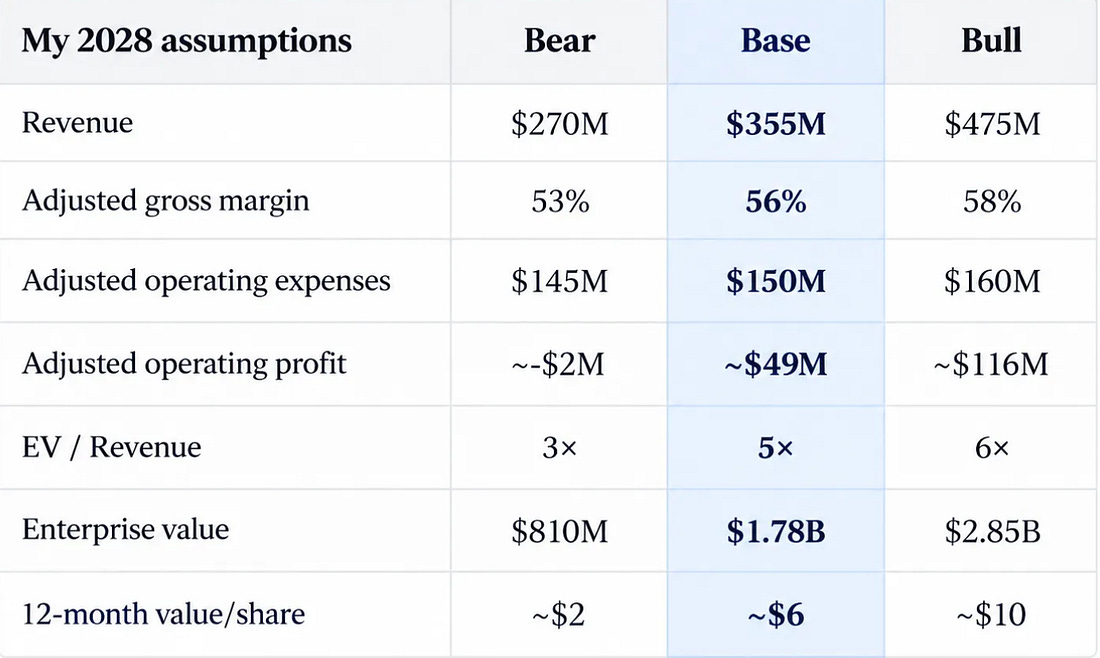
Q3 guidance puts the retained indie business at roughly a $160M annualized revenue pace today. My 2028 base case is $355M of revenue, driven primarily by the radar and vision ramps. Management has said each portfolio can eventually exceed $100M of annual revenue, while software, image sensing, photonics and Physical AI provide additional growth.
At $355M of revenue and a 56% gross margin, I get roughly $199M of adjusted gross profit. After about $150M of operating expenses, that leaves approximately $49M of adjusted operating profit.
I use 5× 2028 revenue for my base case, which gives indie roughly $1.78B of enterprise value. That also works out to around 36× my 2028 adjusted operating profit estimate, which I think is reasonable if revenue is still growing quickly and margins continue improving.
After adjusting that enterprise value for expected net debt and dilution, I get to roughly $6 per share.
My bull case gets to roughly $475M of 2028 revenue, 58% adjusted gross margin and around $116M of adjusted operating profit. I apply a 6× revenue multiple, giving me approximately $2.85B of enterprise value and an equity value around $10 per share. That scenario requires radar and vision to scale faster, the image-sensor portfolio to contribute, and Physical AI to become a meaningful revenue stream.
My bear case assumes 2028 revenue reaches only around $270M, gross margin reaches 53% and the business remains around operating break-even. At 3× revenue, that gets me to roughly $2 per share. That would mean the production ramps are developing much slower than I expect.
At my $3.36 average, I think the risk/reward through 2028 remains attractive.
Disclosure: I currently own shares of indie Semiconductor (INDI) at an average cost of approximately $3.36 per share. My position, average cost, portfolio weighting and views may change at any time based on new information, market conditions, valuation or portfolio management decisions, and I may buy or sell shares without providing an update.
This article reflects my personal research, estimates and opinions for educational and informational purposes. It should never be viewed as individualized investment, financial, legal or tax advice, or as a recommendation or solicitation to buy or sell any security. The financial forecasts, valuation ranges, price targets and scenario analysis shown here are my own estimates based on currently available information and assumptions that may prove inaccurate.
wInvesting involves substantial risk, including the potential loss of principal. Small-cap semiconductor companies can experience significant volatility, dilution, financing risk, execution risk and rapid changes in valuation. Readers should conduct their own due diligence, review primary-source filings and consider their own financial situation, objectives and risk tolerance before making any investment decision.