2026.09.26 | Substack | Cloud | Neocloud IPO Bigger Backlog Than CRWV
原标题:This Unknown Neocloud IPO Has A Bigger Backlog Than Coreweave
Compute is the one thing nobody in AI can get enough of. Hyperscalers are pouring hundreds of billions into new capacity while frontier labs sign multi-year deals just to lock in supply. That’s why we’re looking at a company set to IPO at an estimated $30B valuation that’s already signed more than $100B in contracts.
The company is Nscale.

Two weeks ago, when we published our Anthropic playbook, we named Aker ASA as one of our top picks because of its ~27% equity stake in Nscale. We wrote that Nscale was “supposedly planning to IPO as soon as September,” and on September 18 it filed its S-1.
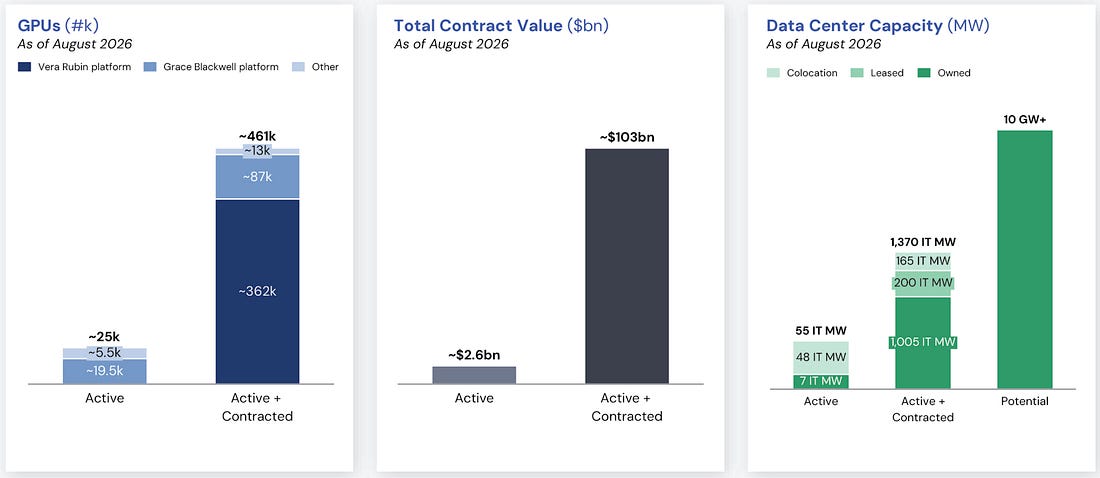
Nscale calls itself a “full-stack AI hyperscaler,” but the gap between what it has today and what it’s aiming for is huge. The company currently operates 55 MW of live capacity and reports approximately 1.37 GW of active and contracted capacity. Its development pipeline could reach 10 GW by 2031.
Nscale is a promising neocloud with an unproven infrastructure buildout, and its value depends on financing and delivering future capacity. Because of that, this article comes down to one question:
Can a company with 55 MW live today deliver on a 10 GW timeline and become one of the most important compute providers in the world?
Before we begin, this Substack is for informational and entertainment purposes only and does not constitute financial advice. Past performance is not indicative of future results. Never invest more than you can afford to lose. Our writers may hold positions in the securities discussed and may buy or sell them at any time without notice.
Table of Contents
[1] What Nscale Operates Today
[2] What Is Contracted
[3] What Needs to Be Built
[4] Active-Capacity Economics and Financials
[5] Customers & Partnerships
[6] NVIDIA Relationship and the Supply Chain
[7] Software Strategy and the Anyscale Acquisition
[8] Ownership and Management
[9] Valuation Framework
[10] Risks
[11] Final Thoughts
[1] What Nscale Operates Today
In May 2024, the company spun out of Arkon Energy (an Australian crypto-mining infrastructure business). At the time, the business included data center sites in Norway, the US, and Australia.
As of today, Nscale has five active sites with 55 MW of live IT capacity, and all of it runs on leased and colocation space. The active GPU fleet is 25,000 units, and the S-1 doesn’t disclose which GPU models are deployed.
[2] What Is Contracted
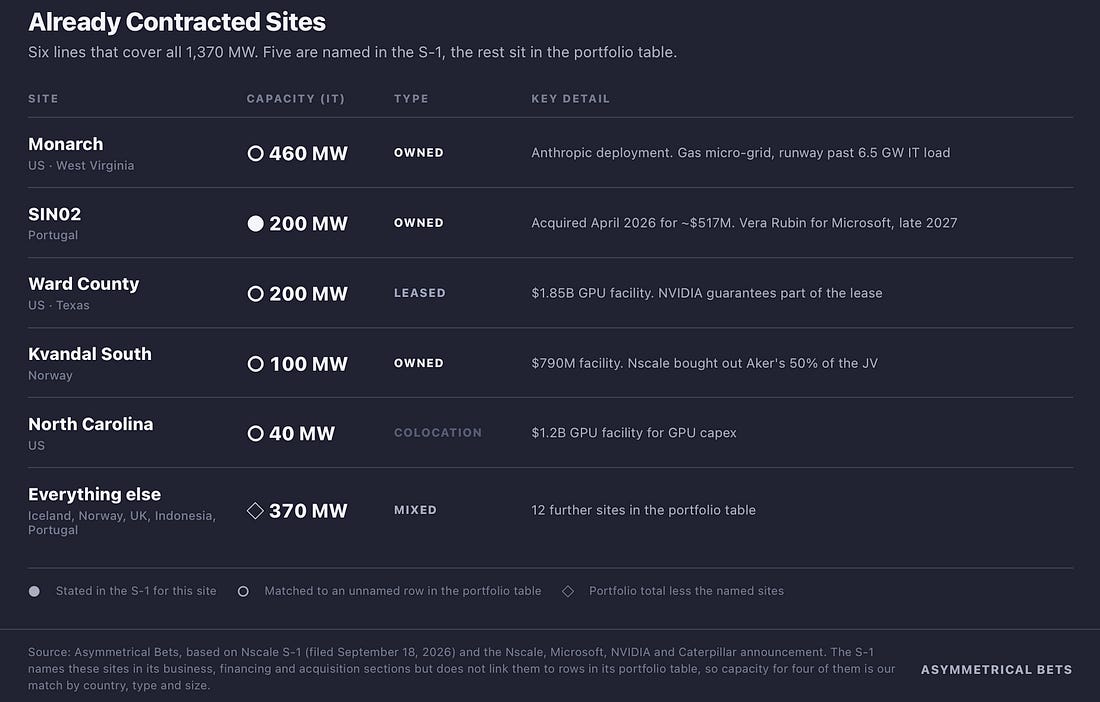
Across five active and 12 contracted sites, Nscale reports approximately 1.37 GW of combined active and contracted capacity. About 1 GW is planned for owned sites, with another 200 MW leased and 165 MW in colocation facilities.

As of today, Nscale has 436,000 contracted GPUs, meaning customers have signed for this capacity, but the GPUs haven’t been deployed yet. Deliveries are beginning to ramp as sites come online with the bulk expected between late 2027 and
The S-1 says its strategy of “focusing on data center ownership” will give it more control over cooling, power density, maintenance and hardware upgrades. Most of its contracted capacity (roughly 75%) is located at owned sites, but short-term active capacity is heavily dependent on colocation.
[3] What Needs to Be Built
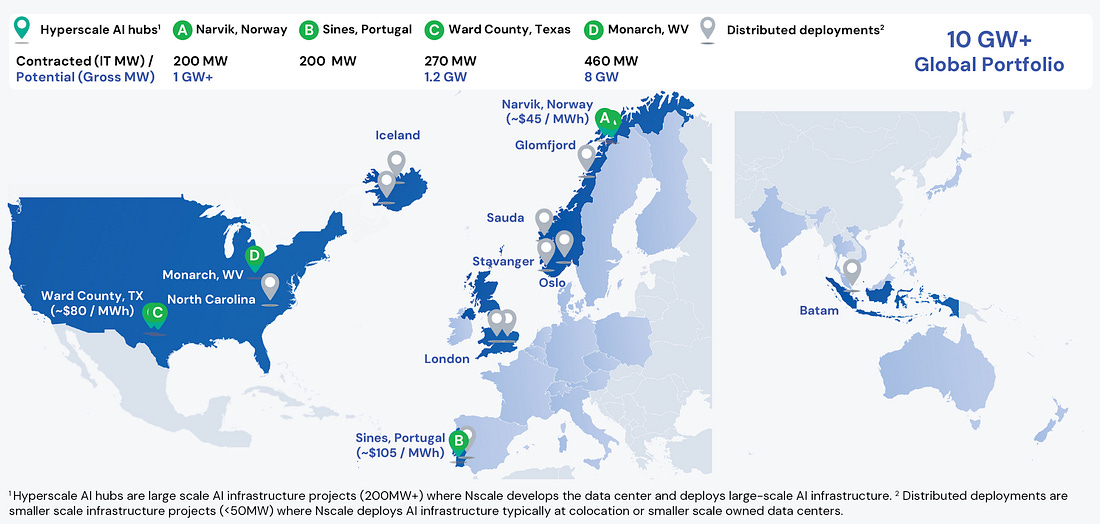
Monarch, the West Virginia campus, accounts for 8 GW, or 80%, of Nscale’s stated 10 GW development pipeline.
Monarch is a greenfield development, meaning Nscale must build the campus infrastructure from scratch rather than expand an operating data center. Power generation, data center construction, permitting, and interconnections are still in progress. The site covers 2,250 acres and is said to be one of the first state-certified AI micro-grid\* in the US. Nscale picked up the site in March 2026 when it acquired AIPCorp.
The first phase targets 2 GW gross by H1 2028, with the full campus scaling to 8 GW gross by 2031. The campus will generate electricity on site using behind-the-meter natural gas micro-grids. The Caterpillar equipment (Cat G3516 Fast Response, used for electricity generation) is expected to be delivered between September 2026 and August 2027.
Monarch sits near the Marcellus and Utica formations, the region that produces about 30% of US natural gas. Nscale plans to connect the campus to a high-pressure gas pipeline and generate electricity on site, reducing its dependence on the regional power grid.

Source
Here’s how the gas gets turned into electricity:
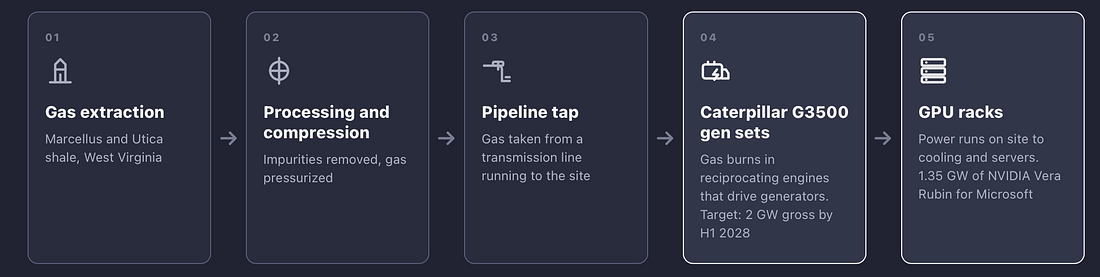
By 2028, competitors like CRWV and NBIS will have off-grid capacity online. Nebius targets 328 MW as Phase 1 (using BE ’s solid oxide fuel cells). CoreWeave didn’t disclose its off-grid capacity forecasts but said it’ll be “a part of their capacity buildout”.
Caterpillar gensets vs Bloom fuel cells at 5 MW:

Source: Asymmetrical Bets, based on an April 2026 combined heat and power comparison prepared by [Scott Tomsu (CHP-COMP-001 Rev
- 0).
Illustrative only: Nscale hasn’t disclosed which Caterpillar G3500 genset model it’s buying, whether Monarch uses heat-driven cooling, or what it’s paying.

\*MMBtu (one million British thermal units) is the unit natural gas is priced in, and worth about 293 kWh of raw energy. At $4 per MMBtu the gas costs roughly $14 per MWh before anything converts it.
Over twenty years the two options land within $1M of each other: $49.1M for the Caterpillar gensets and $48.1M for Bloom. The latter saves $734k a year on fuel and maintenance, which repays its $13.6M of extra capital. That only works if capital is free. If we apply a 10% discount rate, those savings are worth $6.2M instead of $14.7M, and the Caterpillar engine wins by $7.3M.
On-site generation could reduce Nscale’s initial dependence on the grid, but its effect on margins will depend on fuel prices, utilization, maintenance, financing, permitting, and the final cost of the generating equipment.
Monarch isn’t expected to begin operating until 2028, so any cost advantage remains unproven.
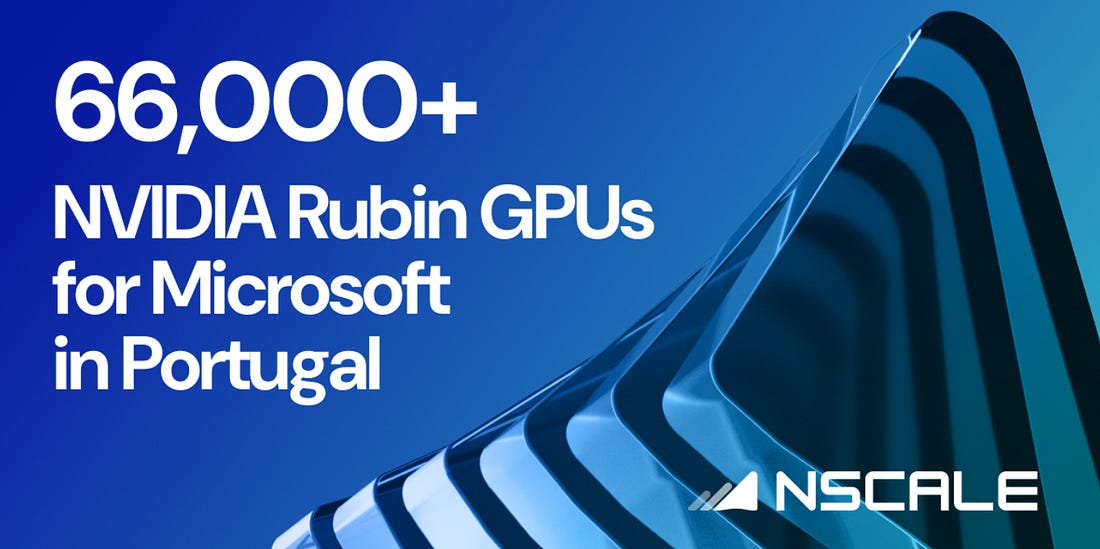
Aside from Monarch, the company is building out its Portugal Site called “SIN02”,with 200 MW of power capacity. The site needs to bring online 66,000+ Vera Rubin GPUs by late 2027, all under the Microsoft contract.
\*Micro-grid: a self-contained power system that generates and distributes power within a single campus
[4] Active-Capacity Economics and Financials
Nscale says electricity at its European sites costs about 70% less than in major US power markets. The company inherited part of this footprint from Arkon Energy, which located bitcoin mining operations near inexpensive hydroelectric power. Back in 2022, the founder noticed that hydropower in Norway cost ~$0.03/KWh vs the European average of $0.20/KWh, and decided to build energy-intensive infrastructure there.
The company’s financials:
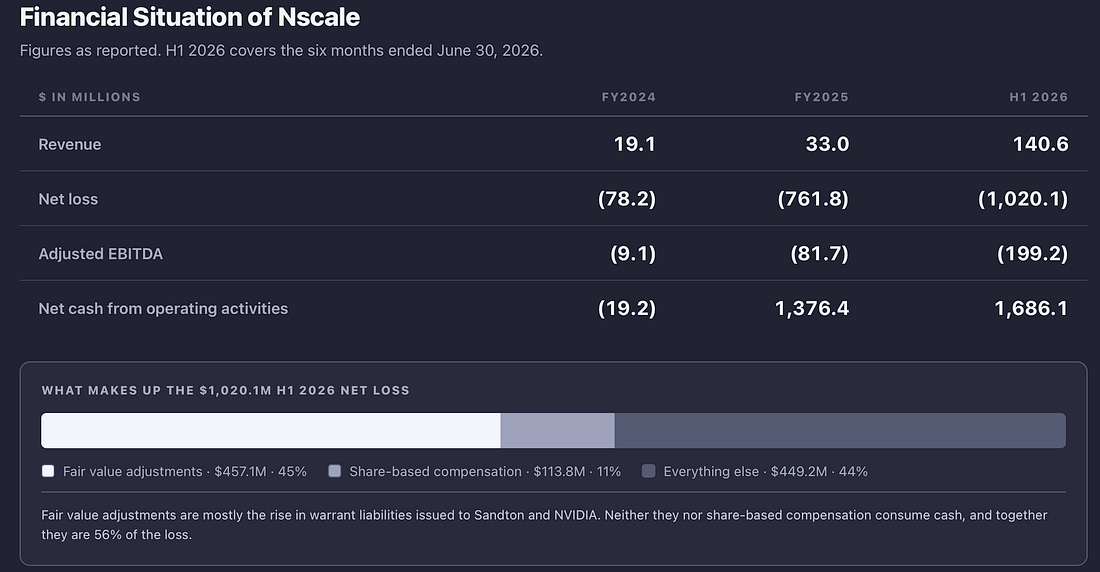
As of August 31, 2026, the TCV (total contract value) sits at $103.4B, with a 5.7-year weighted average contract life. H1 2026 revenue came in at $140.6M, up from $10.4M in H1 2025.
The company is still unprofitable, though: H1 2026 net loss came in at $1.02B.
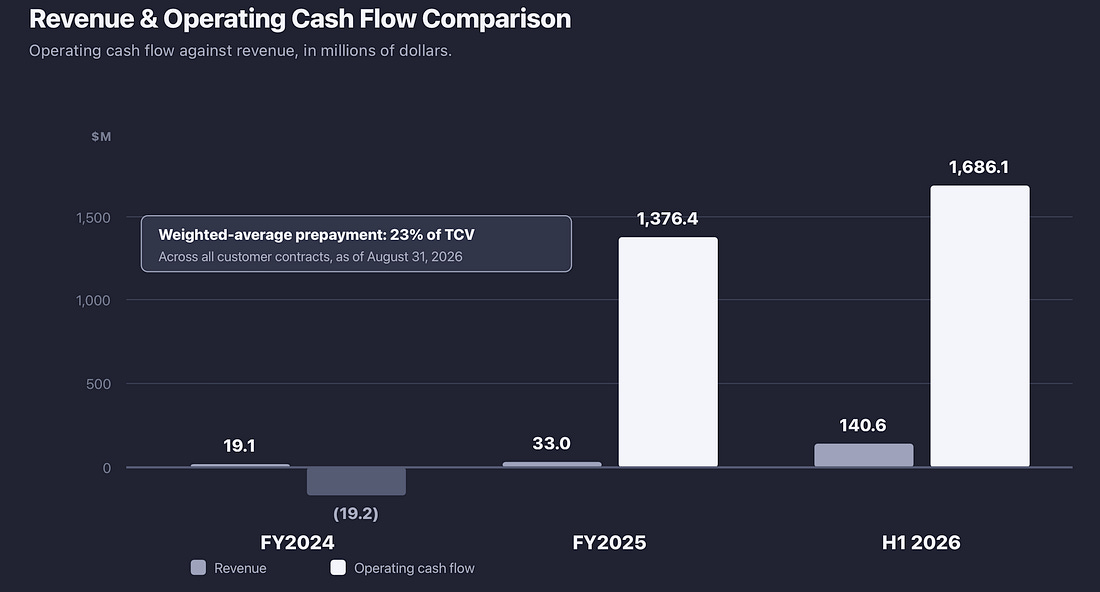
Customer prepayments account for much of Nscale’s operating cash inflow. On average customers prepay about 23% of their TCV upfront. These prepayments provide Nscale with cash before the related capacity begins generating revenue. They fund part of the buildout but don’t prove the projects will be profitable.
Power pricing is another thing to look at because it directly affects how much short- and long-term opportunity there is for Nscale. Based on recent reports, NBIS has its core deals at $20-25M/MW, with short-term capacity priced at $40-50M/MW. IREN disclosed that its recent contracts are priced slightly above $20M/MW, similar range to $NBIS.
Nscale doesn’t disclose revenue per MW or site-level margins. Lower electricity costs may support margins at its European sites, but the disclosures aren’t enough to quantify the benefit.
[5] Customers & Partnerships
The company says it’s trusted by OpenAI, Anthropic, $NVDA , MSFT , DELL , NVDA , META , Figure AI, GOOG , NOK , and more (per its website).
However, only two customers account for most of Nscale’s TCV. Microsoft signed contracts worth up to $43.8B, running from September 2025 to December 2033. Microsoft accounted for slightly more than half of Nscale’s revenue in the first half of 2026. Its contracted deployments at the SIN02 site also make it an important source of near-term growth. Anthropic is the largest customer by contract value, with deals worth up to $44.6B across four separate agreements, all to be deployed at Monarch.
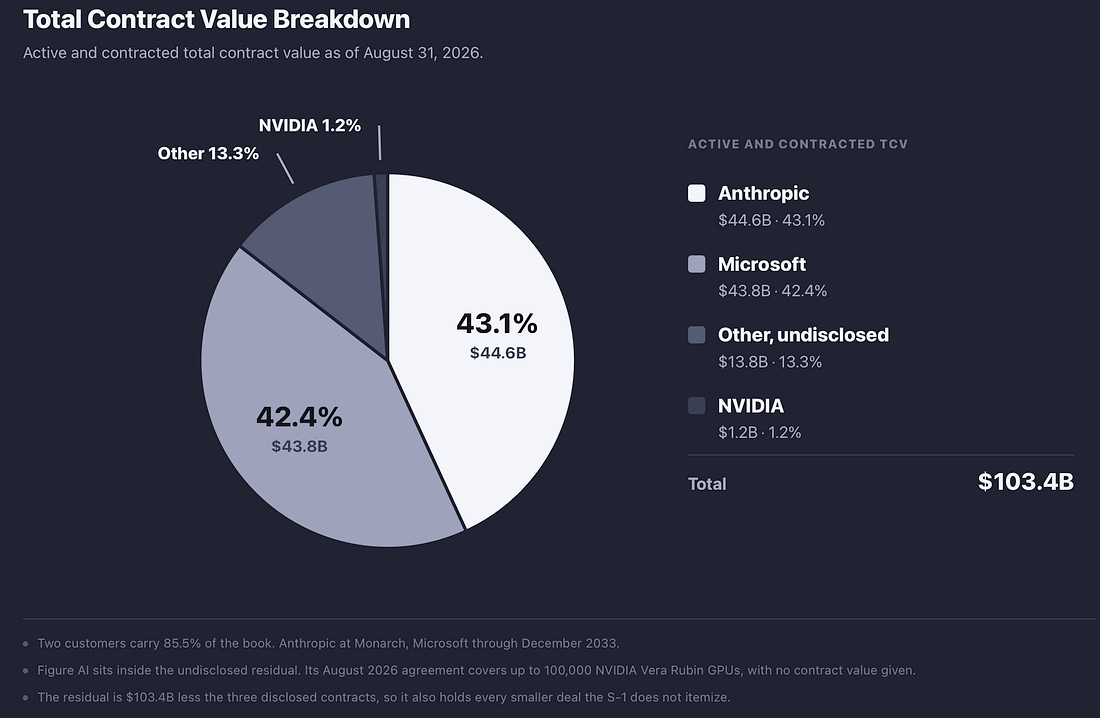
Figure AI has made an initial commitment valued at $3.5B for capacity supporting up to 100,000 Vera Rubin GPUs. The agreement could expand to $6B. Deployments start in H2 2027, and as part of the deal, Nscale is taking an equity stake in Figure AI. The size of the stake wasn’t disclosed.
[6] NVIDIA Relationship and the Supply Chain
NVIDIA has several relationships with Nscale: it supplies GPUs, buys cloud capacity, holds an investment and backs certain financing arrangements.
The supplier side is clear since NVIDIA’s GPUs are deployed across Nscale’s entire infrastructure. NVIDIA is a customer through a $1.2B master services agreement (MSA) for cloud compute across Nscale’s European sites. It invested in the Series B, Series C and the $3.1B pre-IPO convertible round, and it’s the guarantor backing $860M lease for the site in Ward County, Texas.

Nscale purchases GPUs through three resellers that account for 53%, 37%, and 10% of its purchases, respectively. Dell Financial Services provides $2.54B in equipment lease financing for NVIDIA chips (spread across 40 payments).
[7] Software Strategy and the Anyscale Acquisition
Nscale’s monitoring software tracks the condition and availability of GPUs across its fleet. When a GPU fails, the software detects the failure, isolates the node, and moves the workload to a healthy one. Workloads keep running while a technician replaces the failed node. This automation is designed to help Nscale meet the availability requirements in its customer contracts.
What makes Nscale even more interesting is the Anyscale acquisition in July 2026.
Nscale agreed to buy Anyscale for $1.65B, funded entirely with equity, which suggests that Anyscale’s executives and owners believe in Nscale’s long-term upside. Anyscale was built by the creators of Ray, an open-source framework with over 740M cumulative downloads that lets developers distribute AI workloads automatically. The deal brought around 200 specialized employees to the firm.
The acquisition gives Nscale an established software team and the technology behind Ray. The deal’s commercial value will depend on customer adoption and successful integration with Nscale’s infrastructure.
Nscale Cloud includes NKS (orchestration), Managed Slurm (training and batch) and serverless inference (serving). The company also offers fine-tuning pipelines (for anyone who wants to customize open-source models on their own data), and a model library with pre-loaded open-weight models ready to deploy.
[8] Ownership and Management
Even though the exact ownership percentages aren’t disclosed in the S-1, we know the biggest shareholders and how they’re tied to the company. The largest shareholder is Aker ASA with a roughly 27% equity stake, acquired through Series B, Series C and assets contributed from the Norwegian joint venture. Aker’s CEO also sits on Nscale’s board.
Founder and CEO Josh Payne holds his shares directly and through his family trust. He also has a ~$750M IPO Award tied to the stock price performance and MW deployment milestones through 2032.
Payne’s experience is relevant because Nscale is attempting a much larger infrastructure buildout than he has previously managed. Payne is 32 years old, never went to university, and started out working in coal mines in Australia. In 2022, after he discovered cheap hydropower in Norway, he decided to build Arkon Energy (a bitcoin mining company) around it and spun out Nscale two years later. The draft prospectus doesn’t indicate whether Payne plans to sell shares in the offering.
The other notable investors are Sandton Capital and NVIDIA. Sandton holds roughly 22M shares, and NVIDIA invested through Series B, Series C, and the $3.1B pre-IPO convertible round (converting into non-voting shares after listing).

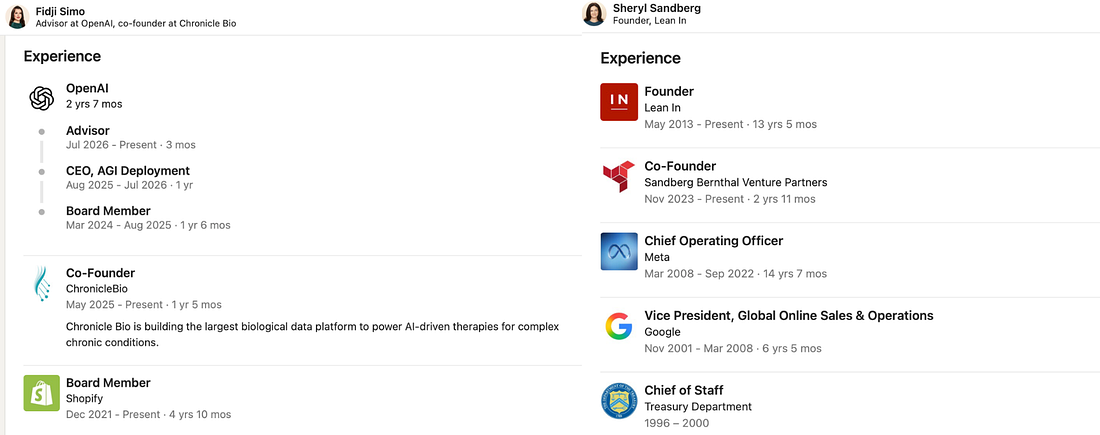
In 2026 alone, Nscale added directors with C-suite experience at hyperscalers and frontier AI labs. The names that stand out are Sheryl Sandberg (ex-Meta COO) and Fidji Simo (ex-OpenAI CEO of AGI deployment).
The people actually running the buildout include Sam Huckaby (ex-SVP of Data Center Infrastructure at Oracle) and Nidhi Chappell (ex-VP of AI at Microsoft). The company acquired Future-Tech in December 2025, which brought data center design and build expertise in-house.

[9] Valuation Framework
Any comparison must separate operating capacity from contracted projects and potential development capacity.
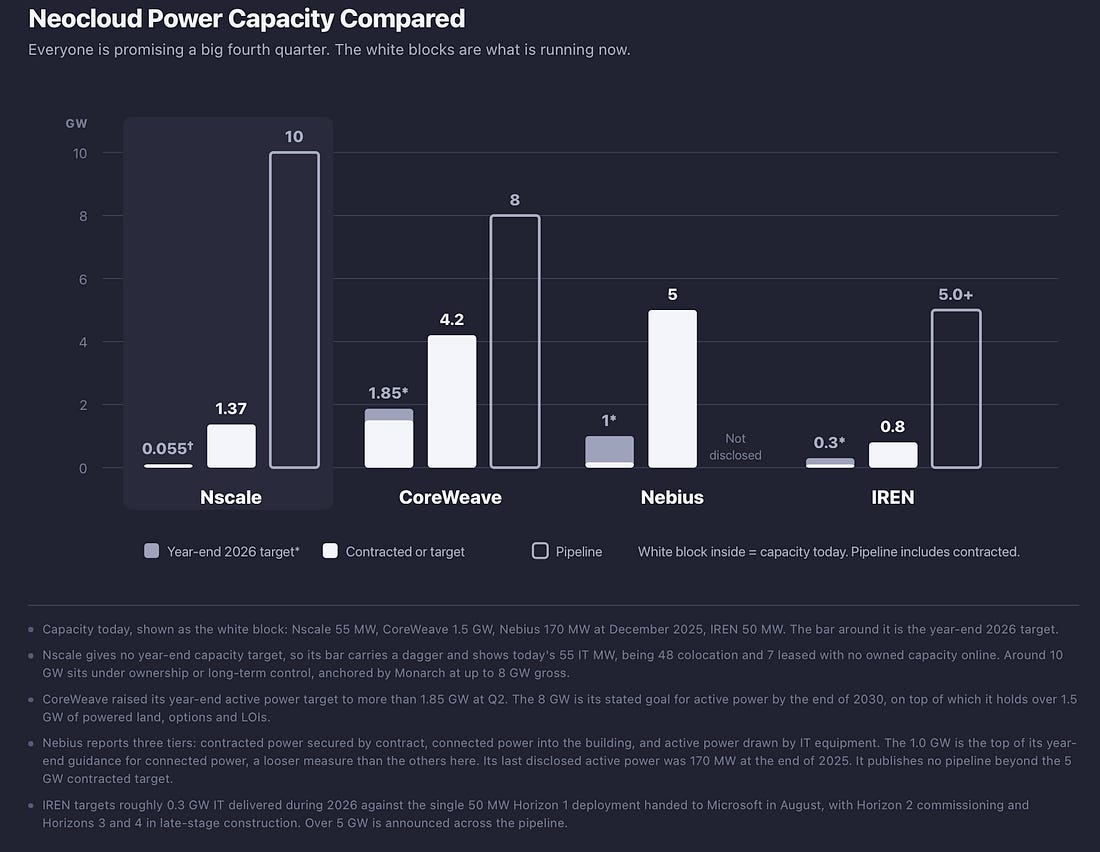
Nscale’s active footprint is the smallest among the neoclouds we cover right now, but the comparison shifts in 2028. Monarch campus alone targets 2 GW gross by H1 2028, and 8 GW gross by 2031. For comparison CRWV is targeting 8 GW across its entire portfolio by 2030. Nscale aims for similar power on one site, in a similar timeframe.
The gap between the bars is important because it shows how much of each company’s valuation is backed by assets that already generate revenue. With that in mind, here’s where Nscale sits across other neoclouds:

At a $30B equity value, Nscale’s enterprise value comes to about $28.7B, or $21B per contracted GW, which is similar to both IREN ($25B/cGW) and CRWV ($23B/cGW) valuation, and well above Nebius ($14B/cGW). On EV/Active GW basis, Nscale looks disproportionately expensive because only 55 MW is live.
Nscale hasn’t announced an IPO price or final share count. The $30B figure reported by Reuters is therefore a scenario rather than a confirmed valuation.
[10] Risks
Before putting money into any company, an investor should understand the risks best of all. Nscale is a neocloud with a backlog that needs enormous capex, so there are plenty.
Execution Risk
Nscale runs 55 MW and 25,000 GPUs today. The active and contracted totals are 1.37 GW and 461,000 GPUs, and Monarch's first phase is due by H1 2028. Nscale hasn't operated an owned site yet, so investors have little evidence that it can complete and manage this expansion on schedule. That's the biggest risk with this company.
Revenue Concentration
Although short-term revenue concentration is declining (from 93% in 2024 to 52% in H1 2026), the TCV is still dominated by two companies: Anthropic and Microsoft. They account for around 85% of the $103B backlog, so delaying either contract would hurt the company.
Buildout Funding
The S-1 states that Nscale “hasn’t obtained binding commitments for any of the financings required” for the Anthropic buildout at Monarch. Nscale has around $1.5B in cash and cash equivalents, which isn’t sufficient to fund the Monarch site on its own, let alone the whole buildout. As of June 30, 2026, Nscale had $24B of commitments to purchase technology equipment not yet delivered, and $3.5B of data center build commitments. A delay in securing financing could postpone construction and prevent Nscale from meeting customer deployment dates.
Monarch Permitting
This month, the company received state high-impact data center certification under HB 2014, and Governor Morrisey has been supportive of the buildout, saying, “This is how West Virginia can engage in responsible development while protecting our communities, our natural resources and our ratepayers.” Then there’s the air-quality permit application with West Virginia’s Department of Environmental Protection (DEP), which was filed in April and still hasn’t received a decision. A may 2026 DEP inspection also found dust violations at the construction site. The construction schedule remains exposed to permitting delays, including the pending air-quality decision.
West Virginia Policies
Though West Virginia is a pro-data-center state, locals have been pushing to slowdown the Monarch buildout. In March 2026, Mason County residents organized a protest that drew more than 60 people, and over 900 people submitted comments opposing this project. Democrats are also pushing to restore local control and water protections. State politicians want more data centers in the region, but continued local opposition could lead to additional permitting conditions, litigation, or future changes in state policy.
Dilution
Expect plenty of it. The pre-IPO convertible round, the equity-funded Anyscale acquisition, warrants held by NVDA and Sandton, and Monarch’s financing needs all point to meaningful share count growth over the next two or three years.
Financial Reporting Problems
The S-1 discloses weaknesses in internal controls over financial reporting. The company lacks sufficient business process controls and accounting personnel. Even though remediation is planned through FY26 and FY27, there’s an elevated risk of financial restatements or even delayed filings.
IPO Pricing
The company has a long road ahead, and that’s one of the biggest risks. If expectations run too high, the $30B+ valuation might be too rich for a company with 55 MW of active capacity. Though its pipeline is larger than that of most neoclouds we cover, those are 2028 to 2030 targets. An IPO valuation that assumes Monarch arrives on schedule would leave investors exposed to construction or financing delays.
[11] Final Thoughts
Nscale has seven owned sites and a 10 GW pipeline, which if delivered on time would make it the largest neocloud in the world by power capacity. The partnerships run deep, and the board draws from OpenAI, Oracle, Meta, Snowflake, and even Berkshire Hathaway.
But the company hasn’t proven it can execute at scale yet. Nscale’s current operating footprint remains small relative to its plans. Monarch will test whether the company can finance, construct, and operate infrastructure at a much larger scale.
If the permits come through and financing commitments get locked in, we can start looking for entries based on where the stock is trading. Nscale could become a meaningful neocloud provider if it delivers the contracted portfolio. Whether the IPO is attractive will depend on the final valuation, diluted share count, financing terms, and progress at Monarch.
We’ll run the full valuation once the IPO price is announced. We’ll post it on our discord, so make sure to join:
Our Discord Link is HERE.