2026.09.27 | Substack | AMZN | Agents vs Sponsored Ads
原标题:Amazon (AMZN) and Agentic AI: do agents actually click on sponsored adds?
I needed to oil my seven-foot tiki statue. Somehow, this turned into a study of AMZN’s Ads business. I asked GPT to find the right oil, brushes and supplies, and specifically told it to use Amazon and add everything to my cart because I love my same-day/two-day delivery.
That’s the tension here: I was happy to outsource product discovery and selection to an agent, but I still wanted Amazon’s convenience and fulfillment. Amazon could keep the transaction, but would it still get the ad click?
Given all the recent focus on agents and AMZN’s Ads business, we decided to test exactly that. Because Muse isn’t currently available on Amazon, we used ChatGPT’s browser control to run 60 shopping tasks directly on Amazon.com, tracking whether its first product click went to a sponsored listing or an organic result. To our knowledge, this is the first published live test of its kind.
The answer:
No.
We gave ChatGPT’s shopping agent (browser control) 60 everyday shopping jobs on Amazon.com. In the 58 where results loaded, its first click went to an organic listing every time.
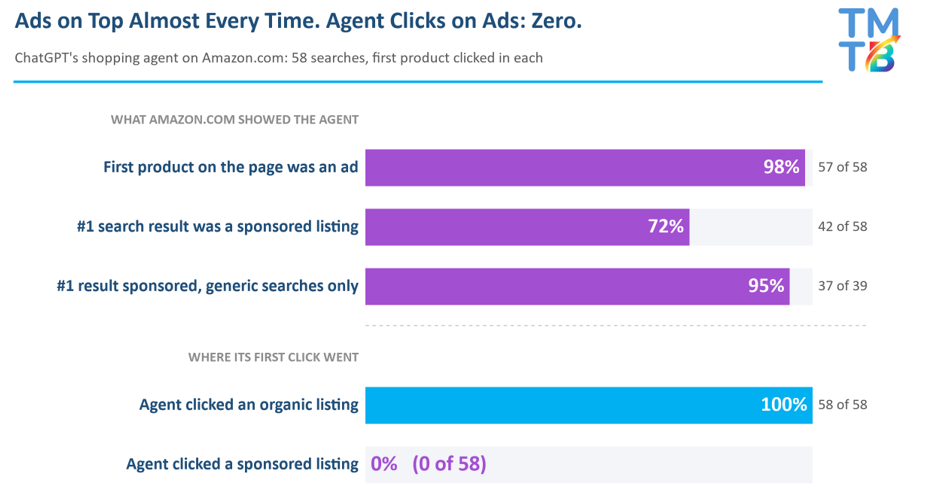
An ad was the first product on the page in 57 of 58 searches, and at least 140 sponsored listings sat above the agent’s picks. On generic “find me X under $Y” searches, the core of Sponsored Products, an ad held the #1 slot 95% of the time. The agent’s first click went to none of them.
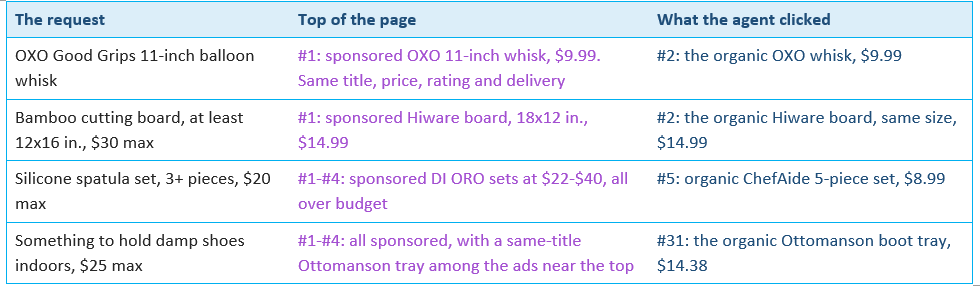
The typical generic search opened with four sponsored listings in a row (25 of 39), and the agent’s median pick was the 5th result. In 31 of the 54 searches with a complete record it took the first organic listing on the page, and in 41 the first or second. Once it went all the way down to result #31 for the organic listing it wanted.

In its explanations, the agent consistently cited fit, budget and reviews; paid placement never appeared to influence the choice. None of its 58 explanations mentioned placement. In two of the cases below, the ad and the organic listing looked identical (same title, same price), and the agent still took the organic one. Same sale for AMZN, minus the ad fee.
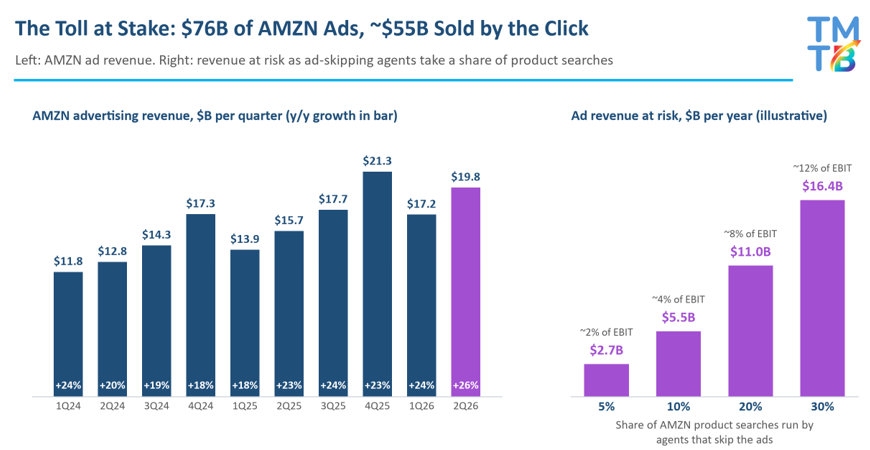
The tension that started this whole experiment is obvious: I was happy to outsource product discovery and selection to an agent, but I still wanted AMZN’s convenience and fulfillment. It’ll be interesting to see how those competing forces play out and how Amazon adapts.
Disclaimer:
This newsletter is published for informational and educational purposes only. Nothing here is individualized investment advice, a recommendation tailored to any person’s circumstances, an offer, or a solicitation to buy or sell any security or financial instrument. This newsletter is not an investment advisory service, and no advisory or fiduciary relationship is created between me and any reader.
I actively trade the securities discussed here, often short-term. My positioning may be inconsistent with the views expressed, and I may buy or sell — including immediately before or after publication — without notice or updates. Price targets, upside/downside scenarios and time frames are illustrative opinions, not commitments to hold.
This publication is for the subscriber’s personal use only and may not be redistributed, republished, forwarded, or quoted without prior written permission.
Copyright © 2026 TMT Breakout. All rights reserved.
Full disclosures here