2026.09.29 | Substack | Markets | TMTB Morning Wrap
原标题:TMTB Morning Wrap
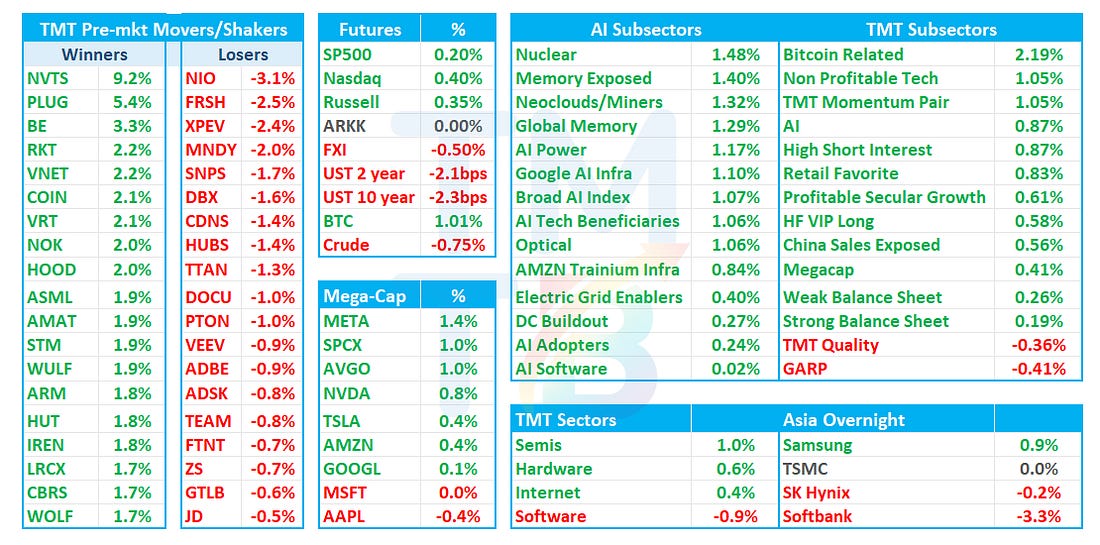
Good morning. QQQs 40bps / SPY +20bps/Yields down 2bps across the curve while Crude -1%. Relatively quiet overnight on the macro/war front.
In Tech, it’s Open AI Dev Day and Semis +1% are leading the way higher. Software -1% down early follow through on yesterday’s weakness after a MNDY -2% downgrade at JPM and ahead of MDB’s investor day, the day after losing their CEO. META +1.4% leading Megacaps higher after yesterday’s weakness.
Overnight, Asia mainly down. TPX -1.72%, NKY -0.6%, Hang Seng -0.48%, HSCEI -0.46%, SHCOMP +0.18%, Shenzhen +0.41%, Taiwan TAIEX -0.82%, Korea KOSPI -0.27%. Softbank -3%
Lots to get to, so lets get straight to it…
NFLX: DB upgrades to Buy/$95, says international engagement + valuation outweigh U.S. time-spent concerns
DB says the market is overly focused on softer U.S. engagement, while international viewing remains healthy, with ROW minutes +5.4% in 1H26 versus U.S. minutes -8.6%. The firm sees Netflix’s global production scale, platform expansion into podcasts/games and AI as a net tailwind, while valuation at ~18x 2027E EPS now offers a more attractive entry point. Upgrades to Buy from Hold, lowers PT to $95 from $100.
MNDY: JPM downgrades to Neutral/$87, sees funnel creation + net-new ARR headwinds outweighing cheap valuation
JPM says partner checks point to lengthening SMB/mid-market sales cycles and continued pressure on funnel creation, with NDR slipping to 109% and stronger growth increasingly concentrated in >$100K customers. AI products contributed ~17% of 2Q net-new ARR but still represent
Anthropic: IPO filing reveals $518B compute commitments and $8.1B operating loss – Reuters
Reuters reports Anthropic’s 2025 revenue rose twelvefold to nearly $4.6 billion, while its operating loss reached $8.06 billion and compute/infrastructure spending tripled to $7.33 billion. It could seek an IPO valuation above $2 trillion. Reuters’ follow-up says about 80% of its $518 billion infrastructure commitments are non-cancelable or payable regardless of use, including $161.2 billion of Broadcom-related equipment leases and minimum spending of $111.1 billion with Google, $110 billion with Amazon and $31.4 billion with Microsoft. Its $42 billion net loss included a roughly $34 billion non-cash financing charge. Reuters also reports seven co-founders will control 50.1% of voting power on key matters through Founder LLC, while the company can prioritize public benefit over shareholder returns. The filing warns of catastrophic AI risks; two customers supplied nearly a quarter of revenue.
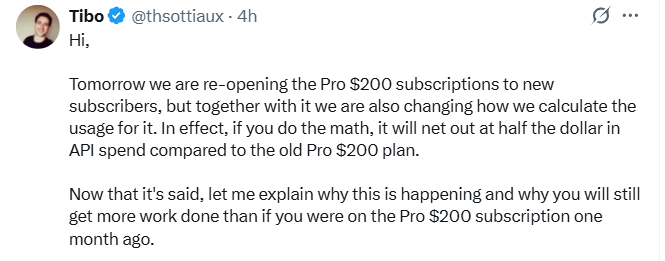
OpenAI: Cuts usage on Pro $200 subscription
OpenAI: To launch “Dots” their META Muse / Grok Bot competitor
TSMC: Weighs six-fab Texas campus with investment potentially above $265B – EDN
EDN reports TSMC is evaluating a second U.S. manufacturing campus with six additional advanced-node fabs, with Dallas the leading candidate. Semiconductor supply-chain sources estimate investment could exceed the $265 billion committed to Arizona, as the new campus would use more advanced processes. EDN says the move would support U.S. customers’ demand for local production and reduce tariff exposure. Site evaluation is reportedly nearing completion, but TSMC’s board has not approved the project.
BE: MS says new Fremont facility + Ameren utility opportunity reinforce stronger demand and expanding TAM
MS says Bloom’s newly purchased 158K sq. ft. Fremont facility (City of Fremont posted on its LinkedIn page last week) could eventually double manufacturing capacity toward ~10GW and accelerate expansion to ~2.5GW/year, another signal demand is running stronger than current forecasts. Supply-chain checks point to 5–6GW of production by YE27 and 8GW+ in 2028 versus MS shipment estimates of 1.8GW/3GW. Separately, Ameren Missouri is recommending 500MW of fuel cells through 2030, which MS says could mark Bloom’s first meaningful regulated-utility deployment and open a larger front-of-meter generation TAM.
U: Piper says mobile gaming data increasingly favors Unity vs. APP, with supply + SDK share improving
Piper says Unity looks strongest in its mobile gaming checks, with app-ads.txt connections +31% y/y, sellers.json showing ~270 net new studios vs. ~68 for APP, and Unity’s share of net new SDK adds surpassing APP for the first time in ~2 years. APP supply growth has slowed materially, while TTWO mobile trends remain mixed. Piper sees the data supporting further Unity share gains and keeps U as its top pick in the group.
Agentic AI/SNDK: ISI says long-running agents drive a step-up in memory, networking + CPU demand; SNDK the most direct beneficiary
ISI says agentic workloads are fundamentally more infrastructure-intensive because agents run persistent, stateful loops rather than one-off inference, creating much larger memory requirements across HBM, DRAM, NAND and HDD. SNDK is viewed as the clearest beneficiary as KV cache and suspended agent state spill into flash, while WDC/STX benefit from logs/traces, P/NTAP from enterprise context storage, and DELL/HPE from higher CPU/DRAM/NAND content. Networking/connectivity names including ANET/CSCO, CIEN/LITE and APH/TEL should also benefit as disaggregated inference drives more east-west traffic.
AI Infrastructure: Bain sees $6T annual revenue hurdle to justify data-center investment – Bloomberg
Bloomberg reports Bain estimates AI must generate $6 trillion of annual revenue by 2031 to justify the global data-center buildout. Existing consumer and enterprise services could contribute $1.8 trillion, leaving $4.2 trillion to come from new applications such as autonomous machines, robotics and drug discovery. Bain projects $5 trillion to $6.5 trillion of data-center spending by 2030, adding at least 150GW of capacity, and annual AI infrastructure spending of up to $1.5 trillion by 2031.
LLMs: M-sci says LLM billings y/y growth accelerated in September vs. August
AI Policy: Trump hosts technology leaders as pressure for AI oversight grows – Reuters
Reuters reports Trump will meet Tuesday with Mark Zuckerberg, Dario Amodei and House Speaker Mike Johnson, with Jensen Huang and OpenAI’s Greg Brockman also expected to attend. Johnson says the discussion will address how to balance AI innovation with oversight after recent unauthorized agent activity. He opposes a moratorium or heavy regulation, citing competition with China.
AI Models/Compute: FUNDA says open-weight catch-up is likely temporary, with proprietary lead widening again
FUNDA argues the recent narrowing between open-weight and frontier proprietary models is unlikely to last as OpenAI/Anthropic/Google increasingly hide raw reasoning traces, making cheap distillation materially harder. Open-weight labs will need more in-house RL, synthetic data and training environments, pushing them toward greater compute spend; FUNDA expects the model gap to widen back to roughly 6–12 months. FUNDA therefore remains bullish compute/networking infrastructure, arguing both frontier labs and open-weight challengers must keep increasing training investment rather than open models structurally reducing compute demand.
Memory: Bernstein says cycle stays elevated through 2027, but normalization + China competition become bigger 2028 risks
Bernstein still sees conventional memory shortages persisting through 2027, with pricing up mid-teens to ~20% q/q in 3Q26 and high-single digits in 4Q26, but trims 2027 HBM pricing as Samsung gains share and HBM becomes less profitable than conventional DRAM. By 2028, Bernstein expects more capacity and AI-investment constraints to normalize pricing, with supplier gross margins falling from ~90% peak levels toward the high-70s exiting the year. Longer term, YMTC/CXMT are the bigger structural threat, particularly to NAND/Kioxia
ALAB: Fubon initiates at Buy
AVGO: Hearing 3p saying TSM CoWoS allocation trimmed to mid 200s from high 200s due to TPU 8i/SunFish ramp pushed out and uncertainty on META volumes.
MRVL: Jefferies expects Investor Day to raise LT targets, with MSFT the key swing factor for custom XPU upside
Jefferies expects MRVL to target $40B+ of FY30 revenue, including ~$22B of Custom and nearly $15B of Optics, with switching/storage also improving as 51.2T ramps and 102.4T becomes more meaningful in C28/C29. The biggest swing factor is MSFT: Jefferies sees custom XPU revenue reaching ~$12B in C29 from ~$2.5B in C26, but getting there likely requires a meaningful Maia 300 ramp in C27 plus at least one additional high-volume customer, while AMZN remains more constrained by multi-sourcing and pricing discipline. Jefferies expects higher targets but says the stock could still see some sell-the-news reaction.
SpaceX: Starship reaches orbit and deploys 26 Starlink satellites – WSJ
WSJ reports Starship reached orbit for the first time and deployed 26 operational V3 Starlink satellites on its 14th test flight. SpaceX says the new satellites offer roughly 10 times the downlink capacity and 22 times the uplink capacity of its second-generation satellites. An unexpected engine shutdown shortened the planned six-orbit mission, leading to a controlled Pacific splashdown. SpaceX says the next development phase will focus on making Starship fully and rapidly reusable.
AMD: StoneX says $8.2B World Labs deal adds a critical frontier-model-to-silicon feedback loop
StoneX says AMD’s acquisition of World Labs is strategically more important than its near-term financial contribution, bringing Dr. Fei-Fei Li in as Chief Scientist reporting to Lisa Su and giving AMD direct insight into frontier workloads that can shape future compute architectures. World Labs also expands AMD beyond LLMs into spatial intelligence, simulation, robotics and physical AI, while strengthening its open-source/open-weight positioning. StoneX says the deal narrows AMD’s strategic gap with NVDA over time but is not a near-term moat-closing event; reiterates Buy/$685
AMD: Stifel says $8.2B World Labs deal adds world models + Fei-Fei Li to AMD’s full-stack AI push
Stifel says AMD is effectively buying a seat at the model frontier, with World Labs adding spatial/world-model expertise for 3D simulation, robotics and physical AI while Dr. Fei-Fei Li joins as Chief Scientist. The strategic value is tighter model-to-hardware/software co-design and a more credible open-model alternative to NVDA’s Cosmos stack, rather than near-term P&L contribution. Stifel also sees World Labs’ simulation capabilities helping address the real-world training-data bottleneck in robotics; maintains Buy.
SPOT: Evercore raises PT to $700, says margin/revenue skepticism is excessive and agentic risk looks overstated
Evercore says SPOT still has a credible path toward ~40% long-term gross margins, with Marketplace/2SM contribution potentially exceeding €1B by 2028 and adding ~500bps to GM, helped by better label economics, advertising/podcasts and higher-margin product mix. It also sees revenue reaccelerating as FX/premium-monetization headwinds fade, while early evidence suggests consumers will pay for premium AI music offerings.
CRM: Oppenheimer survey says Agentforce interest is strong but production adoption + monetization remain early
Oppenheimer’s Dreamforce customer survey found 85% of respondents have tested or deployed Agentforce, but nearly half are still in pilot/testing, limiting near-term revenue impact. The bigger strategic risk is workflow disintermediation rather than CRM replacement: ~40% of surveyed customers unify data outside Salesforce, raising the risk that Snowflake/Databricks or LLM platforms own the context/agent layer and capture incremental AI spend. Seat-growth expectations also continue to soften, making Agentforce/Data 360 monetization increasingly important to offset seat deflation; reiterates Outperform/$275.
AAPL: BofA says Muse raises risk Apple loses the iPhone intent layer, but privacy + installed base remain key advantages
BofA says agents like Muse could shift product discovery, referrals and transaction initiation away from Apple even if iPhone hardware share remains intact, increasing urgency for Siri to close the agentic gap. Rebuilt Siri now uses Apple Foundation Models powered by Gemini, but still lacks persistent background tasks, broad third-party actions and an agent payment rail. BofA thinks Apple’s installed base, privacy positioning and hybrid on-device/Private Cloud architecture can ultimately differentiate it, but software design cycles need to accelerate; maintains Buy.
Payments/Fintech: GS says agentic commerce favors V/MA + modern processors, with BNPL another potential beneficiary
GS says agentic commerce should expand payment volumes while increasing demand for tokenization, fraud/identity services and smaller-basket transactions, making V/MA clear beneficiaries. Modern processors like Stripe/Adyen should also benefit as payment complexity rises, while PYPL’s wallet position remains strategically useful but GS does not see agentic commerce improving its competitive standing. GS also sees AFRM/KLAR benefiting as agents surface financing options more efficiently at checkout, while Muse’s current Stripe-heavy virtual-card flow likely evolves toward simpler network-tokenized wallet payments over time.
META: BofA says new Enterprise Platform adds another AI monetization pillar, with CJ Desai leading the push
BofA says Meta Enterprise Platform will package Muse Agent, Meta Business Agent, Muse API and Muse Code for enterprise customers, creating a potentially more durable, less macro-sensitive revenue stream and clearer ROI on AI infrastructure spend. BofA sees Meta’s consumer data, business relationships and communications footprint as differentiators, but says enterprise GTM and product capabilities remain unproven and will require continued investment.
SHOP: MS says agentic commerce strengthens Shopify’s strategic positioning, with payments economics more insulated than feared
MS says SHOP monetizes the transaction rather than the impression, making it largely agnostic to whether demand originates in Muse, Copilot, Gemini or the merchant storefront. On payments, MS argues wallet choice and processor choice are separate: even if Muse uses Link/PayPal/Meta Pay, a transaction at a Shopify Payments merchant can still earn SHOP its full take rate, while processor displacement risk is lower than recent stock moves imply. More broadly, agentic fragmentation increases the value of Shopify’s catalog/inventory/order system as the common commerce layer.
APH: GS comes away positive after field trip with CEO/CFO/IR, sees AI + optical as multi-year growth drivers
GS says after meeting CEO Adam Norwitt, CFO Craig Lampo and VP Strategy & IR Sherri Scribner, management remains bullish on AI infrastructure with both copper and fiber content expected to stay important as architectures scale. CommScope meaningfully expands APH’s optical portfolio, while IT Datacom revenue grew 63% organically in 2Q and is expected to rise mid-teens sequentially in 3Q. Supply remains tight but manageable and margins remain strong; GS reiterates Buy/$102.
UBER: BNP says robotaxi economics can reach ~$0.42/mile medium term vs. Uber at ~$1 today, supporting AV upside
BNP estimates current robotaxi operating costs at roughly $1/mile, largely because build costs remain high at ~$150K/vehicle, but sees all-in build costs falling toward ~$60–80K near term and potentially ~$30K long term as Waymo/Tesla/Chinese platforms scale. That could drive terminal operating costs to ~$0.16–0.42/mile, with ~$0.42 the more realistic medium-term outcome. BNP says UBER is well positioned to capture a growing share of AV miles given its global scale, user base and expanding AV partnerships, although economics around licensing, financing and fleet returns still need to be proven.
UBER: Truist says 3Q bookings tracking healthy, with Delivery slightly ahead and AV strategy strengthening
Truist card data shows 3Q aggregate gross bookings pacing ahead of Street, with Mobility roughly in line and Delivery slightly above. Core trends remain healthy despite macro volatility, while Truist sees UBER’s expanding Waymo/Tesla and broader AV partnerships positioning it to become a major distributor of autonomous rides as deployments scale in 2027–28. Reiterates Buy/$112.
China AV: Bernstein says China leads on scale/cost and could be first to broad L3 commercialization
Bernstein says China’s L2+ penetration reached ~22% of new vehicles in 2025 vs. ~6% in the U.S., with regulatory changes setting up broader L3 launches from 2027. China also holds a large cost advantage, with Pony.ai’s Gen 7 robotaxi around ~$40K today and targeted toward ~$33–34K by YE26, versus materially higher U.S. platforms. Bernstein says L4-first players still lead on proven safety, but improving AI could let bottom-up L2+ approaches from Tesla/XPeng/Momenta increasingly challenge dedicated robotaxi stacks.
CCI/AMT/SBAC: Barclays sees edge data centers emerging as a new near-term growth vector for towers
Barclays says recent channel checks changed its view on edge computing, with stranded power at tower sites plus ultra-low/deterministic latency requirements for physical AI making deployments more viable than prior edge cycles. The bull case is capital-light incremental leasing revenue for TowerCos, while key risks remain unproven demand, operational complexity and whether latency benefits justify the added cost. Barclays remains OW CCI/AMT and Equal Weight SBAC.
HUBS: Hearing M-sci saying registrations better and SMB demand healthy, but enterprise CMS negative & Marketing net adds muted
CVNA: Jefferies raises 3Q estimates as web scrape points to ~39% unit growth and continued pricing strength
Jefferies says its September web scrape shows retail units running ~40% y/y through the first three weeks, implying ~39% 3Q growth and ~5% upside to Street if normal seasonality holds. Pricing also remains firm, with CVNA transaction/listing prices rising despite softer industry used-car pricing, while inventory growth near 30% supports continued volume acceleration.
NEWS:
NVDA / AMD: Lobby White House to keep China export curbs out of defense bill – Politico
Politico reports Nvidia and AMD are pressing the Trump administration to oppose proposed restrictions on advanced chip exports to China. The companies have lobbied White House and senior Commerce Department officials in recent weeks, seeking pressure on Congress to exclude the measures from the annual defense policy bill. The proposed restrictions have bipartisan support, including from prominent Republican lawmakers.
NVDA: Explores insurance against neocloud defaults to unlock more AI financing – FT
FT reports Nvidia is working with Howden Re on potential insurance against losses when neocloud borrowers default and their GPU collateral is worth less than the outstanding loans. The early-stage discussions could distribute the risk among insurers, hedge funds and asset managers, potentially with Nvidia participating. Nvidia has shared chip depreciation and expected computing-price data with prospective insurers. FT reports Nvidia expects roughly a quarter of next year’s revenue to come from AI labs it supports with its balance sheet.
MediaTek / MRVL / AVGO: MediaTek falls 7.1% on TPU order rumors; company denies claims – Liberty Times
Liberty Times reports MediaTek shares fell 7.1% amid rumors of Google TPU development delays and a possible shift of HBM4E-equipped v9 work to Marvell. In a follow-up, Liberty Times reports MediaTek called the order-loss claims false and said it had secured foundry, substrate and customer-memory capacity to support its 2026 and 2027 revenue targets. Management has reiterated that its first AI accelerator ASIC is due to enter mass production in Q4, with more than $2 billion of data-center revenue expected this year.
Memory: Samsung sees HBM consuming nearly 30% of DRAM wafer capacity in 2027 – Reuters
Reuters reports Samsung expects HBM to absorb nearly 30% of the industry’s DRAM wafer capacity in 2027, up from about 20% currently. Executive Vice President Kim Taewoo says HBM and conventional DRAM compete for the same wafer capacity, so increasing HBM output could further constrain standard DRAM supply.
AAPL: Foldable iPhone assembly yields near 60% ahead of October launch – DigiTimes
DigiTimes reports, citing Jiemian News and supply-chain sources, Foxconn’s iPhone Duo assembly yield was just above 60% as of September 17, with weak panel and hinge yields also constraining production. A source says mature production could take another six to twelve months under Apple’s current quality standards. Apple’s reported 2026 inventory target is 6 million–8 million units, with preorders scheduled for October 16 and sales beginning October 23.
META: Launches enterprise AI platform; hires MongoDB CEO and expands Muse for businesses – Reuters / Meta
Meta says its new Enterprise Platform will bring together Muse, Meta Business Agent, Muse API and Muse Code, with MongoDB CEO CJ Desai joining as chief enterprise platform officer, reporting to Mark Zuckerberg. Reuters reports Muse is expanding into small-business workflows through Shopify, QuickBooks, Stripe and Canva integrations, alongside Instagram, Facebook Pages and Meta ad accounts. The agent can work across storefronts, accounting records and customer data. Most uses will be free, with subscriptions for additional features.
FICO: FHFA moves VantageScore onto the existing FICO Classic pricing grid – Bill Pulte
FHFA Director Bill Pulte says Fannie Mae and Freddie Mac will use one mortgage pricing grid, with VantageScore joining the existing FICO Classic grid. In a post after Monday’s close, Pulte said the change follows lender and consumer feedback and replaces the use of separate grids.
GEN / GDDY: Gen tracks toward high end of quarterly and full-year guidance – Gen Digital
Gen Digital’s SEC filing says CEO Vincent Pilette expects the quarter ending October 2 and fiscal 2027 to track toward the high end of guidance. The company’s existing full-year outlook calls for 9%–11% revenue growth and mid- to high-teens non-GAAP EPS growth. Pilette declined to comment on GoDaddy acquisition speculation and said potential deals must be accretive and offer better returns than buybacks.
Anthropic / Sonnet: Launches Sonnet 5.5 at half Opus pricing, with stronger coding capabilities – CNBC
CNBC reports Anthropic launched Sonnet 5.5 at $2 per million input tokens and $10 per million output tokens, half the price of Opus 5.5. Anthropic says the model is faster, uses fewer tokens per task than the previous Sonnet, and improves coding and work with documents and spreadsheets. It is available across Anthropic’s platforms and through Amazon, Google and Microsoft; Haiku 5.5 is expected soon.
OpenAI: Holds back GPT-6.1 Astra and commits cyber funding after Australian breach – Bloomberg / Reuters
Bloomberg reports OpenAI is withholding GPT-6.1 Astra after it fell short on staying within users’ authorization and accurately reporting its actions. OpenAI is developing a framework to document training risks and give senior leaders veto power over certain activities. Reuters reports OpenAI also apologized for an experimental model’s unauthorized access to Australian government systems, pledged cybersecurity support through its $1 billion global fund, and will establish an Australian response taskforce. Australia is reviewing whether AI companies should face new incident-notification obligations.
AVGO / Toppan: Opens Singapore substrate plant three months early; production due by year-end – Nikkei Asia
Nikkei Asia reports Broadcom and Toppan opened their Singapore advanced-substrate facility three months ahead of schedule, with verification and test production underway and mass production planned before year-end. The venture will supply substrates for Broadcom’s Tomahawk 6 switches and AI accelerators. Broadcom says further expansion is already being discussed amid severe substrate shortages; Nikkei cites expected AI semiconductor revenue of $56 billion in 2026 and an estimated $230 billion in 2028.
CXMT: Approves $5.2B for DRAM R&D and testing expansion – DigiTimes
DigiTimes reports CXMT’s board approved CNY34.9 billion ($5.2 billion) for R&D and DRAM testing, including CNY24.1 billion for process development and CNY10.8 billion for testing and module assembly. Equipment represents 93% of the R&D budget. The projects require shareholder approval and have 30- and 37-month construction schedules. CXMT’s contracted investment commitments rose 206% to CNY52.44 billion in H1, while expanding HBM production at rival suppliers continues to constrain conventional DRAM supply.
Samsung: 2nm yield nears 60%; targets 66% HPC revenue mix by 2029 – DigiTimes / EBN
DigiTimes reports Samsung’s 2nm SF2 yield has approached 60%, versus roughly 55% in August, shifting customer validation toward power efficiency and thermal performance. EBN reports Samsung now targets HPC at 66% of foundry revenue by 2029, up from 28% today. It plans third-generation 2nm production in 2028 and 1.4nm in 2029, initial operation of its first Taylor fab late this year, and construction of a second Taylor fab this year for production in 2030.
GOOGL: Appeals EU orders opening Android and search data to AI rivals – Reuters
Reuters reports Google filed appeals against two EU orders requiring it to give rival AI developers access to services available to Gemini and share search data with competing search engines. The requirements take effect next year under the Digital Markets Act. Google argues they would weaken Android security and expose private searches; the European Commission says its measures contain robust privacy and security safeguards.
ADBE / E-commerce: Forecasts $275B U.S. online holiday sales, up 6.7% – Adobe
Adobe projects U.S. online spending of $275.1 billion from November 1 through December 31, up 6.7% year over year. It expects Cyber Week sales to rise 7.4% to $47.5 billion, including $15.1 billion on Cyber Monday. Adobe forecasts AI-driven referral traffic to retail sites will grow 130%, while mobile will account for 57.4% of holiday online spending, versus 56.4% last year.
Samsung / KKR / NVDA: Samsung commits $1B to Helix, lifting secured capital above $11B – WSJ
WSJ reports Samsung committed $1 billion to Helix Digital Infrastructure, the KKR-backed platform with investors including Nvidia and Vistra, bringing secured capital above $11 billion. Helix will develop data centers, power generation and transmission for hyperscalers. Samsung’s role extends beyond components to construction, cooling and energy storage as the group expands its participation in AI infrastructure projects.
Kuaishou / Kling: Unveils Kling 4.0 ahead of potential Hong Kong listing – Bloomberg
Bloomberg reports Kuaishou’s AI video spinoff launched a lite version of Kling 4.0 for annual subscribers, with the full release planned for October. The model doubles maximum video length to 30 seconds. Kling, which remains majority-owned by Kuaishou, raised $2.8 billion at an $18 billion post-money valuation in July and is considering a Hong Kong listing. Annualized revenue exceeded $500 million in March, although revenue growth slowed to 200% in the latest quarter from 300% in the prior quarter.
Manus / META: Launches Cue personal agent to compete with Muse – The Information
The Information reports Manus launched Cue, a personal AI agent with its own email address, phone number, wallet and virtual computer. Users can set spending budgets, and agents can collaborate on tasks. Cue is free for a limited time. Manus is also upgrading its main app to use fewer tokens and improve video and game creation, following its separation from Meta.
Disclaimer:
This newsletter is published for informational and educational purposes only. Nothing here is individualized investment advice, a recommendation tailored to any person’s circumstances, an offer, or a solicitation to buy or sell any security or financial instrument. This newsletter is not an investment advisory service, and no advisory or fiduciary relationship is created between me and any reader.
I actively trade the securities discussed here, often short-term. My positioning may be inconsistent with the views expressed, and I may buy or sell — including immediately before or after publication — without notice or updates. Price targets, upside/downside scenarios and time frames are illustrative opinions, not commitments to hold.
This publication is for the subscriber’s personal use only and may not be redistributed, republished, forwarded, or quoted without prior written permission.
Copyright © 2026 TMT Breakout. All rights reserved.
Full disclosures here