2026.09.30 | Substack | Aerospace | FTAI: Aviation Aftermarket Meets AI Power
原标题:Deep|FTAI: Aviation Aftermarket Meets AI Power
Executive Summary
- We initiate coverage of FTAI, an independent aviation aftermarket platform focused on the CFM56-5B/-7B and V2500 engine families. It is expanding into power generation by converting CFM56 engines into aeroderivative turbines. FTAI is the second BTM solution provider we have covered, after Bloom Energy. We remain bullish on off-grid power providers. As estimated in our AIDC Deep Dive, North America could face a ~15GW power shortfall in 2027. Securing grid power could take ~5 years, while traditional gas turbine OEMs such as GEV are booked out to 2032 with cash commitments. We are therefore looking for alternative BTM providers with reliable technology and confirmed orders.
- FTAI trades at ~10.5x forward EV/EBITDA and has yet to receive the re-rating seen at other BTM providers, despite the $1.465b Power order announced in late July. We see two reasons. Its traditional Leasing and MRE businesses face pressure on margins and industry demand. Its Power business has yet to deliver Mod-1 units to customers, making future earnings harder to assess. Bears still view Mod-1 as a prototype rather than a mature commercial product.
- In short, we believe that margin compression in its MRE business does not prevent it from maintaining earnings growth, supported by expanding market share from ~15% to ~26% based on our proprietary supply-demand industry model; and Power could deliver ~10 Mod-1 products in 26Q4 vs LSD consensus; ~80 in 2027 vs ~70 consensus and ~100 company maximum target. Management were guiding $450-750mn Adj. EBITDA in Power, suggesting a range of ~60 to 100 Mod-1 deliveries as guidance in 2027.
- We see the first batch of Mod-1 delivery in Q4 as the next rerating catalyst, and do not think the execution bar for Power is that high in the near term. Successful delivery and acceptance from customers should be enough for the street to catch up as it clears ambiguity at current valuation. Our reverse SOTP suggests that the market is paying nothing for Power, and we estimate it should be worth $82/share in our base case of 80 Mod-1 delivery in 2027.
Why Now
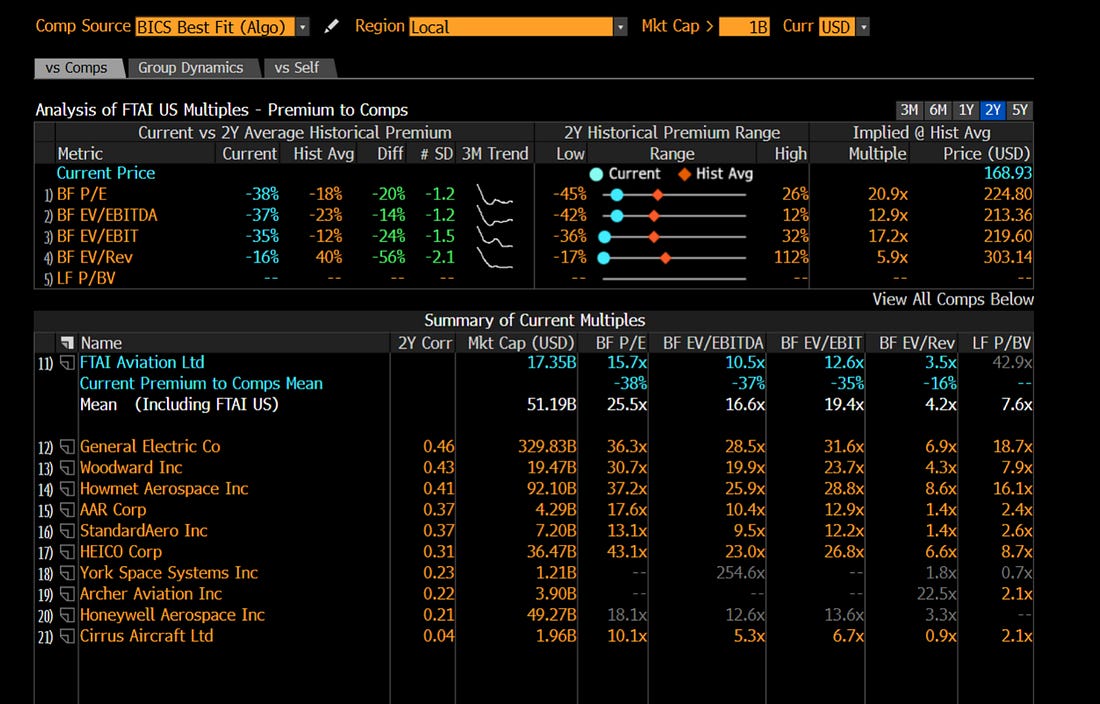
FTAI has yet to receive the valuation re-rating seen at other behind-the-meter (BTM) power providers in the current power shortage cycle. It trades ~30% below its two-year historical average and ~37% below peers, despite the launch of FTAI Power and management’s expectation of ~$450–750m in incremental EBITDA in 2027. We see this as a timely opportunity to examine the company’s fundamentals and quantify its position in the market.
Key Debates & Our Views
1)Does AP margin compression in 26Q2 signal a de-rating, or is the market focused on the wrong issue?
Debate
Aerospace Products (AP) EBITDA margin declined from ~35% in 25Q4 to ~29% in 26Q2. Bears worry that FTAI is prioritizing market share among large Tier-1 customers over profits and cash flow, to the detriment of shareholder value. As the CFM56 fleet ages and its installed base eventually declines, they also question the durability of MRE demand and whether Power will compete with Aerospace MRE for the same feedstock.
Our View
We believe AP can maintain earnings growth through market-share gains even as margins weaken and the CFM56 aftermarket declines. Power could consume some of AP’s feedstock over the longer term, but its higher margins should still add to earnings: ~35–40% for Power versus ~30% for the company overall. We do not expect feedstock competition to become a constraint over the next three to five years. The greater risks are capacity expansion and coordination across Montreal, Miami, Rome and New York.
Our Reasoning
Margin compression mainly reflects a shift in mix toward Tier-1 customers requiring heavier repairs. We expect margins to hold at ~30% over the next two years. Channel checks put gross margins on heavy restorations at ~23–24%, versus ~30–31% on standard engine sales, but with substantially more revenue per project. Heavier work requires more parts and forces FTAI to procure inventory ahead of demand. We also see a timing mismatch between costs and revenue recognition as a contributor to margin pressure.
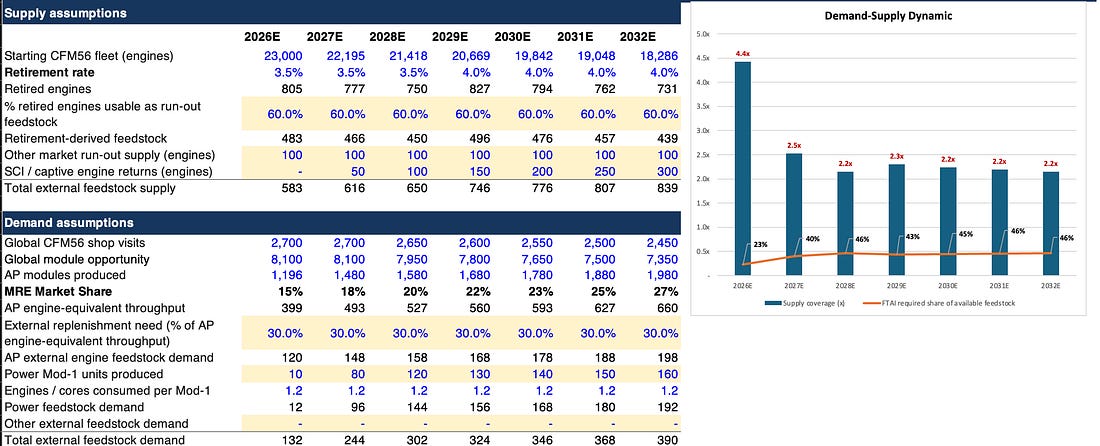
CFM56 retirements reduce future MRE demand but also increase feedstock for AP and Power Mod-1. Our proprietary supply-demand model examines both effects. We assume the CFM56 installed base declines at a five-year CAGR of ~4% through 2031E, while FTAI module output grows at ~9%, implying market share rises from ~15% to ~25%. More retirements and SCI engine returns expand available feedstock, although FTAI’s required share of total supply rises from ~23% today to ~45% as AP and Power grow. Gross feedstock coverage tightens from 4.4x in 2026E to ~2.2x from 2028E onward, without becoming a constraint in our base case. AP also has growth opportunities beyond CFM56. V2500 should support earnings as its restoration program expands, while LEAP offers the next source of growth in 2028–2029. We believe FTAI can apply much of its CFM56 sourcing and MRE expertise to other engine platforms.
On Power, channel checks also suggest early Mod-1 production relies largely on existing inventory and lower-green-time material with limited aviation value, making one-for-one cannibalization of AP unlikely. The more meaningful overlap appears to be in shop capacity, selected modules, test-cell time and skilled labor, rather than in engines.
Exhibit 1: FTAI Aerospace Products Supply-Demand Model
 Subscribed
Source: Company data, FUNDA estimates and analysis
2)Can FTAI Power drive another re-rating, and how much is it worth?
Debate
Since FTAI Power launched, bears have questioned whether it can deliver ~100 Mod-1 units in 2027 and continue winning hyperscaler customers after the turbine shortage ends. The $1.465b order announced in July demonstrates demand, but it has not demonstrated delivery execution or the ability to expand production. Nor does it establish why hyperscalers would continue choosing a repurposed CFM56 over established products from GEV, Siemens Energy or BKR. With the first Mod-1 deliveries expected in 26Q4, there is still little operating evidence on which to base earnings forecasts. Bears therefore continue to view Mod-1 as a prototype rather than a mature commercial product.
Our View
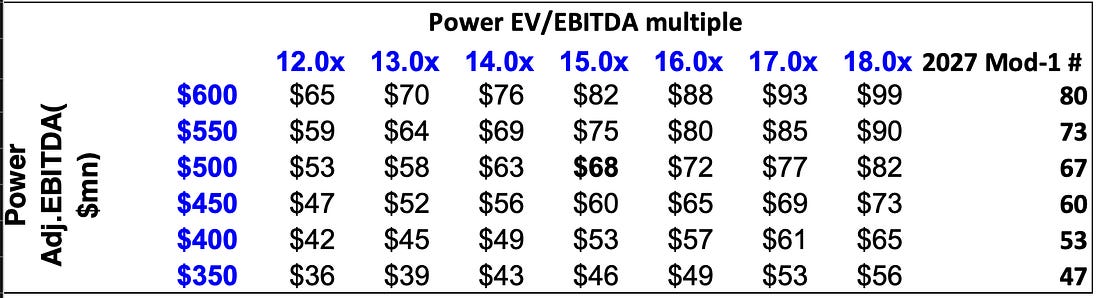
We expect FTAI to deliver ~80 Mod-1 units in 2027. Its near-term advantages are speed and modularity rather than technological leadership. Even if turbine supply constraints ease after 2030, CFM56’s reliability and lower costs relative to some alternatives could make FTAI a durable BTM supplier. In our base case, Power is worth ~$82/share, equivalent to ~50% upside on its own, while the market assigns it virtually no value.
Our Reasoning
Channel checks indicate Mod-1 is already in production in Montreal, with a dedicated Power line being built alongside the aviation operation. Montreal is now running at ~150 modules, or ~50 engine-equivalents, per quarter. Across Montreal, Miami and Rome, checks suggest total material throughput of ~70 engine-equivalents per quarter, of which ~60% becomes complete engines, theoretically enough to support the 100-unit target. The bigger issue is execution. FTAI appears to have enough core material for ~100 engines and labor is not yet the main constraint after recent hiring. Bottlenecks are more likely to come from configuration-specific parts, complete-package availability and testing. A missing wiring harness can hold up an engine, while each delivery also needs the gearbox, generator, shaft and related equipment. The first ~10 units also require aviation testing, conversion and retesting before the process can be standardized. We therefore model 80 units in 2027 rather than 100 outright.
Mod-1’s main advantage today is speed. Channel checks suggest ~3–4 weeks for assembly and ~2–2.5 months to reach a North American site, versus multi-year lead times for new industrial aeroderivatives. Its 25MW modular format also suits phased data-center construction. We think hyperscalers may accept lower efficiency because time-to-power matters more than fuel cost in the current market. Longer-term demand remains an open question. Our checks suggest broader adoption may require ~3 years of operating history. We estimate that the 100-unit target requires at least one customer beyond the $1.47b order announced in July. After the initial 26Q4 deliveries, a second hyperscaler order and subsequent field reliability data should be the next meaningful re-rating catalysts.
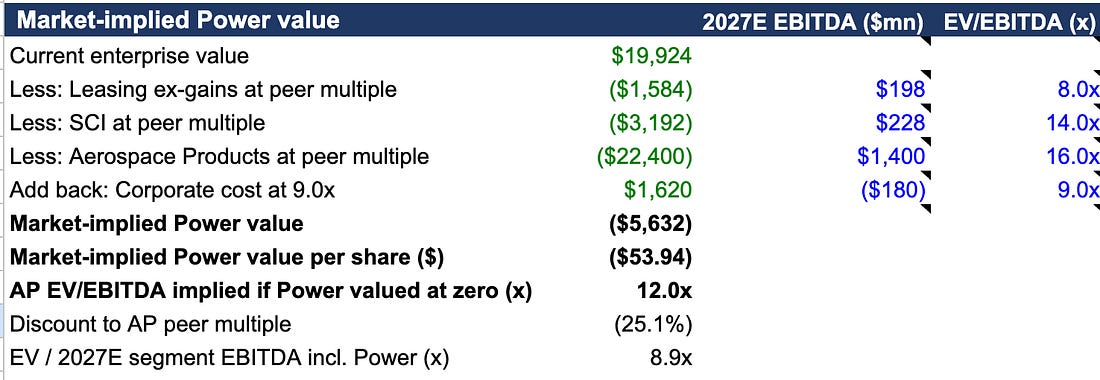
The market is paying virtually nothing for Power. In our reverse SOTP, valuing the non-Power businesses at peer multiples puts their combined value ~$5.6b above the current enterprise value. We value Power at 15x our $600m 2027 EBITDA estimate, or ~$82/share. This assumes ~80 Mod-1 deliveries, below the company’s 100-unit guidance. Even our bear case implies ~$36/share, with only 47 deliveries in 2027. We therefore see Power as a free option in the stock today.
Exhibit 2: Power Is Worth ~$82/Share in Our Base Case
Source: Company data, FUNDA estimates and analysis
Valuation and Catalysts
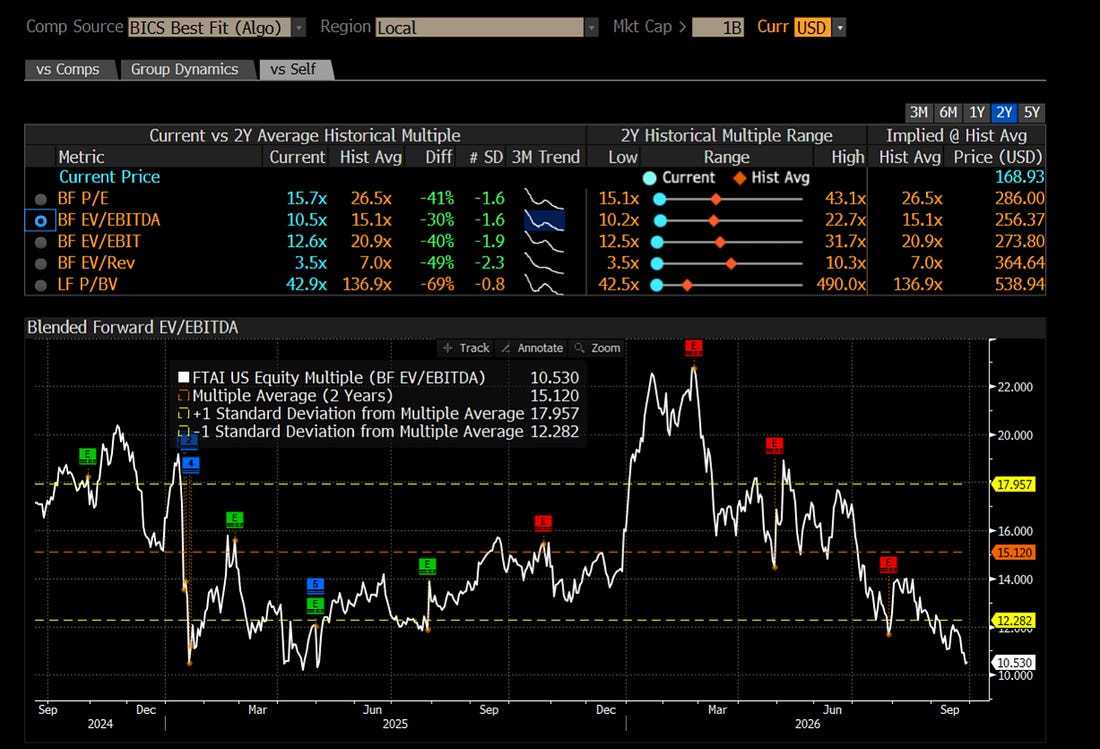
FTAI trades at 10.5x forward EV/EBITDA, ~30% below its two-year average of 15.1x and 1.6 standard deviations below that average. It is back near the valuation lows following the January 2025 short report. At that point, FTAI had not announced Power, North America’s power shortage was less pronounced, SCI had only just launched, and module output was roughly half today’s level. Since the Power announcement in December 2025, each earnings release has raised fresh concerns: one-offs in Leasing in 25Q4, AP margin compression in 26Q1 and 26Q2, and the $450m Power EBITDA guidance issued in 26Q2, implying ~60 Mod-1 deliveries in 2027 versus the ~100-unit target. Management subsequently explained that $450m was the low end of its internal $450–750m range and reflected a conservative approach to investor guidance.
Our reverse SOTP suggests the market is paying nothing for Power, leaving a relatively low hurdle for the business in the near term. Initial units need to be delivered, accepted and paid for; flawless unit economics can come later. The greater risk remains in the traditional businesses. AP needs to show market-share gains and stable EBITDA per module despite lower margins. Leasing needs to maintain its earnings run-rate as the owned portfolio shrinks ahead of the SCI ramp.
We expect limited progress in 26Q3: little improvement in traditional MRE and Leasing, with no Mod-1 deliveries or Power contribution yet. The first major Power catalyst comes in 26Q4, with ~10 initial Mod-1 deliveries, the expected first close of the 2026 SPV and an update to 2027 guidance. In 2027, deliveries against the anchor order, a second hyperscaler order announcement and a steadier production run-rate should drive estimate revisions and narrow the valuation discount. Longer term, FTAI needs to establish Mod-1 before the turbine shortage eases and the time-to-power premium shrinks.
Exhibit 3: Peer Comps
Source: Bloomberg
Exhibit 4: FTAI Forward EV/EBITDA
FTAI trades at 10.5x forward EV/EBITDA, ~30% below its two-year average of 15.1x and 1.6 standard deviations below that average. It is back near the lows following the January 2025 short report, before the Power business was announced.
Source: Bloomberg
Business Overview
Founded in 2011, FTAI Aviation is an independent aviation aftermarket platform focused on the CFM56-5B/-7B and V2500 engine families.
Aerospace Products contributes ~92% of revenue and includes the company’s MRE model, engine/module repair, rebuild, exchange and aftermarket sales.
Aviation Leasing contributes the remaining ~8% through aircraft and engine ownership and leasing. FTAI is also shifting toward a more asset-light model through its Strategic Capital Initiative, which uses third-party capital to acquire and manage aviation assets.
Understanding FTAI Through the CFM56 Engine Lifecycle
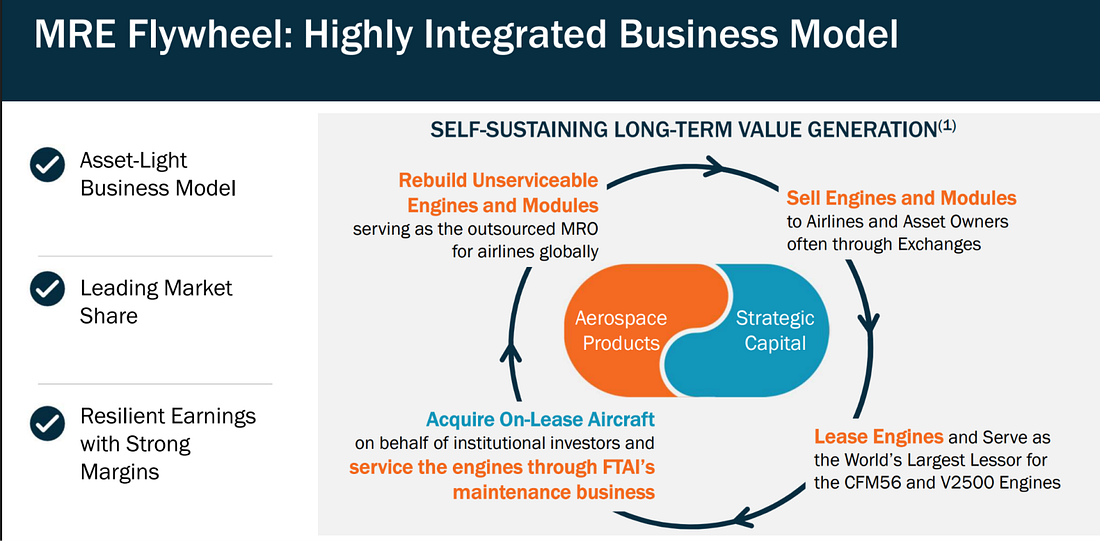
FTAI spans aircraft leasing, engine maintenance, asset management and power generation. We find it clearest to follow the lifecycle of its core engine platform, CFM56. Aviation Leasing earns returns while engines are in service. Aerospace Products earns returns from maintenance, remaining aviation life and parts. Power seeks a new use for turbines once commercial aviation is no longer their most valuable application.
CFM56 is not FTAI’s only engine platform. V2500 already makes a meaningful contribution, and LEAP is the planned next-generation platform, with an initial contribution expected in 2028–2029.
Exhibit 5: MRE Flywheel
Source: Company Website
Why CFM56 Creates the Opportunity
CFM56 primarily powers the Boeing 737NG and Airbus A320ceo families. We estimate that there are about 23,000 engines in service as of now.
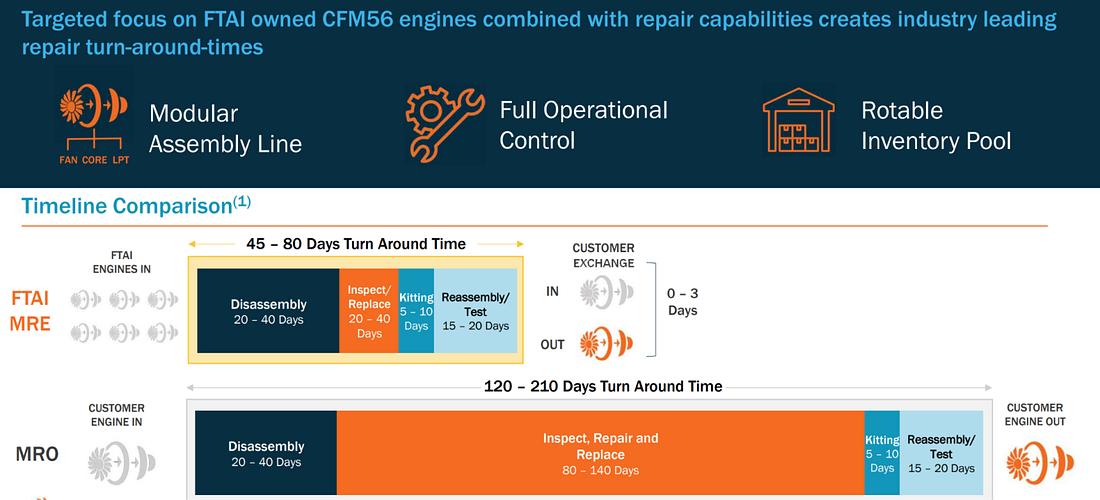
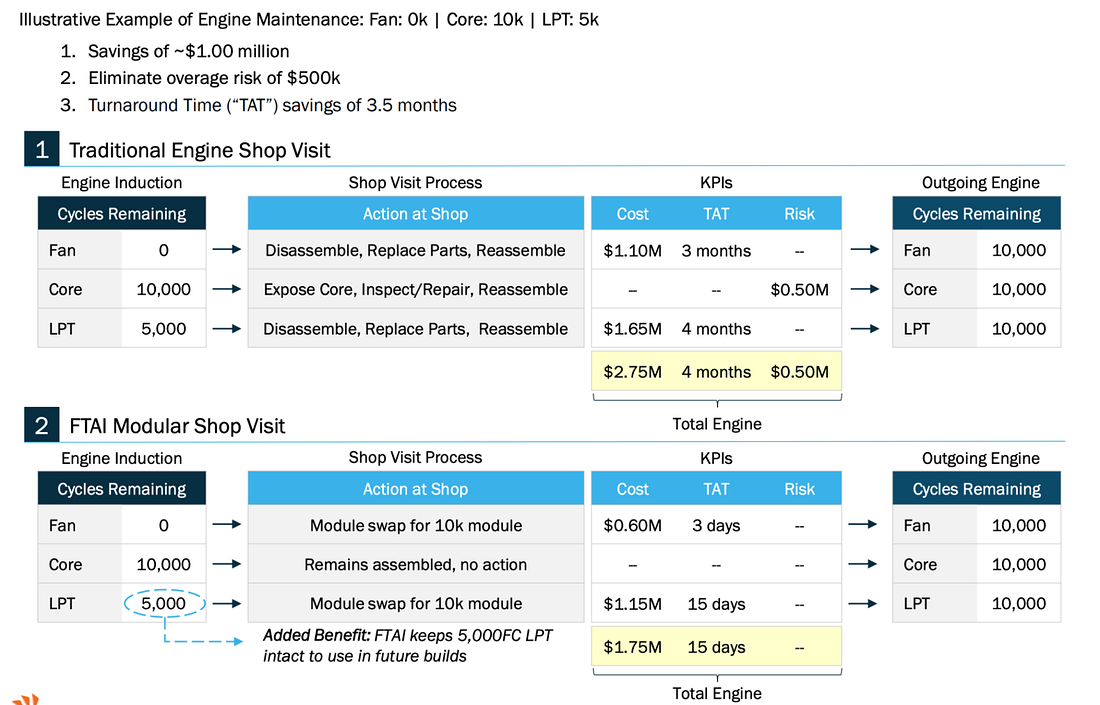
As important, the engine is modular. It separates into three major modules (the Fan, the Core and the Low-Pressure Turbine), which wear out at different rates; ~30,000 cycles for the Fan, 20,000 for the Core and 25,000 for the LPT. An airline often does not need a full overhaul when only one module is running short of green time. This mismatch underpins FTAI’s Maintenance, Repair and Exchange (MRE) model. A traditional shop repairs whatever engine the customer sends in. FTAI instead owns engines and modules, repairs them ahead of demand, and matches that prepared inventory to the green time each customer requires. FTAI’s product is therefore not simply a repair; it is available green time, delivered to the right specification at the right time.
Exhibit 6: FTAI Engine Exchange Versus Traditional Shop Visit (1)
Source: Company Presentation, FUNDA
Exhibit 7: FTAI Engine Exchange Versus Traditional Shop Visit (2)
Source: Company Presentation, FUNDA
The table below maps each stage of the CFM56 lifecycle to FTAI’s segments and the drivers of earnings at each stage.

The key point is that an engine does not remain in one segment. A leased engine can become MRE inventory; an exchanged engine can be repaired and returned to service; an engine that is no longer economical to fly can be torn down for parts; and a retired turbine can potentially become feedstock for Power.
SCI expands the asset base with less FTAI capital
Historically, FTAI acquired aircraft and engines with its own capital and earned leasing income and gains on sale. SCI changes who provides the capital. Institutional investors fund most aircraft acquisitions, while FTAI acts as asset manager and servicer and invests alongside them as a minority co-investor.
SCI also generates demand for Aerospace Products. The aircraft in SCI’s portfolio will eventually require engine maintenance, and SCI I’s maintenance agreement commits the portfolio to fixed-price engine exchanges with FTAI. Aerospace is contractually paired with a multiyear pipeline of demand for rebuilt engines. SCI I was expected to include roughly 350 aircraft, or approximately 700 engines, under this framework. FTAI captures three layers of economics from SCI (servicing fees, co-investment returns and maintenance revenue) while influencing a far larger installed base than it could fund off its own balance sheet.
Exhibit 9: Aviation Leasing Bottom-up Model Analysis

Source: Company Data, FUNDA estimates and analysis
Aerospace Products Monetizes Engine Maintenance
When an engine approaches a shop visit, the key question for the airline is how much additional life it actually needs. FTAI’s MRE model replaces the traditional shop-visit wait with an immediate engine or module exchange. FTAI takes back the depleted unit, repairs it and returns it to inventory for the next customer; channel checks suggest ~80% of transactions are exchanges.
This creates a self-reinforcing inventory flywheel: more transactions expand the pool of available configurations and green time, improving availability and driving further adoption. Output is scaling quickly, with 757 CFM56 modules refurbished in 2025, 296 in 26Q2, and a 2026 target of 1,200. Mix is also shifting toward larger Tier-1 programs and heavier restorations, which carry lower margins but higher EBITDA dollars per engine.
CFM56 is not the only engine platform
While CFM56 is the core profit engine of Aerospace Products today, FTAI already operates across three engine platforms at different stages of maturity. V2500 is a real but smaller second leg, while LEAP remains an early-stage capability build. The key differences lie in how much of the repair process FTAI controls, how open each aftermarket is to independent players, and when each platform becomes financially relevant.
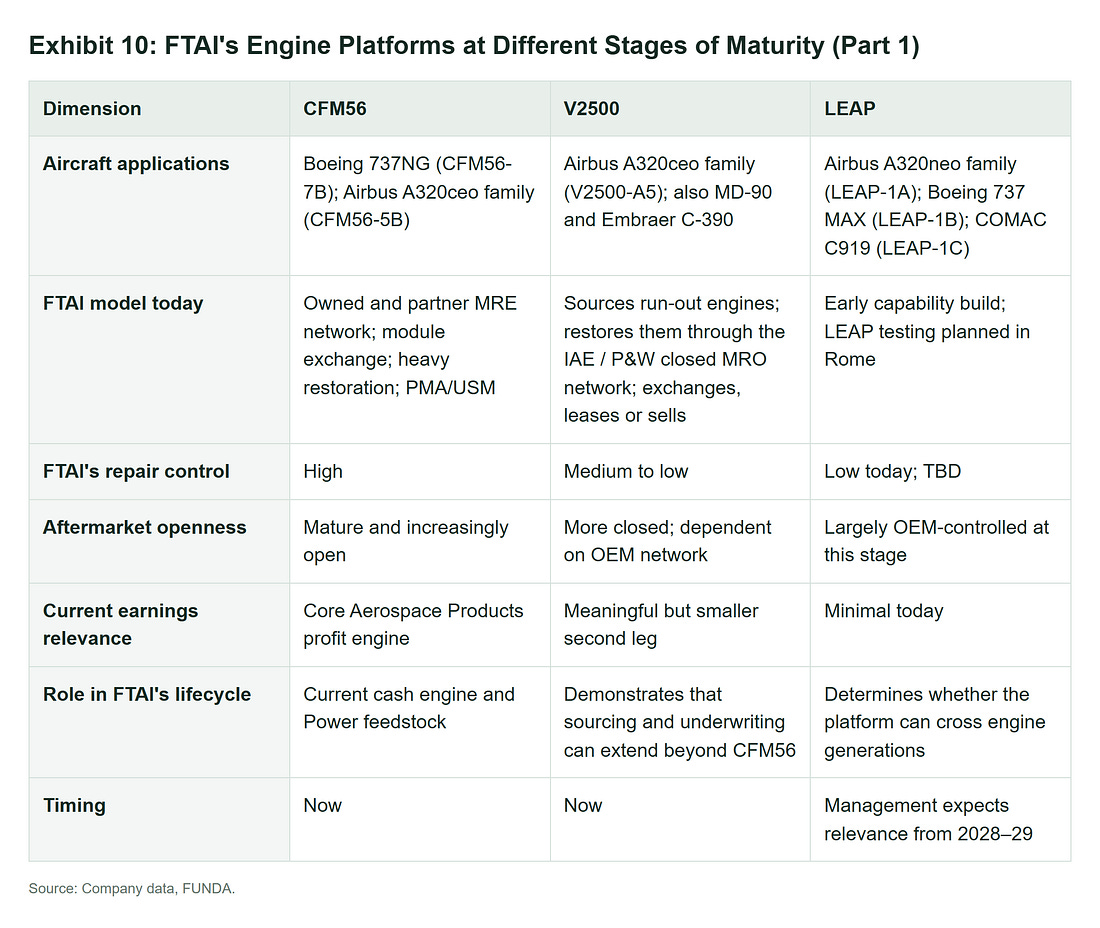
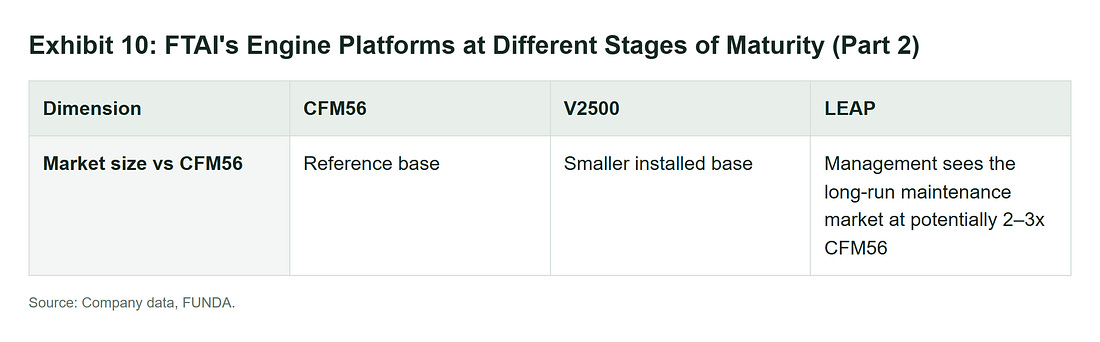
On CFM56, FTAI controls much of the repair cost stack in a mature and increasingly open aftermarket, which supports its high profitability. On V2500, FTAI’s value lies mainly in sourcing and underwriting engines, with restoration performed within the OEM network, so its control over repair economics is lower. On LEAP, the aftermarket remains largely OEM-controlled, and FTAI’s position is still being built.
Power Creates a New Terminal Value
Historically, once an engine was no longer economic to fly, its value came mainly from its parts. FTAI Power creates an additional buyer. The Mod-1 is an approximately 25MW aeroderivative gas turbine built from CFM56 feedstock, and its production logic mirrors Aerospace: source, inspect, rebuild, configure and sell. Management has noted that Power allows FTAI to pursue engines it previously would have treated mainly as part-out candidates.
FTAI Power: Extending the CFM56 Lifecycle into Power Generation
FTAI officially launched FTAI Power on December 30, 2025, following more than a year of development to adapt its CFM56 platform for stationary power generation. The business leverages FTAI’s existing engine inventory and refurbishment capabilities to produce Mod-1, a 25MW aeroderivative turbine, with commercial production targeted for 26Q4 and approximately 100 units in 2027.
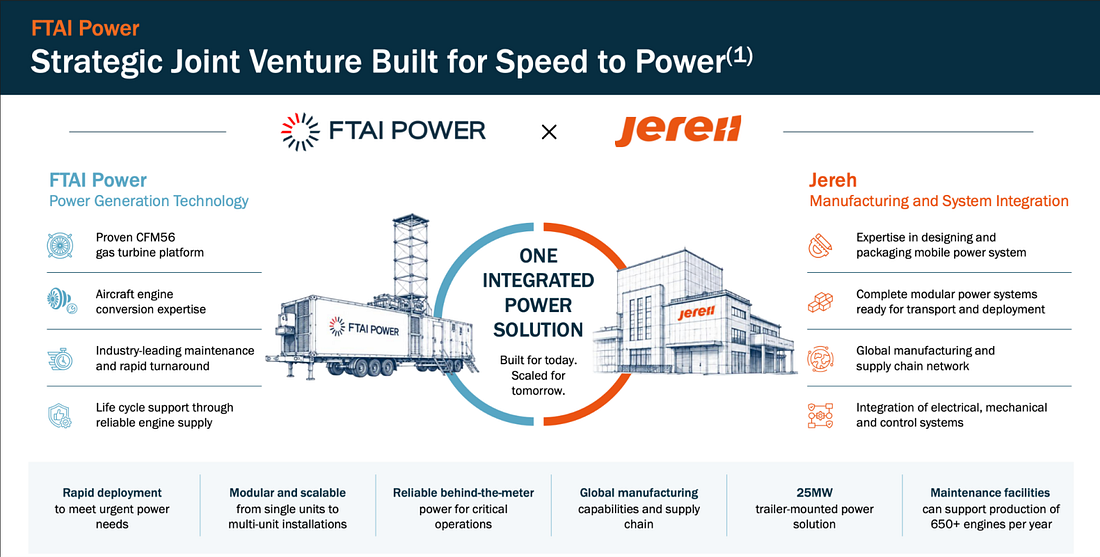
In April 2026, FTAI partnered with Jereh Group to form J&F Power Systems. FTAI manufactures the CFM56-derived Mod-1 turbine. J&F integrates it with the generator and other equipment, packages the complete generator set and delivers it to the customer.
The partnership secured its first major order on July 22, 2026: a five-year agreement with an international cloud service provider and an initial $1.465b purchase order, with deliveries scheduled through November 2027. The contract value reflects complete generator-set sales by J&F, rather than FTAI’s standalone turbine revenue.
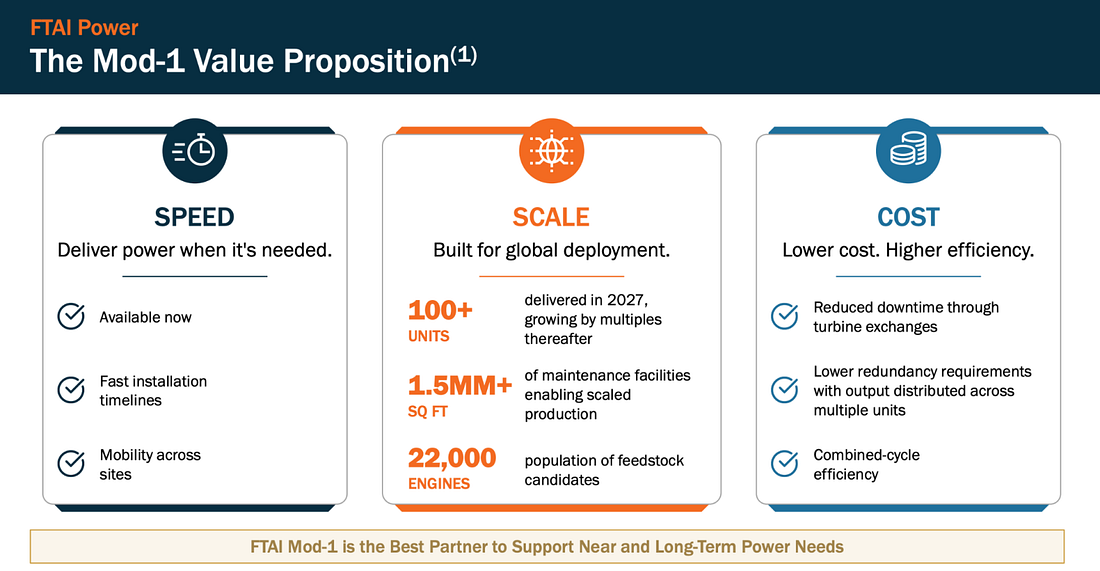
Exhibit 11: Mod-1 Value Proposition
Source: Company Website
Exhibit 12: Partnership with Jereh
Source: Company Website
How Mod-1 Works
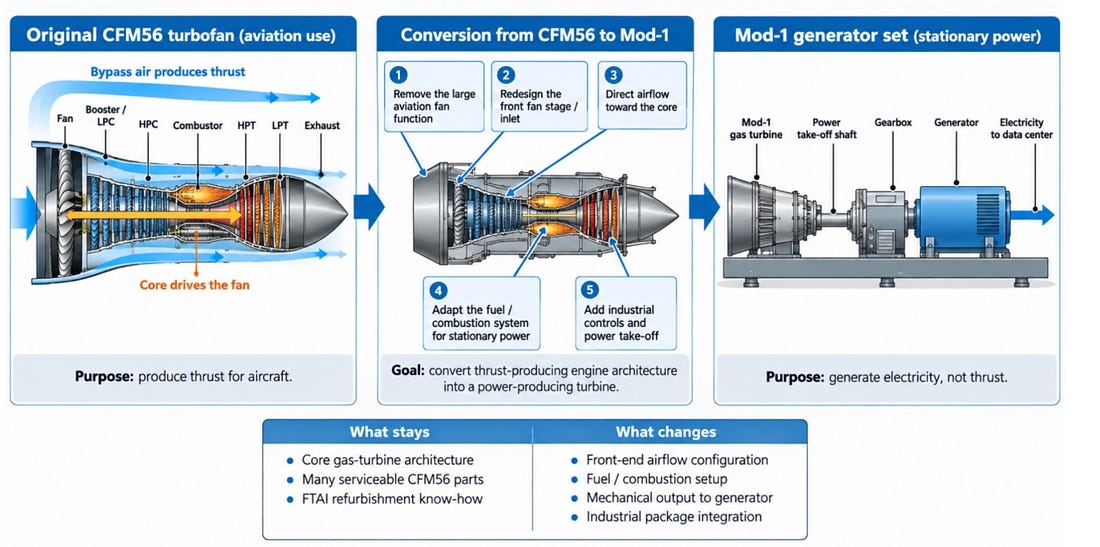
Mod-1 repurposes the CFM56 from producing aircraft thrust to driving a generator. The conversion removes much of the aviation-specific front-end architecture and redirects airflow into the compressor and core. Channel checks indicate the design uses shorter fan blades, a redesigned fan disk and inlet, together with modifications to the fuel nozzles and combustion system. Much of the compressor, combustor and turbine architecture remains intact, allowing FTAI to reuse serviceable CFM56 components and its existing repair capabilities.
The converted turbine is then coupled to a generator through a power take-off shaft, gearbox and related drivetrain. J&F Power Systems handles much of the downstream packaging and integration, while FTAI focuses on the turbine.
Early units require more testing. Our checks indicate the first batch is tested in aviation configuration and again after conversion to establish the relationship between familiar engine-health metrics and electrical output. Once that baseline is established, later units should require less cross-testing.
Exhibit 13: How Mod-1 Converts From CFM56
Source: Company Disclosures, FUNDA analysis and summary
How Aeroderivatives Fit into the AIDC Buildout and BTM Power Market
Aeroderivatives sit between large frame turbines and smaller distributed generation. They offer meaningful unit size, a compact footprint, fast startup and modular deployment, making them well suited to data centers that need power quickly and want to add capacity alongside new data halls.
They are not always the most efficient option. Combined-cycle plants offer better efficiency, while RICE and SOFCs can be attractive in different applications. The appeal of aeroderivatives is primarily speed, flexibility and power density.
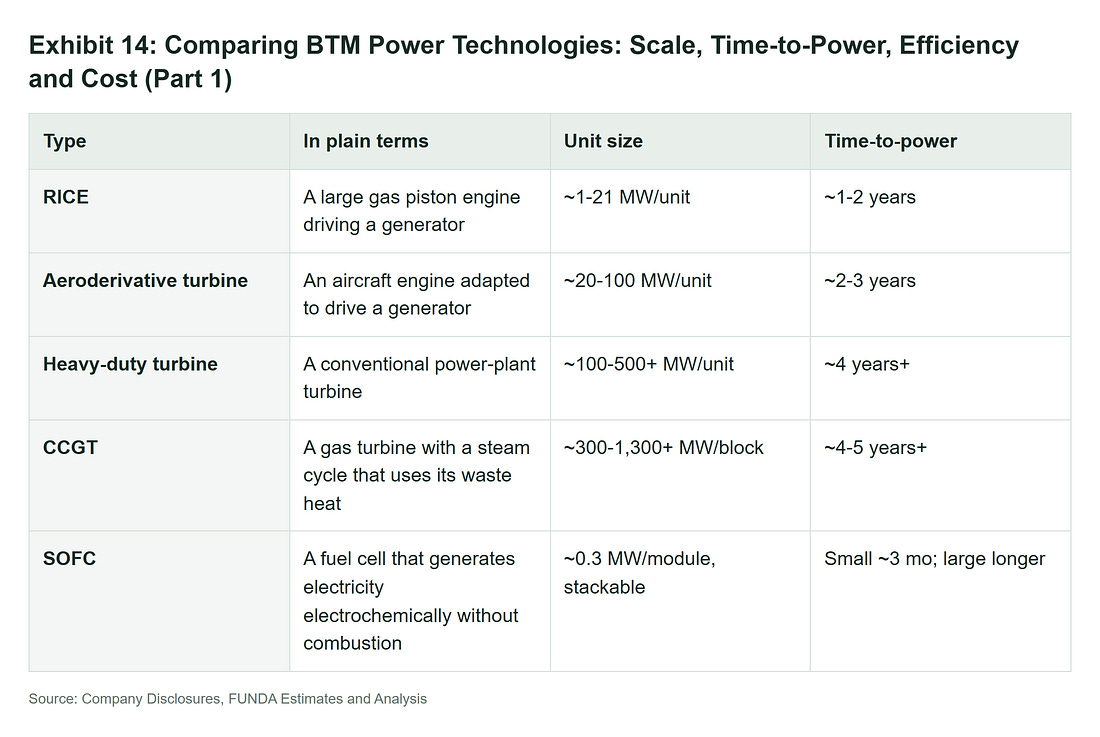
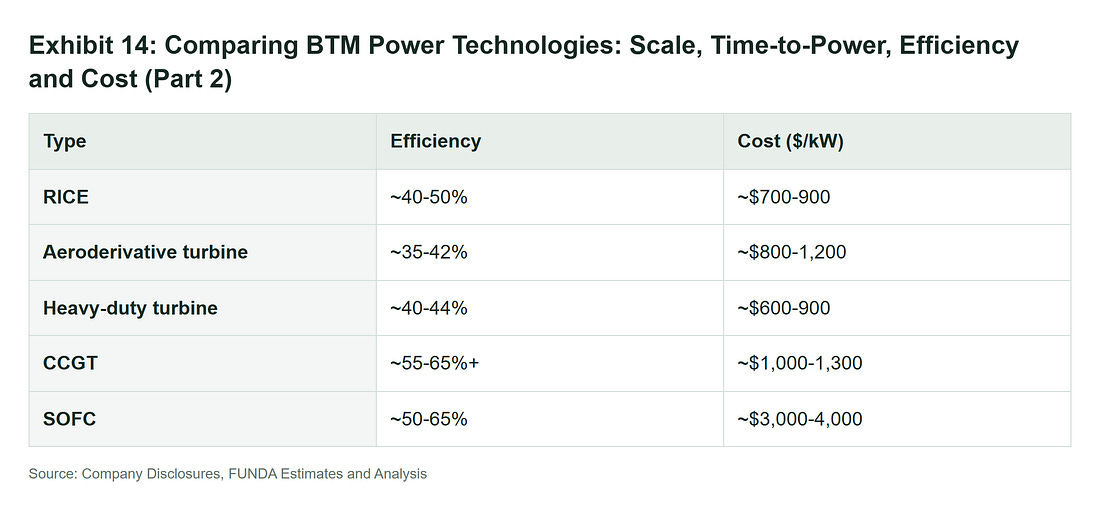
Comparing Mod-1 with other Aeroderivative solutions
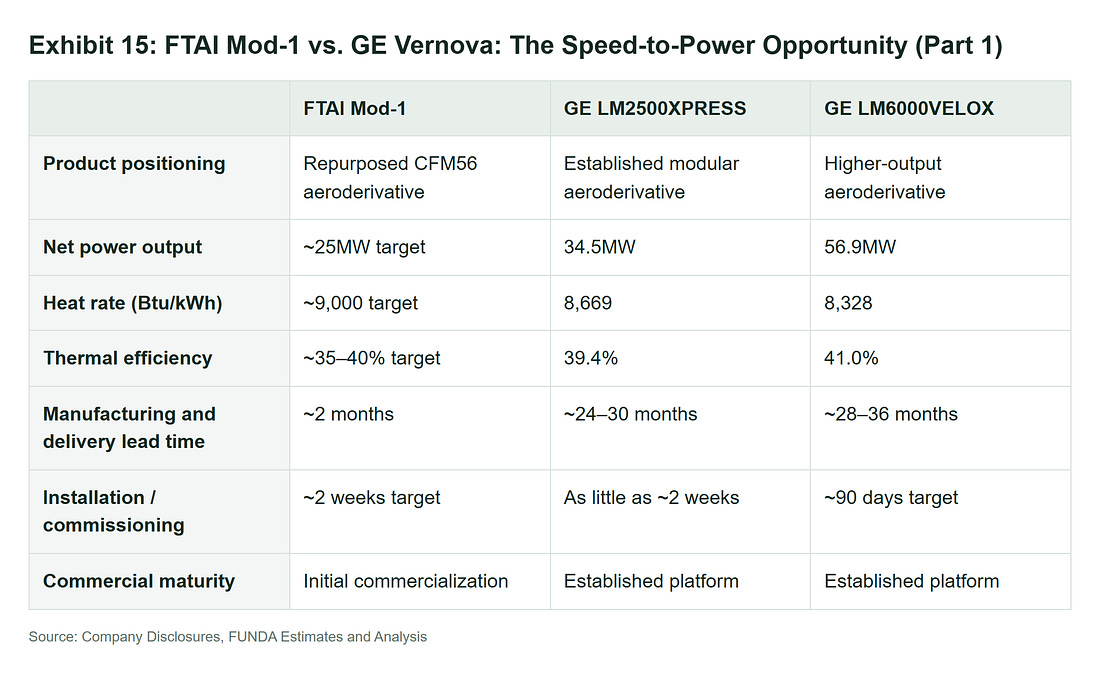
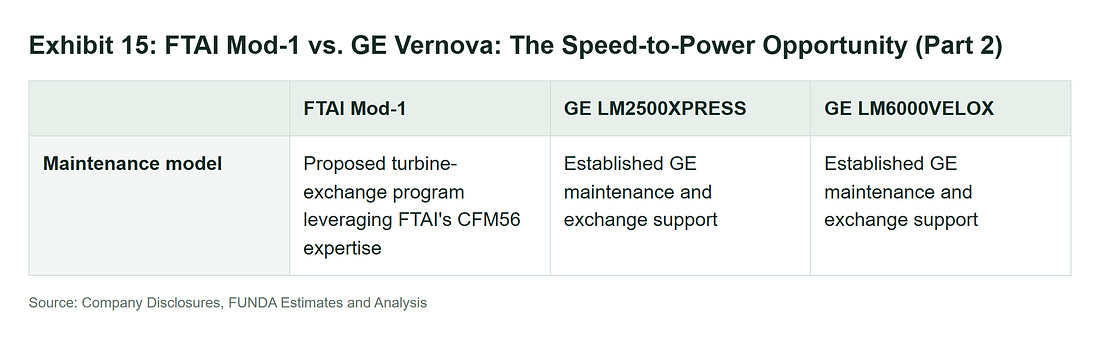
FTAI is entering an established market led by GE Vernova, Siemens Energy and Baker Hughes. Mod-1 is smaller and somewhat less efficient than GE’s LM2500XPRESS and LM6000VELOX. Its targeted 25MW output and ~9,000 Btu/kWh heat rate compare with larger and more efficient GE products, which also come with established industrial reliability and service networks.
The advantage is availability and time to power. Third-party estimates suggest new-build LM2500 and LM6000 lead times of roughly 24–36 months, while our channel checks indicate a Mod-1 engine could be assembled and delivered to a North American site in roughly 2–2.5 months. FTAI can do this because it is rebuilding from existing CFM56 inventory rather than waiting for new turbine production. For hyperscalers, that time difference can outweigh a modest fuel-efficiency penalty. A 1GW AI data center generating ~$12–24b of annual revenue implies roughly $1–2b of revenue per month. At illustrative margins, bringing a site online one month earlier could be worth hundreds of millions of dollars—far more than the incremental fuel cost of a less efficient turbine.
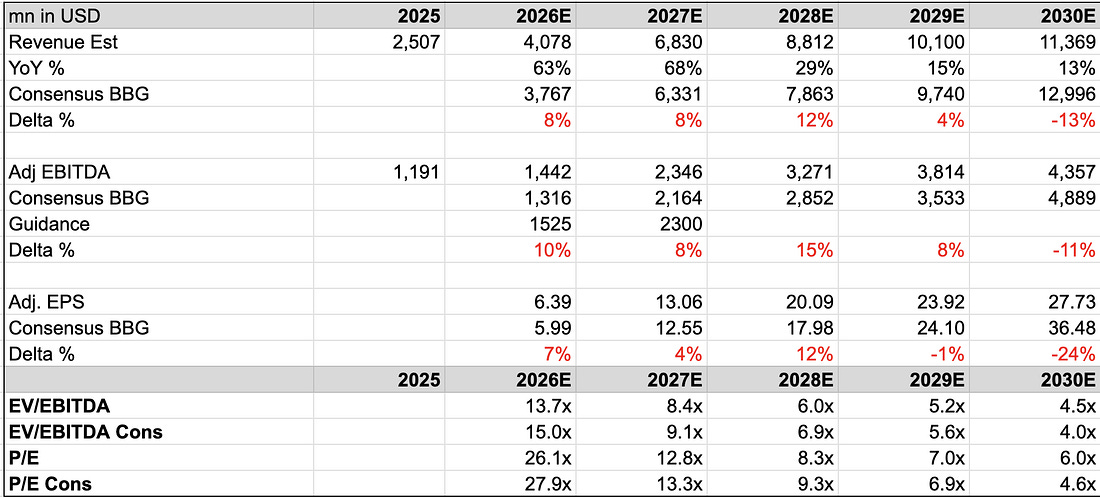
FUNDA Estimates Versus Consensus
Exhibit 16: 2026–2030E Forecasts
Source: Bloomberg, FUNDA Estimates and Analysis
Disclaimer and Terms of Use
Analyst Independence Statement
The views expressed in this report accurately reflect the personal and independent views of the analyst(s) regarding the securities and issuers discussed herein. No part of the analyst’s compensation was, is, or will be directly or indirectly related to the specific recommendations or views expressed in this report. The Company adheres to strict compliance procedures to ensure the integrity, security, and legality of the data sources and information utilized.
About FUNDA
Consensus AI Technology Pte. Ltd. (the “Company” or “FUNDA”) is an independent research firm incorporated in Singapore. The Company is not affiliated with any securities dealer, investment bank, or asset management firm, nor is it registered as an investment advisor or broker-dealer in any jurisdiction. The Company does not have any investment banking or underwriting relationship with the companies covered in this report, and does not accept sponsorship or funding from publicly listed companies.
No Investment Advice and Report Neutrality
The contents of this report and the information contained herein are for informational purposes only and do not constitute investment advice or a basis for business decisions. The views expressed herein represent solely the personal opinions of the respective authors at a specific point in time and do not reflect the position of FUNDA. As an independently operated platform, FUNDA maintains a neutral third-party status and makes no express or implied warranties regarding the accuracy, completeness, or applicability of such views.
No Offer or Solicitation: This report does not constitute an offer, solicitation, recommendation, or advice to buy, sell, or hold any securities or financial instruments, nor does it provide any legal, tax, or accounting advice.
Third-Party Data: All third-party data cited in this report is derived from public or authorized sources. The Company makes no representations or warranties, express or implied, as to the accuracy or completeness thereof.
Non-Participation in Decision-Making: The Company does not participate, directly or indirectly, in the investment decision-making process of its clients or readers. Readers should make independent investment decisions based on their own investment objectives and financial circumstances, and consult professional financial or legal advisors prior to executing any transactions.
Timeliness Statement
Given the rapid changes in market environments and technological trends, this report reflects market conditions as of the date prior to its publication. Relevant information may become outdated over time. FUNDA has no obligation to update the contents of this report in real-time.
Intellectual Property, Confidentiality, and Restrictions on Commercial Use
All reports, data, models, and content provided by the Company constitute its exclusive proprietary intellectual property and are protected by copyright and intellectual property laws.
Ownership of Rights: Unless otherwise expressly stipulated in a written agreement, all intellectual property rights (including copyrights) arising from or relating to this report are exclusively owned by the Company.
Authorized Use: Institutional clients may use this report internally within the scope permitted by their internal compliance policies; however, disclosure or sharing with any third party is strictly prohibited.
Prohibition on Commercial Use: Without the prior express written consent of the Company, no individual or entity may reproduce, republish, distribute, resell, repackage, or otherwise use this report or any part thereof for any commercial or profit-making purpose.
Legal Recourse: The Company reserves the right to pursue all available legal remedies and claims against any unauthorized commercial use, redistribution, or infringement of its intellectual property rights.
Forward-Looking Statements and Disclaimer
This report may contain forward-looking statements, including forecasts, estimates, and analyses of industry trends. Such statements are subject to risks and uncertainties that may cause actual results to differ materially from those anticipated. The Company shall not be liable for any direct, indirect, or consequential losses arising from the use of or reliance on the contents of this report.