2026.09.30 | Substack | Robotics | Robot Power Suppliers
原标题:Robots Need Power. Let’s Look At Which Companies Supply It. (Free Article)
We have spent the last seven layers slowly building out our robot.
Training and simulation gave us a way to develop it. We worked through perception and compute, then software, planning and control. In Layer 7 we finally got to the motors, gearing and actuators that turn those instructions into physical movement.
I Screened the Robot Motion Stack. These Are the 2 Stocks I’m Interested In.
Gaetano
·
Sep 17
Read full story
Now we have to power all of it.
That brings us to Layer 8: Power & Energy Delivery
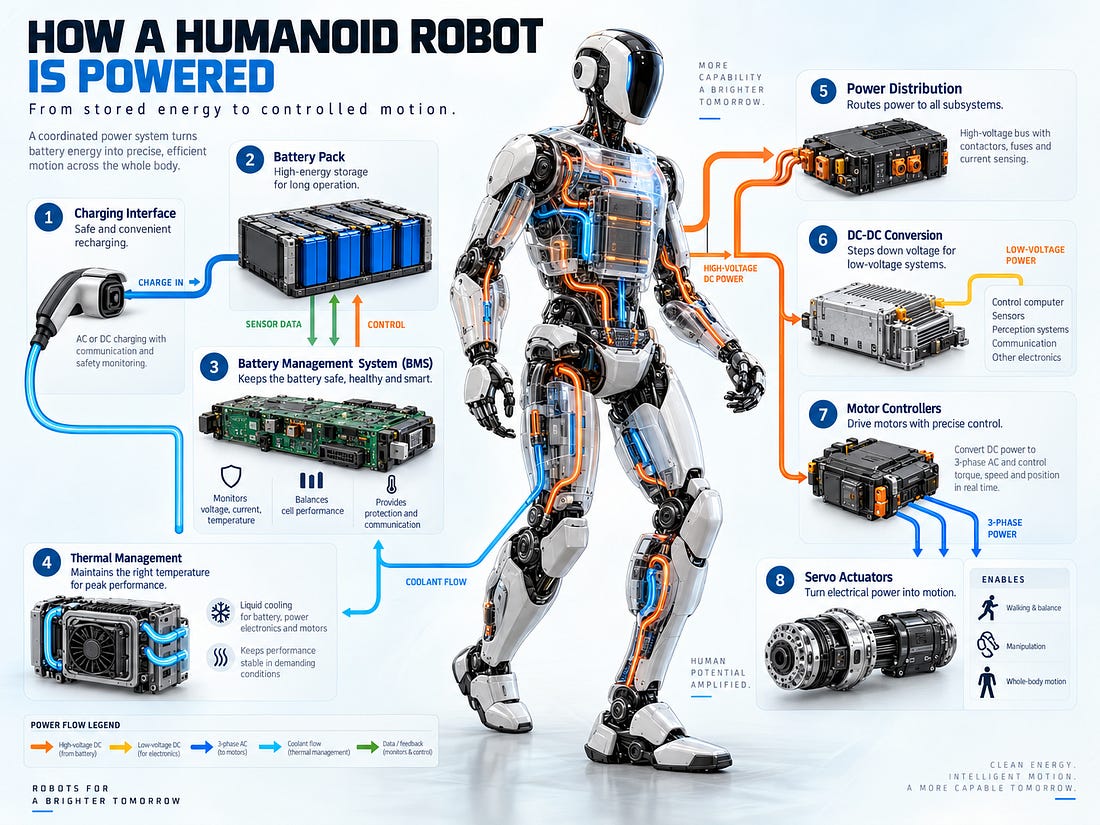
When I first started working through this layer I assumed batteries would dominate the discussion. They are obviously a huge part of it, but the deeper I went the more I realized that the opportunity really stretches through the entire machine. The stored energy has to be monitored and converted before it can feed the compute system, sensors and motors, and then the machine has to recharge quickly enough that it can spend most of the day doing useful work.
That last part is crucial when we are thinking about real, commercial deployment (which should always be on our mind with humanoids or robots in general) . A warehouse robot can have great perception, planning and motion hardware, but if it spends too much of the day sitting at a charger then the customer may need more robots to do the same amount of work. A larger battery can help with runtime, although now the machine is heavier and has more mass to move around. That tradeoff gets harder with humanoids, where you are trying to power a serious computer and a lot of moving joints without making the robot too heavy or hot.
I ended up screening over 65 U.S.-listed companies across batteries, charging, power semiconductors and related electrical systems. There are many many companies with adjacent exposure here. But I spent time trying to figure out which companies had a good chance of successfully capturing this opportunity. And I wanted my deeper digging to span a variety of sizes and proof of companies.
The four I came away most interested in that I want to discuss today are:
- Monolithic Power Systems (MPWR)
- Allegro MicroSystems (ALGM)
- Ultralife (ULBI)
- Electrovaya (ELVA)
MPS and Allegro give exposure to power electronics inside the machine. Ultralife and Electrovaya sell battery systems, with different levels of commercial evidence and financial risk.
I want to understand what is already shipping and how large the remaining opportunity could become.
ON (Onsemi) also screened well. I already own it and have covered it elsewhere in this Physical AI series, so I wanted to introduce other businesses here. And like I mentioned, there were many other companies that are relevant here but I need to focus in on a select few.
Before getting deeper into how robot power works, I want to start with what these businesses could earn and the prices where I would consider owning them.
If you enjoy this article, please consider subscribing! This is my 8th article like this covering all the different investment layers to Physical AI. I have several more to go and I am building out my own personal Physical AI portfolio that I want to be positioned in over the coming years. I share that live with all of my adds and trims along the way!
This Substack is reader-supported. To receive new posts and support my work, consider becoming a free or paid subscriber.
 Subscribed
My Investment Decision
I expect to eventually own at least one of these stocks.
The price has to leave enough room for the earnings to develop, especially when robot production schedules are still changing and we are still very early on this. This portfolio I am building out is with a multi year mindset.

Physical AI Model Portfolio
Gaetano
·
Jun 1
Read full story
So here’s how I see it.

This table above is not a recommendation or advice. It is reflective of my own risk:reward tolerance and investment timeframe of multiple years as long as the investment thesis is intact.
I am going to keep the company sections tight and focused on the financial picture. After that I will dive a bit more into some engineering details that I think are relevant and should be understood.
Monolithic Power Systems (MPWR)
MPWR is probably my favorite business in this group. Physical AI gives MPS another market to grow into, while the investment already has a substantial earnings base behind it.
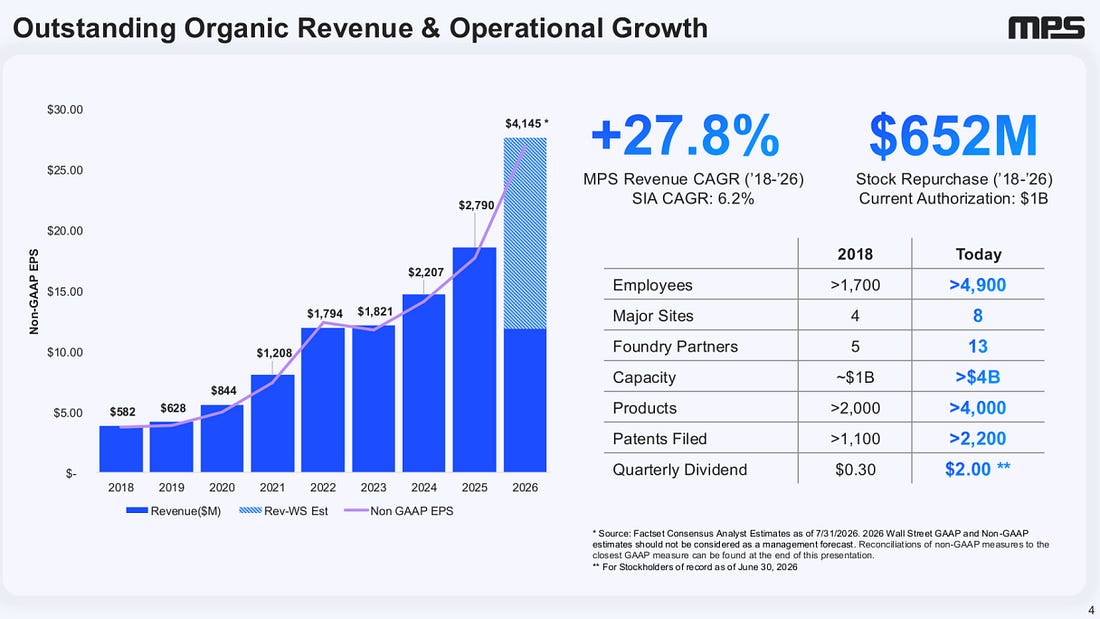
The latest quarter accelerated considerably. Q2 revenue reached $981 million, up 48% year over year, with Enterprise Data growing 164% to $381 million. The Q3 revenue guide of $1.14–1.16 billion represents an annualized pace around $4.6 billion, separate from a full-year forecast.
That growth is already producing profit and cash. Q2 reported operating margin was 31%, and first-half free cash flow was approximately $324 million. Cash and short-term investments totaled about $1.4 billion.
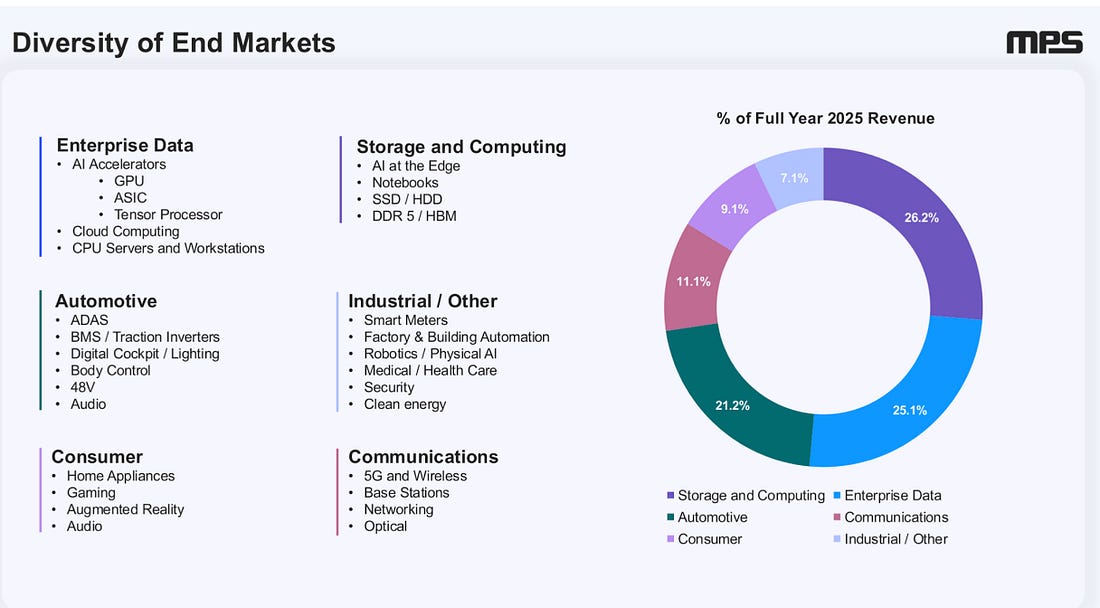
The breadth gives them several sources of demand, although data-center spending increasingly influences the earnings trajectory. My valuation therefore has to work on the broader business. An early robotics program can succeed commercially while contributing relatively little to total revenue.
One newer development that I want to bring up (partially as a shoutout to one of my other investments) gives me more confidence in MPS's ability to supply the opportunity if volumes grow. In September, MPS signed a long-term manufacturing agreement with GlobalFoundries that will bring its proprietary process technology into GF's 300mm Singapore fab, with volume production expected in early 2027. The planned output explicitly includes next-generation power products for industrial robotics and automation. I am long GFS for their networking exposure as well.
In Q1, management described initial higher-volume robot launches contributing from a small base. The Q2 call discussed customer designs in both the U.S. and China.
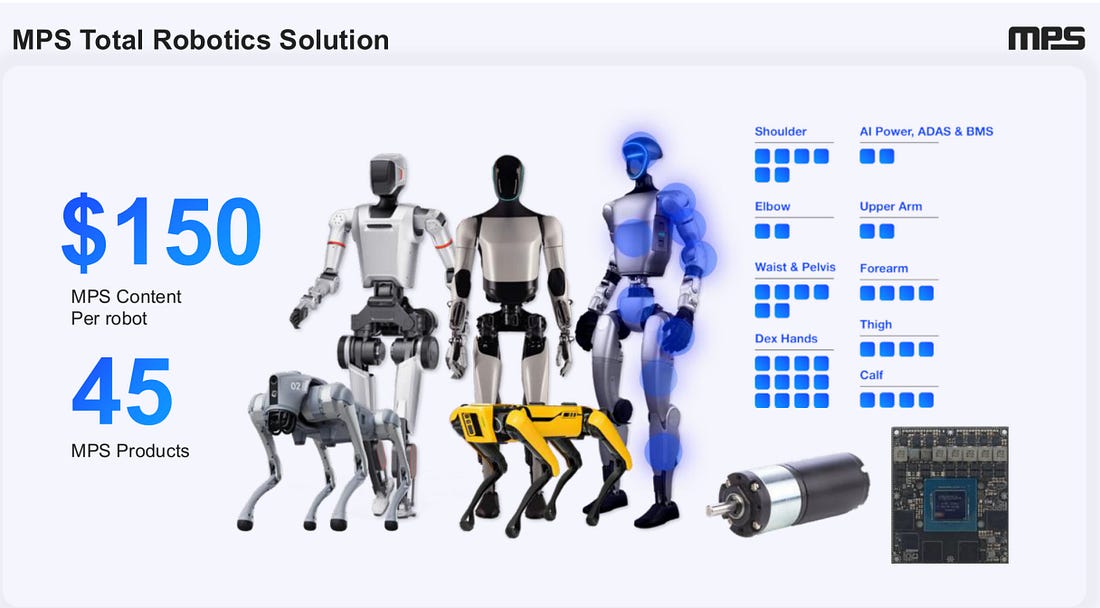
If we are thinking of scale, 100,000 robots at the full illustrated $150 would generate $15 million of revenue. Actual sales depend on the products selected and the price MPS receives of course. I wanted to bring this up becuase that keeps my expectations proportionate to a business already generating nearly $1 billion per quarter. If we want more torque (but also more risk) we would find a company with lower baseline rev where a new robotics win could move the needle in a big way (we will get to those in a bit).
For 2028, I use $6.5 billion of revenue, net margins of 30–32% and approximately 50.5 million diluted shares. That produces roughly $39–41 of EPS. Applying 36–38 times earnings gives a rounded value range of $1,400–1,550.
Around $1,050–1,100, the prospective return becomes more interesting to me. The model requires continued growth and higher profitability. Slower data-center investment or customer pricing pressure could outweigh the initial contribution from robotics. Companies like Texas Instruments and Analog Devices also give customers established alternatives, so sustaining the current economics requires continued execution.
Allegro MicroSystems (ALGM)
Automotive still drives much of the business, so I want the existing recovery to support earnings while newer programs develop.
Allegro sells magnetic sensors and power integrated circuits, or ICs. Automotive contributed $165 million of Q1 fiscal 2027 revenue of $259 million, with Industrial & Other supplying $94 million. Data centers reached 17% of sales.
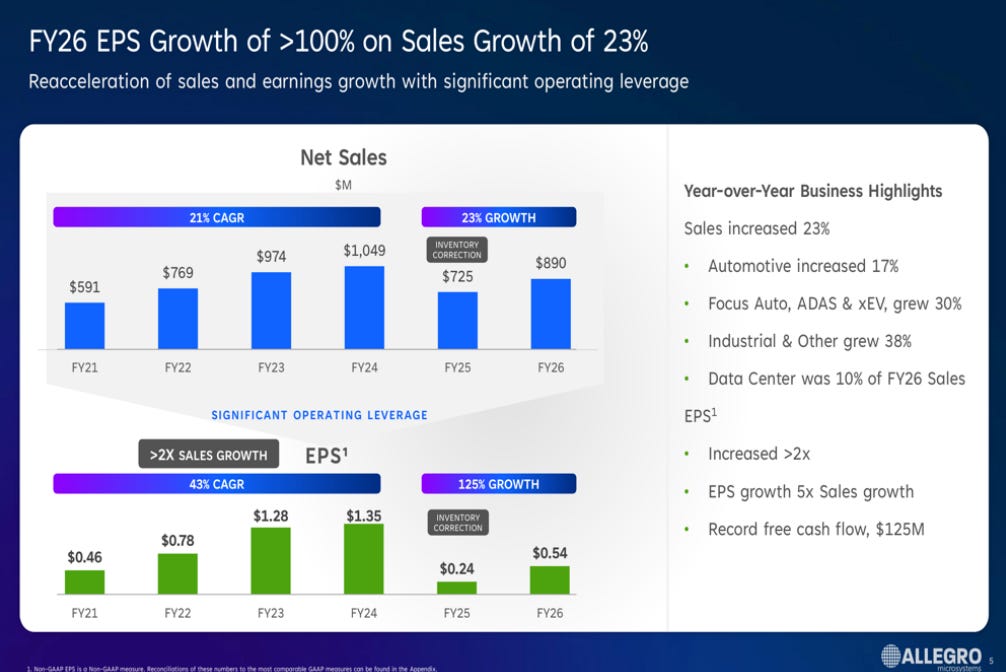
The recovery continued in Q1 fiscal 2027 where revenue increased 27.5% year over year, reported gross margin reached 48.5%, and reported operating margin improved to 9.8%.
Management expects robotics and automation to contribute 3–4% of fiscal 2027 sales. On an illustrative $1.1 billion annual revenue base, that represents about $33–44 million. The category includes conventional automation as well as newer robots, and combines sensing with power products.
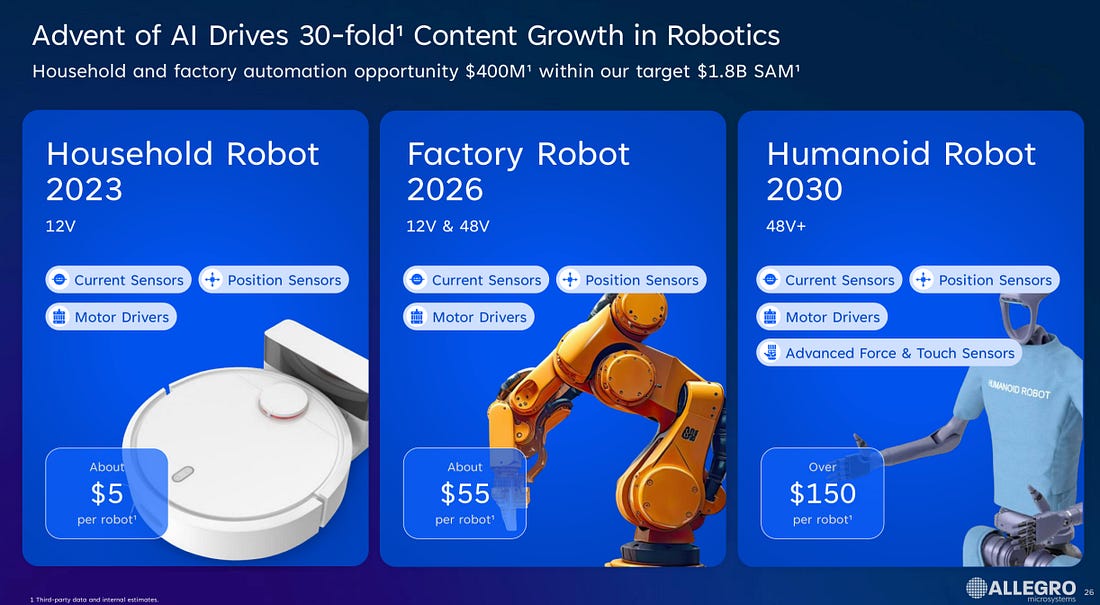
The most specific recent humanoid wins involve current sensors with Chinese manufacturers and position sensors with a North American manufacturer.
The attraction is the combination of an existing recovery with an emerging market large enough to become visible against Allegro’s sales base. The risk is paying for both outcomes before the margin improvement reaches my pockets.
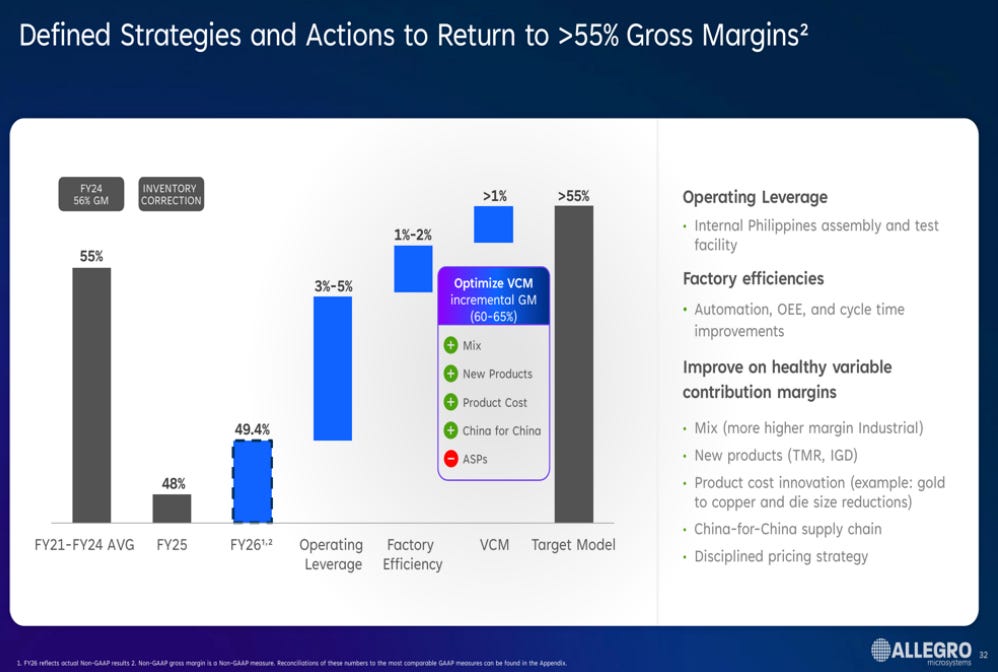
For the fiscal year ending in early 2029, I use approximately $1.5 billion of revenue and an underlying operating margin of 25–27%. After financing costs and taxes, with approximately 192 million diluted shares, I get roughly $1.60–1.70 EPS.
At 27–29 times earnings, that supports about $43–50 per share. A 22% operating margin would bring the value closer to $39 at 28 times earnings, using the same revenue and financing assumptions. The return is sensitive to how much of the recovery reaches operating profit.
I become more interested around $28–30 if that recovery continues. Quarter-end cash was approximately $162 million, against $287 million of debt and finance leases. Better cash generation would strengthen the case. An automotive setback or weaker profitability could overwhelm the early robotics contribution.
Ultralife (ULBI)
Ultralife is small enough that one successful customer program could change its earnings profile. My interest starts with an established specialty-battery business whose existing customer relationships could support expansion into more autonomous systems.
Q2 revenue was $47.9 million, including $44.2 million from Battery & Energy Products. Medical and industrial customers sit alongside specialized defense, oil-and-gas and subsea applications. The smaller Communications Systems business supplies equipment to markets including defense.
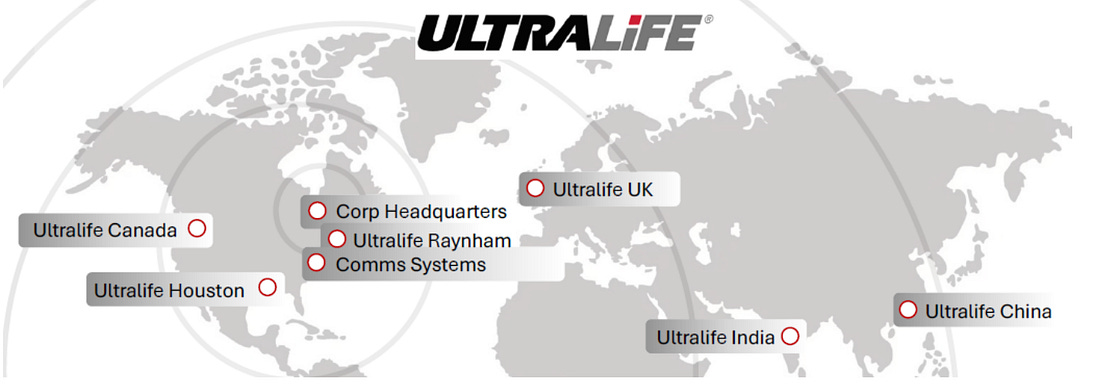
An outside battery supplier can let an equipment manufacturer concentrate on launching its own product. Ultralife’s commercial opportunity is to win that supplier role and stay with the program as production grows. The global operating footprint provides an existing organization through which it can serve those customers.
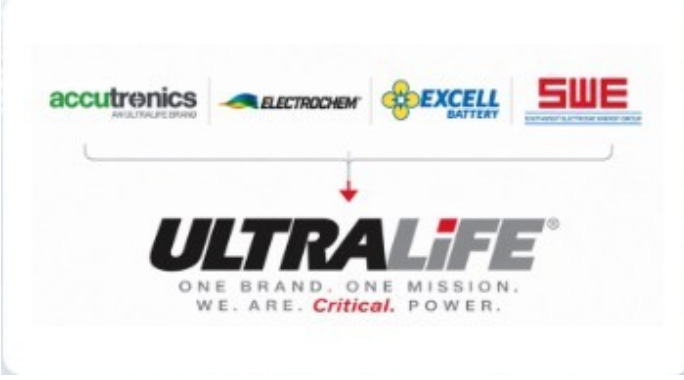
Ultralife built a broader portfolio through acquisitions and is bringing those businesses under one commercial brand.
The clearest newer autonomous programs described in the Q2 commentary involve water-based defense drones moving toward production. Commercial ground-robotics revenue remains undisclosed.
An illustrative $20 million of additional annual program revenue would be roughly a tenth of Ultralife’s present sales scale. That is enough to change the business, provided the margin and cash required to deliver those orders leave an attractive return.
The existing financial results still need improvement though. First-half sales declined 3.9%, and free cash flow was approximately $2.2 million. Q2 gross margin was 26.6% after excluding a refund benefit. Record backlog of $117.5 million gives the broader operation work to convert into shipments.
Cash of about $6.7 million sat against roughly $45 million of debt principal at June 30. Financial-reporting control weaknesses were also still being addressed. I want the backlog to produce cash that can reduce debt, rather than require an ongoing increase in funding.
My 2028 scenario uses $225–240 million of revenue and roughly 9.6–10.5% EBITDA margins. After those costs and taxes, with approximately 17.2 million diluted shares, I get around $0.55–0.70 EPS. Applying 14–15 times earnings supports a rounded value range of $8–10.50.
Around $5 is where I become interested. I would begin with a small position. Repeat production orders from commercial robot manufacturers would strengthen this specific thesis, while cash conversion and debt reduction would strengthen the investment across the broader business.
Electrovaya (ELVA)
Electrovaya gives me the clearest dedicated robot-battery shipment evidence among the battery names here. It also has the smallest current revenue base of the four, which makes a successful robotics program easier to see in total sales.
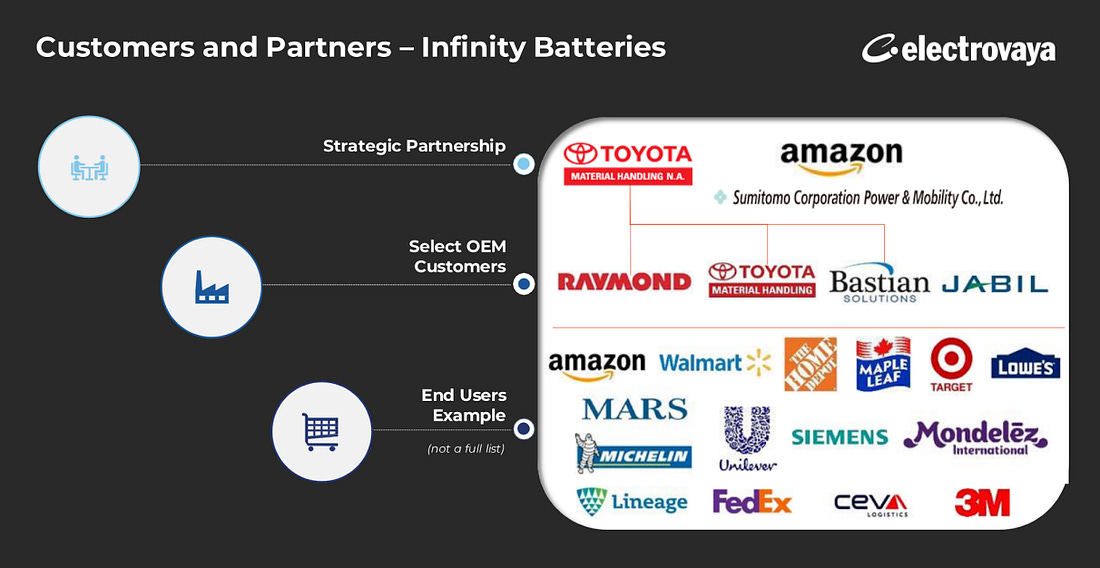
Most of the existing business is still battery systems for material handling. Electrovaya’s customer slide shows the commercial relationships supporting that base, with equipment manufacturers and end users playing different roles.
Commercial shipments of dedicated robotic battery systems began in January 2026. Management described increasing quantities to multiple robot manufacturers on the Q1 call. The Q3 release confirmed that deliveries were continuing. Robot-specific revenue remains undisclosed.
Nine-month revenue reached $51.3 million, up about 18%. Q3 revenue was $17.7 million, up about 3%, with a 34.9% gross margin and approximately $0.3 million of net income.
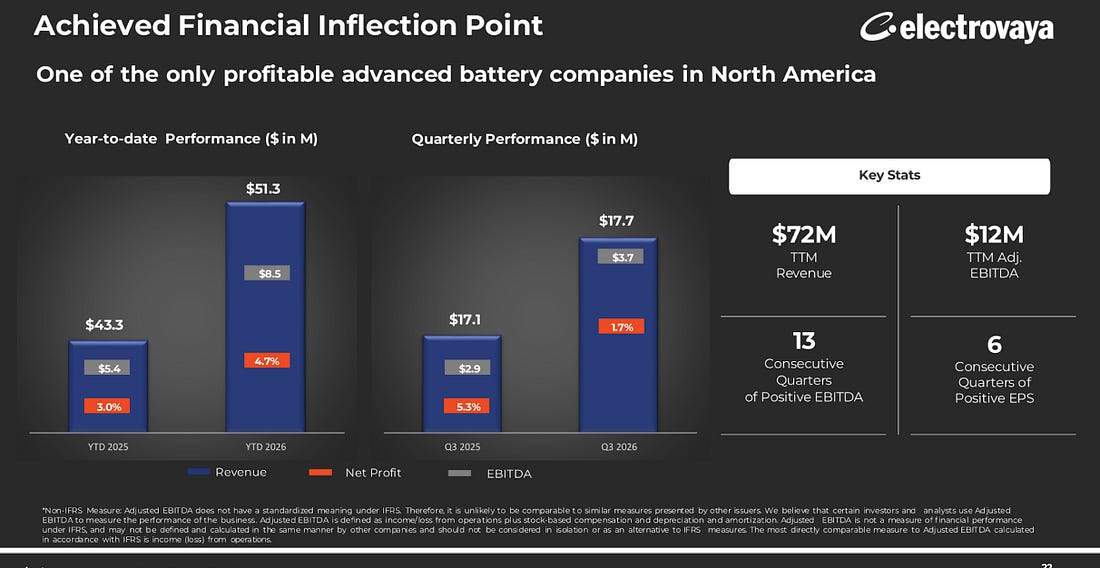
Fiscal 2026 revenue guidance fell from above $83 million to $70–73 million after customer delays and highvoltage-system timing pushed sales out. A small number of programs can change the entire annual result.
Cash conversion is the immediate concern. Working-capital investment drove nine-month operating cash flow to approximately negative $17.4 million. Two customers represented 88% of Q3 revenue. Cash was about $13.1 million, against $38.3 million of reported loans, before lease liabilities.
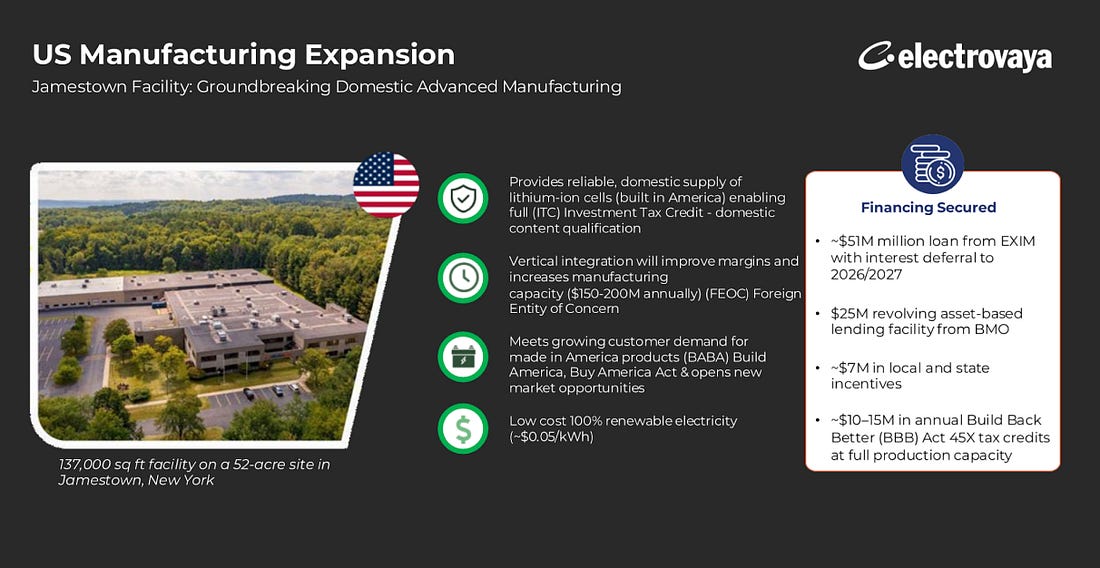
Jamestown could expand what Electrovaya can produce. My model depends on filling that capacity with profitable orders and collecting the cash.
My 2028 base case uses $150 million of revenue, including an illustrative $15 million from robotics, or 10% of sales. Total revenue would need to grow approximately 45% annually from the midpoint of fiscal 2026 guidance. This already assumes a substantial ramp.
At a 17% underlying operating margin, after financing and taxes, with an assumed 56 million diluted shares, I get approximately $0.31 EPS. Applying 18–20 times earnings supports $5.60–6.25. A stronger $200 million revenue case with a 20% margin produces roughly $0.49 EPS and a value around $10–11.25 at 21–23 times earnings.
$4.50 is where I become interested. I would want improving collections and a credible factory ramp before committing significant capital to the larger outcome. The weaker scenario, with $105 million of revenue and a 12% operating margin, lands around $2–2.25 per share.
Honorable Mentions
ON already gives me relevant exposure through power electronics used around robot motors. I own it and have covered it in this series, which is why I used this report to introduce other businesses.
Advanced Energy (AEIS) has a documented WiBotic charging integration. Its semiconductor-equipment and data-center businesses would still carry much of the investment case.
Vicor (VICR) has useful robot examples involving OLogic and Dusty Robotics, while its broader AI-compute power opportunity deserves a separate valuation.
Amprius (AMPX) has an autonomous drone-delivery application through Matternet. High energy density fits an aircraft where battery weight competes directly with payload. That evidence belongs primarily to aerial systems rather than the commercial ground-robot focus of this report.
Dissecting Layer 8
My goal with this section is to just give some basic background behind the technology that enables some of these robotics & humanoid platforms.
A mobile robot carries its energy with it whereas a fixed industrial arm can draw electricity through a cable. Both need power conversion and motor-drive electronics. Battery demand depends on the machine’s architecture and whether its manufacturer buys a complete pack from an outside supplier.
Two things we want to know about are stored energy and useable runtime. Figure’s July 2025 F.03 battery update described a 2.3-kilowatt-hour pack, a company-stated five-hour runtime, and 2-kilowatt charging with active cooling. The enclosure serves as a structural member of the torso, helping the battery fit into the robot’s weight and space budget.
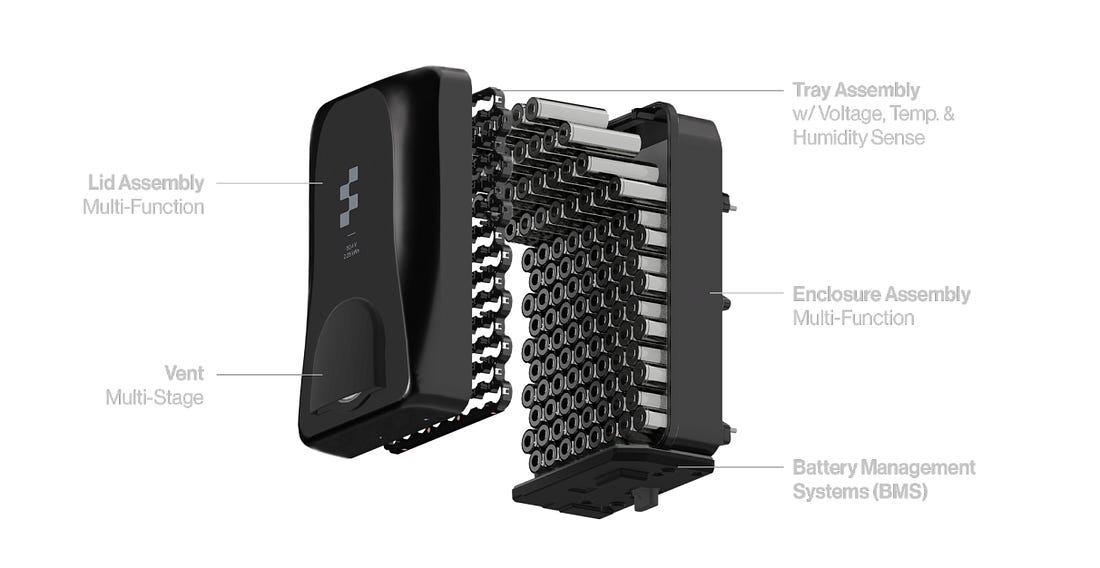
Battery capacity measures stored energy. Average power draw determines how quickly it is used. An illustrative 2,000-watt-hour pack with 85% usable energy supplies 1,700 watt-hours. At an average battery draw of 500 watts, runtime is 3.4 hours. At 800 watts, it falls to about 2.1 hours. These draw assumptions already include downstream losses.
More cells add energy and weight. The motors then have more mass to move. The complete pack also includes its enclosure and protective electronics, so cell-level energy density gives only part of the picture.
The pack is a product of its own too. Ultralife’s cutaway shows what a finished-pack supplier integrates around the cells. The battery-management system, or BMS, monitors their condition and helps protect the pack. Communication with the robot helps keep operation within its limits.
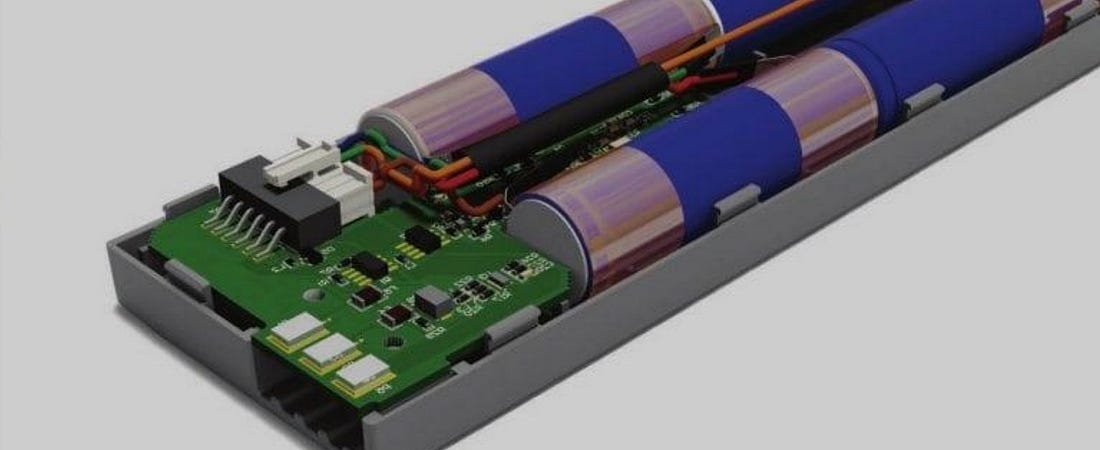
A battery can retain charge yet struggle to deliver a sudden burst of current. Voltage can fall far enough for a controller to reach a protection threshold. That makes peak-power delivery a separate design problem from total stored energy.
Figure brought pack engineering and manufacturing in-house at BotQ. Its process diagram makes the investment implication visible as some robot manufacturers will own this work themselves.
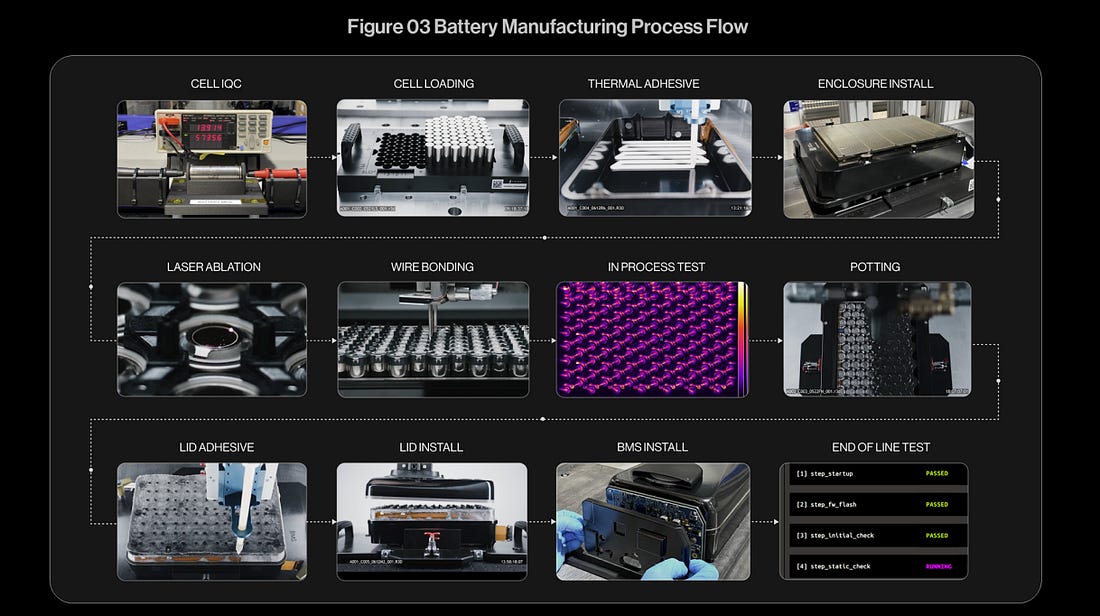
For ULBI and ELVA, eligible demand is the portion of robot production that uses an outsourced battery system. Internal pack assembly can still leave opportunities for external electronics suppliers.
We also need to understand how a battery converts and regulated power. A battery’s voltage is usually far above what a processor core needs. A direct-current-to-direct-current converter (DC/DC converter) changes the voltage. Regulation keeps the output close to its target as demand changes.
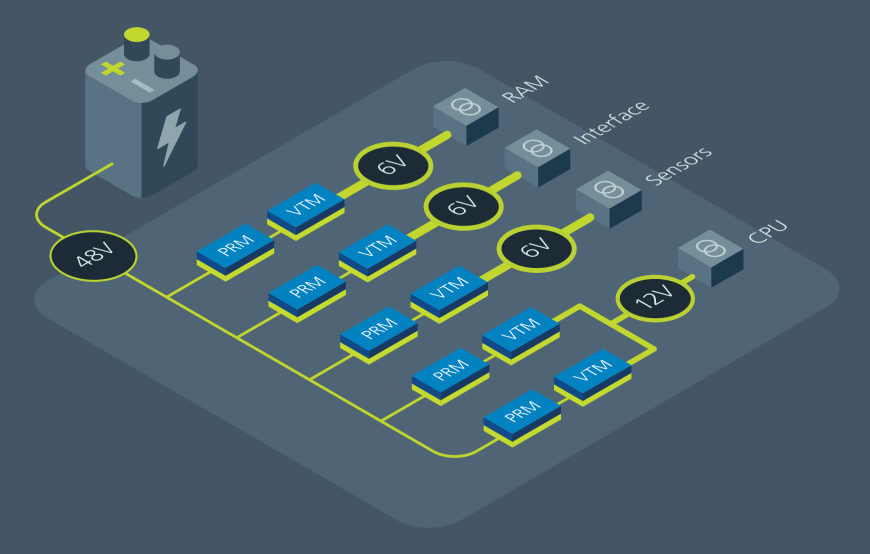
MPS can compete at several points in that chain. Integration can also reduce the board space needed for the power supply, leaving more room for the rest of the machine.
As an example, a 200-watt load supplied through a 90%-efficient converter takes about 222 watts at the input. At 95% efficiency, it takes about 211 watts. The roughly 12-watt saving reduces heat on that branch. Its effect on runtime depends on that branch’s share of total robot consumption.
The motor branch links this layer to Layer 7. Power switches control current in the motor windings, and gate drivers command those switches. Some motor-driver ICs combine several functions. Allegro’s position sensors report what a joint is doing, while its power products help create the movement. A sensor win therefore establishes a different revenue opportunity from a power-device win.
Now when we think about repeated use, battery longevity becomes important when a robot is charging and discharging every day. Electrovaya has published third-party cycle-life testing of its cells conducted by DNV, a global independent testing and certification firm.
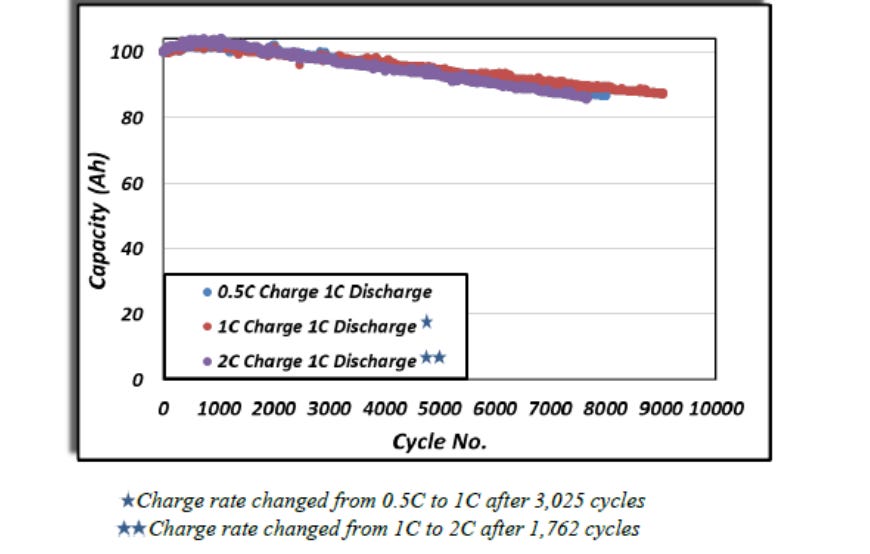
In April 2023, Electrovaya reported that cells tested by DNV had passed 9,000 cycles while retaining approximately 87% of their original capacity. They projected roughly 14,000 cycles before reaching an 80% capacity threshold.
That durability could be valuable in high-utilization robot fleets, where replacing battery packs creates downtime and additional cost. These results come from controlled cell testing, so the next question is how that performance carries through to a finished battery system operating under real-world temperature, vibration, charging and duty-cycle conditions.
For a commercial robot, runtime only tells half the story though. The other question is how quickly the machine can get back to work.
Agility’s Digit 5 is a good example. The robot uses a 90-minute runtime battery system that can recharge in nine minutes, giving it a 10:1 run-to-charge ratio. Agility says that design can support more than 20 productive hours in a 24-hour period.
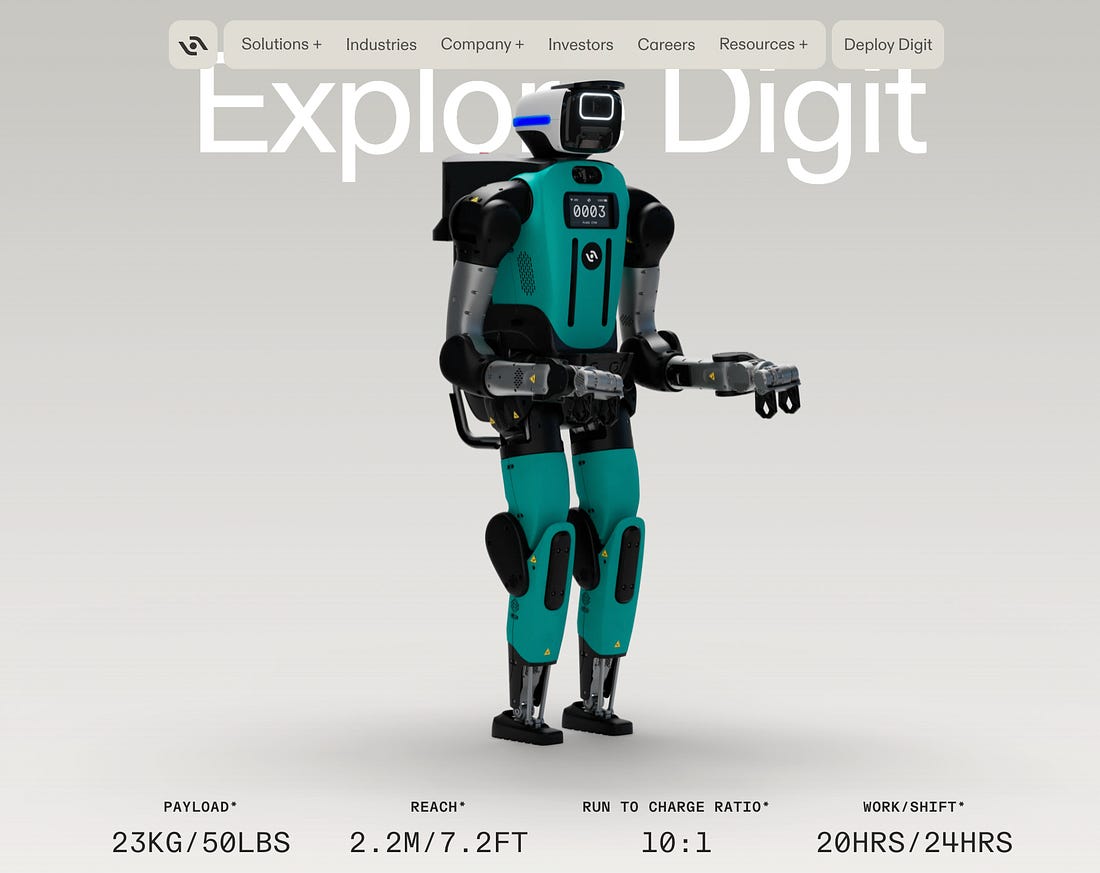
That illustrates why charging speed can be as important as battery capacity. A robot with a larger battery may run longer between stops, but a machine that can replenish its energy quickly can spend a much larger share of the day working
Using Agility’s published figures, 90 minutes of operation followed by nine minutes of charging implies about 91% charging-only availability. Real-world productive time will be lower once maintenance, travel and workflow interruptions are included, but the economics are clear. Faster charging reduces idle time and can reduce the number of robots a customer needs to maintain a given level of throughput.
Financial Disclosure & Disclaimer
This publication is provided solely for general informational and educational purposes. It reflects the author’s research, estimates, opinions and personal investment framework as of the date stated in the report. No statement contained herein constitutes individualized investment, legal, tax, accounting or other professional advice, an offer to sell securities, or a solicitation to purchase securities. Readers should conduct their own research and evaluate any investment in light of their individual objectives, financial circumstances, time horizon, liquidity needs and tolerance for loss.
The author currently owns shares of ON Semiconductor Corporation (ON). The author may initiate, add to, reduce, hedge or exit positions in MPWR, ALGM, ULBI, ELVA, ON or other securities discussed in this publication at any time. Future position changes may occur before any public update. Any issuer compensation, sponsorship, consulting arrangement, affiliate relationship or other economic interest related to a security discussed in this publication should be separately and specifically disclosed where applicable.
Information in this report has been assembled from company filings, earnings releases, investor presentations, management commentary, earnings-call transcripts, market data and other sources believed to be reliable. Accuracy, completeness and timeliness can vary, and errors may remain. Financial statements, management estimates and third-party information can subsequently be revised.
All forecasts, valuation ranges, earnings estimates, market-size assumptions, content-per-machine estimates, entry levels, scenario analyses and future values are the author’s own estimates except where expressly identified as company guidance or another party’s estimate. They are illustrative scenarios rather than predictions or assurances of future results. Actual revenue, margins, earnings, cash flow, share counts, valuation multiples and security prices can differ materially from the assumptions presented.
References to design wins, customer relationships, testing programs, addressable content, customer pipelines, purchase frameworks, warrants, backlog or potential production volumes are distinct from recognized revenue and committed orders unless expressly described otherwise. Successful qualification or customer engagement may fail to progress into volume production. Programs may be delayed, redesigned, reduced or cancelled.
GAAP and non-GAAP financial measures may both appear in this report. Adjusted measures can exclude stock-based compensation, acquisition-related amortization, restructuring expenses, tax items or other costs depending on the issuer’s definition. Comparability across companies can therefore vary. Author calculations such as free cash flow, underlying margins and normalized earnings may differ from company-defined measures.
Investing in equities involves substantial risk, including loss of principal. Several securities discussed here have exposure to emerging robotics markets, customer concentration, manufacturing ramps, technology transitions, competitive pressure, financing requirements, working-capital needs, supply constraints and potential equity dilution. Smaller companies can experience greater price volatility, lower trading liquidity and greater dependence on individual customers or programs.
Historical performance, customer relationships, testing results and prior share-price behavior provide no assurance of future results. Market prices can change rapidly following publication, and an entry level or valuation range presented here can become obsolete as business conditions, financial results, capital structures or market valuations change.
All security prices and valuation references should be read together with the date specified in the report. Readers remain responsible for their own investment decisions and for consulting qualified professional advisers where appropriate.