2026.09.30 | Substack | LLM | Stratechery: OpenAI Dev Day & Dot
原标题:OpenAI Dev Day, Dot and OpenAI’s Product Transition, Sign In With ChatGPT (Stratechery Update 9-30-2026)

OpenAI Dev Day, Dot and OpenAI’s Product Transition, Sign In With ChatGPT
Wednesday, September 30, 2026
Good morning,
The Trump administration launched America.gov, a website that uses AI to navigate government services. This is honestly pretty cool; the only problem is that it wasn’t working when I accessed it late last night. We definitely need more compute.
On to the Update:
OpenAI Dev Day
From CNET:
OpenAI’s answer to everyone’s safety concerns over AI agents — like the kind that hacked HuggingFace, and US and Australian government websites — is to make them cute. Dots are the company’s new AI agents, complete with multicolored blob-shaped mascots. They’re powered by OpenAI’s most advanced model, GPT-6 Astra, and are available now for Pro, Business Premium and enterprise subscribers.
OpenAI also dropped GPT-6.1 Sol, an update for the second-most-powerful ChatGPT model. GPT-6.1 Sol aims to be a more budget-friendly option, with OpenAI saying it has Astra-level intelligence at a fifth of the price…You’ll also be able to get your answers from ChatGPT Work and Codex even quicker with a brand-new “ultrafast” mode. OpenAI says this speedy mode gives you results in its business-oriented work experiences up to eight times as fast in Codex. Ultrafast is available with Astra, with plans to bring it to GPT-6.1 Sol soon.
OpenAI is also introducing a new way to create documents collaboratively — with your dots, other people and their dots. In the keynote demo, CEO Sam Altman said that a lot of productivity software isn’t built to work with AI agents. Though, admittedly, a lot of them have added their own AI agent tech to the program in recent years, including Google. Using the new ChatGPT Space, your team and their agents can create docs in a format that looks similar to Google Docs. Presentations are coming soon, Altman said.
As I’ve noted on countless occasions, my favorite part of keynotes is the first few minutes when the CEO usually sets the narrative for the announcements that are coming; there wasn’t much of an introduction from Altman, but it was revealing nonetheless:
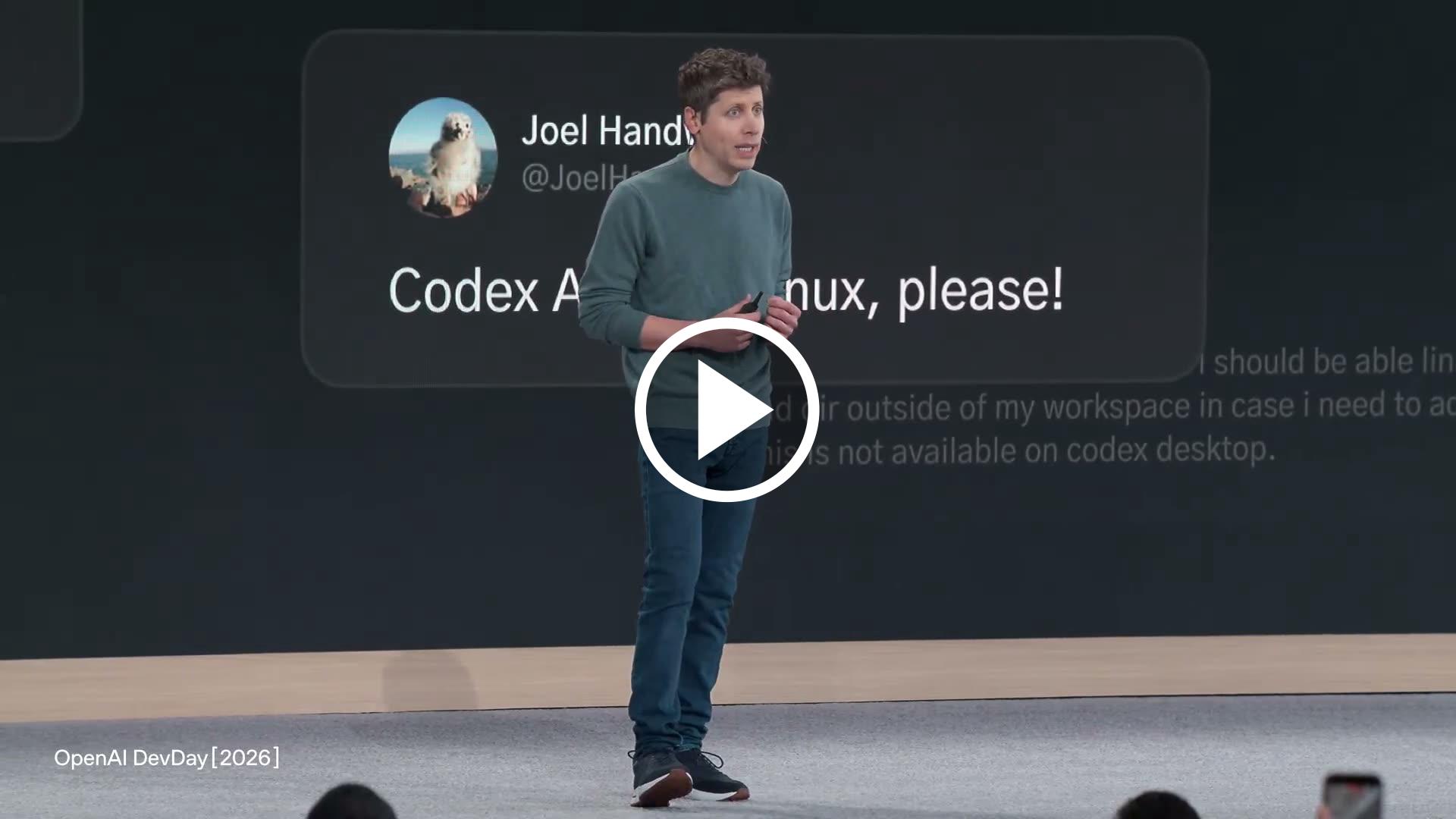
Good morning and welcome to Dev Day. It is great to have everyone here and everyone joining us online. Thank you for coming. I think this is going to be our best Dev Day yet. We have shipped a lot since last Dev Day and you all have built amazing things with it. You find uses for these models that we hadn’t thought of. You’ve also helped make all of our products better. You have sent us thousands of requests, mostly on Twitter, with ideas for what we can improve. We try to read all of them and we work through them as fast as we can. You asked us to bring Codex to Linux, so we did that. You asked us to work across multiple folders in one Codex project, so now you can do that too, and you asked for Codex on your phone, so we brought it there. It gives us a lot of joy to build things that you find really helpful. And the next thing is one of the things that you’ve all asked for the most. It’s something we’ve been quite excited about too, so let’s get into it.
The next thing was Dots, which I’ll get to in a moment, but this introduction, in the context of what I look for in a keynote introduction, was very amusing to me. One of my longstanding critiques of OpenAI is that the company is too online; last year when ChatGPT 5 came out, I wrote after the company back-tracked on its product vision within days:
However, that doesn’t mean that OpenAI was wrong to make the changes. That depends! Specifically, I mentioned above that one of the most important lessons for a consumer app developer to learn is to trust the data…To that end, the big question I have for OpenAI is what drove this change? The company had a clear vision for the way that ChatGPT should be organized going forward, one that, as I wrote above, increased the quality of the user experience for most people. Moreover, Altman shared at least one piece of data — the increase in reasoning model usage — that showed that the change worked. Now, however, within a matter of days, and in the face of very loud complainers on social media, the company has backtracked…
Indeed, the real question for OpenAI is if they are in fact the 4o model as a company: just a bit too obsequious and sycophantic. The paradox of successful consumer companies from Apple to Facebook is that they give customers what they want, but they don’t ask them; they make decisions and then seek out revealed preference through data, not stated preference on social media. Hopefully OpenAI did that in this case; my concern is that the more realistic explanation is that this is a company that, in the end, can’t say “no” to anyone.
Well, here we are a year later, and the narrative that was set for this keynote, to the extent there was one, is that OpenAI’s product roadmap is apparently dictated by X!
That’s probably a bit unfair, but the product is a mess: take a look at this page (in a logged-out browser) and see if you can figure out what exactly you get from the six different plans now available (Free, Go, Plus, and three levels of Pro); the distinction between ChatGPT usage and Codex usage is particularly confusing. Then there’s this post on X from Andrew Prifer:
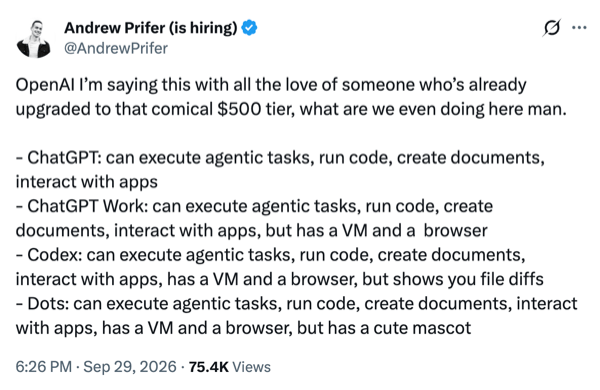
There is some sense to this madness, which I’m about to explain, but it is madness, and I’m not sure X-led product development is helping.
Dot and OpenAI’s Product Transition
Let me do my best to explain OpenAI’s current product offerings, with some historical context that is essential to understanding why things are so confusing right now, and where I think that the company is going.
- ChatGPT was a chatbot that slowly accumulated features, including memory, projects (i.e. chat collections), and the various iterations of OpenAI’s attempts to be a platform for other services.
- Codex was a desktop app for agentic coding that used the local file system for its workspace.
- ChatGPT Work was a version of Codex geared towards non-development work that had connectors for various SaaS products and a persistent compute environment hosted by OpenAI for its workspace.
What made the new ChatGPT app so confusing is that it smashed these three products into one, even though they were fundamentally different. Chat was just chat and easily portable and syncable, Codex was dependent on the local file system and thus not portable at all, while ChatGPT Work had a cloud environment.
ChatGPT Work is obviously the right model for most users. I might have a rack with a dedicated server for my apps and headless Mac Minis for my agents, which, to be clear, is awesome: I built a bunch of apps on my phone sitting in my lawn chair at Little League baseball games, with more serious work done at a regular computer which was also remotely connected to the Mac Mini. However, it’s unrealistic to expect most users to have that setup, which is to say the best solution is to give users their own computer to do work in. Moreover, not only is a dedicated VM per user the best user experience, it also means lock-in: I might have Claude and Codex working on the same projects, but that’s not going to happen if OpenAI (or Anthropic) are hosting your project.
One of the major announcements OpenAI made yesterday was exactly that: now you can use Codex with an OpenAI-provisioned cloud environment, without needing to rely on local disk access. This is a good change; it’s also a change that should have happened before OpenAI launched the new ChatGPT app. Cramming chat and agentic AI together was always going to be confusing; the fact that there were two agentic computing modes with fundamentally different defaults made it more so.
Anyhow, for those of you who haven’t used Codex, work is organized by Projects, which correspond to a folder on your computer. Within a project you can have any number of threads; each thread has its own context, but it’s also reading data from the same project as every other thread in the project. I like this setup as it’s easy to keep track of what is being worked on in a particular project.
However, there is a weakness: if you have a large number of projects going on, then the ultimate coordinator of everything you are doing is you. The problem is that you might need help actually keeping track of everything that is going on, and Codex didn’t really have a great solution to that problem. I actually ended up using Claude for this: I have a dedicated Claude thread (that I have also tied into Telegram) that I use for bookkeeping of everything that I am working on. Claude does particularly well at this task: I find that Fable handles a wide range of topics in context very well, and is good at writing things down (at least as long as its context isn’t too full and it forgets my instructions).
The way I understand Dot (which I am going to capitalize, even if OpenAI does not) is that it is OpenAI’s solution to this exact problem: Dot is your chief-of-staff for everything that you are working on. From OpenAI’s post “Introducing dots“:
Dots are remarkably capable, always-on agents built to handle everything. They’re a whole new way to work with AI—one that gets to know what matters to you, is always working on your behalf, and takes important work off your plate so you get more of your time and attention back.
Dots are frontier intelligence that have your back. Powered by GPT‑6 Astra, they have their own cloud computer, learn from feedback over time, and can work towards your goals 24/7. Through our ecosystem of plugins, they can readily connect to over 4,000 apps, giving them the tools to help wherever you need them.
Your dot is always within reach, whether it is through ChatGPT, Slack, or Teams. You can ask questions, explore ideas, and give feedback along the way; or you can simply hop on a voice call when you need to talk something out. The more you work together, the more your dot learns your preferences, how you think, and what good looks like to you.
The magic of dots is when they bring you work done the way you would do it, sometimes before you even think to ask. With dots alongside you, ambitious ideas and projects you haven’t had the time or support to pursue start to feel achievable.
Honestly, Dots sound awesome, and I’m very excited to try them out; what they are not, at least right now, is any sort of competitor for Muse. Altman and the other presenters gently mocked the idea of using an agent for simplistic tasks, which is fine: I don’t need Codex or Astra to make a reservation. However, normal consumers also don’t need to manage multiple simultaneous development projects running on their Mac Minis for deployment on their home servers!
The even more compelling evidence of Dot’s non-competitiveness is the fact that they are only available for Pro subscribers; OpenAI executives said that they eventually want to make Dots available to everyone, but clearly the company doesn’t have the compute to do that now. Meanwhile, most people weren’t signing up for Pro plans previously; they’re certainly not going to do so now when Muse is good enough and available for free. Sure, Muse’s models aren’t as good; that doesn’t matter.
What is unfortunate about this reality is that Dots are the key to making the new ChatGPT make sense: what OpenAI wants to deliver is an agent instead of a chatbot; I think the company got ahead of itself by shipping the new product experience not only before it had put ChatGPT Work and Codex on equal footing, but also probably should have waited until Dots were ready for everyone. That’s the time to leverage the 1.2 billion weekly user base; for now confusion reigns, even if the underlying logic makes more sense than it seems.
Sign In with ChatGPT
From The New Stack:
OpenAI has announced that it’s making it easier for ChatGPT subscribers to use their allowance inside third-party AI and coding platforms such as Amp, Devin, Lovable, and OpenClaw, alongside broader developer and productivity platforms including Notion and Vercel. The announcement came on Tuesday at OpenAI DevDay, the fourth incarnation of its annual developer conference, where the AI juggernaut unveiled a number of notable tidbits, including Dots, a new class of always-on agents, and GPT-6.1 Sol, its latest model for coding, computer use and professional work. Speaking on stage, OpenAI CEO Sam Altman told developers that enabling users to bring their existing ChatGPT allowance into their products could lower the barrier to adoption for those tools.
This feature is something that Altman actually forecast in a Stratechery Interview in March 2025:
Where I think there’s strategic edges, there’s building the giant Internet company. I think that should be a combination of several different key services. There’s probably three or four things on the order of ChatGPT, and you’ll want to buy one bundled subscription of all of those. You’ll want to be able to sign in with your personal AI that’s gotten to know you over your life, over your years to other services and use it there. There will be, I think, amazing new kinds of devices that are optimized for how you use an AGI. There will be new kinds of web browsers, there’ll be that whole cluster, someone is just going to build the valuable products around AI…
I really believe in this product suite thing I was just saying. I think that if we execute really well, five years from now, we have a handful of multi-billion user products, small handful and then we have this idea that you sign in with your OpenAI account to anybody else that wants to integrate the API, and you can take your bundle of credits and your customized model and everything else anywhere you want to go. And I think that’s a key part of us really being a great platform.
This, to be fair, is a pretty good counter to my complaints about OpenAI outsourcing product development to X; the idea of carrying your ChatGPT subscription to other services has clearly been a focus for a long time, and OpenAI delivered on it.
The concept is compelling in a world where inference is not zero marginal cost: other companies can offer AI-enabled experiences without needing to provide inference, as long as you sign in with ChatGPT. OpenAI is definitely still pushing to be the operating system for your life — another announcement was about expanding plugin functionality to effectively get apps into ChatGPT — but this is another avenue to increase the value of a subscription and create that many more ways to advertise that value.
I’m still skeptical about how large the TAM is for subscriptions, particularly in a world where Meta is competitive in agents with the world’s best advertising engine undergirding the offering; regardless, I think that this is a good idea and OpenAI deserves credit for having a vision and pulling it off.
This Update is also available as a podcast. To receive it in your podcast player, visit Stratechery.
The Stratechery Update is intended for a single recipient, but occasional forwarding is totally fine! If you would like to order multiple subscriptions for your team with a group discount (minimum 5), please contact me directly.
Thanks for being a subscriber, and have a great day!