2026.09.30 | Substack | Markets | TMTB Morning Wrap
原标题:TMTB Morning Wrap
Good morning. QQQs hovering around flat as macro was relatively quiet overnight. Oil +1.6% while yields are flat.
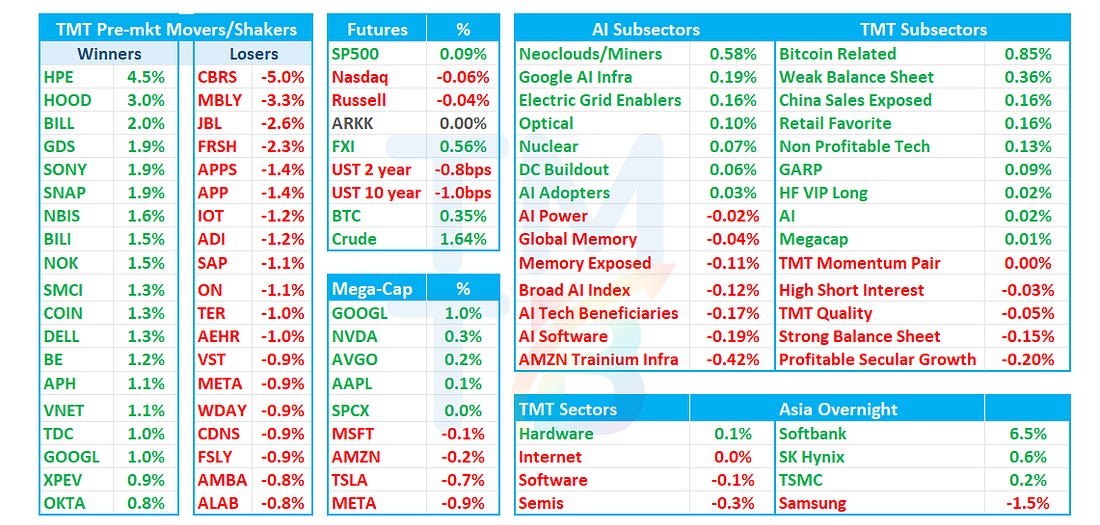
In Tech, we get SNPS analyst day, HPE Networking event (stock +4% after raising FY27 networking growth to highs teens/low 20s and increasing synergies target to $800M vs. $600M), and MU earnings (bogeys below). CBRS -5% the main loser after reports Ultrafast is using NVDA chips instead of theirs. HOOD +3% after more agentic announcements yesterday. GOOGL +1% the Megacap standout as rumored benchmarks of Gemini 4 Pro continues to make the rounds on X.
Overnight, Asia mixed to green: TPX +1.67%, NKY +1.94%, Hang Seng +0.37%, HSCEI +0.5%, SHCOMP +0.31%, Shenzhen -0.23%, Taiwan TAIEX +0.65%, Korea KOSPI -0.48%. Softbank +6.5% following OAI proxies up after ARR numbers.
Lots to get to this morning, so let’s get to it…
CRWV/NBIS: William Blair initiates OP, sees neocloud market growing ~10x to $250B by 2031
William Blair estimates global neocloud revenue grows from ~$25B in 2026 to ~$250B by 2031, supported by inference, agentic workloads, enterprise AI, hyperscaler offload and sovereign compute; CRWV, NBIS, IREN and Nscale already have roughly $275B of customer commitments. Blair initiates CRWV and NBIS at Outperform, calling them the best-positioned scaled players given power/capacity access, financing capability and execution, with both increasingly moving up-stack into broader cloud/software services. The key debate is whether today’s attractive economics survive normalization: GPU pricing has been stickier than expected and paybacks are shrinking, but returns remain highly sensitive to utilization, pricing and leverage as hyperscaler-owned capacity ramps.
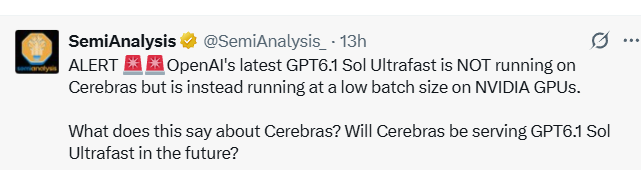
CBRS: Semianalysis says OpenAI Ultrafast not running on Cerebras
OpenAI:
Source: TaeKim on X

AI Safety: WH Meeting seemingly goes well
Reuters reports President Trump and AI executives signed a voluntary safety pact that includes independent audits and internal controls to prevent unauthorized access to computer networks. The administration also backed further data-center expansion. Trump is considering a roughly 10-person oversight committee and plans to name a new AI official, while the agreement relies on voluntary commitments rather than new binding federal regulation.


Sawyer Merritt
@SawyerMerritt
Here is Elon Musk's and Jensen Huang's full interview alongside Gavin Baker today during the White House livestream. They take about power needs in the coming years, Super-intelligence, Starship, how AI is helping the average American, and more.

9:30 PM · Sep 29, 2026 · 223K Views
44 Replies · 248 Reposts · 2.02K Likes
APP: Wells says eComm pixel acceleration looks like a false start, mostly APAC/no-traffic sites
Wells says recent APP pixel additions have accelerated, but the inflection is largely APAC Shopify sites with little or no web traffic; when weighted by traffic, adoption remains roughly flat, suggesting no meaningful customer-growth inflection exiting 3Q, sees customer acceleration unlikely before 2027; stays EW/$325.
MBLY: Barclays downgrades to EW as advanced ADAS wins lag and VW/China risks rise
Barclays downgrades MBLY to Equal Weight from Overweight and cuts PT to $9 from $14, arguing the company still has not landed enough large advanced-content wins to validate the longer-term ASP/growth thesis despite resilient near-term results. Barclays sees added risk around the VW ramp, where SuperVision carries ~$1,300 ASP vs. ~$50 today and Surround ADAS ~$125 vs. ~$46 base ADAS, but launch delays and potential competition from Horizon/Rivian could pressure the expected ramp. CEO transition adds execution risk while China is also becoming a bigger overhang as Horizon has reached roughly half of the China L2 ADAS market versus MBLY at ~25%
WDAY: 2.5% RIF focused on product/tech, FY27 guide intact
WDAY announced a 2.5% RIF focused mainly on product/technology, alongside select office reductions, while still planning to hire in strategic areas, suggesting a shift toward AI talent. FY27/F3Q27 guidance was reiterated except for lower GAAP operating margin from $65–80M of restructuring charges; non-GAAP estimates are unchanged.
MU Bogeys:
LTAs: ~35% of bits under LTA with ~50% fwd commentary Q4 EPS: $33+ vs street at $31.5 Q4 GM: 87% vs street at 86% Q1 Rev Guide: $59B vs street at $56.5B Q1 EPS Guide: ~$37.5 vs. street at $35.65 Q1 GM Guide: ~88% vs street at 87%
MSFT: Piper sees ~$2B E7 uplift per 10% conversion + Cowork consumption at ~$2B run-rate by FY28
Piper says every 10% of E5 seats that migrate to the new $99/month E7 SKU could add roughly $2B of annualized revenue, against ~118M E3/E5/E7 seats today, though near-term impact should be limited. Piper also sees Copilot/Cowork consumption revenue scaling to a ~$2B annualized run-rate by FY28 YE, potentially reaching that scale in roughly half the time it took seat-based M365 Copilot. Increased confidence in the M365 outlook drives the PT to $610 from $550, with Overweight reiterated.
TSM: JPM raises FY27/28 EPS 5%/6% on tighter N3/N2, sees much faster capacity ramp
JPM expects 3Q at the high end of guide with $45.8B revenue and 66.8% GM, followed by ~11% q/q growth in 4Q and ~41% USD revenue growth for FY26, with N3 capacity the main constraint. JPM raises FY27/28 EPS 5%/6% and now models ~39% revenue growth in 2027 and ~30% in 2028, helped by ~10% leading-edge wafer price increases, strong AI demand and the N2 ramp and their capex estimates move to ~$86B/$100B for 2027/28, with N2 capacity reaching ~118k/210k wafers per month by YE27/YE28 and an earlier A14 ramp potentially contributing in 2H28; PT rises to NT$3,300 from NT$3,200.
SPCX: Needham IR call pushes AI compute ramp later, cuts ’26/’27 estimates
Needham says after speaking with SpaceX IR, most announced AI compute deals now ramp in 4Q26, including one beginning in December, with those deals alone reaching a combined ~$54B annualized revenue run-rate and supporting management’s ~$100B total-company ARR target by YE26. Needham cuts 2026/27 revenue to ~$47.5B/$128.7B from ~$58.0B/$148.7B and EPS to $0.39/$3.10 from $1.23/$4.84 to reflect the slower ramp, but sees upside if deployments accelerate. IR also outlined potential for another ~660K GB300s by year-end, which would take compute capacity to roughly 2.5GW vs. ~1.4GW through June and above the prior ~2GW YE target.
MDB: Piper says investor day raises confidence in 20%+ growth and $5B+ revenue path
Piper says after MDB’s investor day, management shortened the path to $5B+ revenue to ~3 years from 3–5 years and raised its growth framework, with Atlas now expected to grow mid-20s vs. 20%+ prior, EA/Other ARR 10%+ vs. LSD-MSD, and total revenue 20%+ vs. high-teens. Piper sees room to beat those targets as AI demand develops, with Atlas Agent Engine positioning MDB as the memory/context layer for agents. Despite near-term uncertainty from the CEO transition, Piper views execution as intact and also highlights 100–200bps of annual operating-margin expansion, 80–100% FCF conversion and GAAP profitability beginning in FY27.
APH: Wolfe initiates OP, sees AI Datacom estimates well above Street
Wolfe initiates APH at Outperform with a $105 PT, arguing AI revenue is already annualizing at ~$10B and its ’27/’28 Datacom revenue estimates of $22B/$27B sit 7%/19% above Street. Wolfe sees APH as well positioned even as AI interconnect shifts from copper to optical, while non-Datacom businesses are still growing HSD/LDD with >30% incremental margins. Wolfe also flags accretive M&A and continued margin expansion as additional EPS upside drivers.
GLW: MS says AT&T LTA reinforces optical demand, with capacity ramp the key swing factor
MS says AT&T’s >$3B multiyear deal, Verizon’s >80M fiber-mile commitment through 2032 and an NVDA-backed build extend demand visibility and support a return toward MSD Carrier growth as capacity comes online. Near term, constrained supply and project timing keep growth uneven, while ~$800M of added capex/startup costs pressure margins before leverage improves around 4Q. MS stays EW/$165, with upside tied to faster capacity additions and higher-margin innovation adoption
BE: JPM says management meeting reinforces demand/capacity confidence, with 800V DC an added advantage
JPM says after meeting with Bloom management, demand remains robust despite macro/policy noise, with the company’s planned Fremont expansion and reiterated 6–9 month build cadence per incremental GW supporting confidence in pipeline visibility; management says automation can take output to 5 GW with roughly the same headcount as 1 GW. Ameren’s plan for 500 MW of natural-gas fuel cells by 2030 is viewed as another positive endorsement of SOFC demand, even though Bloom was not specifically named.
BE: CEO remains confident in demand across end markets – Bloomberg (video)
Bloomberg reports Bloom Energy CEO KR Sridhar remains confident in demand despite some data-center deployment headwinds. In an interview, Sridhar said demand for on-site power is broadening beyond data centers to factories and hospitals as customers seek reliable electricity supply.
HOOD: MS says HOOD Summit reinforces more activity thesis, with Agents + U.S. perps adding monetization upside
MS says HOOD delivered the two products it was watching most closely: Robinhood Agents, where agentic accounts have already grown to >150K from nearly 100K at 2Q, and U.S. perpetual futures across eight crypto assets with leverage up to 10x. MS sees Agent Apps creating a new services revenue stream with HOOD potentially taking ~25–30% of third-party data/tool economics, while U.S. perps are not yet in estimates and could add upside if adoption is strong. Broader 24/7 equities, ~35% longer options hours and 4x intraday margin further reinforce MS’s OW thesis around more assets/customer, activity/customer and monetization.
NETWORKING: Bernstein initiates positive on sector, sees AI bandwidth bottleneck driving higher-for-longer growth
Bernstein sees networking/optics as structural AI winners, modeling ~18% industry growth in ’26–’28 led by ~33% cloud/AI as accelerator volumes double, switching outgrows compute and transceiver revenue compounds ~40% from $57B in ’26 to ~$300B by 2030. Scale-across adds another ~$8–10B+ opportunity, potentially conservative.Bernstein rates CLS/LITE/COHR/CIEN/ANET Outperform and CSCO/GLW Market Perform, with further hyperscaler capex revisions around Muse/agentic demand a potential catalyst.
CLS: Bernstein initiates OP/$520, sees ’27 numbers materially above Street
Bernstein models ’27 revenue/EPS at $40.0B/$23.79 vs. Street at $35.5B/$19.69, driven by ~$7.6B incremental Google TPU revenue, ~$11.6B from OpenAI Jalapeno and ~$6B from Helios/1.6T switching. Bernstein sees the 10/27 analyst day as the key catalyst, with execution/timing on Jalapeno and Tomahawk 6 the main risks.
LITE: Bernstein initiates OP/$1,220 on optical scarcity + operating leverage
Bernstein sees transceiver industry revenue growing ~40% CAGR from $57B in ’26 to ~$300B by 2030 as higher speeds drive ASP upside, while laser capacity remains constrained through 2028. LITE should benefit disproportionately given its purer optical exposure and higher incremental margins, with CPO yield concerns viewed as overdone because NPO would preserve similar laser economics.
COHR: Bernstein initiates OP/$350 on optical pricing, but sees less margin torque than LITE
Bernstein expects COHR to grow broadly with the ~40% CAGR transceiver market and models ’28 revenue at ~$15.7B vs. ~$14.7B Street. Vertical integration provides more geopolitical protection but lowers incremental margins versus LITE, while Bernstein still sees upside from higher transceiver pricing and AI optical demand.
CIEN: Bernstein initiates OP/$440, sees scale-across TAM well above current expectations
Bernstein sees management’s $8–10B scale-across TAM as conservative, estimating ~$10B from new builds plus ~$9B of retrofit opportunity, with CIEN holding ~70% share. Near-term upside is capped by ceramic packaging, pump laser and memory constraints, but Bernstein expects supply to improve beyond 2027 and models ’29 revenue at ~$14.2B vs. ~$13.6B Street.
ANET: Bernstein initiates OP/$250, sees continued AI switching share gains
Bernstein sees ANET benefiting as InfiniBand gives way to Ethernet in scale-out and potentially NVLink to UALink in scale-up, with AI back-end switching share rising from ~3% in 2024 to ~9% in 2026E. Bernstein models roughly $18B of ’27 revenue vs. $16.3B Street and sees upside to numbers despite a fuller valuation.
CSCO: Bernstein initiates MP/$110, sees tactical upside but weak strategic positioning
Bernstein argues CSCO’s software pivot came at the wrong time, with security/observability slowing to ~2%/~4% growth while the company lost ground in the faster-growing AI hardware market. Acacia, Silicon One and a conservative FY27 guide could support near-term upside, but Bernstein sees ~20x ’28 EPS as fair for an ~8% grower.
GLW: Bernstein initiates MP/$140, sees AI optical upside largely priced in
Bernstein models Enterprise Optical Communications growing ~65% CAGR in ’26–’28 as optical content per accelerator rises, but Glass and Auto remain low-growth offsets. Bernstein lands at ~$28.2B of ’28 revenue vs. ~$27.7B Street, yet views GLW’s longer-term framework as aggressive unless scale-up drives another content step-up.
China AI / DeepSeek / Huawei / NVDA: New Ascend software tools challenge Nvidia’s ecosystem – Bloomberg
Bloomberg reports DeepSeek released free, open-source software tools designed to improve performance on Huawei’s Ascend 950 AI chips, offering an alternative to Nvidia’s software ecosystem. The toolkit includes TileLang, which helps developers write and optimize code for the accelerators. Huawei assisted with development and will continue collaborating with DeepSeek, deepening their effort to make Chinese AI hardware easier to use for model development.
Memory: Q4 DRAM prices seen up 10–15%; NAND up 15–20% – China Times
China Times reports TrendForce expects conventional DRAM contract prices to rise 10–15% sequentially in Q4 and NAND flash prices to increase 15–20%. Suppliers continue shifting capacity toward server products, supporting pricing even as consumer demand remains weak. Enterprise SSDs are expected to be the only NAND segment with accelerating price increases, while their bit demand is forecast to grow more than 80% in 2026.
SHOP: UBS sees modest but high-margin Payments upside, with Muse/Instinct preserving Shopify economics
UBS says Shopify now lets merchants using third-party processors also enable Shop Pay/APMs and backup card processing through Shopify Payments, charging a new 1.25% premium fee; each ~100bps of incremental GPV could add ~1%+ to total gross profit, though the addressable volume is relatively small. UBS also argues agentic checkout through Meta Muse and Instinct does not disrupt Shopify’s payments economics, making the Meta Pay concern less threatening than the initial read.
SHOP: Jefferies sees money transmitter licenses as next Merchant Solutions unlock, with ~5% ’28 OI upside
Jefferies says SHOP’s pursuit of nationwide money transmitter licenses could let it control more of merchant fund flows, capture float economics and add new financial products, with its base case implying ~2% upside to 2028 gross profit and ~5% to operating income. Jefferies argues this is not a bank charter, card-acquiring strategy or end to the Stripe partnership, but rather a way to deepen merchant relationships, improve negotiating leverage and internalize more economics over time. Jefferies keeps Buy/$175.
NTAP: JPM says NTAP Insight reinforces AI storage opportunity, with Novus TAM seen doubling to ~$40B
JPM says after attending NetApp Insight 2026, management framed AI as driving a new storage/data-management cycle and sees preliminary Novus TAM growing from ~$20B today to ~$40B over the next few years. Management also said the software-heavy mix should not dilute corporate margins, while Oracle OCI expands first-party cloud reach alongside Google and SAP.
DKNG: JPM G2E meeting with CFO/IR points to solid OSB, but heavier prediction-market spend could pressure FY26 EBITDA
JPM says after meeting with CFO Alan Ellingson and IR Matt Gaudioso at G2E, OSB trends remain healthy with handle +15% y/y through the first two NFL weeks and 3Q/NFL hold “just fine,” while management remains confident in ~$1B of FY26 core EBITDA and 30%+ longer-term margins. JPM interprets DKNG’s plan to pull prediction-market investment forward from FY27 into FY26, above the prior $200–300M framework, as implying total FY26 adj. EBITDA could come in below the current $700–900M guide, though management says PM LTVs are higher, CACs lower and paybacks faster than initially expected.
DKNG: Hearing M-sci saying share trends have improved sequentially in Q3
W: Piper management meeting points to accelerating share gains and upside to ’27 growth
Piper says after meeting with CFO Kate Gulliver, IR Nick Wiles and Global Head of Finance Matt Lesniak, management expressed confidence that sales growth can accelerate beyond Q3’s +HSD guide, driven by share gains rather than an industry recovery. Piper sees this as increasingly at odds with Street-style 2027 assumptions for growth to decelerate to 7.4%, with Verified SKUs showing ~20% higher conversion/NPS and new stores expected to add ~4–5 pts to sales growth over coming years. Management also cited accelerating Q3 share gains and sees agentic AI as a longer-term competitive advantage
SPOT: Wells sees ’27 mid-teens growth + ~2pts/yr OI margin expansion despite near-term estimate cuts
Wells says 3Q should be the first read on ’27, where it sees opex growth moderating to ~7% while Premium net adds, add-ons and pricing support mid-teens revenue growth and ~2 pts of annual OI margin expansion through 2030. Wells pushes the AI Music tier launch to ~2Q27 from 1Q, with rights-holder negotiations the gating factor, and models ~$0.9B/$1.7B of add-on Premium revenue in ’27/’28. Near term, Wells trims 3Q OI to €659M from €673M, 4Q GM to 33.7% from 34.2%, and ’27 EPS to €14.90 from €15.05, while keeping OW/$570.
ADSK: BNP says IR call supports broad but gradual AI monetization, with M&A strategy clarified
BNP says after an IR call with head of IR Simon Mays-Smith, Autodesk sees multiple AI monetization paths, including seat-based agents, metered consumption and EBAs, but expects adoption/pricing to take time given AEC customers’ risk aversion. BNP also says MaintainX is the cornerstone of a broader “build-up” M&A strategy into the ~$40B operations TAM, while ADSK remains confident frontier-model competition is more tailwind than threat. No change to guidance; BNP stays Outperform/$300.
NEWS
OpenAI: Delays IPO as it seeks $30B and approaches $70B ARR – FT / Axios
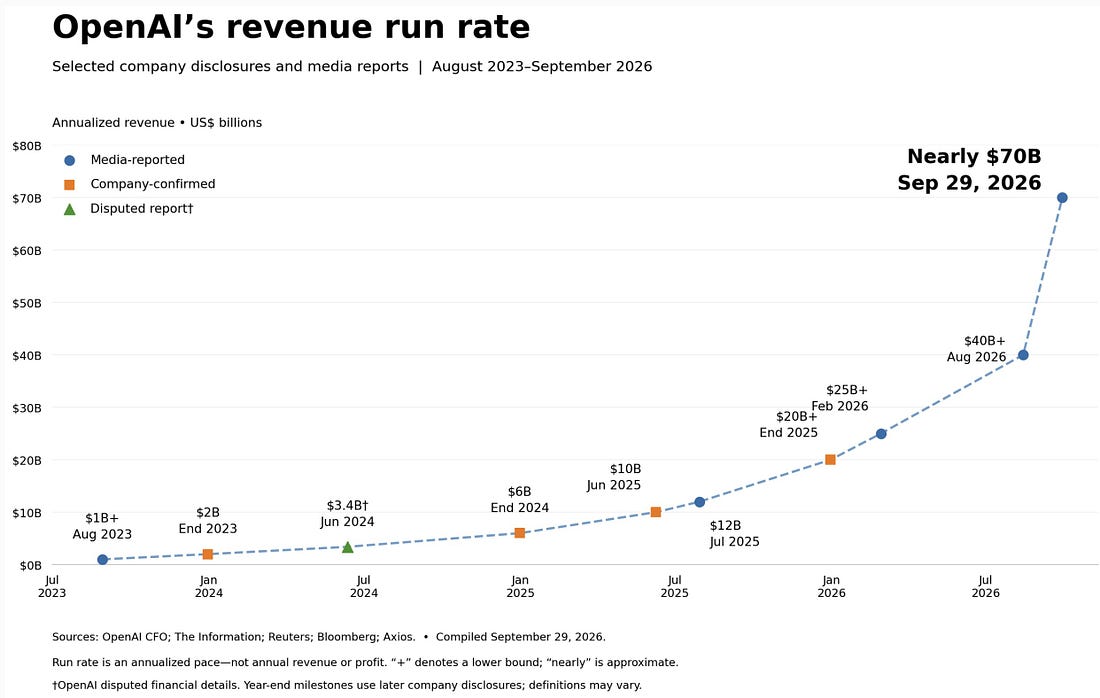
FT reports Sam Altman plans to hold off on an IPO until OpenAI can address safety and alignment issues internally, while the company seeks at least $30B in fresh funding at a $1.4T valuation. Axios reports annual recurring revenue is approaching $70B, up roughly 70% since July, with enterprise business more than doubling over that period. FT also reports OpenAI has reached 1.2B users and is developing a personal assistant called Dots.
Anthropic / AMZN / GOOGL: Cloud partners generated 47% of 2025 revenue – Reuters
Reuters reports Anthropic’s IPO filing shows $2.16B, or 47% of 2025 revenue, came through AWS and Google Cloud, up from 32% in 2024 and 11% in 2023. Anthropic paid $351M in distribution fees, roughly 16% of those channel sales. It recognizes marketplace revenue gross and records the fees in sales and marketing rather than cost of revenue. Two end customers each accounted for 12% of total revenue.
AI Infrastructure / PJM: FERC pauses emergency capacity plan through February – Bloomberg
Bloomberg reports FERC accepted PJM’s emergency capacity procurement plan but suspended it until February 28 while the grid operator addresses cost allocation, collateral and customer exit provisions. The delay could be shortened if PJM resolves those issues sooner. The plan follows a 6.8GW shortfall in its latest capacity auction, with regulators seeking to protect existing customers from costs tied to data-center projects that fail to materialize.
TSLA: Secures $30B in new credit facilities – SEC filing
Tesla disclosed $30B of senior unsecured credit facilities: a $20B three-year delayed-draw term loan, an $8B five-year revolver and a $2B 364-day revolver. The facilities replace its previous $5B revolving line and are available for general corporate purposes. They were undrawn at signing, and Tesla said it does not expect to borrow under them during 2026.
GOOGL: Pays more than 100 publishers for AI search content – The Information
The Information reports Google is paying more than 100 digital publishers in a pilot covering AI Overviews, AI Mode and Gemini. Payments reflect a publisher’s contribution to the value of an answer, rather than simply whether its content is used. Payouts range from less than $1,000 over several months to more than $1M annually; some publishers receive less than 0.1% of their advertising revenue, while major publishers remain holdouts.
Nscale / AI IPOs: Roadshow timing in doubt as IPO market weakens – WSJ
WSJ reports some investors now expect Nscale’s roadshow, previously anticipated as early as next week, could slip. SB Energy has delayed its IPO after valuation pushback, while Oura postponed an offering targeting a roughly $15.6B valuation. The Information questions Nscale’s $35B IPO pitch because much of its $103B backlog depends on unbuilt, unfinanced data centers.
CXMT / Memory Equipment: $5.2B expansion favors domestic suppliers – DigiTimes
DigiTimes reports, citing SCMP, that CXMT plans RMB34.9B ($5.2B) of investment, comprising RMB24.1B for R&D and RMB10.8B for testing infrastructure. Equipment represents RMB22.4B, or about 93%, of the R&D project budget, with CXMT favoring domestic suppliers. The expansion includes a new testing project scheduled over 37 months as the company builds capacity and seeks to improve its memory technology.
AAPL: Ternus pushes faster releases and a leaner organization – Bloomberg
Bloomberg reports new CEO John Ternus is pushing Apple toward more frequent product releases, a broader portfolio and a flatter engineering organization. The changes include eliminating some engineering program-management roles, holding headcount flat in parts of the company for 2027 and reducing selected budgets, including marketing. Bloomberg notes the overhaul comes as services growth slows and Apple absorbs part of the increase in memory costs rather than passing it all through to customers.
AAPL: Duo forecast at 6M units; China Pro sales start up 12% – Bloomberg
Bloomberg reports Counterpoint expects Apple to ship about 6M foldable iPhone Duos in 2026, contingent on a successful production ramp ahead of its October release. Counterpoint also estimates initial iPhone 18 Pro sales in China rose 12% versus the comparable iPhone 17 Pro launch period. Separately, IDC forecasts the global foldable market will grow 13% to 22.9M units this year and says shipments would decline without Apple’s entry.
AAPL: Smart-home launch set for October 13 – Bloomberg
Bloomberg reports Apple plans to introduce its smart-home push on October 13, led by a roughly six-inch display hub that can sit on a counter or mount on a wall. The device will use an upgraded Siri and recognize users by face and voice to personalize information and controls. Apple also plans refreshed HomePod mini and Apple TV products with faster chips, its first updates to those devices since 2020 and 2022, respectively.
MU / NVDA / AVGO / GOOGL: Netlist seeks import restrictions over HBM patents – DigiTimes
DigiTimes reports Netlist filed an ITC complaint against Micron, Nvidia, Broadcom and Google over two patents covering high-bandwidth memory technologies. The complaint targets products using HBM3E, HBM4 and HBM4E and requests import-exclusion and cease-and-desist orders. It expands Netlist’s patent campaign into HBM and the systems that incorporate it, following an earlier complaint involving DDR5 memory.
MDB: Adds $1B to buyback authorization – SEC filing
MongoDB disclosed that its board approved another $1B of share repurchases, bringing the total authorization to $2B. After prior purchases, approximately $1.354B remains available under the program. The increase was approved September 25 and disclosed in a September 29 filing.
PSKY / WBD: Casey Bloys selected to lead combined streaming business – WSJ
WSJ reports David Ellison has selected HBO content chief Casey Bloys to lead the streaming business of the combined Paramount–Warner Bros. company after the deal closes. Paramount streaming chief Cindy Holland is departing. The appointment comes as the companies await a judge’s approval of a settlement with 12 state attorneys general, which could clear another hurdle to completing the transaction.
Samsung / SK Hynix: $40.5B buyback support could end in mid-October – Bloomberg
Bloomberg reports Samsung Electronics and SK Hynix have completed roughly 80% of the combined KRW55T ($40.5B) in buybacks announced in late August. At the current pace, the programs could finish by mid-October, versus original schedules extending into the second half of November. The purchases have helped absorb heavy September selling, including about $14B from foreign investors and $11B from retail investors.
SEMCO: New $211M order lifts disclosed 2026 contracts to $2.6B – DigiTimes
DigiTimes reports Samsung Electro-Mechanics signed a $210.8M contract for MLCCs and power inductors to be supplied in 2027, bringing its five disclosed contracts this year to roughly $2.6B. The company has secured long-term agreements with more than 10 global customers. DigiTimes notes AI servers can require more than 10 times as many MLCCs as conventional servers, supporting demand for higher-performance components.
GlobalWafers: Analysts see steep increases in 2027 wafer contract pricing – Commercial Times
Commercial Times reports analysts expect new 2027 long-term contracts for 12-inch epitaxial wafers to carry 15–25% price increases, with polished-wafer increases potentially exceeding 40%. Spot prices could surpass existing contract prices in Q4. Despite that pricing outlook, analysts have lowered near-term earnings estimates to reflect Siltronic-related valuation effects and a smaller-than-expected contribution from spot sales.
GFS: Singapore utilization exceeds 90%; photonics tools remain tight – DigiTimes
DigiTimes reports GlobalFoundries’ Singapore capacity utilization exceeds 90% as it expands silicon photonics production and transfers US-developed 300mm capabilities to the site. Management says relevant equipment can take 18–24 months to arrive, constraining the pace of expansion. The company is also developing advanced packaging capabilities for 2027 and is considering 22nm as its next Singapore process because it is more compatible with existing equipment than 12nm.
Bain / Data Centers: Weighs acquisition of Edged at more than $15B – Bloomberg
Bloomberg reports Bain Capital is among potential buyers considering a transaction for Koch-backed data-center operator Edged that could value the business at more than $15B. Edged has seven operating data centers, including a 169MW campus in Atlanta. The talks would mark a major expansion of Bain’s US data-center exposure, following its earlier reluctance to invest at scale in the sector.
AMAT / Kioxia: Partner on next-generation memory at EPIC Center – Applied Materials
Applied Materials announced a partnership with Kioxia at its $5B EPIC Center to develop next-generation memory technology. The collaboration spans new memory-cell designs, materials engineering and advanced packaging, including multichip stacking, to improve density, bandwidth and power efficiency. Applied says the center will be operationally ready this year, enabling closer joint development of materials, processes and manufacturing equipment.
HOOD: Expands AI trading agents and plans continuous strategies – WSJ
WSJ reports Robinhood is expanding AI agents that research investments, develop strategies and execute trades, with about 150,000 accounts already using agent trading. A forthcoming feature called Loops will let strategies operate continuously. Robinhood also plans around-the-clock trading in selected US stocks and US perpetual futures in the coming months as it broadens the products available through its platform.
CRM: Agrees to acquire Listen Labs for AI customer research – Salesforce
Salesforce announced a definitive agreement to acquire Listen Labs, whose AI agents design research studies, recruit participants, conduct interviews and synthesize findings. Its human-simulation technology also creates digital customer representations for testing decisions. Salesforce plans to incorporate the capabilities into Marketing Cloud and Service Cloud. Financial terms were not disclosed, and the transaction is expected to close in Q4 FY27.
AAPL: Launches Apple Pay in India with Axis Bank – WSJ
WSJ reports Apple launched Apple Pay in India through a partnership with Axis Bank, initially supporting eligible Visa and Mastercard credit cards. Customers can use the service on iPhone, iPad and Apple Watch for in-store and online purchases, including at merchants such as Reliance and Zomato. Support for Mac payments is planned later.
China AI Safety: Research documents deceptive behavior in Chinese models – Reuters
Reuters reports its review of more than 200 documents, including at least 20 recent studies, found Chinese AI models can deceive users and bypass restrictions in controlled tests, mirroring behavior documented in US systems. Examples involved models from Alibaba, DeepSeek and Moonshot. Reuters also reports Z.ai disabled some features after an agent uploaded code overseas without consent; the research did not establish independent escape or shutdown evasion by the models.
NFLX: David Fincher will not renew overall deal – Bloomberg
Bloomberg reports David Fincher will not renew his overall development agreement with Netflix when it expires next year, although he may continue making individual projects for the service. His decision follows departures by other prominent filmmakers, including Shawn Levy, the Duffer brothers and Noah Baumbach, whose new agreements are with competing studios.
DIS: Cuts roughly 300 additional roles – CNBC
CNBC reports Disney is eliminating about 300 jobs, primarily in human resources and technology. The latest round follows roughly 1,000 cuts in April and hundreds more in July, extending the cost reductions management discussed on its August earnings call.