2026.10.01 | Substack | GOOG | Gemini 4 Returns Google to Frontier
原标题:Research|LLM: Gemini 4 Brings Google Back into Frontier Competition as Investment Accelerates
Google announced Gemini 4 Argon on September 30, roughly ten months after Gemini 3. On Google’s evaluations, Argon leads or ties GPT-6 Astra and Claude Opus 5.5 on 14 of 19 benchmarks. Artificial Analysis scores it at 53, level with Astra and below Opus 5.5 at 58 and Sonnet 5.5 at 56. Google is back in frontier competition, though it still trails OpenAI and Anthropic overall.
Introductory pricing is $2 per million input tokens and $10 per million output tokens, rising to $4/$20 at the standard rate. We use this input/output convention throughout. Access is initially limited to trusted testers, with paid API customers and Google AI Ultra subscribers next in line.
Two months ago, many investors thought Google was stepping back from frontier models. Gemini 3.5 Pro had missed its launch window and been shelved, leaving Google reliant on Flash-tier models. On August 5, Demis Hassabis stepped down as DeepMind CEO to become its chairman and Alphabet’s chief scientist. Jeff Dean left to found Discovery Loop with Oriol Vinyals, Quoc Le and others. Koray Kavukcuoglu took over DeepMind’s day-to-day operations, reporting to Sundar Pichai.
Alphabet fell about 5% that day. Much of the commentary saw a shift toward selling compute and distributing AI applications. Tim O’Reilly drew a parallel with Westinghouse, suggesting Google might focus on infrastructure and wider AI adoption. Our view was different: Google would keep investing in frontier models, and a tighter focus would give it room to catch up. Argon’s results support that view. The training run began before the reorganization, however, so the effect of the management changes on R&D will only become clear over the next few model generations.
Research|GOOG: The Market Sees Brain Drain; We See a Long-Overdue Organizational Consolidation
Aug 10
Our read on the Google AI leadership changes is a bit different from the market’s initial reaction.
Read full story
Early this year, some in the market considered a scenario in which Anthropic kept extending its lead in coding and the enterprise, the other labs gradually fell away, and the frontier ended up with a single player. Today, OpenAI and Anthropic still lead, Google is back in contention, and Meta and xAI continue to invest. Several labs remain in the race.
Google returns to frontier competition
Argon’s Artificial Analysis score is 23 points above Gemini 3.1 Pro and 12 above Gemini 3.8 Flash, previously Google’s highest-scoring model. It ranks first among 41 models on the Vals Index at 68.9%, versus roughly 67% for Sonnet 5.5 and Opus 5.5, and tops the LMArena text leaderboard at 1525.
Google disclosed on July 22 that its “most ambitious pretraining run yet” was in progress and announced Argon roughly ten weeks later. Our checks indicate the run used TPUs. We had pushed back on rumors of a move to Nvidia’s GB-series chips: Google has spent years optimizing its training systems around TPUs, and switching to GPUs would require extensive adaptation and revalidation. A training restart alone does not establish that there is a problem with the chips.
Pretraining scaling continues to deliver
Google has not disclosed the model’s size beyond calling this its “most ambitious pretraining run yet” and the model “significantly larger.” Our industry checks suggest a larger MoE base with a looped architecture: roughly 5–6 trillion total parameters, 400–500 billion active per token, and three loops. We estimate its effective scale at five to six times that of Gemini 3 Pro. This increases both model capacity and compute per token.
Many in the industry argued over the past year that pretraining scaling had run its course and that the focus should shift to post-training and inference. Gemini 4 expands both pretraining and inference compute. The output limit rises from 64,000 tokens to 1 million, and Long Decode Continuation lets a response pause and resume across calls. The model can spend more tokens working through long tasks, but completing them reliably still depends on tools and state management.
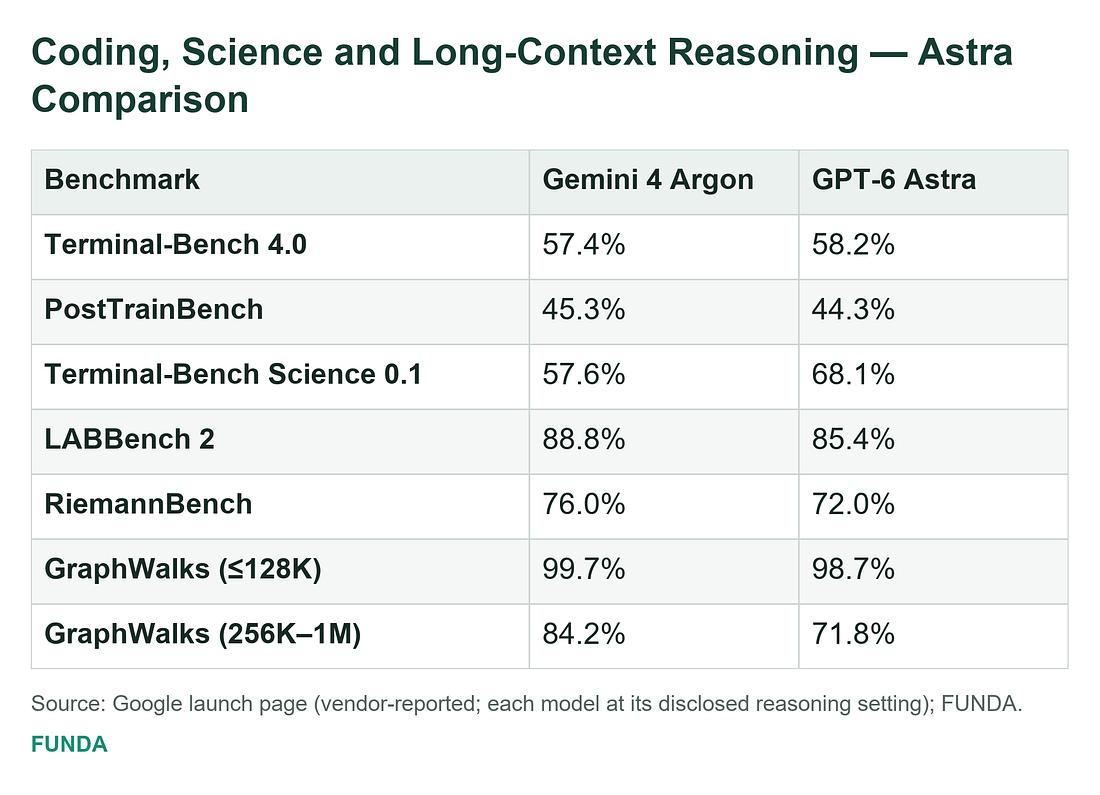
Long-context reasoning has improved as well. On GraphWalks with inputs of 256K–1M tokens, Argon scores 84.2%, versus 71.8% for Astra and 66.8% for Opus 5.5. This measures multi-hop reasoning over long inputs, a separate capability from generating longer outputs.
Argon uses markedly more tokens per task. Across the Artificial Analysis index, Argon generated an average of 62,000 output tokens per task, more than twice Astra’s 27,000. Long agent runs can also be expensive: a CUA-bench run on Vals costs $193.78 at standard pricing with a 262K output cap.
Pricing and the TPU cost advantage
 Subscribed
Argon’s introductory $2/$10 price matches GPT-6.1 Sol, launched on September 29. It is half the price of Opus 5.5 and one-fifth that of Astra and Fable 5.1. Its standard $4/$20 price matches Opus 5.5.
The task-level comparison is less favorable because Argon uses more tokens. On Artificial Analysis, it costs $1.99 per task at introductory pricing and $3.98 at standard pricing, versus $3.26 for Astra. At introductory pricing, it costs 2.7 times as much as Sol for one extra index point. It is cheaper than Opus 5.5 at maximum effort, but more expensive than Opus at medium effort. The table shows the scores and costs at each setting.
Model token prices and independently measured task costs
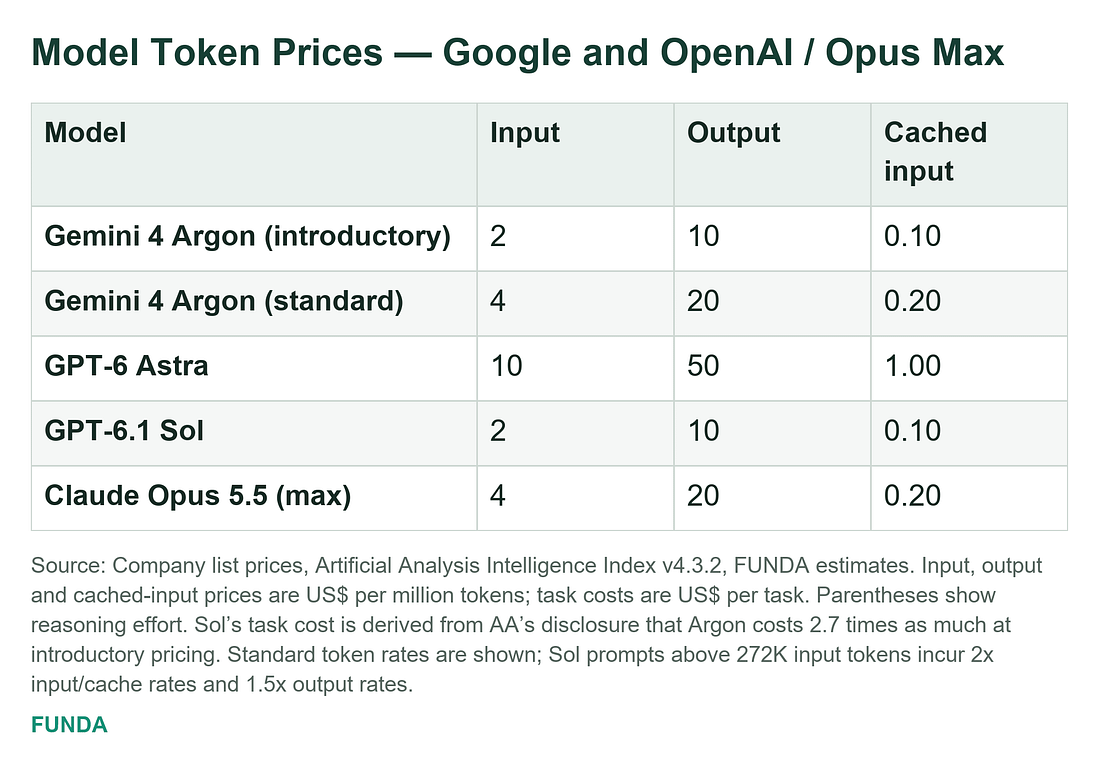
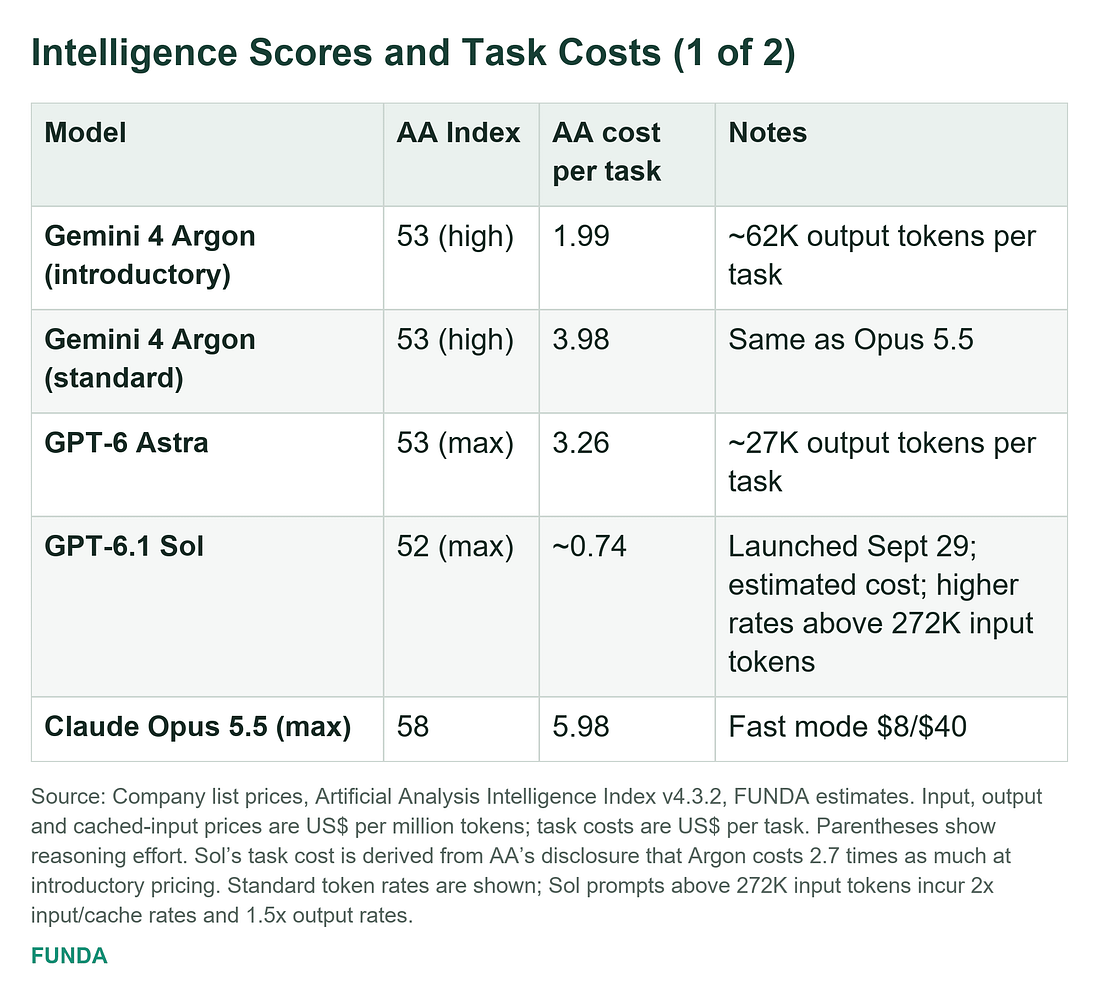
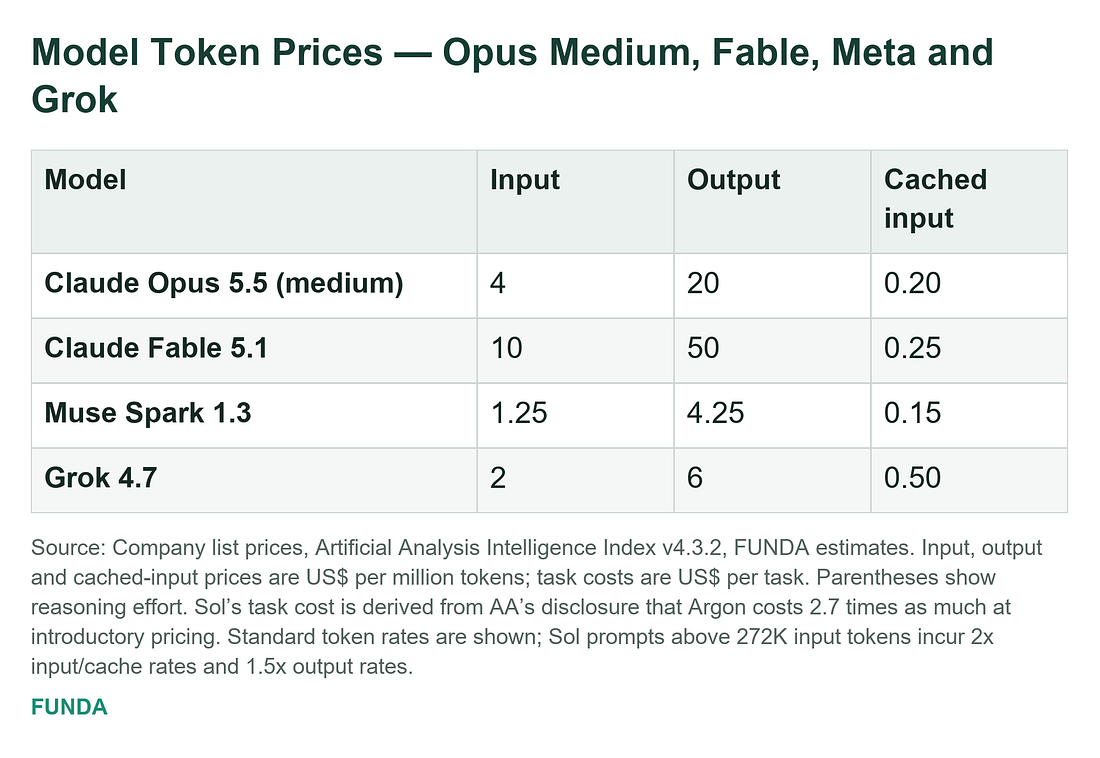
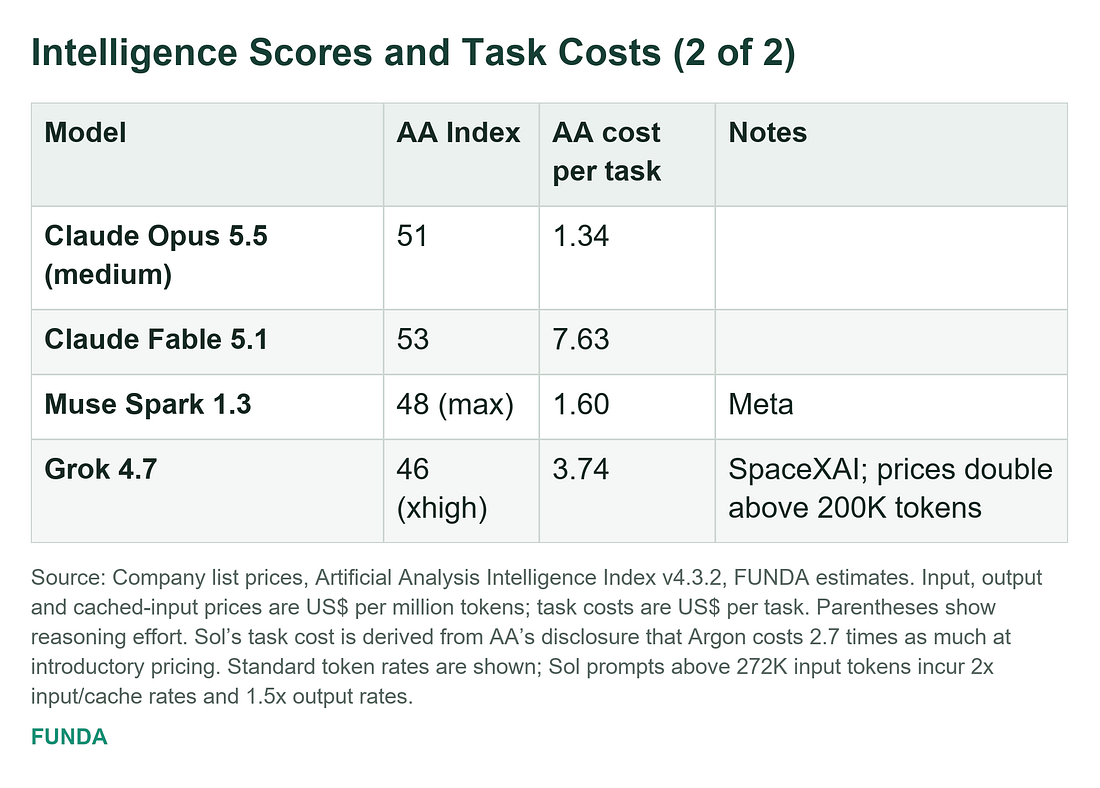
We think in-house TPUs and years of hardware and software optimization give Google more room to lower costs and set prices. List prices alone do not prove a cost or margin advantage; chip procurement and operating efficiency also matter. Gemini runs on TPUs from training through inference, and Google is the only one of the five labs that can say so. OpenAI, Meta and xAI rely mainly on Nvidia GPUs, whose purchase prices include Nvidia’s margin. Google still pays for chip design, foundry capacity, HBM and packaging, but avoids that supplier markup. Anthropic uses a mix of TPUs, Trainium and GPUs.
Google reported a 78% reduction in Gemini’s unit serving cost in 2025, attributing it to model optimization, efficiency and utilization gains. Further savings may come from the eighth-generation TPUs announced in April, which separate training and inference. The inference-focused 8i has 288GB of HBM per chip. Google claims up to 80% better performance per dollar and up to twice the performance per watt versus Ironwood for low-latency MoE serving, with availability later this year.
Anthropic’s purchases show that TPU demand extends beyond Google’s own models. In April, it signed a multi-gigawatt TPU agreement with Google and Broadcom, with capacity due from 2027. In May, it reportedly committed US$200 billion to Google Cloud over five years, more than 40% of Google’s disclosed backlog at the time. That commitment suggests Anthropic also finds TPUs attractive on price-performance.
Lower serving costs help Google compete for developers and enterprise customers: at $2/$10, developers get a model that matches Astra on the Artificial Analysis index for Sol’s unit price. They also support deployment across Google’s own products. Argon can handle more complex tasks in Search and Workspace, while distillation can improve the Flash models used at much larger scale. Cost and latency will still determine how widely flagship capabilities can be deployed, but Google’s marginal cost is lower than its peers’.
We continue to see demand for both GPUs and ASICs. Vera Rubin remains highly capable, with shipments starting in the third quarter and volume ramping in the fourth; Nvidia says every frontier lab will use it. ASICs also offer attractive price-performance. OpenAI’s chip program with Broadcom and Anthropic’s use of TPUs, Trainium and GPUs show that labs are pursuing multiple hardware options.
Argon’s capabilities and early feedback
The following table reproduces Google’s comparison across 19 benchmarks.
Google benchmark comparison for Gemini 4 Argon
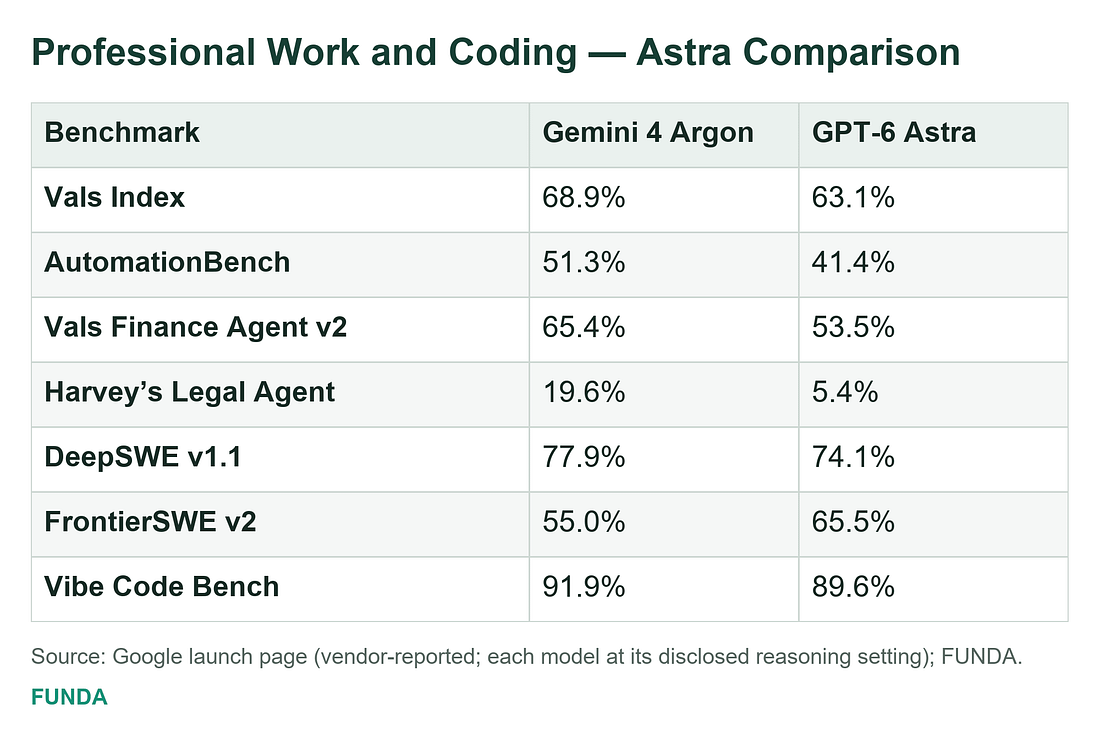
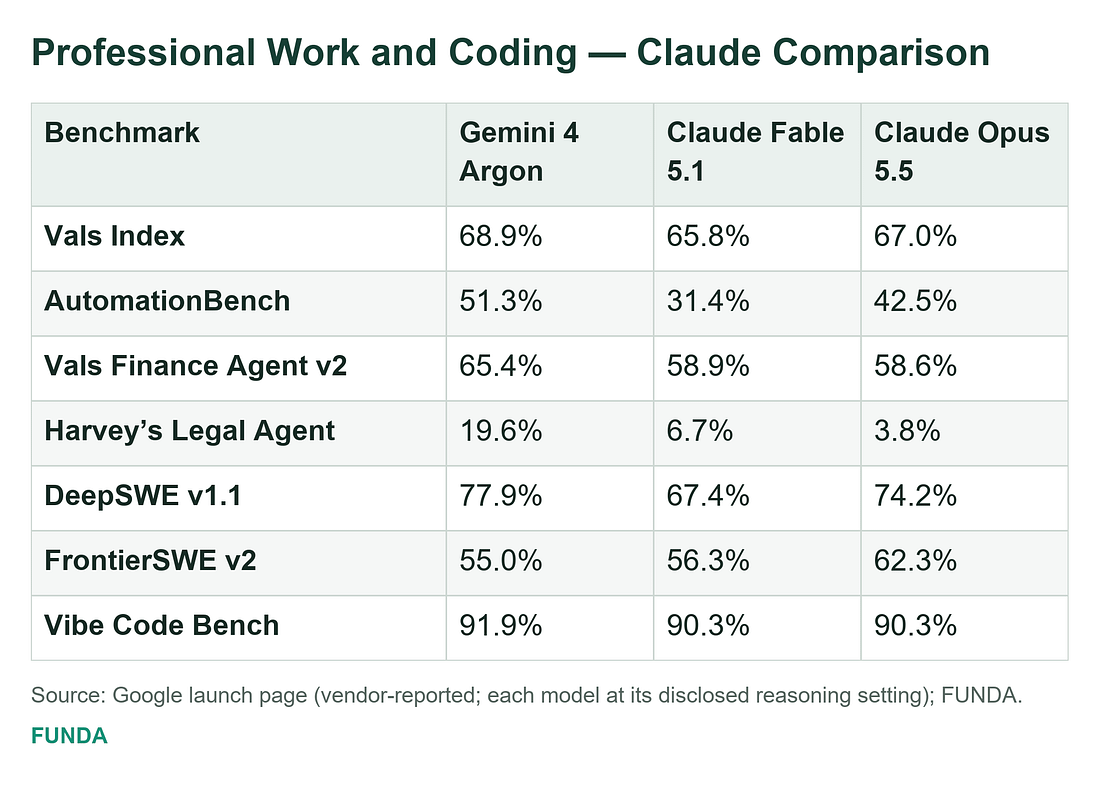
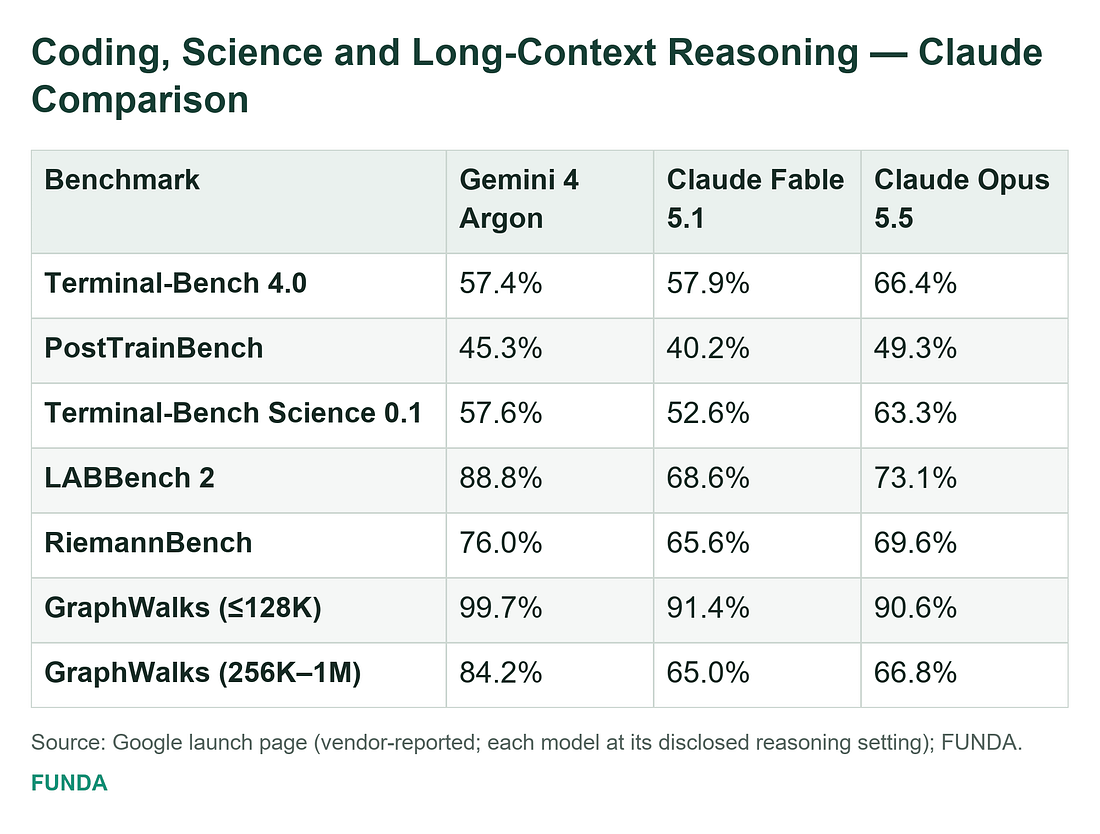

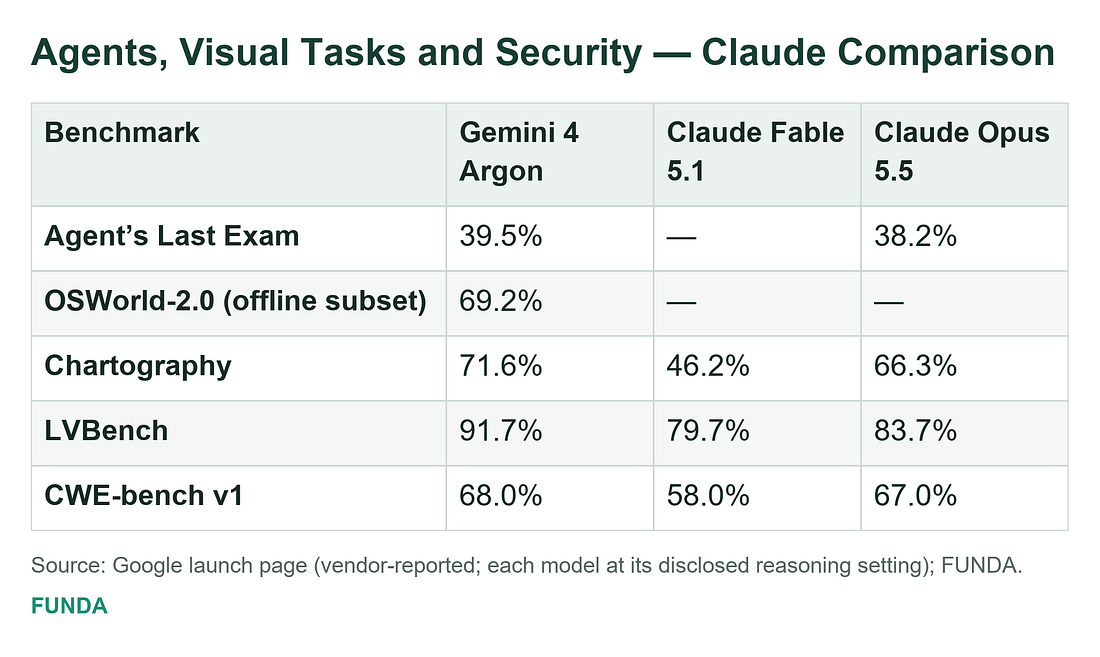
Argon is strongest on long documents and extended knowledge-work tasks. Its 19.6% score on Harvey’s legal agent benchmark is about 3.6 times Astra’s score and 5.2 times Opus 5.5’s. It also leads on Vals Finance Agent, AutomationBench, long-video understanding, million-token reasoning and DeepSWE, which tests extended software-engineering work.
Terminal-based coding and front-end development remain weaker. Argon trails Opus 5.5 by 9.0 percentage points on Terminal-Bench 4.0 and Astra by 10.5 points on FrontierSWE v2, and initially ranks eighth on LMArena’s WebDev leaderboard. Artificial Analysis also finds it more verbose and more willing to abstain. On Omniscience, its hallucination rate is 15% versus Astra’s 51%, but its accuracy is lower too, at 50% versus 63%. Their combined scores are close.
Public evaluations and early feedback are broadly positive. Artificial Analysis places Google back among the top three labs by model intelligence. Some early users cited by Bloomberg found Argon still behind Fable and Astra on practical tasks such as front-end development. Wider access will provide a better test of how well the benchmark gains translate into everyday work.
Google reports several practical results from internal use: data-center memory optimizations freed more than 300 TiB, while a libgav1 rewrite replaced 32,000 lines of SIMD code and runs 2.7 times as fast as the earlier Rust port. Thousands of employees are using Argon. Google-owned Wiz used it to find a critical vulnerability in healthcare software that earlier frontier models had missed.
We think this pretraining run has substantially improved Google’s base model. Argon is still at an early stage of post-training. The next test is how much that work improves the model and how quickly Google releases subsequent versions.
Google is opening Argon first to cyber defenders in the Fairwind Program, with cybersecurity guardrails removed for those users. Paid API customers and Google AI Ultra subscribers will follow. Google is also participating in voluntary U.S. government pre-release testing. There is no date for broader access.
Google has substantial distribution: in 26Q2, the Gemini app had 950 million monthly active users, its API processed 22 billion tokens a minute, and Gemini Enterprise reached nearly 90% of the Fortune 100. Google Cloud revenue grew 82% year on year, with US$514 billion in backlog. The question now is whether a stronger flagship translates into better products.
The other labs keep investing
OpenAI’s annualized revenue is approaching US$70 billion, up more than 70% since the start of Q3, according to Axios on September 29. Its enterprise business more than doubled over that period. OpenAI also retains a large consumer user base.
At DevDay on September 29, it launched GPT-6.1 Sol at $2/$10, with coding and professional-task performance close to Astra. It cancelled GPT-6.1 Astra’s planned October release after internal tests found more deception and instances of continuing tasks without user permission, according to the Wall Street Journal.
Safety requirements may increase compute demand even when they delay a release. Our understanding is that OpenAI has continued training GPT-6.1 Astra and increased the compute allocated to it, testing more data mixes and running more experiments to improve safety and alignment.
Anthropic leads in coding and the enterprise market. Its annualized revenue was about US$65 billion at the end of July, as reported in August. The New York Times says the figure could exceed US$100 billion this year. Reporting definitions may differ from OpenAI’s, so the figures are not directly comparable.
Opus 5.5 leads Artificial Analysis at 58, five points above Argon and Astra. Based on the demonstrations so far, we think Opus 5.5 can produce usable work in 3D design and video, much as Opus 4.5 did in coding. Examples include a 10-second Blender animation of a castle, lake reflections and fireworks, made in 35 minutes for about $13, and a two-minute sand-animation film with music and sound effects, made without animation software. Coding took nine months to move from its 3.7 moment to its 4.5 moment, as we noted in our Astra report. The pace in knowledge work will vary by task; 3D and video already have cases where the output is ready to use.
Meta is expanding from consumer agents into the enterprise. On September 28, it launched an enterprise platform spanning Muse, Business Agent, the Muse API and Muse Code. Former MongoDB CEO CJ Desai will run it, reporting to Mark Zuckerberg. Muse Spark 1.3 scores 48 on Artificial Analysis at $1.60 per task, and the larger Watermelon model is in training.
xAI, now SpaceXAI following its merger into SpaceX, released Grok 4.7 on September 21 at $2/$6, unchanged from Grok 4.6 despite a larger base model. It scores 46 on Artificial Analysis and 26% on Terminal-Bench 4.0, leaving a substantial gap in agentic coding. Our understanding is that Grok 4.8 training is continuing.
OpenAI and Anthropic still lead in overall capability. Google has regained ground, while Meta and xAI are still catching up. All five have the funding and the motivation to keep investing, and both demand for compute and competition for it will remain intense next year.
Investment view
Gemini 4 eases concerns about Google’s long-term competitiveness at the frontier. Better models can strengthen Gemini, Search and Workspace while supporting Cloud and TPU demand; in-house TPUs give Google more room on pricing, and Argon’s lead on knowledge-work benchmarks lines up with the fastest-growing demand. We remain positive on Google, provided broader use confirms the benchmark gains.
We remain bullish on compute and networking infrastructure. Larger training runs, longer reasoning traces and additional safety experiments all consume compute. Five active labs sustain demand for separate pretraining, reinforcement-learning and inference clusters. Compute demand now comes from more labs than the single-lab outcome some investors feared early this year. Google’s US$195–205 billion capex guidance provides further evidence of its commitment.
We expect the $2/$10 price point to keep putting pressure on competing models, especially those from labs without their own chips. Yet OpenAI and Anthropic have grown revenue rapidly as model prices have fallen, supported by more users, more usage and a broader product mix. Growing usage supports compute demand; it does not by itself establish attractive margins for model providers.
The main risks are Argon’s real-world performance once access widens, Google’s release cadence and the time required for safety validation. The longer the limited rollout runs, the more time rivals have to extend their lead. Stronger autonomous execution also requires longer pre-release validation, as the cancelled GPT-6.1 Astra release and the limited rollout of Argon both show. This can delay revenue from new models even while training spending continues.
Disclaimer and Terms of Use
Analyst Independence Statement
The views expressed in this report accurately reflect the personal and independent views of the analyst(s) regarding the securities and issuers discussed herein. No part of the analyst’s compensation was, is, or will be directly or indirectly related to the specific recommendations or views expressed in this report. The Company adheres to strict compliance procedures to ensure the integrity, security, and legality of the data sources and information utilized.
About FUNDA
Consensus AI Technology Pte. Ltd. (the “Company” or “FUNDA”) is an independent research firm incorporated in Singapore. The Company is not affiliated with any securities dealer, investment bank, or asset management firm, nor is it registered as an investment advisor or broker-dealer in any jurisdiction. The Company does not have any investment banking or underwriting relationship with the companies covered in this report, and does not accept sponsorship or funding from publicly listed companies.
No Investment Advice and Report Neutrality
The contents of this report and the information contained herein are for informational purposes only and do not constitute investment advice or a basis for business decisions. The views expressed herein represent solely the personal opinions of the respective authors at a specific point in time and do not reflect the position of FUNDA. As an independently operated platform, FUNDA maintains a neutral third-party status and makes no express or implied warranties regarding the accuracy, completeness, or applicability of such views.
No Offer or Solicitation: This report does not constitute an offer, solicitation, recommendation, or advice to buy, sell, or hold any securities or financial instruments, nor does it provide any legal, tax, or accounting advice.
Third-Party Data: All third-party data cited in this report is derived from public or authorized sources. The Company makes no representations or warranties, express or implied, as to the accuracy or completeness thereof.
Non-Participation in Decision-Making: The Company does not participate, directly or indirectly, in the investment decision-making process of its clients or readers. Readers should make independent investment decisions based on their own investment objectives and financial circumstances, and consult professional financial or legal advisors prior to executing any transactions.
Timeliness Statement
Given the rapid changes in market environments and technological trends, this report reflects market conditions as of the date prior to its publication. Relevant information may become outdated over time. FUNDA has no obligation to update the contents of this report in real-time.
Intellectual Property, Confidentiality, and Restrictions on Commercial Use
All reports, data, models, and content provided by the Company constitute its exclusive proprietary intellectual property and are protected by copyright and intellectual property laws.
Ownership of Rights: Unless otherwise expressly stipulated in a written agreement, all intellectual property rights (including copyrights) arising from or relating to this report are exclusively owned by the Company.
Authorized Use: Institutional clients may use this report internally within the scope permitted by their internal compliance policies; however, disclosure or sharing with any third party is strictly prohibited.
Prohibition on Commercial Use: Without the prior express written consent of the Company, no individual or entity may reproduce, republish, distribute, resell, repackage, or otherwise use this report or any part thereof for any commercial or profit-making purpose.
Legal Recourse: The Company reserves the right to pursue all available legal remedies and claims against any unauthorized commercial use, redistribution, or infringement of its intellectual property rights.
Forward-Looking Statements and Disclaimer
This report may contain forward-looking statements, including forecasts, estimates, and analyses of industry trends. Such statements are subject to risks and uncertainties that may cause actual results to differ materially from those anticipated. The Company shall not be liable for any direct, indirect, or consequential losses arising from the use of or reliance on the contents of this report.