2026.10.01 | Substack | Markets | TMTB Morning Wrap
原标题:TMTB Morning Wrap
Good morning. QQQs +55bps. Oil +1.4% and yields flattish as macro news pretty quiet overnight.
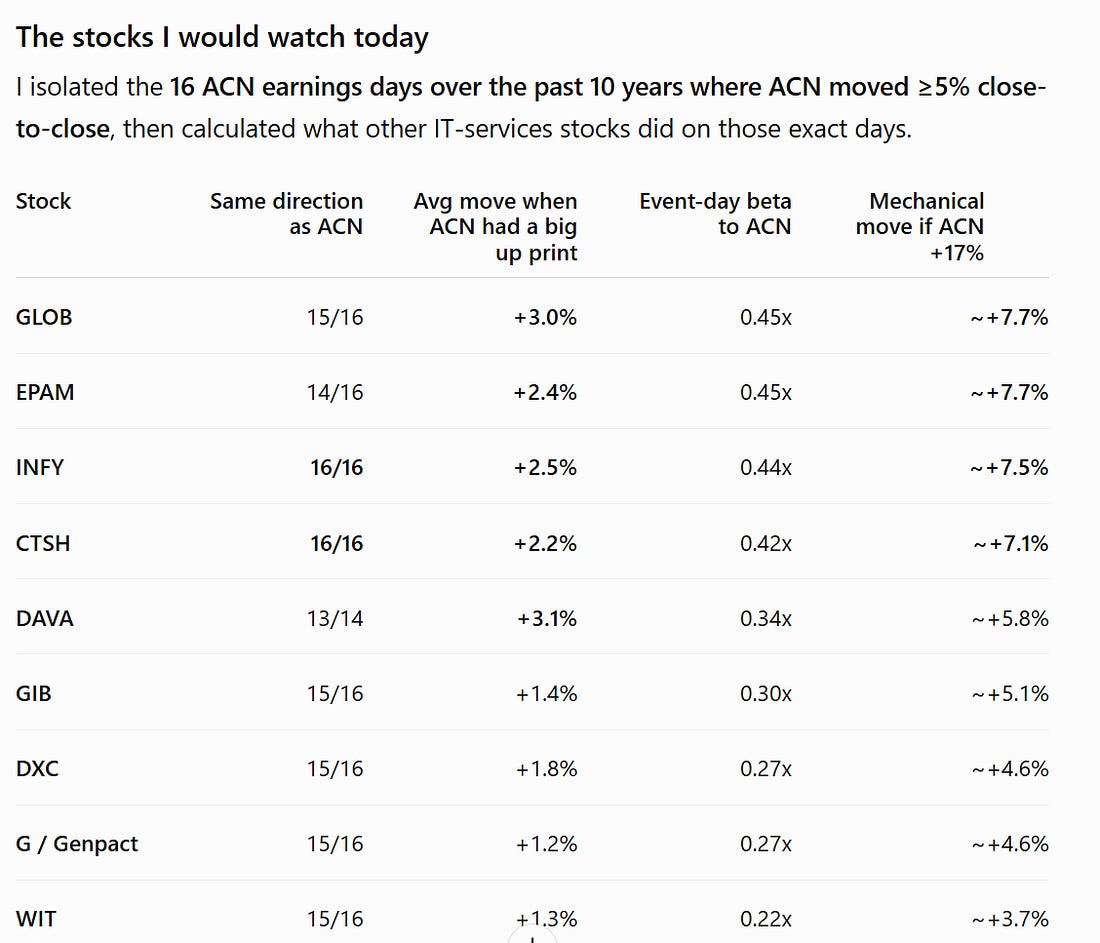
In Tech, Both Semis +1% and Software +1.4% up early. MU flattish despite a nice beat and raise as GM guide was the main nit and print didn’t really resolve any outstanding bull vs. bear debates. GOOGL +1.5% after releasing Gemini 4 Argon, which is near SOTA although investors are focused on when company will come out with their own consumer agent product. ACN +17% following a set of better numbers vs low expectations (IBM +6% ; CTSH +7%) in sympathy, and likely helps the “AI loser” basket today (HUBS +3.5%; FIG +3%, INTU +3% etc.)
Asia mixed overnight: TPX +0.57%, NKY +3.3%, Taiwan TAIEX +0.86%, Korea KOSPI +1.95% Chip stocks higher in Japan (Advantest +9.8%, Lasertec +11.1%, Tokyo Electron +6.5%, etc.). Softbank +4%; Hynix +3%; Samsung +3%
We’ll hit MU and ACN first then move onto the usual. Let’s get to it…

MU: Big revenue/EPS beat and strong FQ1 guide, with gross margin the only real blemish. Tighter supply through 2028 extends the earnings runway, but cost base is resetting higher
MU beat across the board, with FQ4 revenue well above Street and EPS above even the buyside bogey, while FQ1 revenue/EPS guidance also cleared expects. NAND accounted for 2/3 of the rev upside. The one nit is gross margin guide: FQ4 hit the ~87% bogey, but FQ1 guides down to 86.25% vs. ~87-88% buyside, although it’s mainly due to mid-shift to HBM and mgmt said Q1 will be floor for GMs in ‘27. Mgmt expects supply to remain tighter in CY27/CY28 than CY26, with customer discussions increasingly focused on 2028.
A lot of back and forth between investors overnight (you can check out TMTB Slack thread here). Positioning was mixed heading into the print with memory positioning having been reset over the past couple of months. Overall, buyside #s not really moving much with better EPS but GMs weaker (bulls at $200+ for CY2027 EPS). Typical bull vs. bear debate on memory we’ve been hearing over last couple months with bulls pointing to better visibility/LTAs/supply/demand dynamics with potential for big cash returns on a stock trading at ~5-6x while bears will point to uncertainty in ‘28 and beyond. Overall, we think memory continues to be choppy & trending up over time.
The #s:
FQ4 revenue: $54.23B vs. ~$51B Street FQ4 EPS: $33.42 vs. ~$31.50 Street / $33+ bogey FQ4 gross margin: 87.0% vs. ~87% bogey FQ4 operating margin: 82.3% FQ4 operating cash flow: ~$44B FQ4 adjusted FCF: ~$33B
FQ1 revenue guide: $60-63B, midpoint $61.5B vs. ~$57B Street / ~$60B bogey FQ1 EPS guide: $37.15-39.15, midpoint $38.15 vs. ~$36 Street / ~$37.5 bogey FQ1 gross margin guide: 86.25% vs. ~87-88% bogey
Key Takeaways
- Durability. Mgmt sees demand exceeding supply in both CY27 and CY28, even after incorporating new cleanrooms, and says customers continue to request additional supply. More than 75% of 2027 output is committed, including both SCAs and non-SCA purchase orders. The nuance: “tighter than 2026” does not establish that 2028 pricing or profitability will exceed 2027
- Contracts. Strategic customer agreements increased to 26 from 16, now covering more than 35% of expected revenue through 2030; the eventual objective remains approximately 50%, not 60–70%. Three-quarters of SCA revenue has a defined pricing framework, a majority of that with floors and ceilings, while the remaining quarter is periodically market-priced. RPO increased 50% to approximately $150B, calculated using committed volumes and minimum applicable prices. New agreements are being negotiated at higher prevailing prices, and some extend into 2031.
- HBM. The vast majority of CY27 HBM bit supply is contracted at significantly higher y/y prices, with the reset beginning in calendar 2027. This narrows the profitability gap with conventional DRAM; it does not establish margin parity. HBM revenue grew faster than total company revenue, the customer base expanded, and HBM4 execution remains on track. MU is also co-developing NVHBM, a custom HBM4E implementation, with NVDA.
- NAND. NAND accounted for roughly two-thirds of the revenue upside. NAND pricing increased approximately 30% q/q vs. Street approximately 20%, while bits increased approximately 10% vs. 5%. Data center SSD revenue approached $10B, more than 10x y/y and over two-thirds of NAND revenue, supported by KV-cache offload and HDD displacement opportunities. CPU-based agent workloads also broaden the opportunity into LP memory, DDR and SSDs. This is increasingly an investment in the full AI memory hierarchy, not just HBM attached to GPUs.
- Cash returns. Adjusted FCF reached $33.2B, approximately 61% of revenue, and mgmt expects November FCF to be significantly higher despite increased CapEx. Importantly, SCA deposits are financing cash flows and do not inflate FCF. MU expects to reach its target cash balance by the end of FQ1 and increase capital returns from December 9, primarily through repurchases. However, the target cash balance and buyback amount remain undisclosed, and only $2.2B remains under the existing authorization. Mgmt did not endorse the $100B-plus return suggested in Q&A. The commitment is to return 100% of excess cash over time, not automatically 100% of annual FCF immediately
- Margins. The revenue beat did not translate into equally clean operating leverage. FQ4 GM reached 87.0% vs. Street 86.2%, but OpEx was $2.57B, up 69% q/q, vs. Street approximately $1.68B, reflecting incentive compensation and $300M of community investments. November OpEx is guided to $2.06B vs. Street $1.83B. FY27 OpEx increases another approximately $2.5B y/y, principally for R&D and incentive compensation. The important distinction is that mgmt expects sequential revenue growth each quarter and GMs above November’s floor thereafter.
- CFO callback. The post-earnings one-on-one with CFO Mark Murphy covered the incentive-compensation bridge, bit-growth/cost assumptions and SCA coverage. The important modeling takeaway is to separate inventory timing from the ongoing cost reset. Manufacturing compensation accrued in FQ4 principally hits November COGS, but higher FY27 compensation starts affecting manufacturing margins more fully in FQ2, alongside startup costs and depreciation. The approximately $1B of higher November costs is not just a clean one-quarter addback.
- Capex/Capacity. FY27 net CapEx is implicitly above $50B: approximately $25B in the first half, with the second half higher. That is more than 80% above FY26’s approximately $27.3B, but mgmt did not provide a precise $55B full-year guide. Most of the increase versus prior plans is construction, primarily accelerating cleanroom availability in late CY28 and beyond, rather than immediately adding equipped wafer capacity. There are earlier additions, including Idaho ID1 and Tongluo in mid-CY27 and Singapore HBM packaging in early CY27. The distinction matters: first output is not full production, and mgmt intends to equip new fabs according to demand.
- End markets. Mgmt expects server units to grow high-teens percentages in both CY26 and CY27, with lower memory-content growth than previously assumed enabling more units to ship. That is its answer to de-spec concerns: rationing available memory, rather than a reduction in the underlying need for memory. Consumer demand is less clean. PC and smartphone units could decline double digits in CY26, even as industry revenue grows on premium mix; MU’s mobile/client bits declined sequentially.
Bull vs. Bear Debate:
The broader bull case is that MU and memory is becoming more strategic in the datacenter, gross margins will stay higher for longer given increasing amount of LTAs which should make the stock less cyclical and re-rate it higher, and MU will return an increasing amount of FCF to investors, being able to buyback up to 10% of the float a year. More broadly, MU is becoming less dependent on consumer-device units and more exposed to the memory required to make AI useful, while memory is becoming more strategic in the datacenter and gross margins will stay higher for longer. Training, inference, longer context windows and concurrent agents consume different combinations of HBM, conventional DRAM and NAND. MU therefore does not need to pick the winning model or compute architecture to participate. Physical AI offers additional late-decade demand potential, but the near-term thesis does not require a large robot revenue contribution.
The supply argument is equally important. Higher HBM mix consumes disproportionate wafer resources, future node transitions deliver less incremental productivity per wafer, and new cleanrooms take years to build and additional quarters to ramp. Bulls see that combination allowing pricing strength to persist without requiring another acceleration in AI spending. MU’s leading production nodes, custom-HBM collaboration and expanding customer relationships provide a company-specific execution story on top of that industry backdrop. SCAs then offer a potential bridge from strong current demand to a higher through-cycle earnings floor: committed volumes improve investment planning, pricing frameworks protect part of the business, and new agreements are being written at stronger prices. The repricing catalyst is not simply another EPS raise; it is evidence that profits remain high after customers have more supply options. Cash generation gives bulls a second route to returns even without a dramatic multiple expansion. Mgmt expects to reach its target cash balance shortly and has reiterated the intention to return excess cash.
The bear case is that exceptional scarcity profits are being mistaken for a permanently different earnings model. Customers already have incentives to optimize memory content, use lower-cost tiers and maximize units shipped per available gigabyte. Mgmt’s explanation that de-specing reflects rationing is plausible, but it does not quantify how much HBM content might be removed or how much wafer capacity could ultimately shift back toward conventional DRAM. NVDA’s context-storage architecture illustrates both sides: it expands flash demand while helping customers use expensive GPU memory more efficiently.
SCAs improve visibility, but the disclosed protection is narrower than a casual reading of “75% committed” suggests. That figure refers to 2027 output across both SCA and non-SCA customers. Only three-quarters of the more-than-35% through-2030 SCA revenue has a defined pricing framework, leaving substantial exposure to future market pricing. The contracts have not been tested through a downturn, and $32B of customer financial commitments is not equivalent to $150B of cash collateral or guaranteed profit. The market can reasonably demand evidence that customers honor the economics when spot prices fall.
The cost and supply risks also become more consequential as pricing growth moderates. November demonstrates that higher revenue does not automatically translate into higher GM, while R&D, compensation, startup costs and depreciation are all stepping up. Construction spending does not immediately create bits, but it eventually removes a constraint that currently supports pricing. Meanwhile, premium mix is masking weaker consumer-unit demand, and Chinese competition remains a potential source of global pricing pressure even if MU’s direct China exposure declines. There is already a meaningful split in out-year estimates: bears will model flat FY28 revenue and slightly lower EPS, while bulls assume continued strong growth.
ACN +17%: Clean F4Q beat, bookings rebound and solid FY27 guide push back on the AI-disruption bear case
Expects were low to put it lightly, and ACN beat the high end of its F4Q revenue guide with $18.68B of revenue, +7% y/y in local currency, as both Consulting and Managed Services came in ahead and margins were modestly better than expected. New bookings improved to $22.17B, +5% y/y in local currency after declining 3% last quarter, with Consulting bookings +6% and Managed Services +3%. ACN also repurchased $2B of stock in the quarter.
ACN guided FY27 local-currency growth to +3-6%, roughly bracketing Street expectations, with 10-30bps of margin expansion and EPS essentially in line at the midpoint. F1Q revenue guidance also brackets Street, while +2-6% LC growth implies some deceleration from F4Q’s +7%. Overall, not a huge estimates reset, but a clean print with bookings and demand better than feared.
Key KPIs vs. Street
Revenue: $18.68B, +6.2% y/y reported / +7.0% LC vs. Street $18.04B; guide was $17.75-18.40B Consulting revenue: $9.28B vs. ~$9.0B Street Managed Services revenue: $9.40B vs. ~$9.2B Street Operating margin: 15.3% vs. Street 15.2% EPS: $3.29 vs. Street $3.19 Bookings: $22.17B, +4% y/y reported / +5% LC; Consulting $9.4B +6%, Managed Services $12.77B +3%
F1Q27 revenue: $18.95-19.60B vs. Street ~$19.4B F1Q27 LC growth: +2-6% vs. Street ~+3.8%
FY27 LC revenue growth: +3-6% vs. Street ~+4.0% FY27 operating margin: 15.9-16.1%, +10-30bps y/y vs. Street 15.9% FY27 EPS: $14.39-14.81 vs. Street $14.62 FY27 FCF: $11.0-11.8B vs. Street ~$11.6B Cash returns: At least $9.5B vs. $11.5B returned in FY26
TECH RESEARCH/NEWS
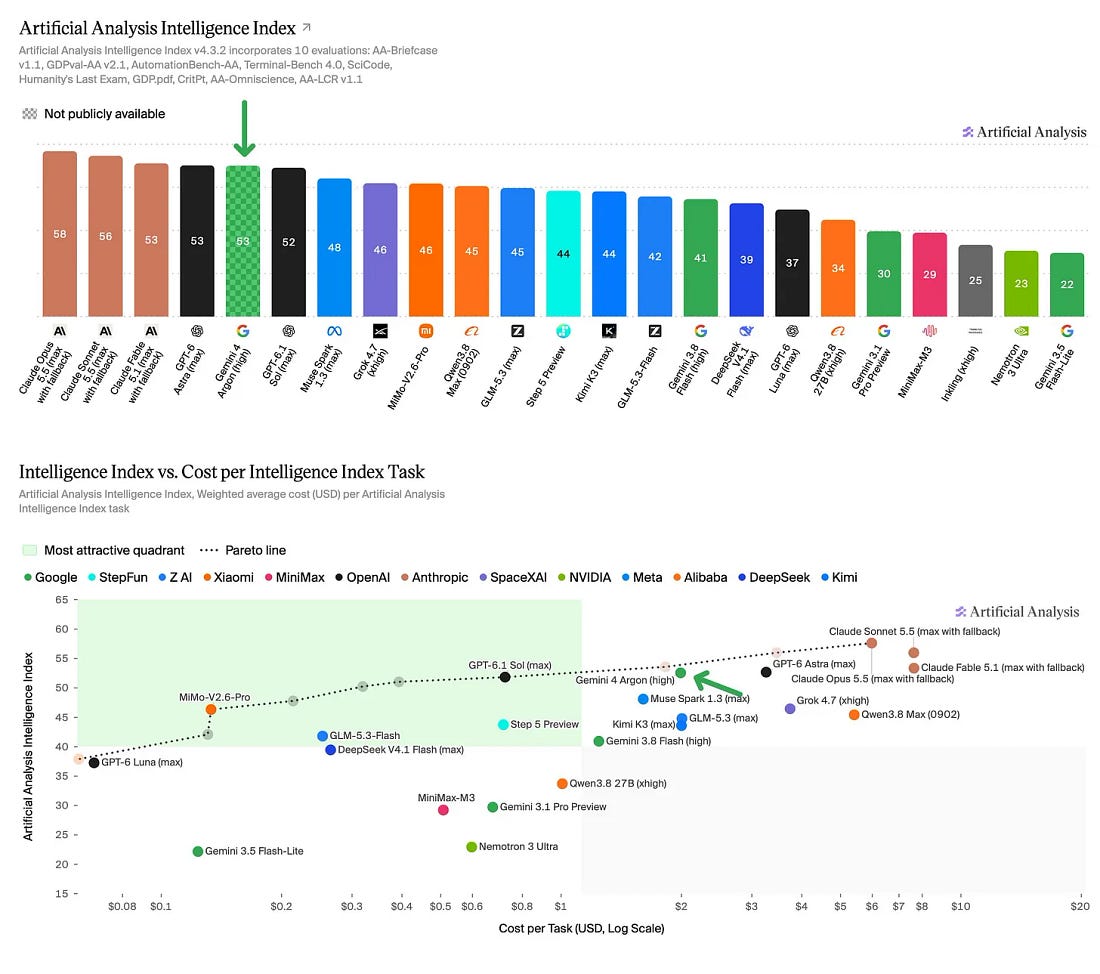
GOOGL: Releases SOTA model Gemini 4 Argon
Gemini 4 Argon carries “introductory” pricing of $2 per 1M input tokens and $10 per 1M output tokens, well below Claude Fable 5.1 at $10/$50 and Claude Opus 5.5 at $4/$20. Its maximum output length also increases to 1M tokens from 64K previously, versus 128K for both Claude Fable 5.1 and Opus 5.5.

NVDA: Cantor says investor roadshow points to upside to 70%+ CY27 growth, with share gains still underappreciated
Cantor says after hosting Jensen Huang, CFO Colette Kress and IR Toshiya Hari, management sounded incrementally more bullish on demand, with upside to guided 70%+ CY27 growth and NVDA’s share of hyperscaler IT capex potentially rising to mid-40s% from ~40% today. Supply remains the key constraint, with ~70% of tracked GW still under construction vs. ~20% for the broader field, while Cantor sees GMs holding better than feared and highlights a ~$250B NVLink opportunity by CY30. Cantor reiterates OW/$350 and raises CY28 EPS to ~$2
NVDA: Barclays says NVDA NDR deck implies $30B+ upside to hyperscaler revenue in both CY26/27
Barclays says NVDA’s NDR deck implies ~$237B/$401B of CY26/27 hyperscaler revenue vs. its current ~$206B/$370B estimates, or ~$30B+ upside in each year; using historical CSP capex conversion pushes potential upside to ~$40B/$48B. The math excludes SPXC from the top-5 CSP base even though SPXC is included in NVDA’s hyperscaler revenue, suggesting total upside could be larger.
Tencent / ORCL: Five-year, $7B lease secures access to 100,000 AI chips – FT
FT reports Tencent signed its largest overseas computing lease: a five-year agreement across Oracle data centers in Southeast Asia providing access to about 100,000 advanced AI chips unavailable in China. The deal is estimated at $7B, with roughly 30% paid upfront, contributing to Tencent’s first negative quarterly free cash flow in more than a decade
AAPL: Needham sees META’s Muse platform as a growing threat to App Store economics
Needham argues META’s 0% Muse Connectors fee directly challenges AAPL’s 15–30% App Store take; if 20% of App Store revenue migrated, it estimates ~$10B revenue and ~$7.5B EBITDA downside for AAPL. META also has >1,500 developer applications since launch and is spending $130–145B of FY26 capex to build an AI/agentic stack across 3.6B DAUs, raising the risk of developer defection and longer-term iPhone ecosystem disintermediation. Needham keeps AAPL at Hold.
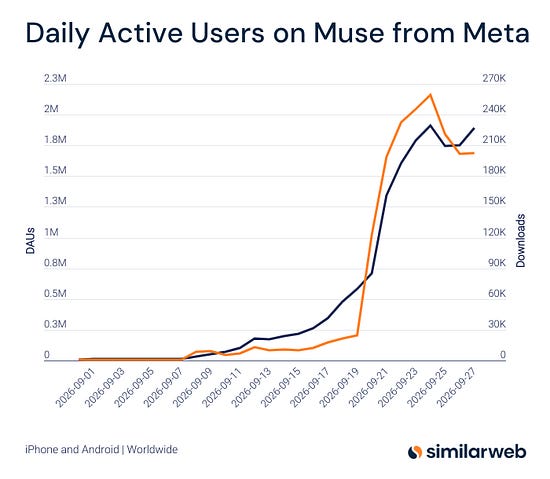
META: DAUs approach 2M

Similarweb
@Similarweb
DAUs on @Muse are approaching 2M
11:22 AM · Oct 1, 2026 · 140 Views
META: MS says 23 days of Muse point to late-’27/’28 monetization, ample capacity and a large enterprise/API opportunity
MS expects direct Muse monetization to stay minimal near term, with the bigger opportunity emerging late ’27/’28 through transaction/acquisition auctions across a ~$30T consumer TAM; serving costs range from ~$3–130/user/month, while ’26 CPU purchases alone could support ~1B DAUs at 25% token usage. MS also frames enterprise as a ~$25T knowledge-work opportunity, with subscriptions across META’s ~100M businesses and an eventual API business, where just 100MW of dedicated capacity could add ~4%/~$1 to ’28 EPS. After the Muse-driven rerate to ~21x, MS says further upside increasingly depends on adoption, commercial behavior and competitive response; META remains Top Pick/OW with a $775 PT.
META / NVDA / Anthropic / SI Safety: Zuckerberg helps shape voluntary AI safety pact as CEOs challenge Amodei – WSJ
WSJ reports Zuckerberg helped finalize the White House’s voluntary AI safety principles through frequent talks with Trump and Commerce Secretary Howard Lutnick. Zuckerberg and Nvidia’s Jensen Huang backed the administration’s light-touch approach and opposed calls from Anthropic and OpenAI researchers for government-coordinated slowdowns in model development when needed. Huang and other executives privately challenged Anthropic CEO Dario Amodei’s public warnings; Amodei argued risks should be communicated honestly.
META/AMZN/WMT/SHOP: Stratechery says Muse sharpens agentic commerce divide, with Amazon protecting ads while Walmart/Shopify lean in
Stratechery’s Jason Del Rey says Muse is still failing many real-world shopping tasks, but the strategic threat is clear: browser-based agents can bypass retailer APIs and potentially disintermediate discovery/ads. AMZN is blocking Muse, likely reflecting protection of its ad economics/data, while WMT sees an opportunity to gain share by remaining open and SHOP wants its merchants available across every AI surface via Shop Pay. Longer term, Stratechery argues AMZN may eventually need to accommodate large agents if they control enough consumer demand, potentially favoring partners willing to preserve Amazon’s ad/fulfillment economics.
OpenAI: Measurement gaps keep ChatGPT advertising budgets at test levels – Digiday
Digiday reports measurement gaps and reluctance to share customer data are limiting ChatGPT ad spending seven months after launch. Accuracast saw lead forms completed but zero reported conversions two weeks later; ChatGPT also logged about 100 clicks versus 20 in the agency’s tracking. One executive cited clients spending $10M monthly on Google but less than $100K on ChatGPT. Digiday notes other agencies have not seen the same click discrepancies.
SI Safety: Bipartisan proposal targets company liability for AI-agent hacking – Axios
Axios reports Sens. Josh Hawley and Chris Murphy plan to introduce the AI Agent Accountability Act, seeking to hold companies civilly and criminally liable for hacking incidents involving AI agents. The proposal challenges the White House’s preference for industry self-regulation and reliance on existing laws. Broader Senate AI negotiations have stalled as Congress heads into election season.
BE: Barclays sees capacity doubling + front-of-meter as key upside, raises PT to $308
Barclays says BE’s second Fremont facility provides line of sight to ~10–12GW of capacity vs. ~5–6GW today, helping support an order book it estimates is now >$9B. Ameren’s plan for 500MW of fuel cells by 2030 could open a meaningful front-of-meter utility TAM, while Project Jupiter’s air permit remains the near-term gating item and Project Lighthouse could absorb fuel-cell deliveries if Jupiter slips. Barclays also says the likely ~260MW Nebius delivery in 2Q demonstrates BE’s speed-to-power advantage; stays EW and raises PT to $308 from $276.
BE: MS says investor meeting reinforces broader demand + 800V DC advantage
MS says after hosting BE management, confidence increased around demand and execution, with upside extending beyond U.S. data centers into front-of-meter utility, international and industrial markets. Management argues “rack cost of electricity” better captures BE’s economics than LCOE, with native 800V DC potentially saving ~$3.7B/GW of capex and ~$5.5B/GW including opex. MS also sees carbon capture/CHP as underappreciated and remains OW/$310.
POWER/BE: Evercore says BTM power is becoming a major AI infra asset class, with ~72GW deliverable by 2030
Evercore sees behind-the-meter power increasingly used to arbitrage grid delays, sizing ~244GW of addressable load and ~72GW actually deliverable by 2030, implying ~$41B of annual revenue and ~$323B cumulative equipment/install spend through 2035. The opportunity extends well beyond data centers, with industrial loads ~64% of the SAM, while the key constraint is increasingly equipment/fuel/execution rather than demand. Evercore sees BE, EROC, GEV and CAT among the primary beneficiaries, with storage increasingly mandatory and newer midstream/OFS entrants broadening the competitive set.
CRDO: Jefferies NDR reinforces AEC/ZF upside, with OmniConnect potentially $1B+ from 2H27
Jefferies says after hosting CRDO management meetings in NYC, AEC and ZF Optics remain key upside drivers, with SPCX potentially adding another 660K GB300s and Positron AI’s Titan rack deployment alone implying a $1B+ revenue opportunity at ~$2–3K of CRDO content/XPU. OmniConnect also begins ramping in 2H27 and could represent another $1B+ opportunity, while OCP in October brings the first ALCS/MicroLED demo. Jefferies stays Buy/$270.
CRWV: MS says Fully Connected conference reinforces demand/pricing strength + broader AI platform thesis
MS says after attending CRWV’s Fully Connected conference with CEO Michael Intrator and senior management, demand remains well above supply with visibility into 2027/28, while the ~25% July price increase is holding and customers appear able to absorb further increases. Forge and broader full-stack products are increasing services attach, with 75% of customers already using >3 products, while enterprise traction is improving. CRWV also launched Vera Rubin availability, added Vera CPU, and highlighted Cognition as the first production Rubin customer; MS stays EW/$99.

Memory: Q4 PC DRAM price forecast lifted to 13–18%; legacy MLC NAND seen flat – EBN
EBN reports TrendForce raised its Q4 PC DRAM contract-price forecast to 13–18% sequential growth from 3–8%, as suppliers prioritize server memory and reduce PC allocations. September DDR4 8Gb contract prices rose 4% to a record $26. Legacy 128Gb MLC NAND reached $30.60 after 21 consecutive monthly increases, but TrendForce expects that product’s Q4 pricing to remain roughly flat as buyers resist further increases.
AVGO / Anthropic: Up to $42B financing facility backs $125B TPU lease commitment – Reuters
Reuters reports Broadcom agreed to provide Anthropic with up to $42B of financing, potentially covering roughly one-third of its $125.2B, five-year TPU leasing commitment. The debt could convert into Anthropic equity, and Broadcom may designate a financing partner. Anthropic is expected to become Broadcom’s largest compute customer in 2027.
AMD / META: Venice CPU orders extend into 2028 as agent workloads tighten supply – DigiTimes
DigiTimes reports industry checks cited by Chinastarmarket indicate AMD’s 2027 EPYC 9006 Venice capacity is sold out, with orders being accepted for 2028. TrendForce puts server CPU lead times at 25–30 weeks, up from 16–20 weeks, as AI agents increase orchestration and execution workloads. The report cites Morgan Stanley forecasting 6.75 million Venice shipments in 2027, up from about 1.25 million in 2026.
SNPS: StoneX says analyst day was unusually incremental, raises FY27/28 estimates on stronger growth outlook
StoneX says SNPS surprised with FY27 revenue guidance of $11.15B, +15% y/y and >300bps above prior Street, while lifting its long-term growth framework from DDD to mid-teens. StoneX raises FY27/FY28 revenue/EPS to $11.15B/$19.08 and $12.83B/$23.81 from $10.79B/$17.67 and $12.03B/$21.28, supported by ANSS synergies starting in FY27, AI-agent monetization and a $1B+ AWS IP license deal. StoneX sees AI as a net tailwind, keeps Buy/$570 and views SNPS as a top large-cap idea.
SNPS: JPM says Investor Day lays out path to ~$35 FY30 EPS, with AI + custom IP driving upside
JPM says after SNPS Investor Day, management now targets mid-teens FY26–30 revenue CAGR, ~50% OPM and ~$35 EPS by FY30, with AI agents expected to drive 5–10x more tool calls rather than cannibalize EDA. Custom IP is also stepping up, including a $1B+ multi-year AWS agreement and a 17%+ IP growth target, while ANSS cost synergies are running a year ahead and revenue synergies are ramping sooner. FY27 guide of ~$11.15B revenue, ~44% OPM and ~$19.08 EPS is above JPM’s prior estimates; stays OW/$600.
SOFTWARE
MDB: D.A. Davidson says MongoDB.local checks point to legacy migration pickup + strong Agent Engine interest
D.A. Davidson says after MongoDB.local customer/partner conversations, including large banks, legacy database migrations appear to be picking up, with Cognition saying Devin materially reduces migration time/cost and another GSI seeing increased activity. Atlas Agent Engine is still too early to move near-term numbers, but customer interest was strong and it could position MDB for internal enterprise agents now and broader consumer-facing AI workloads later, though hallucination concerns continue to delay the latter. D.A. Davidson stays Buy/$415.
MSFT: Wells sees Azure ~46% in FQ1 with improving Copilot checks, raises PT to $725
Wells expects FQ1 Azure growth of ~46% cc, >1pt above the 44–45% guide, with a similar FQ2 outlook as capacity continues to ramp. Copilot checks are improving, with MSFT reportedly using seat discounts to drive consumption commitments, while FY27 margin/FCF expectations remain largely unchanged. Wells nudges FY28 estimates higher on Azure and reiterates OW.
GTLB: BofA says investor meetings improve confidence in Orbit/Flex, but monetization still unproven
BofA says after meeting with VP Finance/Strategy/Ops Nic Edwards, it came away more constructive on Orbit and Flex but stays Neutral, with 90%+ gross retention supporting the seat base while upside depends on usage-based products driving a credible path toward ~20% growth. Orbit remains early/public beta and Flex is still small, while the transition can pressure reported FY27 revenue by up to ~$13M. BofA is watching bookings per rep, attach rates and paid consumption, with FQ2 bookings growth improving ~1pt to 15% y/y.
TTAN: MS survey reinforces vertical AI advantage as adoption rises, but ROI/trust remain key gating factors
MS says its survey of 1,017 trades contractors shows AI adoption accelerating, with 61% already using AI and willingness to invest rising, while cost has fallen to the least-important adoption barrier. The bigger hurdles are execution and trust: 44% cite understanding how to use AI, 43% lack of clear use cases and 58% have little/no trust, while only 47% report profitability benefits despite 64% seeing productivity gains. MS sees this favoring ServiceTitan’s embedded, vertical AI approach, trade-specific data and outcome-based monetization; stays OW/$92.
DT: UBS sees AI observability adding ~3–4pts of growth, with Arize key to sustaining high-teens ARR
UBS says checks with four F500 Arize customers point to AI observability reaching ~20–25% of total observability spend over the next few years, potentially adding ~3–4pts to DT growth and supporting ~19%/18%/19% c/c ARR growth in FY27–29. UBS sees ~$40–50M of Arize net-new ARR in FY28, with the bigger upside from cross-selling into DT’s installed base; DDOG should also benefit as the opportunity looks largely incremental rather than share-shifting. UBS keeps Buy and raises PT to $74 from $65.
TSLA: September registrations extend European recovery – Reuters
Reuters reports Tesla’s September registrations rose 61.9% YoY in France, 38.4% in Sweden and 2.2% in Norway, extending its European rebound after two years of declining sales. January–August registrations across the EU, UK and EFTA increased 43.3%, ahead of the broader battery-electric market’s 38.8% growth. Reuters cites easier comparisons, higher fuel prices, government incentives and growing EV interest as supporting factors.
INTERNET
GOOGL: Citi says Gemini 4 Argon removes a key AI overhang, with SOTA performance + attractive pricing
Citi says Argon ranks #1 on 14 of 19 core benchmarks vs. GPT-6 Astra, Claude Fable 5.1 and Claude Opus 5.5, reinforcing management’s commitment to frontier models and potentially accelerating product cadence across Cloud, Workspace, Search and developer tools. Intro pricing is $2/$10 per 1M input/output tokens, rising to $4/$20, still below ~$10/$50 for frontier peers. Citi sees this as the restart of Google’s product cycle, with capacity the key watchpoint; reiterates Buy/$447.
AMZN: Wells says 4th straight AWS GPU reserve price hike reinforces pricing power, demand > supply
Wells says AWS is raising GPU reserve pricing another 15% on Oct. 7 after +20% in July, taking H100/H200 and B200/B300 pricing up ~40–75% YTD and marking the fourth straight quarterly increase. Wells sees this as evidence AWS can pass through supply-chain inflation and supports revenue acceleration into early ’27, though contracted capacity creates a lag to reported monetization; Trainium2 pricing is unchanged. Wells stays OW/$338.
RBLX: Wells adds to Q4 Tactical Ideas, sees favorable setup into 3Q EPS
Wells says even including a November GTA 6 impact, it expects 4Q bookings guidance to land ~5% above Street, while the post-EPS setup also looks favorable given low 2027 bookings expectations, easier comps and new product catalysts. Wells keeps OW/$64.
DASH: GS says Dash Forward strengthens agentic commerce positioning, with less ad risk than feared
GS says Dash Forward shows DASH evolving from food delivery into a broader local-commerce/fulfillment layer, with Ask DoorDash already driving ~5x faster grocery basket creation and ~50% larger baskets, while new text-based ordering, returns, office ordering and DoorDash Air expand use cases. GS argues agentic commerce could actually benefit DASH given its merchant integrations and fulfillment infrastructure, and sees less risk to ads as formats/pricing shift toward conversion-based models. GS keeps Buy/$275.
SNAP: Guggenheim says September data shows continued NA/Europe usage pressure
Guggenheim says 3Q global Ads Manager reach grew +1.5% y/y vs. +1.2% in 2Q, but was driven by ROW (+4.6%) as North America fell -5.0% and Europe -4.0%. Guggenheim expects 499M DAUs, +6M q/q vs. +10M in 2Q, implying growth slows to +4.7% y/y from +5.0%; 3Q is also the third straight quarter without DAU guidance.
NEWS
AAPL: iPhone Duo faces established Chinese foldable rivals – WSJ
WSJ reports China represents more than a third of global foldable-phone sales, with Huawei leading locally. Huawei says Pura X Max sales rose 77% in the four days following Apple’s Duo announcement versus the comparable prior-week period; cumulative sales have exceeded 1.4M units since April. The Duo starts at RMB15,999 (about $2,400) in China, versus over $1,600 for the Pura X Max. Duo preorders open October 16, with availability October 23.
AMZN / CEG: 20-year nuclear deal secures 690MW and funds Calvert Cliffs expansion – Reuters
Reuters reports Amazon signed a 20-year agreement for 690MW from Constellation’s Calvert Cliffs nuclear plant in Maryland. The agreement supports more than $3B of infrastructure investment, including about 190MW of additional generation expected online in 2030–32. The companies also signed a retail electricity-supply agreement for Amazon’s operations across the 13-state PJM market, and Amazon’s commitment will support a further 20-year license renewal for the plant.
AMZN: Delivery plan targets 39,400 ZIP codes by 2029; building spending rises – Business Insider
Business Insider reports an internal Amazon plan targets delivery coverage of about 39,400 US ZIP codes by 2029, up from 23,700 today, covering 99.9% of customer demand. The plan includes 165 new core delivery stations in 2027–29 and expanded local-business deliveries. Broader last-mile building spending is projected at $17.6B in 2027–28, $7B above the prior forecast, and Amazon’s own network is expected to handle 88.7% of US packages by 2029.
DELL / Apollo: Partners plan $15B, 400MW AI data center in Japan – Reuters
Reuters reports JERA, Dell and RHAELM signed an agreement to develop a repeatable model for AI infrastructure, starting with a $15B data center beside JERA’s Chiba power station. Apollo plans to act as RHAELM’s investment and financing partner. Operations are targeted to begin in phases in 2028, reaching 400MW in 2029. JERA would supply power under a 15–25-year agreement, while Dell supplies rack-scale AI infrastructure.
OpenAI / Moonshot: OpenAI alleges coordinated effort to extract protected model reasoning – The Information
The Information reports OpenAI attributed a core group in a model-distillation campaign to individuals linked to Moonshot AI, developer of Kimi. OpenAI says the operators sought to expose protected reasoning, including by asking models to decrypt reasoning copied from other conversations. It identified similar activity from more than 15,000 users and says the campaign was fully disrupted by July 28, following a sharp increase in requests earlier that month.
Huawei / NVDA: Huawei says Ascend has overtaken Nvidia in China – DigiTimes
DigiTimes reports Huawei chairman Eric Xu says Ascend now leads Nvidia in Chinese sales and market share, with supply security driving domestic adoption. The report cites Goldman Sachs data putting Ascend at about 20% of China’s 2026 AI-chip shipments. Huawei says more than 300 CloudMatrix 384 supernodes are operating across over 20 customers, but production remains insufficient to meet domestic demand while supporting a major overseas expansion.
Huawei / Smartphones: Rising memory costs prompt further handset price increases – Bloomberg
Bloomberg reports Huawei plans further, moderate smartphone price increases after Richard Yu said average handset costs had risen by $200 and were severely hurting profitability. Counterpoint says weekly Chinese smartphone sales have declined by double digits year over year since July. Huawei nevertheless expects to benefit from premium devices and foldables; Yu says Pura X Max sales jumped 76% following Apple’s iPhone Duo launch, with shipments reaching 1.4 million.
NFLX: Sarandos wants faster growth as engagement rises just 2% – Bloomberg
Bloomberg reports Ted Sarandos said Netflix is growing more slowly than he wants, with engagement up 2% in the latest period despite double-digit revenue growth in every region. Netflix is directing about 5% of its $20B content budget toward live programming and expanding theatrical releases to lift engagement. Sarandos said growth should remain primarily organic and Netflix is not seeking a replacement acquisition after declining to match Paramount’s Warner Bros. bid.
Power Semiconductors: Taiwan suppliers follow global peers with 10–15% MOSFET price increases – Commercial Times
Commercial Times reports Taiwanese power-device suppliers are following Infineon and onsemi with October price increases of roughly 10–15% on selected non-contract products, particularly MOSFETs. Tighter 200mm capacity, higher packaging costs and stronger AI-server orders are driving the adjustments. Taiwan Semiconductor plans another pricing round and Q4 automotive-customer renegotiations. The report also says Potens has entered Google’s TPU-rack power supply chain.
SI Adoption: Only 13% of companies are on track despite widespread reported returns – Reuters
Reuters reports a BearingPoint study found only 13% of companies were on track with their AI initiatives, despite nearly three-quarters reporting positive financial results. Fewer than one-third had moved beyond pilots; 40% cited regulation and 34% legacy-system integration as major scaling barriers. About 24% reported cost savings of at least 10%, versus just 4% achieving revenue growth of that magnitude. Deep operational integration rose to 11% from 7% in 2025.
Anthropic: Barclays targets Claude Code deployment to half its developers this year – Bloomberg
Bloomberg reports Barclays expects 50% of its software developers to use Claude Code by year-end, with a broader rollout in 2027, as it modernizes legacy systems. Its markets business already uses Anthropic models to process approximately 120,000 client emails daily. The expansion adds to Anthropic’s financial-services adoption, alongside recent work with ExodusPoint and existing relationships with Millennium and Man Group.
PSKY / WBD: Kreiz named co-CEO ahead of $110B Warner Bros. integration – FT
FT reports Paramount named Mattel CEO Ynon Kreiz co-CEO of the group to be formed by its $110B Warner Bros. Discovery acquisition. Kreiz will oversee operations and integration, while David Ellison remains chairman and co-CEO responsible for strategy, creative direction, technology and capital allocation. The appointment follows a settlement with 12 states that sued to block the deal; Paramount targets more than $6B in annual cost savings.
###