2026.10.05 | Substack | Security | Enterprise AI Security Budget Shift
原标题:Deep|Cybersecurity: Enterprise AI Security Budgets Are Shifting Toward Large Platforms
Recent enterprise interviews show that AI applications are adding demand for identity, runtime and API security, with companies integrating these capabilities into existing platforms. We expect platforms that meet these needs and replace overlapping tools to grow spending within some accounts faster than the customers’ total security budgets. CrowdStrike, Palo Alto Networks and Cloudflare are among the vendors we are watching, although the outcome for each will depend on its products and customer purchases.
This report draws on our recent enterprise interviews. The detailed findings were consolidated into a separate report that is available to all Premium subscribers, covering enterprise experts’ security, databases and related spending and procurement decisions. Reach out to sales@funda.ai to learn more.

The interviews point to additional AI demand and consolidation of older tools as the main drivers.
- AI and personal agents accessing enterprise systems bring new requirements for identity, runtime, API, and tool-call security. Existing platforms can meet these needs by expanding their deployments and incorporating pertinent security data.
- As traditional security budgets grow slowly, enterprises are cutting redundant tools and licenses, reallocating more spending to platform security vendors.
AI Is a Priority for Incremental Enterprise Security Spending With Identity Security in Focus
An expert at a large U.S. telecommunications company expects the total cybersecurity budget to grow 10%–15% in 2026, up from 5%–10% in 2025. As AI workloads move into production, demand shifts to runtime protection, data security, non-human identities, API security, and governance.
The company distinguishes direct spending to protect models and agents, at 5%–8% of its total security budget, from a broader 15%–20% that includes AI-driven demand for data, identity and cloud security.
Agent identity and non-human identities are small but growing areas. The telecom interviewee roughly estimated their share at 15%–25% of direct AI security spending. Applying that range to the 5%–8% share for direct AI security implies about 0.75%–2% of the total security budget. This is a calculation from the two ranges, not a separately measured amount.
Enterprises are adding agents and other non-human identities to their identity management systems, assigning separate identities, accountable owners, least-privilege access, short-lived credentials, and audit trails. Some incremental spending will fund extensions to existing identity platforms and related modules.
Agents Expand the Security Perimeter and Increase Inspection Volumes
Agents interact with enterprise systems through prompts, tool calls and Model Context Protocol (MCP) connections. Security teams need to protect agents acting on employees’ behalf as well as employees and devices.
A user request can trigger several model calls, tool calls and agent interactions, so security checks may grow faster than user requests. The telecom interviewee estimated that production model calls, tokens and agent interactions are growing 60%–100% YoY in 2026, requiring broader security controls.
Security checks must cover the entire execution chain, from the person initiating the task to the agent’s identity and permissions, the data accessed, tools invoked, and final actions taken.
An interviewee at a pharmaceutical company said agents need distinct identities, least-privilege access, short-lived credentials and authorization for each API and tool call.
These controls need to apply throughout a task. If employees use multiple continuously running agents, active identities and interactions will increase further. Malicious prompts and misuse of tool permissions could also spread through successive calls, requiring timely detection and response across systems.
Previously, enterprises used separate security tools focused on human activity, which typically monitored only parts of the execution chain. As execution chains lengthen, integrating information becomes more difficult, increasing the need for cross-system correlation and automated response as AI agents proliferate.
The figure groups eleven security capabilities into foundational configuration, invocation controls, execution controls, and monitoring and response. Identity, gateway, runtime and data controls can operate together. Approvals depend on risk, and recovery depends on what the business system supports.
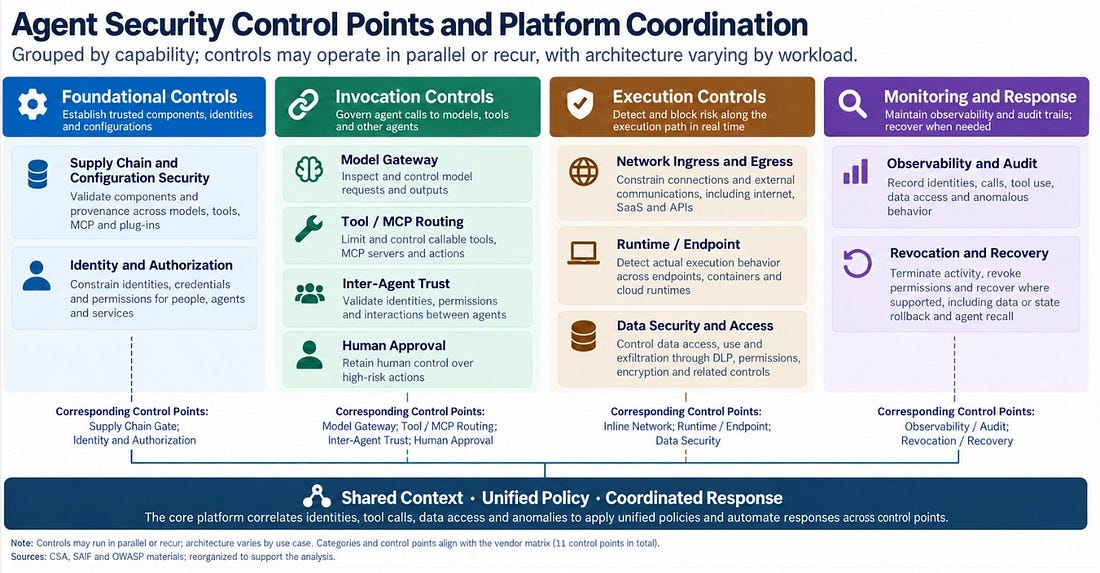
Source: FUNDA, based on CSA, SAIF and OWASP materials on security architecture and agent risks.
Unified Security Data and Policies Favor Platform Vendors
 Subscribed
Assessing an agent’s behavior requires context. A permitted data read may become risky when combined with an unusual login, an unexpected tool call or an external transfer. Identity controls determine access, runtime controls inspect execution, and network and data controls govern connections and information flows. Vendors seek to aggregate signals and apply policies at these points, adding features to expand contracts and reduce customers’ need for separate products.
The telecommunications company said that feeding information into a core platform is more efficient than storing data and alerts across multiple point products and consolidating them manually. Platforms with extensive security telemetry can integrate AI capabilities within existing workflows, reducing integration and coordination costs.
An AI gateway is one way to apply these controls. The telecom company builds its model routing and AI gateway internally.
The gateway handles model selection, access authorization, sensitive data identification, prompt risks, call limits and logging.
Agent workflows also need tool-call permissions. The company wants internal teams to control routing and enterprise policies while using commercial products for data identification and threat detection.
The interviewee roughly estimated that existing commercial products provide 60%–70% of the required security capabilities, with internal integration, routing and policy configuration providing 30%–40%. These percentages describe the source of capabilities, not budget shares.
The platform inspects key AI requests at the gateway and correlates resulting security data with identity, endpoint, network, and cloud information, enabling contextual assessment of agent behavior.
Companies tend to assess existing vendors first to reduce integration and management work. They still add specialist products where the platform falls short, so concentrating spending does not mean choosing a single supplier.
A large bank continues to use several vendors and requires alerts to feed into a common monitoring system. Its model gateway currently handles routing, caching and usage management, with security inspection planned for a later phase.
The bank’s interviewee would prefer to use security capabilities built into the gateway vendor’s products. Additional platform spending still depends on feature coverage and integration costs.
Reusing Existing Deployments Lowers Integration Costs
Inspecting AI inputs, outputs, and tool calls requires additional computing resources. As model calls and agent interactions increase, workloads for detection, log processing, and correlation analysis also rise.
New capabilities that reuse existing sensors, telemetry and security data lakes can reduce redeployment, duplicate data collection and storage, and cross-product integration.
Reusing sensors, identity information and response workflows can reduce duplicate data collection, storage and integration work. Platforms may add AI security to existing contracts through modules, capacity expansion or bundles. The bank would prefer its gateway vendor to supply these features, but this remains part of a later implementation phase.
Cloud and enterprise software platforms also have integration advantages. In its FY26 review, Microsoft reported that Atos had adopted Microsoft 365 E7 and was using Microsoft Foundry, Copilot Studio and Agent 365 to build and manage agents.
An interviewee at a global PR and communications company said existing cloud and identity platforms cover its main needs, with no large-scale purchases of standalone AI security monitoring products yet. It is still piloting Microsoft E7 features for free; this does not conflict with other customers having adopted E7.
Security Workload Growth Must Translate Into Revenue
The telecommunications company expert estimated that about 30%–40% of AI traffic passes through a dedicated security layer for instant inspection. Including identity, gateway, data loss prevention, logging, and other controls increases coverage to 70%–80%. While more calls raise the security workload, billable traffic and revenue do not always grow at the same rate.
Security returns are difficult to quantify. Compliance requirements, risk assessments and annual budget limits influence spending. Enterprises often seek contractual fee caps; with uncapped pricing and a tight budget, they may reserve full inspection for high-risk traffic. To assess revenue growth, we need to track new module purchases, discontinued legacy contracts and changes in core platform spending.
AI Security Vendor Capabilities
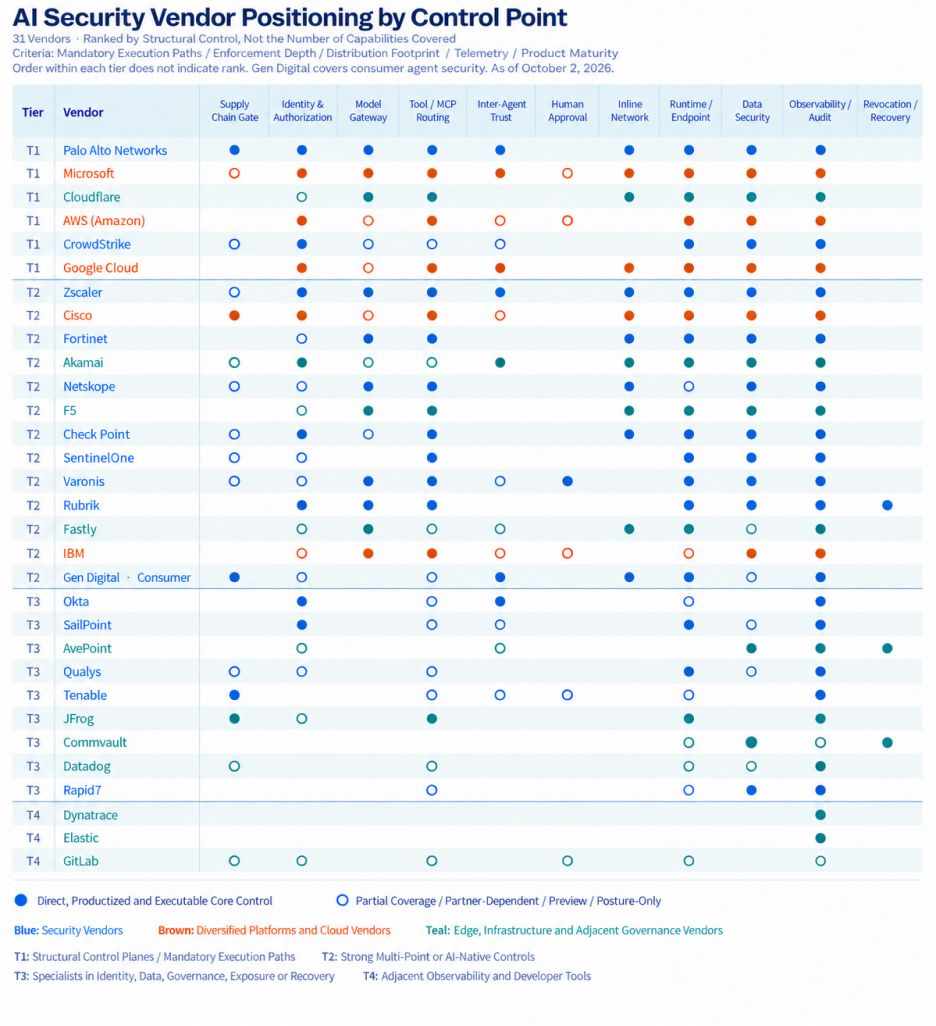
The figure compares product coverage and existing deployment strengths across 31 vendors. The tiers reflect FUNDA’s assessment; order within a tier does not indicate rank.
Tier 1 vendors have broad deployments in key areas such as identity, model or MCP gateways, networking, runtime, data and audit, making it easier to add agent security for existing customers.
Tier 2 vendors cover several control points, with different strengths and deployment bases. Tiers 3 and 4 focus more on identity, data, recovery, observability or developer tools, where specialist capabilities may still complement broader platforms.
Product coverage does not establish customer adoption or equal deployment maturity. We need to see whether these capabilities detect and block risks in actual use, and whether they generate additional contract spending.
Source: FUNDA, based on vendor disclosures as of October 2, 2026. Tiers reflect our assessment; dots indicate product coverage. Actual capabilities depend on version, configuration and deployment.
Consolidation of Traditional Security Tools and Vendors Redirects Existing Budgets
Traditional security budgets have stabilized at some interviewed companies.
An interviewee at a mid-sized US bank cited 3%–5% as a modest increase in a typical year, but expects the total security budget to be broadly flat over the next two years. No quantifiable dedicated AI budget was provided, so budget growth excluding AI cannot be calculated.
Tool consolidation can free funding for new needs. The telecom interviewee illustrated this with an initial budget of 100, rising 10% to 110, and another 5 freed from older tools. That leaves 15 for new security areas while total spending remains 110.
The telecom interviewee expects potential cuts in specific contracts that overlap with core platforms:
- Standalone cloud security posture management contracts: potential spending reductions of 20%–30%;
- Overlapping vulnerability management contracts: potential spending reductions of 10%–20%;
- Overlapping log collection contracts: potential spending reductions of 10%–20%.
These percentages apply to specific products or contracts, not the vendors’ total revenue.
Companies want to reduce duplicate collection of the same security data and overlapping license fees. The interviewee said the company generally prefers its existing platform when it meets 80%–90% of requirements and integrates smoothly with current systems.
Core platforms may gain both new AI spending and budgets released by consolidation. Spending within an account can therefore outpace the customer’s total security budget, depending on renewals, feature coverage and migration costs.
Market Size Under Illustrative Assumptions
In March 2026, IDC projected global security product and service spending of $308b for the year. We use that figure to illustrate the scale implied by changes in budget allocation and vendor shares.
The 2026 IANS and Artico Search survey puts staff and compensation at 37% of the average security budget and separately identified AI security tools at 3%. The calculation assumes that the remaining 63% represents external purchases and that the sample mix applies globally. The sources have different scopes, so this is an illustrative assumption.
On that basis, the 2026 security budget including personnel is $308b ÷ 63% = approximately $488.9b. Personnel costs are $180.9b, separately identified AI security tools $14.7b, and other external purchases $293.3b. The narrow AI tooling category excludes some AI-driven spending on identity, data and cloud security. The survey category may also include AI used in security operations, so it should not be read entirely as spending to protect models and agents.
Assume external purchases grow 10% annually in 2027–2028, personnel remain 37% of total budgets, and AI security tools reach 5% of total budgets in 2028. External purchases would reach $372.7b, total budgets including personnel $591.6b, AI security tools $29.6b and other external purchases $343.1b. The 10% growth rate and 5% allocation are FUNDA assumptions, not IDC or IANS forecasts.
To illustrate the effect of market share, assume CrowdStrike, Palo Alto Networks and Cloudflare together increase their share of other external purchases from 4.5% in 2026 to 6% in 2028, and their share of separately identified AI security tools from 5% to 10%. These are assumed shares, unverified against comparable company revenue. Cloudflare’s non-security businesses should not be counted as security market share.
These assumptions imply combined annual revenue of approximately $13.9b in 2026 and $23.5b in 2028, an increase of $9.6b: $7.4b from other external purchases and $2.2b from AI security tools. The categories do not overlap; calculations use unrounded figures.
The assumed revenue base implies a two-year CAGR of approximately 30%. This illustrates the combined effect of market growth and share gains, but does not establish that actual company revenue will grow at least 30% annually. Outcomes depend on the current revenue base, product scope, discounts, bundles and revenue recognition.
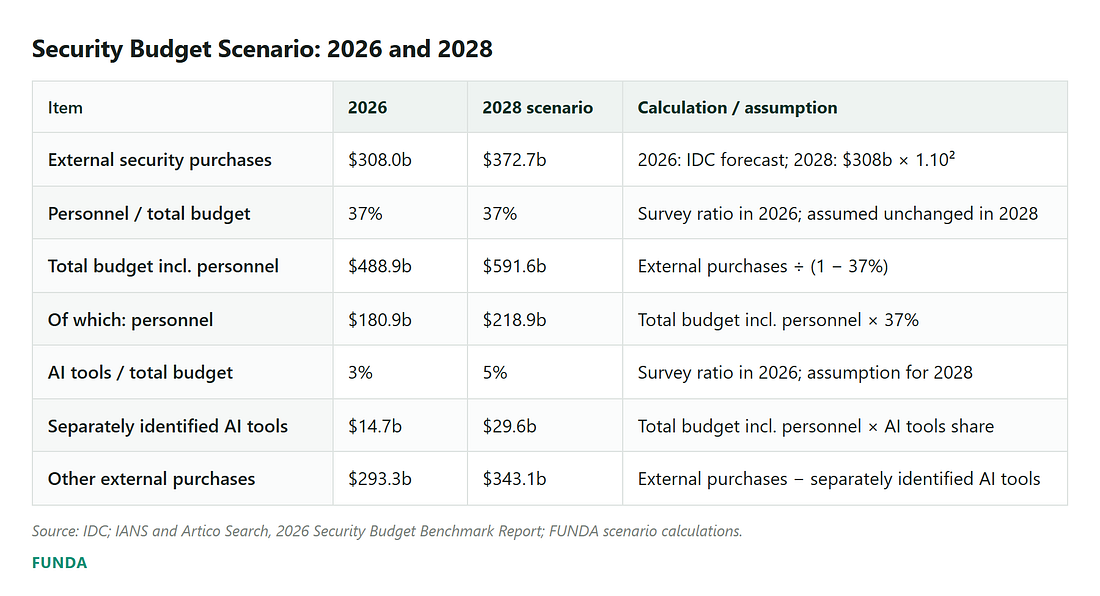

The three vendors are CrowdStrike, Palo Alto Networks and Cloudflare. This scenario is not a company revenue forecast. Calculations use unrounded values; amounts are shown to $0.1b.
Note: Applying the survey budget mix globally and treating all non-personnel budgets as external purchases are assumptions. AI tools may support security operations. Vendor shares are illustrative and exclude Cloudflare’s non-security business. Rounded components may differ from totals.
Disclaimer and Terms of Use
Analyst Independence Statement
The views expressed in this report accurately reflect the personal and independent views of the analyst(s) regarding the securities and issuers discussed herein. No part of the analyst’s compensation was, is, or will be directly or indirectly related to the specific recommendations or views expressed in this report. The Company adheres to strict compliance procedures to ensure the integrity, security, and legality of the data sources and information utilized.
About FUNDA
Consensus AI Technology Pte. Ltd. (the “Company” or “FUNDA”) is an independent research firm incorporated in Singapore. The Company is not affiliated with any securities dealer, investment bank, or asset management firm, nor is it registered as an investment advisor or broker-dealer in any jurisdiction. The Company does not have any investment banking or underwriting relationship with the companies covered in this report, and does not accept sponsorship or funding from publicly listed companies.
No Investment Advice and Report Neutrality
The contents of this report and the information contained herein are for informational purposes only and do not constitute investment advice or a basis for business decisions. The views expressed herein represent solely the personal opinions of the respective authors at a specific point in time and do not reflect the position of FUNDA. As an independently operated platform, FUNDA maintains a neutral third-party status and makes no express or implied warranties regarding the accuracy, completeness, or applicability of such views.
No Offer or Solicitation: This report does not constitute an offer, solicitation, recommendation, or advice to buy, sell, or hold any securities or financial instruments, nor does it provide any legal, tax, or accounting advice.
Third-Party Data: All third-party data cited in this report is derived from public or authorized sources. The Company makes no representations or warranties, express or implied, as to the accuracy or completeness thereof.
Non-Participation in Decision-Making: The Company does not participate, directly or indirectly, in the investment decision-making process of its clients or readers. Readers should make independent investment decisions based on their own investment objectives and financial circumstances, and consult professional financial or legal advisors prior to executing any transactions.
Timeliness Statement
Given the rapid changes in market environments and technological trends, this report reflects market conditions as of the date prior to its publication. Relevant information may become outdated over time. FUNDA has no obligation to update the contents of this report in real-time.
Intellectual Property, Confidentiality, and Restrictions on Commercial Use
All reports, data, models, and content provided by the Company constitute its exclusive proprietary intellectual property and are protected by copyright and intellectual property laws.
Ownership of Rights: Unless otherwise expressly stipulated in a written agreement, all intellectual property rights (including copyrights) arising from or relating to this report are exclusively owned by the Company.
Authorized Use: Institutional clients may use this report internally within the scope permitted by their internal compliance policies; however, disclosure or sharing with any third party is strictly prohibited.
Prohibition on Commercial Use: Without the prior express written consent of the Company, no individual or entity may reproduce, republish, distribute, resell, repackage, or otherwise use this report or any part thereof for any commercial or profit-making purpose.
Legal Recourse: The Company reserves the right to pursue all available legal remedies and claims against any unauthorized commercial use, redistribution, or infringement of its intellectual property rights.
Forward-Looking Statements and Disclaimer
This report may contain forward-looking statements, including forecasts, estimates, and analyses of industry trends. Such statements are subject to risks and uncertainties that may cause actual results to differ materially from those anticipated. The Company shall not be liable for any direct, indirect, or consequential losses arising from the use of or reliance on the contents of this report.