2026.10.05 | Substack | Packaging | Ibiden: Substrate Seller's Market Begins
原标题:Deep|Ibiden: The Substrate Seller’s Market Has Only Just Begun
Executive Summary
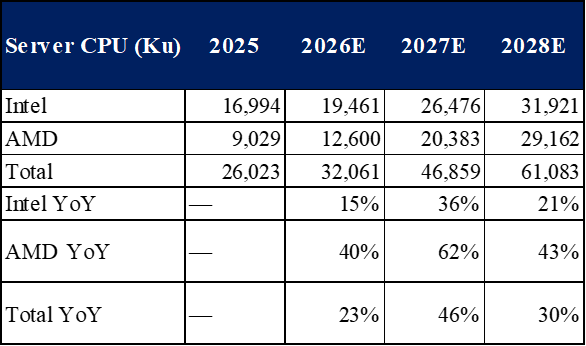
Ibiden’s (4062 JP) core driver remains qualified high-end ABF capacity failing to keep pace with the area and layer count of AI silicon. Intel/AMD server CPU shipments grow +36%/+62% in 2027 on new platforms 56–63% larger in substrate area, widening the CPU gap further. GPUs and EMIB-T consume the highest-end capacity: Rubin yields only 12 units per panel, TPU V9 / Trainium 4 only 4. The next pricing step falls on 27Q1 contract renewals, where new products can price above legacy agreements. We forecast FY3/27 / FY3/28 revenue growth of 35% / 30% and EPS of JPY173 / JPY267; at ~45x FY3/28E PE the shares still have rerating room, with the FY27Q2 results call the near-term catalyst.
- CPU demand is back and widens the supply gap. Resident agents such as Muse push workloads back onto CPUs via headless browsers and high-frequency API calls, and Intel can currently fill only ~50% of orders; shipments have upside if capacity allows. FUNDA models Intel server CPU shipments of 26.5mn units in 2027E (+36%) and AMD 20.4mn (+62%); multiplied by substrate area 63% larger for Diamond Rapids vs. Granite Rapids and 56% larger for Venice vs. Turin, substrate-area demand grows far faster than unit count. Supply is not only limited but already allocated: tier-1 and tier-2 makers are all full as of 26Q4, lead times are 48–52 weeks, total 2027 capacity grows only ~10–15%, and a visible shortfall opens from 27Q1. Customers that did not co-fund capacity sit lower in the allocation queue. This is already visible at Ibiden: AMD substrate revenue declines sequentially through 2H FY3/27 as capacity temporarily allocated to AMD returns to Intel; this does not reflect weaker AMD demand.
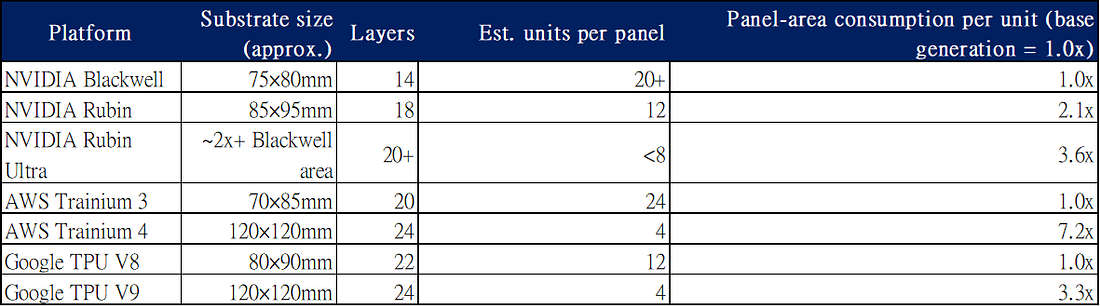
- GPUs and EMIB-T consume the highest-end slice of capacity. Blackwell is 73×81mm at 14 layers; Rubin 83×97mm at 18 layers, an estimated 1.8x the area; Rubin Ultra more than 2x Blackwell’s area at ~3x the price. EMIB-T is more extreme: Google TPU V9 at ~120×120mm, 24 layers with a multi-layer core, and Amazon Trainium 4 at ~120×120mm, 24 layers with a multi-layer core, each yielding only 4 substrates per panel. Even if ASIC unit growth looks modest, what truly consumes capacity is area, layer count and yield (core-stage yield on a multi-layer core drops from 99.9% to 97–98%, and a core defect can render all subsequent build-up layers worthless).
- Substrate price increases continue, supporting Ibiden’s new-product pricing. This year’s increases came mainly from Taiwanese makers; Ibiden only removed its quarterly price-decline assumption and normalized Intel pricing to a fair level. Next year, with the industry shortfall in place and lead times at 48–52 weeks, the next customer contract renewals fall in 27Q1 and new products can secure better quotes; new T-glass suppliers are also expected to qualify in 27Q1, and with Chinese and Taiwanese suppliers raising prices Ibiden also has room to pass through costs, while substrates remain under 10% of chip cost so we expect customers to accept the increase. We have not yet seen specific quotes, but we think a price increase is likely.
Business Overview
Ibiden (4062 JP) is a Japanese electronic-materials company built around high-end IC package substrates (FC-BGA / ABF). Founded in 1912 and headquartered in Ogaki, Gifu Prefecture, its core product is high-end ABF substrates produced on a semi-additive process (SAP), used in AI GPUs, AI ASICs, server CPUs and networking switch ICs. Historically anchored on Intel CPU substrates, the company is now shifting rapidly toward AI accelerators, where its competitive strengths are yield on large, high-layer-count substrates, first-qualification capability on new designs, and close relationships with Japanese materials and equipment suppliers. The lowest unit price is not the main consideration.
Products & Services
Electronics (58% of FY3/26 revenue, ~68% in FY3/27E): the growth engine. IC package substrates dominate the segment. FY3/26 revenue JPY243.3b, operating profit JPY45.2b (18.6%); FY3/27 guidance JPY375.0b / JPY110.0b (29.3%). The customer base is led by NVIDIA, Intel and AMD.
Ceramics (20%). Diesel particulate filters (DPF), SiC ceramic fiber and specialty carbon products for semiconductor processing. FY3/26 revenue JPY82.6b, operating profit JPY7.6b. FY27Q1 revenue rose 24% YoY on temporary DPF replacement demand, but this is not a medium-term growth driver.
Others (22%). Construction materials, synthetic resins and petroleum products; operating margin ~10–12%, a stable but low-growth contributor.
Near-Term Focus: FY27Q2 Results
 Subscribed
- 2H FY3/27 revenue outlook likely to be raised again. Vera Rubin and high-end CPUs ramp together, and Intel price
normalization is reflected for the full year; the 2H Electronics quarterly plan (3Q JPY100.0b, 4Q JPY107.2b) has upside.
- 2H FY3/27 operating-margin outlook also likely to be raised. Mix shifts toward GPUs and EMIB-bearing high-end
CPUs, and price increases propagate down the chain; Electronics operating margin should expand beyond the 27.6% posted in 1Q.
- Timing of the Cell 7 and Cell 9 investment decision. If the FY27Q2 results call delivers both a mid-term target
reset and a new capacity decision, investors gain much clearer visibility on the long-term outlook.
CPU Demand: The Supply Gap and Ibiden’s Opportunity
We think CPUs are the under-appreciated piece of the 2027 shortfall. Most substrate supply-demand models count only incremental GPU and ASIC area; yet Intel + AMD server CPU units grow +46% in 2027 with new platforms 56–63% larger in area, while nearly all high-end capacity coming online in 2H FY3/27 is dedicated floor space funded by NVIDIA and Intel. For Ibiden specifically, investors have long viewed the Intel business as low-margin (FY27Q1 operating margin below 20%), but that reflected depressed pricing and under-utilization rather than structural weakness; we expect the margin to approach 30% by FY27Q4 and product mix to keep improving as new capacity comes online and pricing resets.
CPU demand is recovering for two reasons. The first is the architecture of agentic AI. Meta’s Muse does not run on the handset; Meta proactively provisions every user a resident cloud agent that operates web pages through a headless browser and calls APIs at high frequency. In FUNDA’s database of 654 Muse cases, a single European trip comparison triggered 146 searches and clearing one inbox meant processing 165k emails. Tool execution and browser workloads run on CPUs. FUNDA estimates one CPU hosts roughly 200 DAU; if Muse penetrates Meta’s ecosystem at scale, server CPU demand could rise substantially. The second is the server refresh cycle alongside AI inference demand, as Intel itself describes it: CEO Lip-Bu Tan says CPU demand far exceeds capacity and current output meets only ~50% of real customer demand. Shortage brings pricing power: Intel raises PC CPU prices ~10% from Oct 5, the third round this year after increases in early 2026 and July, and channel checks point to at least another 15% on server CPUs in 26Q4.
On the supply side, Intel is expanding front-end capacity: combined Intel 3 and 18A output grows 40%/30% in 2027/2028, and the August equity raise was earmarked largely for this expansion. Provided wafer supply keeps pace, Ibiden’s share of high-end CPU substrates should increase.
Source: Company, FUNDA estimates
How CPUs widen the gap:
- Substrate demand depends on shipments and area per unit. Intel 26.5mn units in 2027 (+36%), AMD 20.4mn (+62%),
46.9mn combined (+46%); AMD itself has lifted its server CPU TAM CAGR from 18% to 35%+. Multiply by new-platform area: Diamond Rapids is 63% larger than Granite Rapids, Venice 56% larger than Turin (76.5×85mm, 26 layers vs. 72×75.4mm, 20 layers). Combined, 2027 server CPU substrate-area demand grows 50–60 points faster than unit growth.
- Supply is already fully allocated. As of 26Q4, Ibiden, Shinko, SEMCO, AT&S, Unimicron, Nan Ya PCB and Kinsus are
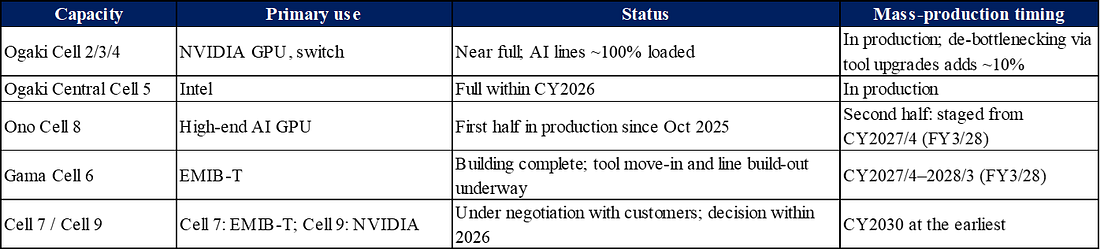
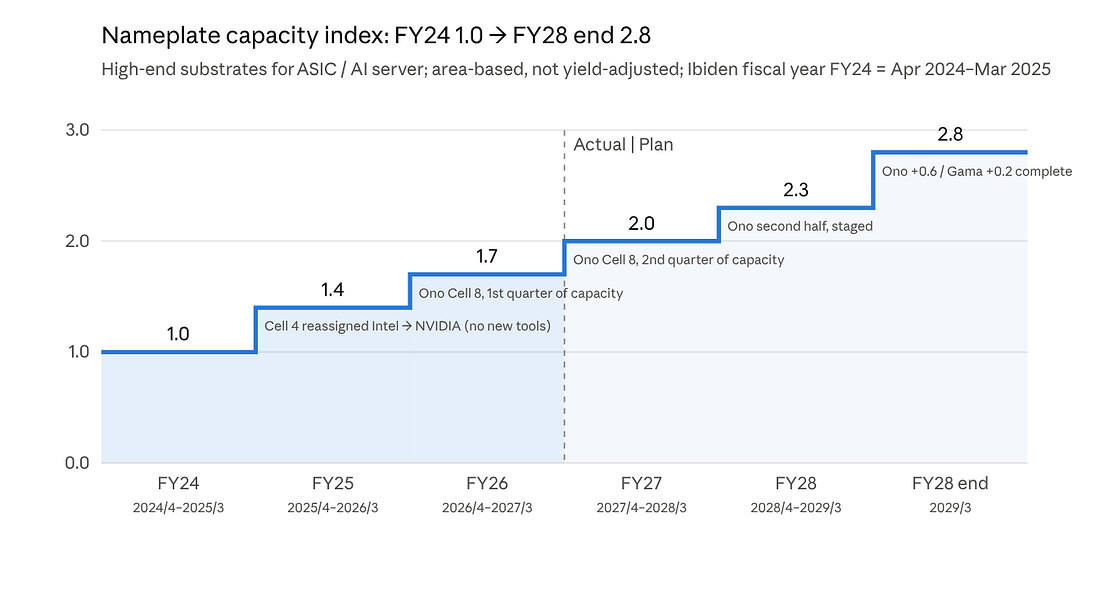
all at full utilization with 48–52 week lead times; 2027 capacity at the major makers grows only 10–15%. More importantly, the new capacity is essentially pre-booked: Ibiden adds only two blocks in FY3/27–FY3/28: the second half of Ono Cell 8, funded by NVIDIA and dedicated mainly to AI GPUs, and Gama Cell 6, funded by Intel.
GPUs and EMIB-T Consume High-End Capacity
Specifications for the leading AI GPU and ASIC platforms show why output per panel is falling. On the same 510×515mm panel, the Blackwell generation still fits 20+ units, Rubin only 12, and EMIB-T TPU V9 just 4; as layer counts move from 14 toward 24, every additional layer adds another round of yield loss.
Source: FUNDA compilation
Effective output falls short of nameplate capacity. Existing Cells 2/3/4/5 can squeeze out another ~10% over the medium term through tool upgrades and yield gains; Cell 8 and Cell 6, running high-end products with fewer units per panel and yields still ramping, will deliver effective output well below nameplate. With demand expanding in multiples and supply growing only incrementally, the gap keeps widening.
Source: FUNDA compilation
Source: Company disclosures, FUNDA estimates
EMIB-T consumes even more capacity per unit
EMIB-T progress update. The substrate is built first, then a second process embeds the silicon bridge into a cavity and makes the vertical TSV connection. That second process requires substantial equipment and floor space, so the same building yields fewer units. However, unit pricing is expected to be at least 2–3x conventional EMIB, and the company guides operating margin above 40%.
Yield status: EMIB-T substrates currently run at ~40% yield, EMIB near 50%; the EMIB-T mass-production threshold is ~57%. The supply chain expects EMIB-T yield to reach production-ready levels in 2H27, with the current bottlenecks being NCF fill voiding and TCB thermo-compression cracking. The main products enter mass production in 2028.
How many EMIB-T units can Cell 6 produce? We estimate output from the laminator count. We assume 18 high-temperature laminators, each 45 panels per hour, 23 hours a day, 30 days a month, or roughly 6.7mn panel-passes a year. EMIB-T is 14 build-up layers plus an 8-layer multi-layer core (22 layers), with build-up laminated both sides at once, 7 passes. On that basis we believe TPU V9 will be fully served on EMIB-T once yield reaches target.

Source: FUNDA estimates
EMIB-T competition: Japanese makers lead on both technology and capacity; Unimicron waits until 2H28. On technology the order is Japanese (Ibiden, Shinko) > Unimicron > AT&S > SEMCO. Capacity follows the same order: Ibiden’s Cell 6 is Intel-funded, EMIB-T-dedicated capacity entering production in 2027, while Unimicron’s Yangmei Plant 2 (EMIB-T) does not come online until 2H28.
Substrate Price Increases Support Ibiden’s New-Product Pricing
We expect the price reset to fall on 27Q1 contract renewals. This year’s ABF price increases came mainly from Taiwanese makers: Unimicron raised pricing ~25% on average from 25Q4 to 26Q2 and another ~10% in 2H26, and Nan Ya PCB plans a broad increase in 1H27. Ibiden did only two things this year: dropped its quarterly price-decline assumption and normalized Intel’s previously depressed pricing to a fair level. Next year the conditions differ. The industry shortfall is already in place and is expected to be larger in 2028 than in 2027, lead times have stretched to 48–52 weeks, and Taiwanese makers are on track for double-digit full-year increases. Ibiden’s next renewals cluster in 27Q1, exactly when new products enter quotation, giving them the opportunity to price above legacy contracts; two new T-glass suppliers, Grace Fabric and Taiwan Glass, are also expected to qualify in 27Q1, and with both Chinese and Taiwanese substrate makers raising prices, Ibiden has room to pass through material costs as well.
Upstream material access is, if anything, a relative advantage for Ibiden. Ibiden’s materials and equipment chain is almost entirely Japanese: Ajinomoto ABF, Nittobo T-glass, Resonac / MGC CCL, Mitsubishi laser drills, Nikko laminators. New materials are typically tested and calibrated at Ibiden first, so its qualification path is shorter than Taiwanese and Korean peers’. T-glass is the tightest material in the industry: shortage is certain through 2027 and may only ease in 2028. Ibiden’s edge is the combination of a shared Japanese supply base and customer-funded capacity: NVIDIA and Intel both reserve Nittobo capacity directly and will add Chinese and Taiwanese suppliers in 2027, helping secure materials for Ibiden. Within the T-glass constraint, Ibiden is therefore the least exposed of the substrate makers.
Financial Analysis
- We forecast Ibiden revenue growth of 35% / 30% in FY3/27 / FY3/28, driven by the NVIDIA Rubin ramp, recovering server
CPU demand and Intel substrate price normalization; FY3/29 grows another 40% as the second half of Ono, Gama Cell 6 and initial EMIB-T shipments come online.
- Margins should keep expanding, with consolidated operating margin rising from 14.9% in FY3/26 to 24.7% in FY3/27 and
29.3% in FY3/28, driven mainly by mix shift toward GPUs and EMIB-bearing high-end CPUs.
- We forecast FY3/27 / FY3/28 EPS of JPY173 / JPY267; the current share price implies ~45.0x FY3/28E and ~28.4x FY3/29E
PE.

Source: FUNDA estimates
Disclaimer and Terms of Use
Analyst Independence Statement
The views expressed in this report accurately reflect the personal and independent views of the analyst(s) regarding the securities and issuers discussed herein. No part of the analyst’s compensation was, is, or will be directly or indirectly related to the specific recommendations or views expressed in this report. The Company adheres to strict compliance procedures to ensure the integrity, security, and legality of the data sources and information utilized.
About FUNDA
Consensus AI Technology Pte. Ltd. (the “Company” or “FUNDA”) is an independent research firm incorporated in Singapore. The Company is not affiliated with any securities dealer, investment bank, or asset management firm, nor is it registered as an investment advisor or broker-dealer in any jurisdiction. The Company does not have any investment banking or underwriting relationship with the companies covered in this report, and does not accept sponsorship or funding from publicly listed companies.
No Investment Advice and Report Neutrality
The contents of this report and the information contained herein are for informational purposes only and do not constitute investment advice or a basis for business decisions. The views expressed herein represent solely the personal opinions of the respective authors at a specific point in time and do not reflect the position of FUNDA. As an independently operated platform, FUNDA maintains a neutral third-party status and makes no express or implied warranties regarding the accuracy, completeness, or applicability of such views.
No Offer or Solicitation: This report does not constitute an offer, solicitation, recommendation, or advice to buy, sell, or hold any securities or financial instruments, nor does it provide any legal, tax, or accounting advice.
Third-Party Data: All third-party data cited in this report is derived from public or authorized sources. The Company makes no representations or warranties, express or implied, as to the accuracy or completeness thereof.
Non-Participation in Decision-Making: The Company does not participate, directly or indirectly, in the investment decision-making process of its clients or readers. Readers should make independent investment decisions based on their own investment objectives and financial circumstances, and consult professional financial or legal advisors prior to executing any transactions.
Timeliness Statement
Given the rapid changes in market environments and technological trends, this report reflects market conditions as of the date prior to its publication. Relevant information may become outdated over time. FUNDA has no obligation to update the contents of this report in real-time.
Intellectual Property, Confidentiality, and Restrictions on Commercial Use
All reports, data, models, and content provided by the Company constitute its exclusive proprietary intellectual property and are protected by copyright and intellectual property laws.
Ownership of Rights: Unless otherwise expressly stipulated in a written agreement, all intellectual property rights (including copyrights) arising from or relating to this report are exclusively owned by the Company.
Authorized Use: Institutional clients may use this report internally within the scope permitted by their internal compliance policies; however, disclosure or sharing with any third party is strictly prohibited.
Prohibition on Commercial Use: Without the prior express written consent of the Company, no individual or entity may reproduce, republish, distribute, resell, repackage, or otherwise use this report or any part thereof for any commercial or profit-making purpose.
Legal Recourse: The Company reserves the right to pursue all available legal remedies and claims against any unauthorized commercial use, redistribution, or infringement of its intellectual property rights.
Forward-Looking Statements and Disclaimer
This report may contain forward-looking statements, including forecasts, estimates, and analyses of industry trends. Such statements are subject to risks and uncertainties that may cause actual results to differ materially from those anticipated. The Company shall not be liable for any direct, indirect, or consequential losses arising from the use of or reliance on the contents of this report.