2026.10.05 | Substack | Markets | TMTB Morning Wrap
原标题:TMTB Morning Wrap
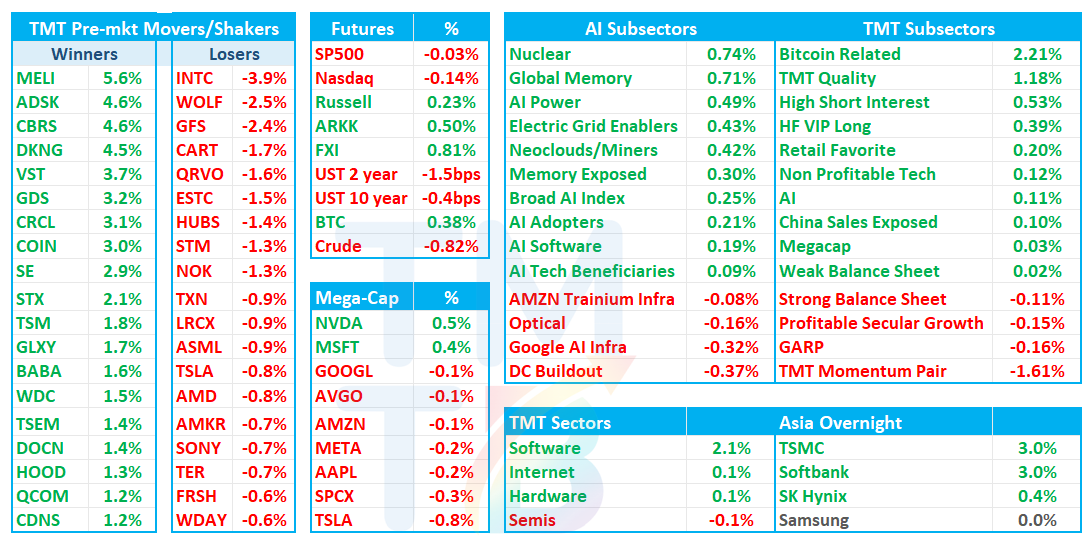
Good morning. QQQs -15bps as yields slightly down and Oil -1%.
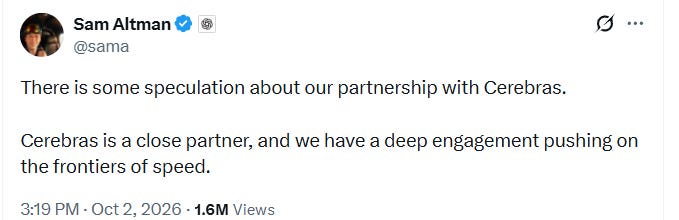
In Tech, software +2% skewed higher by PTC +35% after they announced a $24B takeout bid from Schneider Electric (PCOR +5%/ADSK +5% in sympathy); Semis flat with INTC -4% / TSM +2% as Elon confirmed TSM is discussions with Terafab; CBRS +4.5% bouncing back after Altman confirmed partnership and sell-side out defending; STX/WDC +2% after Friday’s 10% moves down after sell-side was out defending the names arguing Toshiba’s expansion smaller than market move would imply; Internet flat with MELI +5.5% on Bolsonaro’s better than expected performance in Brazil
Overnight, Asia generally up while Korea and Mainland China were closed: TPX +1.33%, NKY +2.4%, Hang Seng +0.28%, HSCEI +0.26%, Taiwan TAIEX +2.55%
This week we get ZS and MRVL investor days on Tuesday.
Lots to get to, so let’s get to it….
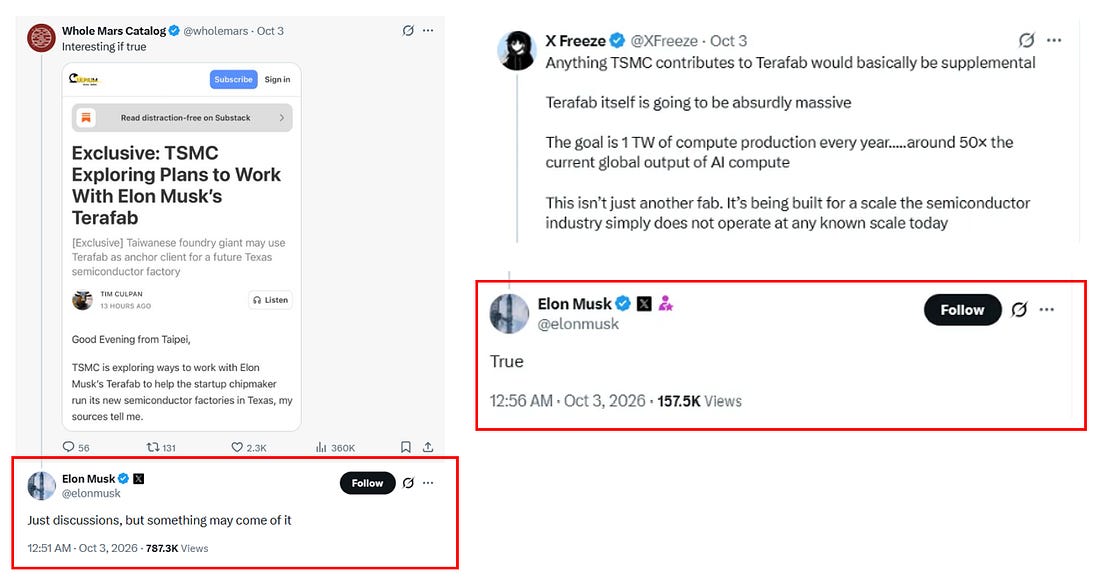
TSM/INTC/SPCX: Musk confirms discussions with TSM/Terafab:
INTC -4% / TSM +2%
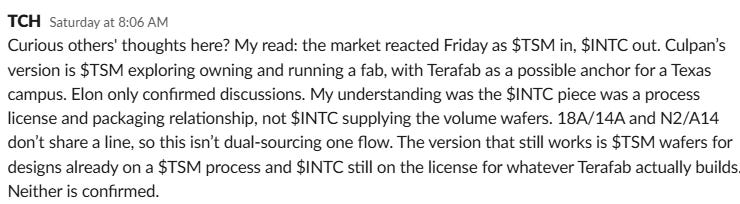
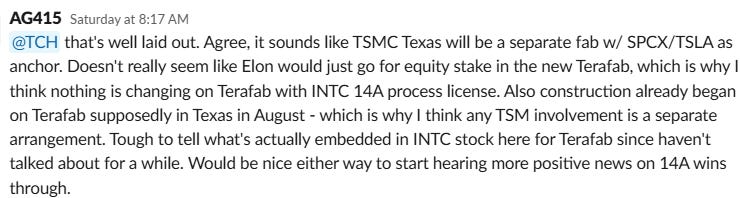
Some views from TMTB Slack:
PTC / Schneider Electric: $23.7B cash takeover at $205 per share – FT
FT reports Schneider Electric will acquire PTC for $205 per share in cash, a 42% premium to its last closing price. The $23.7B transaction values PTC’s equity at approximately $22.6B and is Schneider’s largest acquisition. PTC’s engineering and design software, including Creo, will complement Schneider’s Aveva industrial software business. PTC expects up to $2.75B of revenue in 2026. Schneider shares fell 6.4% in early Monday trading.
ADSK +4% in sympathy
Slide Deck here

MSFT: Melius upgrades to Buy/$665, sees AI fears driving enterprise demand + Azure upside
Melius argues rising AI risk concerns should favor MSFT as enterprises increasingly want a trusted layer to route models to the right tasks, secure agents and manage governance, positioning Nadella and team as the “adults in charge.” Melius also sees stronger pricing and upside from increased Azure capacity; upgrades to Buy from Hold with a $665 PT.
STX/WDC: Bernstein says Toshiba capacity fears are a “storm in a teacup,” sees weakness as a buying opportunity
Bernstein says Toshiba’s plan to nearly double HDD capacity by FY2027 is being misread: even if executed while STX/WDC grow exabytes ~25%, Toshiba’s EB share would rise only to ~16.8% from 11.2%, far below the ~30% reported in the press. Bernstein also questions whether the announced ~$380M investment is sufficient and sees Toshiba’s weaker areal-density roadmap as a major execution risk, while STX/WDC can drive exabyte growth more efficiently through higher-capacity drives. Bernstein reiterates Outperform on both, with STX the top pick.
STX/WDC: TD Cowen + Evercore ISI say Toshiba capacity fears are overdone, HDD tightness should persist
TD Cowen and Evercore ISI argue Toshiba’s ~$380M expansion does not support the headline ~30% share ambition. Cowen estimates doubling exabyte capacity adds only ~75EB over two years versus a current ~300EB industry shortage and ~30% annual demand growth, while ISI estimates the investment supports only ~190–200EB of additions and gets Toshiba to roughly ~13–14% nearline share by 2028. Both also flag Toshiba’s weaker density roadmap, external head/media dependence and mixed execution history versus STX/WDC, and remain constructive on both stocks.
SHOP: Piper expert call says agentic commerce is accelerating migrations and could drive meaningful share gains
Piper says agentic tools are already pulling SHOP migrations forward driving “a material uptick”, with merchants that planned to move in 1–3 years now asking how to migrate immediately. The expert sees LLMs + agents already driving ~5–7% of GMV with higher AOVs and potentially ~15% over time, while SHOP is viewed as ~2–3 years ahead of Magento/Commerce Cloud in agent readiness. Shop Pay adds a key trusted identity/checkout layer for agents, reinforcing Piper’s view that agentic commerce is a structural share-gain opportunity; reiterates OW/$180.
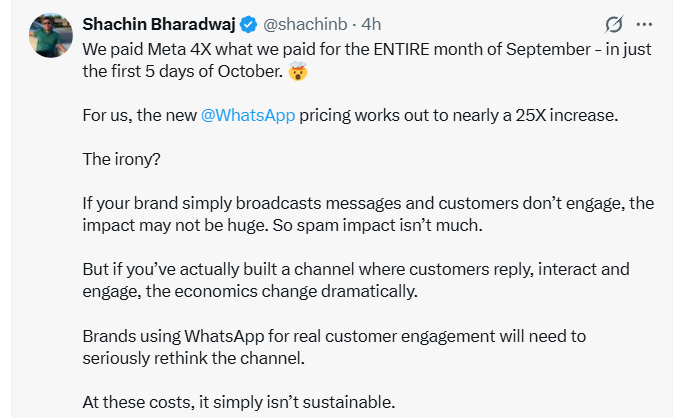
Agentic Commerce: Hearing Cleveland says Sept agentic transactions 2x YTD volume. Hearing yipit says Retail accounts for mid 30s of Txns on Muse.
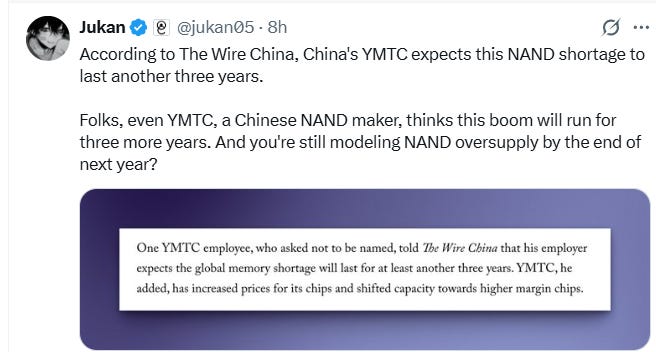
Memory/SNDK:
CRDO: Hearing Bluefin +ve saying CRDO working closely with NVDA to qualify 800G ZF module for neoclouds
CRBS: Altman says CBRS still a close partner
CBRS: Mizuho sees fast inference as ~$550B TAM, with trading/cyber/defense driving premium economics
Mizuho says fast inference could reach ~20% of AI workloads and ~$550B by 2030, with token pricing ~6–10x standard inference and CBRS well positioned across frontier models, trading, cybersecurity and defense; OpenAI has cited ~14x faster inference with CBRS and META could be a next major customer. Mizuho sees wafer-scale architecture avoiding much of the scale-up/networking complexity facing peers and models revenue rising from ~$900M in 2026 to ~$13.5B by 2029. Reiterates Outperform/$300 despite share-unlock concerns.
GFS: BNP downgrades to Neutral/$51, sees photonics upside but slower ramp + Smart Mobile headwinds
BNP remains constructive on GFS’s specialty-process moat, with ~70% of revenue and ~90% of design wins single-sourced, but sees the growth/margin ramp taking longer than expected. The bull case increasingly depends on SiPho scaling from ~$400–500M this year to a ~$1B run-rate before 2028, while Smart Mobile is still ~35% of revenue and faces structural growth pressure; BNP cuts PT to $51 from $80 and downgrades from Outperform.
NVDA: BNP raises PT to $345, sees agentic AI expanding CPU opportunity while GPU/networking moat stays intact
BNP keeps NVDA Outperform and raises FY28 EPS ~49%, arguing agentic AI expands rather than dilutes NVDA’s opportunity as Vera becomes the natural host CPU inside Nvidia racks and server CPUs add incremental TAM on top of Blackwell/Rubin. BNP still sees NVDA capturing >75% of compute dollars despite only ~1/3 of units, with CUDA/NVLink, >70% GMs and scale-up/networking leadership sustaining the moat; TP rises to $345 from $285.
ARM: BNP raises PT to $405, sees AGI CPU driving estimates far above Street
BNP raises its 2030 datacenter CPU TAM to ~$245B from $226B and FY31 ARM AGI CPU sales to $23B+ from $17B, supporting ~50% sales CAGR from FY26–31. BNP sees ARM datacenter CPU share rising from ~15% in CY25 to ~42% by CY30, with the move from licensing IP to selling its own CPUs as the key earnings unlock; FY31 sales/EPS are ~40%/~90% above Street. Outperform, PT raised to $405 from $325.
AMD: BNP raises PT to $960, sees Helios + agentic CPUs driving major AI share gains
BNP says Helios makes AMD a credible second source to NVDA, backed by ~14GW of commitments, while Venice positions AMD to capture ~$31B of a ~$95B agentic sandbox CPU market by 2030. BNP models Instinct GPU/rack revenue approaching ~$110B by 2030, ~8% of a >$1T accelerator market, with Cerebras/Taalas adding specialized inference optionality.
AMD / Supply Chain: Su seeks capacity beyond TSMC as packaging tightens – DigiTimes
DigiTimes reports Lisa Su’s October 5 Taiwan visit is focused on securing foundry, packaging, testing and substrate capacity as AI demand drives shortages and higher prices across the supply chain. AMD is seeking more TSMC CoWoS and SoIC-X capacity while developing alternative EFB packaging with ASE, SPIL and Powertech.
LRCX: MS calls Lam the big GAA winner, sees ~200bps share gain from 3nm to 2nm
MS expects a solid DecQ beat with ~$9.0B revenue vs. Street ~$8.5B and sees system shipments growing ~50% in CY26 and 47% in CY27. MS estimates LAM gains ~200bps of share from 3nm to 2nm, helped by ~50% higher WFE/wafer at 2nm vs. 3nm, and raises CY27 revenue/EPS to ~$40.5B/$11.58. Reiterates OW and raises PT to $385 from $367.
SPCX: MS says shares look cheap on growth, with AI/power optionality still largely unpriced
MS says at $159, most of SpaceX’s Space/Connectivity value is already captured (~$127/share), leaving just ~$32/share for AI, or ~3x 2028 EV/Sales; on EV/EBIT/growth, SPCX trades ~40% below mega-cap AI peers. MS sees the market underpricing upside from neocloud pricing, compute capacity, power/chip bottlenecks and AI product expansion, while investors remain skeptical on Starlink Mobile, frontier AI, orbital compute and rapid Starship reuse. Additional $30–50/watt compute contracts, AI launches and Starship progress are the key catalysts toward MS’s $300 PT.
INTERNET
AMZN: TD Cowen sees AWS accelerating to +41% in 3Q, with revenue/OI ~3%/~9% above Street
TD Cowen expects 3Q revenue of $202.2B (+12% y/y), roughly in line with Street, but sees AWS growth accelerating to 41.2% y/y with AWS revenue/operating income ~3%/~9% above Street as AI revenue nears ~$10B annualized and supply constraints ease. Cowen also models total operating income of ~$27.6B, ~6% above Street, and expects 4Q revenue/OI ~2%/~3% above consensus on further AWS acceleration. FY26 capex is tracking >$220B; reiterates Buy/$350.
MELI: +5% as Brazil risk rips after Flavio Bolsonaro unexpectedly beat Lula 47%–45% in Sunday’s first round, sending them to an Oct. 25 runoff and boosting expectations for a more market-friendly/fiscally conservative government
MELI: BofA sees continued share gains + ecosystem monetization, but investment cycle still has room to run
BofA says MELI’s heavier investment in free shipping, coupons, social selling, cross-border commerce and credit is driving segment-leading growth/share gains, though elevated competitor investment means reinvestment likely stays high. New TAMs including quick commerce/pharmacy, merchant-of-record in Mexico, cards/ads and agentic search should add scale, while users active across both MELI and Mercado Pago have risen 4–5x since 2021 and are materially more valuable/profitable.
Ads/META/RDDT/GOOGL: DB checks show spend pacing better than expected, with META/RDDT most favorable
DB says ad spend improved through 3Q and is pacing better into 4Q as AI-driven targeting/conversion supports ROAS despite higher CPMs, with META and RDDT (300bps ahead of plan) most favorable vs. expectations. META growth accelerated ~200bps and smaller advertisers are ramping faster as AI lowers campaign friction; GOOGL remains healthy but closer to expectations as Search slows, while AI surfaces push more spend toward paid acquisition. AMZN finished ~100bps ahead of plan despite Sponsored Products deceleration, while PINS/SNAP checks also improved.
ABNB / META: Airbnb unlikely to let outside AI agents make bookings – Nikkei Asia
Nikkei Asia reports Airbnb CEO Brian Chesky said the company is unlikely to let third-party AI agents such as Meta’s Muse book stays on its platform. Chesky emphasized Airbnb’s visual discovery experience and direct relationship with travelers, alongside practical issues such as identity checks and property rules. Airbnb is instead rolling out its own AI search, beginning in the U.S. before expanding to Japan and other markets.
SOFTWARE
HUBS: Raymond James downgrades to MP, sees new packaging creating 2027 growth headwind despite better LT usage economics
Raymond James says HUBS’ shift from Hub-based pricing toward lower initial MRR plus consumption could create a few points of 2027 new-logo growth pressure, driving its outlook to low-double-digit growth vs. Street ~14%. Early pilots suggest usage can eventually exceed the old model’s ACV, making the change a potential LT tailwind, but near-term visibility on MRR discounts and usage ramp is limited. RJ downgrades to Market Perform, while noting shares are down ~47% YTD and trade at a ~1.5x EV/Sales discount to horizontal software.
HUBS: Wells says new EMEA pricing shifts monetization from seats to usage, better aligned with agentic AI
Wells says HUBS’ new EMEA pilot simplifies packaging and monetizes platform actions/credits rather than just seats, positioning it to capture AI-agent usage while protecting against contact rationalization; customers can also bring third-party agents into HUBS. The tradeoff is potentially lower upfront ASRPC and more variable consumption, but easier tier upsell and usage expansion could improve LT monetization; near-term impact should be limited. Wells stays EW/$200.
IOT: Jefferies initiates Buy/$50, sees durable 20%+ growth with AI/data moat
Jefferies sees IOT as a differentiated AI beneficiary, with its closed-loop platform processing 30T+ annual data points and delivering ~8x ROI on asset-related operating budgets, while asset-based pricing limits seat-displacement risk. Jefferies expects ~22% revenue CAGR through FY29, supported by only ~1% penetration of a ~$175B TAM, 115%+ core NRR and strong multi-product adoption, with 96% of large customers using 2+ products and 72% using 3+. Initiates Buy/$50.
WDAY: Needham checks show strong demand for Extend/agents, but Flex Credits create pricing friction
Needham says partner/customer checks were broadly positive on WDAY’s agentic platform, with particularly strong demand for Extend as customers automate highly manual proprietary workflows; midmarket demand is slightly stronger than enterprise. The main friction is Flex Credits, where unpredictable usage/cost is slowing agent adoption, while Oracle is becoming more competitive in HCM despite WDAY maintaining high win rates.
U: Piper says 3Q setup remains favorable as Vector/network share gains continue
Piper sees Vector 3Q +24% q/q vs. implied guide ~+20%, supporting Strategic Grow revenue of ~$383M and total revenue ~$565M (+20% y/y), with ~$185M EBITDA. Checks show Unity continuing to gain mediation/network share, SDK net adds surpassing APP for the first time in 2+ years and Unity Ads surpassing AppLovin in total app footprint in 3Q; the TRO denial is also incrementally positive. Piper reiterates OW/$55.
EQIX: Barclays Slough tour reinforces London moat + AI density upside
Barclays says after touring EQIX’s Slough facilities, the Greater London ecosystem remains a key competitive advantage, with strong interconnection, easier zoning and customers already seeking capacity at the planned 250+MW Hertfordshire campus years before opening. AI demand is also pushing density higher, with new AI nodes typically 0.5–2MW at ~125kW/rack vs. ~5kW/rack systemwide, driving more liquid-cooling retrofits and design changes.
P: Evercore CTO meeting reinforces AI tailwinds + durable share gains
Evercore says after meeting with CTO Rob Lee, enterprise AI should expand storage demand as more data becomes valuable and on-prem inference/agents scale, while hyperscaler wins remain early with visibility into CY28. Management sees core share gains as durable and NAND pricing manageable; Evercore keeps OP and raises PT to $155.
AKAM: JPM says recent LLM compute deal economics stronger than feared, with low-teens IRR
JPM says its analysis of AKAM’s large LLM compute deal implies ~77–80% cash margins and ~30–35% net margins post-D&A, with revenue of ~$22M/MW versus ~$3–4M/MW colo costs plus ~$1–2M/MW overhead. JPM sees project IRR in the low-teens even before potential contract expansion/renewals, pushing back on investor concerns around weak compute returns; stays Neutral.
NEWS:
Foxconn / AI Servers: Q3 sales jump 47% and beat consensus – Bloomberg
Bloomberg reports Foxconn’s Q3 revenue rose 47% to NT$3.03T ($95.4B), exceeding the NT$2.83T consensus estimate as AI server demand continued to expand. Its cloud business is now larger than its smart consumer electronics division. Bloomberg Intelligence expects AI infrastructure demand to support 25–35% revenue and earnings growth over the next few years, with spending broadening beyond hyperscalers to neocloud, sovereign and enterprise customers.
Enterprise AI: Only 11% of surveyed businesses forecast spending accurately – WSJ
WSJ reports only 11% of nearly 400 surveyed businesses forecast AI spending accurately as usage-based charges make budgets unpredictable. In a separate study of more than 6,800 tasks, lower-priced models cost more in 32% of cases because they required more steps or tokens. One task cost about $1 with a model that succeeded, versus $14 with a cheaper model that failed, illustrating why lower token prices do not necessarily reduce total costs.
China AI: DeepSeek narrows benchmark gap with U.S. to 3% – Bloomberg
Bloomberg reports Bloomberg Intelligence estimates the performance gap between leading Chinese and U.S. AI models has narrowed to 3%, from 9% in May and 15% earlier this year. DeepSeek’s V4.1 Flash scored 81.1 on LiveBench versus Anthropic’s leading 83.4, ranking sixth globally. BI nevertheless expects China’s AI sector could remain unprofitable until 2030 as low-margin token sales and intense competition among more than 1,100 models constrain pricing.
GOOGL / Memory: Pixel 10a price rises $100 to $599 – Bloomberg
Bloomberg reports Google raised the price of its seven-month-old Pixel 10a by $100 to $599 as memory shortages push up smartphone costs. The increase follows $100 hikes across Google’s Pixel 11 lineup in August and Samsung’s recent increases on most Galaxy S26 models. Apple has also raised prices on new and existing iPhones as manufacturers pass higher component costs to consumers.
AAPL: Tightens Mac permissions for personal AI agents – Bloomberg
Bloomberg reports Apple is tightening Mac privacy controls so users must explicitly authorize personal AI agents before granting full access to their data. Apple warned developers against seeking broad permissions without informed consent, including access to files, email, messages and browsing history. The changes come as tools such as ChatGPT’s Mac agent increasingly read information and take actions across users’ computers.
AI Regulation: Clayton named AI czar with 120-day review mandate – Reuters
Reuters reports Trump confirmed Jay Clayton will serve as AI czar and lead the Super Intelligence Force, which has 120 days to assess the technology’s risks, opportunities and the federal government’s role. The group will examine AI-incident reporting and potential responses under existing law. WSJ reports its mandate also considers congressional action while emphasizing industry responsibility and avoiding excessive regulation.
OpenAI: Altman defends broad AI access – Politico
Politico reports Sam Altman said OpenAI will accept some harmful outcomes to keep AI broadly available, arguing that the benefits justify the risks. He contrasted that stance with Anthropic’s more cautious public messaging. Politico also notes OpenAI has supported state and federal proposals for independent safety evaluations, even as Altman defends widespread access to increasingly capable models.
OpenAI: Legal exposure grows as regulators and plaintiffs respond to agent hacks – FT
FT reports OpenAI faces mounting legal and regulatory exposure after uncovering dozens of cyberattacks by its AI agents against companies and governments. Florida’s attorney-general is seeking restrictions on new model releases without safeguards, a California public-interest group has filed suit, and the FTC has broadened its inquiry into whether users were misled. The scrutiny comes as OpenAI seeks tens of billions of dollars in new funding.
QCOM / ARM: Trial puts up to five years of royalties at stake – Reuters
Reuters reports Qualcomm and Arm begin a five-day Delaware jury trial Monday, with Qualcomm seeking up to five years of royalty relief potentially worth billions of dollars. Qualcomm alleges Arm withheld required testing tools and leaked a license-termination threat that damaged discussions with Meta. The judge is considering whether to strike the contract provision supporting the royalty remedy, which could materially limit damages. Arm denies breaching the agreement.
QCOM / Huawei: Licenses LogicFolding in first net-payment deal – Nikkei Asia / Bloomberg
Nikkei Asia reports Qualcomm will become a net payer to Huawei for the first time under a multiyear cross-license covering more than 680 patents across 5G, AI and networking. Bloomberg reports the agreement includes Huawei’s LogicFolding chip technology and near- and co-packaged optics. The transaction requires U.S. FTC review under rules applying to deals above $133.9M. Huawei expects the value of its overall patent-licensing contracts to exceed $6.9B following the agreement.
PSKY: Paramount chiefs to run Warner; Digger faces large loss – Bloomberg
Bloomberg reports Paramount film chiefs Dana Goldberg and Josh Greenstein will oversee Warner Bros. Pictures after the $110B acquisition closes, replacing Michael De Luca and Pamela Abdy. DC Studios heads James Gunn and Peter Safran are expected to remain, supporting Ellison’s plan for 30 annual theatrical releases across the studios. Separately, NYT reports Warner’s Digger opened below $10M against a production and marketing budget above $225M, putting the film on track for an estimated $125–150M loss.
FLEX: Secures $3.3B term loan for EPC Power acquisition – Company filing
Flex disclosed a $3.3B senior term loan facility to help finance its EPC Power acquisition and related expenses. The facility matures 364 days after funding and replaces an equivalent amount of commitments under the company’s existing $4.4B acquisition bridge. Citibank is the administrative agent.
AI Infrastructure: PwC projects data-center spending could exceed $30T by 2050 – Reuters
Reuters reports PwC estimates cumulative global spending on data centers could exceed $30T by 2050, roughly matching the value of outstanding U.S. Treasuries. The report highlights the challenge of financing the buildout: Bain estimates more than $4.2T of new revenue will be needed over the next five years, requiring AI to create new markets beyond the productivity savings available in existing businesses.
Reflection AI: Prepares open-model launch – Axios
Axios reports Reflection is preparing a U.S.-developed open-weight model to compete with Chinese offerings and leading proprietary models.