2026.10.06 | Substack | Healthcare | Introduction to AI Medicine
原标题:An Introduction to AI Medicine. A Very Promising Theme.
I mentioned a few weeks ago that after I finish up my Physical AI investment layers that I would start digging into AI medicine.
The truth is that I have already started dabbling in this space. And I am just sitting here watching these stocks rip without sharing anything with you guys on here.
So I wanted to just put out some initial thoughts.
I don’t want to jump the gun. I want to take my time on this research and do proper due diligence before making significant investment, and presenting this information to all of you.
But I do want to just put something out there.
Many of you don’t know that I actually had my most lucrative trading period during 2020-2021 trading biotech/pharmaceutical companies. Even more than the optical run from late last year to Q2 of this year.
There would be weeks where I would hit several 100-300% trades.
Of course, there were also weeks where I would have several > 50% losses.
But all things considered, it made out to be an extremely lucrative time for my portfolio.
The overall biotech market really struggled in 2022 and I moved on mostly to the AI trade.
I say all that because while I am very green to what has been happening over the last few years, I spend a majority of my time for 2 years deep in the weeds on many of these companies.
So needless to say, I am very excited to see momentum come into this space and to find some alpha.
Which also is why I am being cautious and taking time. Many of these charts have gone parabolic and I have no interest in buying interim highs.
My goal of this article is just to lay out some initial thoughts on this space that could definitely change over time as I get more familiar.
I also want to introduce some companies to you guys so that you can go and do some more digging on your own in the meantime.
I tend to see these themes in layers. It helps me understand how the whole system fits together before I start deciding which stocks I want to own.
That’s how I’m approaching AI Medicine. I want to work through the different parts of it, understand where AI could actually change the business, and then build a basket around the companies I like most.
I’m still learning a lot of this, so I’ll be sharing the work as I go. For now, these are the six layers I’m using and some of the names I’m digging into.
Research infrastructure
I start with the lab itself. An idea on a computer still needs to be tested, and that takes equipment and physical work. I’m interested in what happens to those businesses as more of the research becomes automated.
Some of the names here include $TMO, $DHR, $BRKR and $TWST. This is the equipment and services side of the theme, from producing biological material to measuring the results of an experiment. Bruker’s graphic below shows how it is connecting laboratory instruments with automation and software.
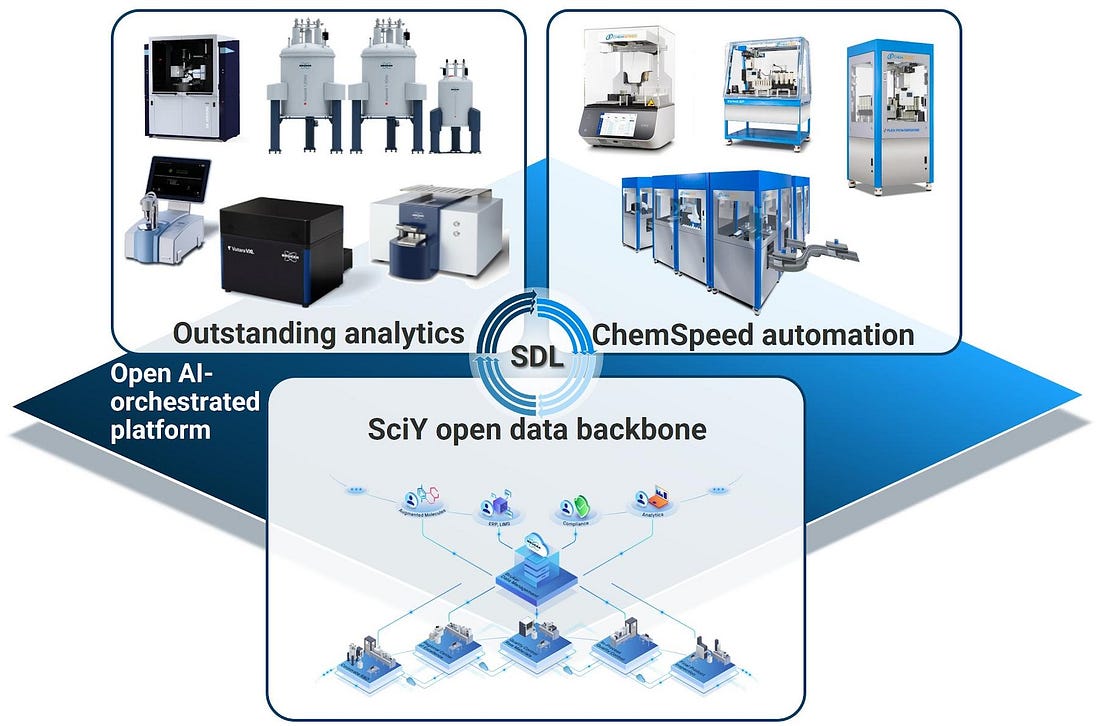
What I’m trying to work out is whether better AI leads to more demand for that equipment and those services. It could also make each experiment more efficient.
Medical data and diagnostics
This is probably where I’m most interested right now. I’m looking at $TEM, $CAI, $GH, $BLLN and $VCYT.
A useful way for me to think about this layer is a test that helps a doctor understand a patient’s disease or choose a treatment. Caris’ tumor profiling is one example.

The result can also become part of a much larger dataset.
The data gets more interesting to me when it connects the biology to what happened afterward. Which treatment did the patient receive, and how did they respond over time? Tempus already brings those kinds of records together for pharmaceutical research.

That feels like a potentially valuable asset as AI improves. I want to understand which businesses have useful data, what rights they have to use it, and how it actually becomes revenue.
Monitoring and ongoing care
$NTRA is one example. Signatera looks for traces of tumor DNA in blood and can be used repeatedly during treatment and follow-up. Molecular residual disease, or MRD, refers to evidence of cancer remaining after treatment.

Then there’s $IRTC in heart-rhythm monitoring and $PODD in automated insulin delivery. Different medical problems, but both put a device into an ongoing relationship with the patient.
I’m interested in the recurring revenue that can come with that relationship, along with the information collected over time. I also want to understand how much of the advantage comes from AI and how much comes from the underlying device and established automation.
AI drug discovery
$SDGR, $RXRX and $ABCL are some of the names I’m digging into here. This is about using computational tools to help find and develop medicines.
The part I want to understand is how the software connects to experiments. A model suggests something, the lab tests it, and the results help guide the next decision. Recursion describes its platform around that kind of feedback.

For me, the big question is whether that process produces useful medicines often enough to build a durable business. Eventually, a treatment still needs to demonstrate safety and benefit in people. I want to understand the clinical trials alongside the discovery technology.
Imaging and clinical decisions
This is where AI helps doctors interpret information and decide what to do next. $HTFL and $GEHC are two names I’m looking at.
Heartflow uses heart CT scans to create patient-specific models of the coronary arteries, giving physicians additional information about blood flow. Its PCI Navigator also helps with planning a coronary intervention. GE HealthCare gives me another angle through AI-assisted image reconstruction inside its scanners.

The appeal to me is having a useful product inside a real medical workflow. I want to see how it helps the physician and who pays for it. The clinical evidence and reimbursement are things I’ll need to figure out too.
Robotics and intervention
This is the layer that connects most directly with my Physical AI work. I’m digging into $ISRG, $PRCT and $GMED.
Here, software is connected to a machine used during a procedure. Intuitive’s da Vinci systems are operated by surgeons. I’m interested in how better imaging and more capable software could make those systems increasingly useful.
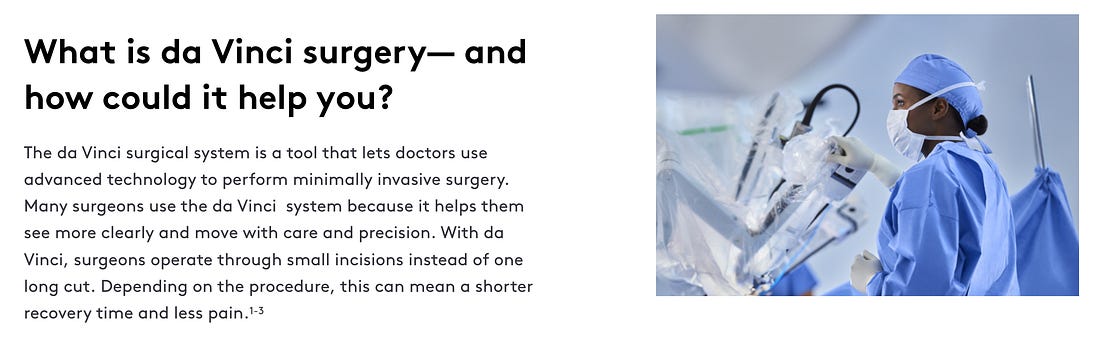
The surrounding business is interesting too. Hospitals train people around the equipment, use specialized instruments and rely on ongoing support. I want to understand how much of an advantage that creates as new competitors arrive.
For now, I’m thinking about tools that help clinicians do their jobs and gradually automate specific tasks. The longer-term autonomy story is something I’ll keep exploring.
How I want to approach the stocks
There’s overlap between these layers. I’m using them to organize the research before deciding which businesses deserve a place in the basket.
I’m also staying patient on price. Some of these stocks feel frothy to me, and I’m comfortable having companies on the research list while I wait for an entry.
The goal is one AI Medicine basket with target weights and the prices where I’d begin buying. I’ll share the company research as I go, and I expect my views to change as I learn more.
Also, to be clear, these are not all the companies I am looking at. My list is quite extensive. But I think these are all worth digging in to!
Financial Disclaimer
This publication is provided solely for informational and educational purposes and should never be construed as investment, financial, legal, tax, or accounting advice, or as an offer, solicitation, or recommendation to buy or sell any security. All opinions, estimates, forecasts, price ranges, valuation scenarios, portfolio weights, and investment frameworks reflect my personal views at the time of publication and may change at any time without notice.
I may currently own, buy, sell, or otherwise have a financial interest in securities discussed in this publication. My positions may change before or after publication, and I have no obligation to provide updates regarding those changes.
The information presented is drawn from sources I believe to be reliable, including company filings, earnings materials, regulatory disclosures, industry publications, clinical studies, and other publicly available information. Accuracy, completeness, and timeliness are never guaranteed. Any financial models, projections, valuation estimates, price targets, or future scenarios involve assumptions and uncertainty and should be viewed as analytical exercises rather than predictions.
Investing involves substantial risk, including the possible loss of principal. Healthcare, biotechnology, diagnostics, medical-device, and AI-related companies can carry additional risks involving clinical outcomes, regulatory approvals, reimbursement, competition, intellectual property, financing needs, dilution, technological change, and commercialization. Historical performance provides no assurance of future results.
Readers should conduct their own research, evaluate their own financial circumstances and risk tolerance, and consult qualified financial, legal, or tax professionals before making investment decisions.