2026.10.06 | Substack | Semis | Qualcomm CFO: Pivot to AI Chips
原标题:Qualcomm CFO Interview On Its Massive Pivot To AI Chips, Wearables, And Robotics
The semiconductor index is up roughly 85% YTD. Qualcomm is up about 10% and sits roughly 30% below its 52-week high.
We flagged Qualcomm as a CPU beneficiary in our April report, “Breaking Down The CPU Shortage,” when the stock was trading around $150. It ran to $260 in a month. We wrote then that Qualcomm was “the highest-risk, highest-asymmetry, cheapest entry in the trade” and that “the market is pricing zero data center upside.”
The stock has pulled back since, but the thesis has gotten stronger.
Breaking Down The CPU Shortage
Asymmetrical Bets
·
Apr 27
Read full story
Qualcomm built one of the most important semiconductor businesses in the world on the back of cellular connectivity. They powered the transition from 3G to 4G, rode the smartphone wave from flip phones to the iPhone era, and became the default silicon provider for Android flagships. For 20 years, that was the company.
The chip business sold processors and modems into handsets and the licensing business collected royalties on wireless patents from every phone maker on the planet.
The two fed each other, and together they printed cash.
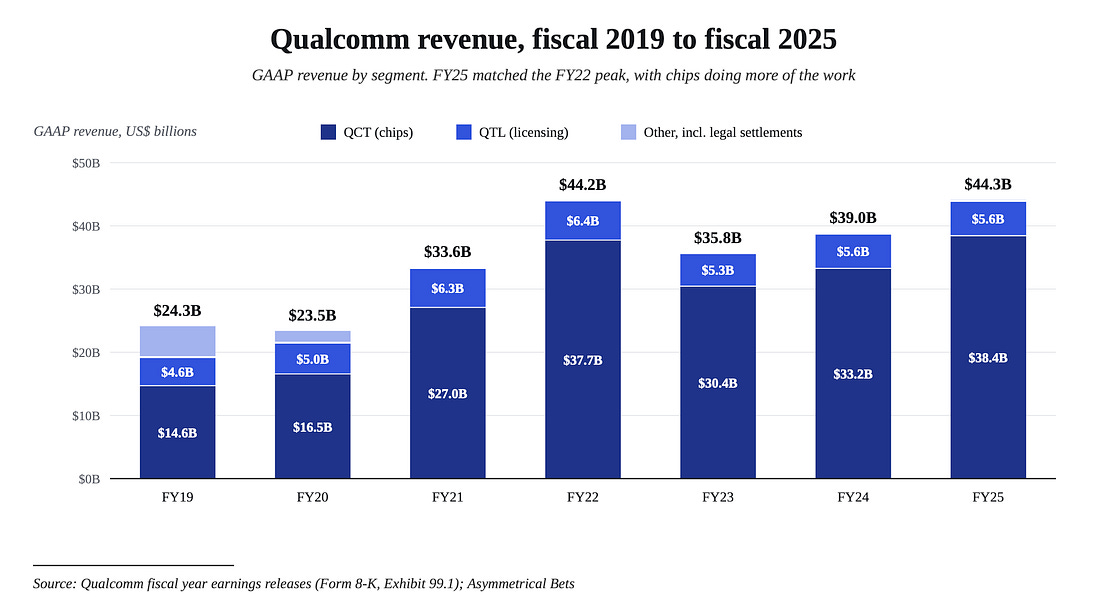
The problem is that story peaked because Apple is pulling its modem in-house and Samsung and Chinese OEMs have been exploring alternatives. Memory supply constraints crushed smartphone demand this year, and Android handset revenues are falling roughly 20%.
The market looked at all of that and priced the stock like a business in decline.
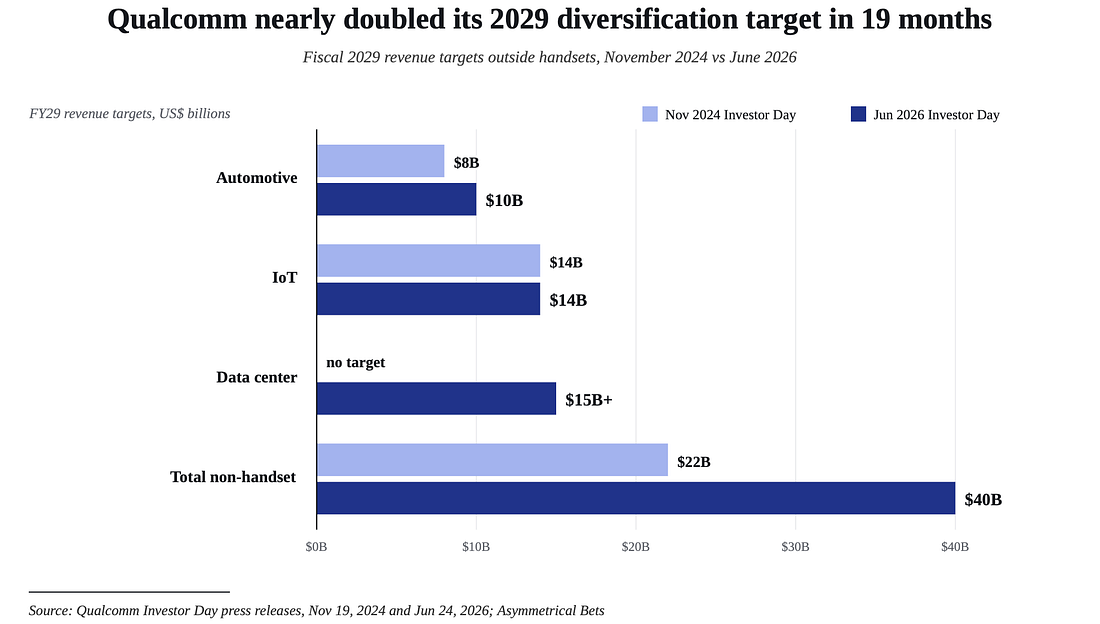
However, at the June Investor Day, the management doubled the FY29 non-handset revenue target from $22B to $40B. The prior target covered automotive and IoT. The new one adds data center. The company is guiding to more than $18 in non-GAAP EPS for that year (vs ~$11.36 trailing).
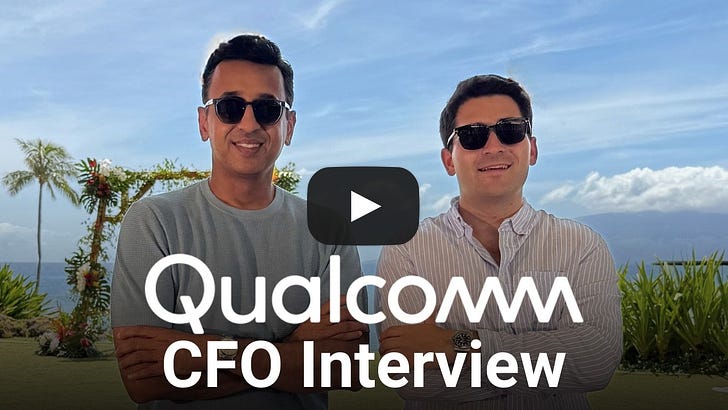
We sat down with Akash Palkhiwala, CFO and COO, at Snapdragon Summit in Maui to pressure-test the roadmap. Palkhiwala has been at Qualcomm since 2001 and sits on the board of Applied Materials. Quotes are from our conversation unless otherwise noted. You can also watch this interview on Michael’s channel at the link below.

Before we begin, this Substack is for informational and entertainment purposes only and does not constitute financial advice. Past performance is not indicative of future results. Never invest more than you can afford to lose. Our writers may hold positions in the securities discussed and may buy or sell them at any time without notice.
Table of Contents
- Introduction
- Then vs Now
- The Skeptics and Amazon
- Personal AI Devices
- The Data Center
- Automotive to Robotics
- What Goes Wrong
- Where Qualcomm Stands
1] Then vs Now
Michael opened by pointing out that Palkhiwala joined Qualcomm in 2001, right after the dot-com bust. He’s been there through the rise of the iPhone, the 3G to 4G transition, and now he’s leading the company into its next chapter. Michael asked how he would have described Qualcomm to an investor back then versus today.
Palkhiwala answered:
“We used to be the smartphone connectivity company, right? And it was all about phones, and it was all about wireless connectivity, 3G, then going to 4G. And it was a different era. And Qualcomm was the most important company in my mind. And I think most people would agree, in terms of delivering chips that did 3G or 4G and smartphones..”
Then he laid out the FY29 vision:
“Today I think of us as positioned to be the most diversified AI and processing chip company in the world. So if you look at our targets for ‘29, we’ll be three big businesses. There’ll be data center, smartphones, and auto IoT. And these three will roughly be equal in size.”
Two transformation waves drive the opportunity in his view and those are Agentic AI and robotics. He said Qualcomm sits at the center of both.
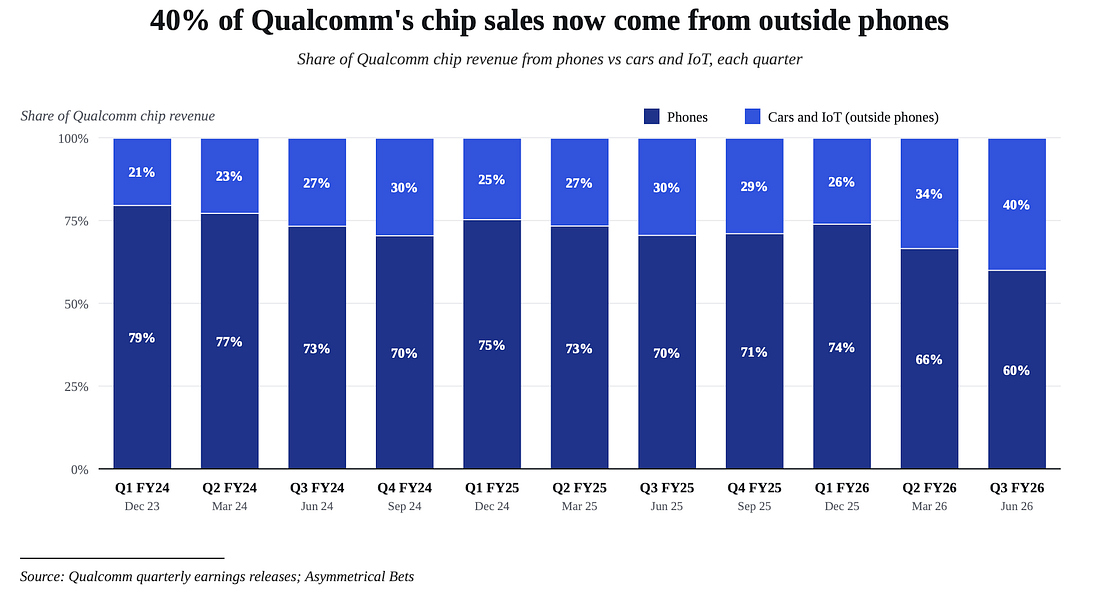
At the June 2026 Investor Day, management put a number on that vision. Non-handset revenue targets went from $22B to $40B for FY29, representing a roughly 40% four-year CAGR from the FY25 base.
Non-handsets are expected to make up about 66% of QCT revenue by that year, up from roughly 28% in FY25.

2] The Skeptics and Amazon
Michael pushed on the skepticism. He asked Palkhiwala what he’d say to investors who aren’t buying the execution story.
“I think the naysayers I’d say is a lot of them are saying, show me proof points. And I understand that.”
He started with automotive, where he said "the amount of growth that we'll see going forward will dwarf actually what we've seen in the past.” From there he pointed to personal AI devices and PCs, a new category with Qualcomm at the center.
And then he got to data center, where the proof point is a deal with Amazon.
“This is a 10-year, $60 billion transaction that we just entered into. A portion of that is committed. I think it gives us a very, very increasingly optimistic shot at achieving the targets we’ve set out for next year, which is $5 billion, and ‘29, $15 billion. We could probably do better than that given how we’re progressing in these new areas.”
The Amazon collaboration was announced on September 8, 2026. It covers custom silicon for AI inference across multiple chip generations and optical connectivity up to 1.6T.
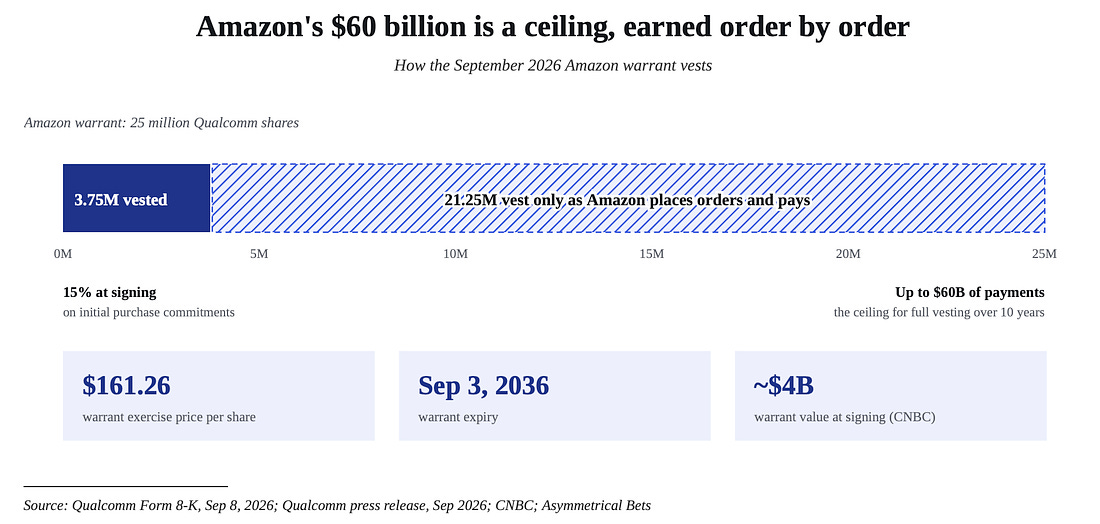
The deal came with a warrant that gives Amazon the right to buy up to 25M Qualcomm shares at $161.26 each, expiring in September 2036. Amazon earned 3.75M of those shares upfront based on initial purchase commitments and the rest unlock as Amazon places more orders, up to a $60B ceiling. Neither company has said how much of that $60B is committed so far.
He closed by saying the company is comfortable with the skepticism.
“We’re okay with people saying, show me, because we’re going to show that over the next several months. And I’m sure it’ll get reflected in the stock.”
3] Personal AI Devices
Michael brought up the AI upgrade cycle for phones and PCs. The market sees these as mature categories and he asked whether there’s a real reason for consumers to upgrade their hardware.
Palkhiwala reframed the question. He said there’s a third device category emerging beyond the phone and PC.
“Think of it as a device that’s on your person, a device that can see what you can see, it can hear what you can hear, and you can have an agentic AI conversation with it. So Meta Glasses is a great example of that.”
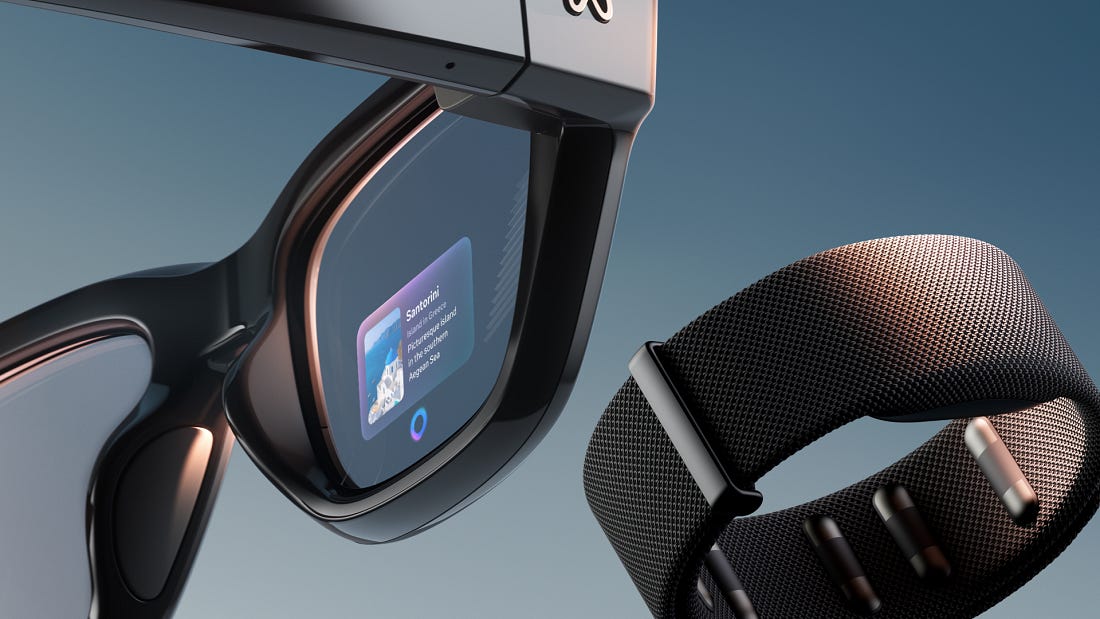
Meta Ray-Ban AI Glasses
He listed the form factors in development: smart glasses, watches, earbuds with cameras, a Microsoft companion device for PCs, and company badges with cameras and microphones.
Michael asked which form factor wins. Palkhiwala replied:
“It doesn’t matter to us […] It might be different for different consumers. And that’s even better for us. I think having this multiplicity of devices that give you similar experiences and the consumer decides how they’re going to consume it, I think just increases the probability that something like that happens.”
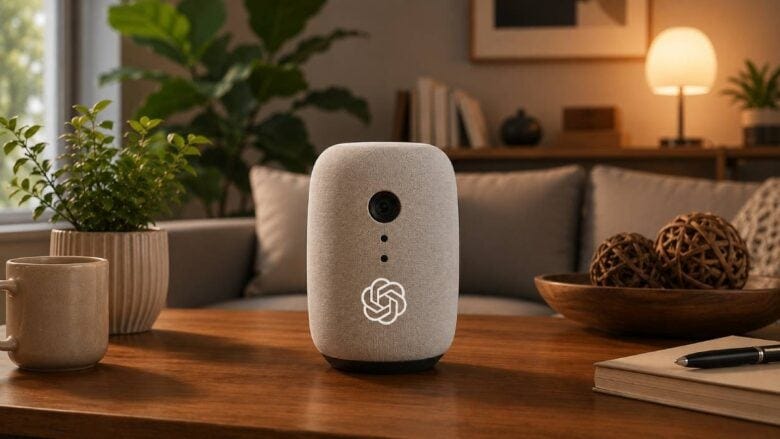
Mockup of OpenAI’s unreleased personal hardware device.
On timing:
“Over the next six to nine months, there’s a whole series of devices that are going to come out. It’ll be from the frontier model companies. It’ll be from the hyperscalers in the US. It’ll be from handset OEMs. It’ll be the hyperscalers in China. And the handset OEMs in China. And you’re going to see all of these companies, really every one of them, is looking at multiple devices, not just one, because we’re not sure what the form factor that’s going to win.”

On phones themselves, Palkhiwala said the shift is comparable to the one that created the smartphone market:
“What will happen in the future in our minds is there’s going to be an agent on the device that is the place where all the understanding of the user sits, of the content that the user has, the location, what the camera sees, what the audio is hearing. And that context is critical to the AI request that you’re going to deliver to your device.”
He gave booking a flight as an example. The phone knows where you are, what your calendar looks like, and picks the best time for you to fly and that’s much different than what people carry today.
“You went from phones to smartphones, smartphones to AI phones. And that’s a change that’s coming.”
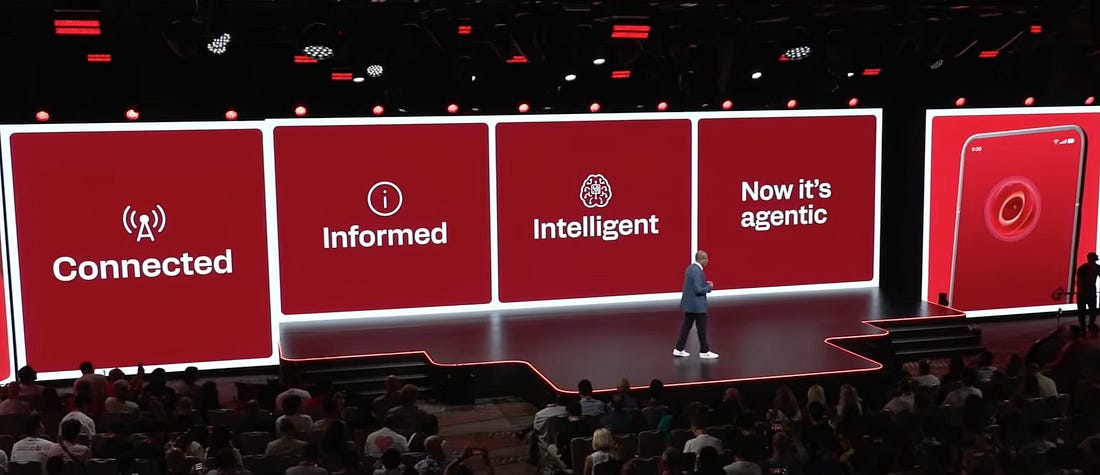
That transition requires IP, and on October 5, Qualcomm and Huawei announced a multiyear patent cross licensing deal covering 5G, AI, and networking technologies. Qualcomm will be the net payer for the first time in 25 years and is also purchasing certain Huawei US patents covering compute, AI, and networking.

4] The Data Center
Michael called data center the “meat and potatoes of the story” and asked Palkhiwala to walk through how the revenue builds from near zero today to $15B by FY29.
Palkhiwala started with why the opportunity exists:
“Power is a problem statement in data center. So there’s a requirement for high-performance, low-power computing engines. The second is the hyperscalers are looking for different suppliers and be able to really kind of fragment the supplier base. And so that creates an opportunity for us. They’re looking for partners who are good at technology and can deliver at scale, which puts Qualcomm in a sweet spot.”
He broke the business into four product lines.
- Connectivity
- Custom silicon for hyperscalers.
- An AI accelerator built around a new memory architecture.
- A server CPU.
He then said:
“We bought Alphawave, they already had a product, but they did not have the scale that these hyperscalers needed. So now when you combine their product with our technology and scale, this has suddenly become a very interesting area.”

The two nearest term revenue drivers are custom silicon and connectivity. Qualcomm has two hyperscaler customers under contract, with Amazon as the US customer and a China-based hyperscaler as the second. In both cases Qualcomm is building the primary accelerator, the chip doing the actual AI computation inside the rack.
“What we’ve said is we have one US and one China hyperscaler. So with Amazon being the US one, this would be the China hyperscaler that we’re working with.”
“In both of these cases, we are working on the primary accelerator for these players. So this is not an ancillary chip, it’s really the main accelerator for those players that you would know about. And they’re consuming that tremendous, tremendous scale.”
On the Q3 earnings call, management said both engagements will generate revenue in the December quarter and wafer production has begun.
On the revenue build from there, Palkhiwala told us:
“Most of our ‘27 revenue will be the two hyperscalers on custom chip plus connectivity chips. And so that’ll drive most of it. We see almost like a linear growth between ‘27, ‘28, and ‘29 to get to 15 billion. That’s our target for ‘29. And then when you look at the target for ‘29, we’ll have the two hyperscalers carrying forward, but then you have Meta CPU coming on top and AI accelerator coming on top.”

The Meta deal was announced at the June 2026 Investor Day. Qualcomm and Meta are collaborating on a multi-generation roadmap for data center CPUs. The first product, the Dragonfly C1000, goes into production in H2 2028 and uses custom Oryon Server cores optimized for operating frequencies above 5GHz with a reportedly 250+ core chiplet design.
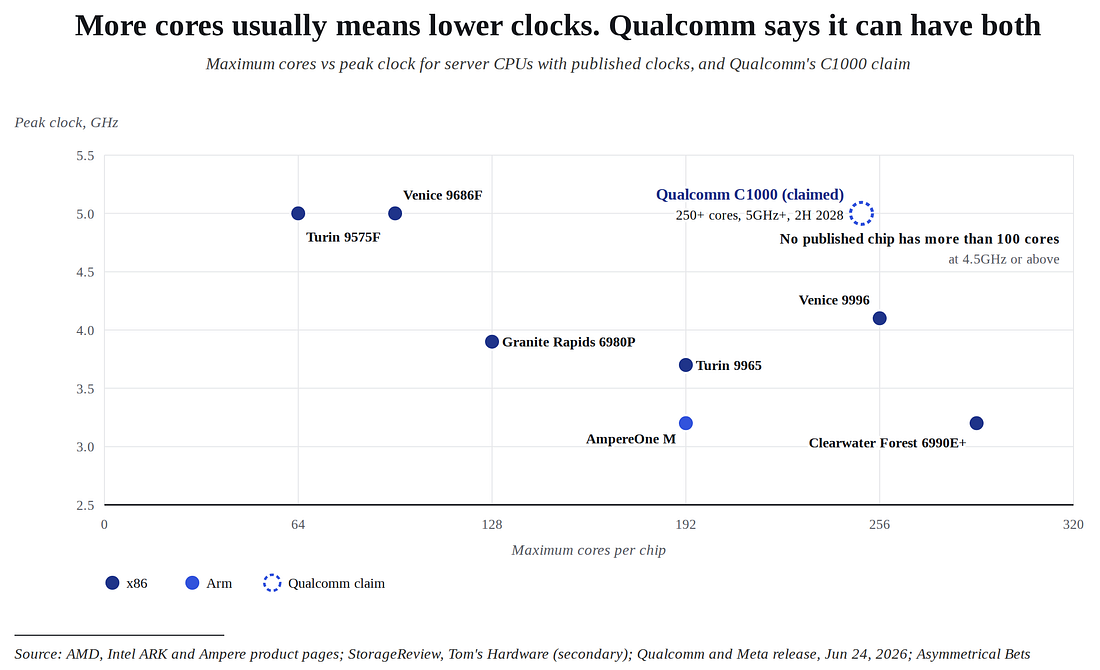
On the AI accelerator, Palkhiwala described the memory bandwidth problem and Qualcomm’s solution:
“We’re going to have a logic die sitting with memory on top and drill holes through it and create the 10-lane freeway in the same building.”
He called this a “tremendous architectural moat.” Qualcomm expects to demonstrate performance on silicon in the coming quarters, with a product launch targeted for mid-2027.

5] Automotive to Robotics
Michael shifted to the business that’s actually delivering results today. QCT automotive revenue hit $1.6B last quarter, up 61% YoY. That’s 23 straight quarters of double digit growth so Michael asked what’s driving it.
Palkhiwala broke the car into three areas:
- Connectivity chips, which are already in most vehicles and aren’t growing.
- The cockpit experience, which is being transformed by agentic AI.
- ADAS (Advanced Driver Assistance Systems), which Qualcomm has barely touched in terms of volume.
“Of all the places where you want to have a conversation and not touch buttons, cars at the top of that list because your hands are already busy.”
Michael mentioned using Grok in his Tesla and Palkhiwala said that experience is coming to other cars, and Qualcomm will be the one making it happen.

The growth math comes from content per vehicle. As OEMs adopt newer generations of Qualcomm’s Snapdragon Digital Chassis, the amount of silicon in each car jumps. Palkhiwala said from Gen 2 to Gen 4, content per vehicle increases eightfold.
“These things do to the content that we can sell in the cars, for our Gen 2 solution, Gen 3 to Gen 4, Gen 2 to Gen 4 has an 8x increase in content.”
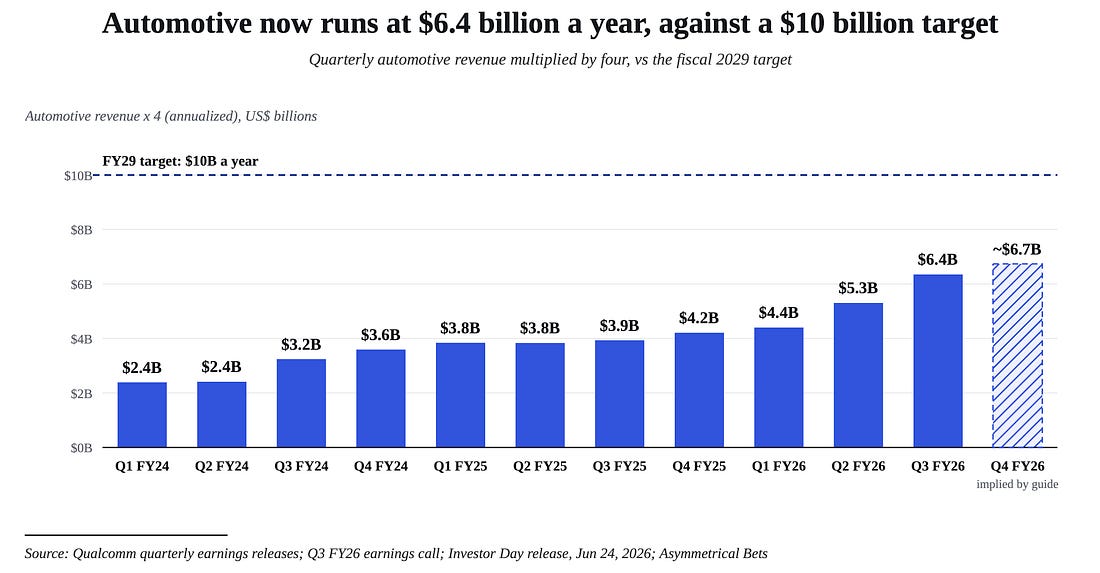
Every new model year with updated silicon adds more revenue per unit. On the Q3 earnings call, management raised the annualized exit run rate for FY26 from $6B to roughly $7B.
And the FY29 target is $10B, up from $8B at the 2024 Investor Day.
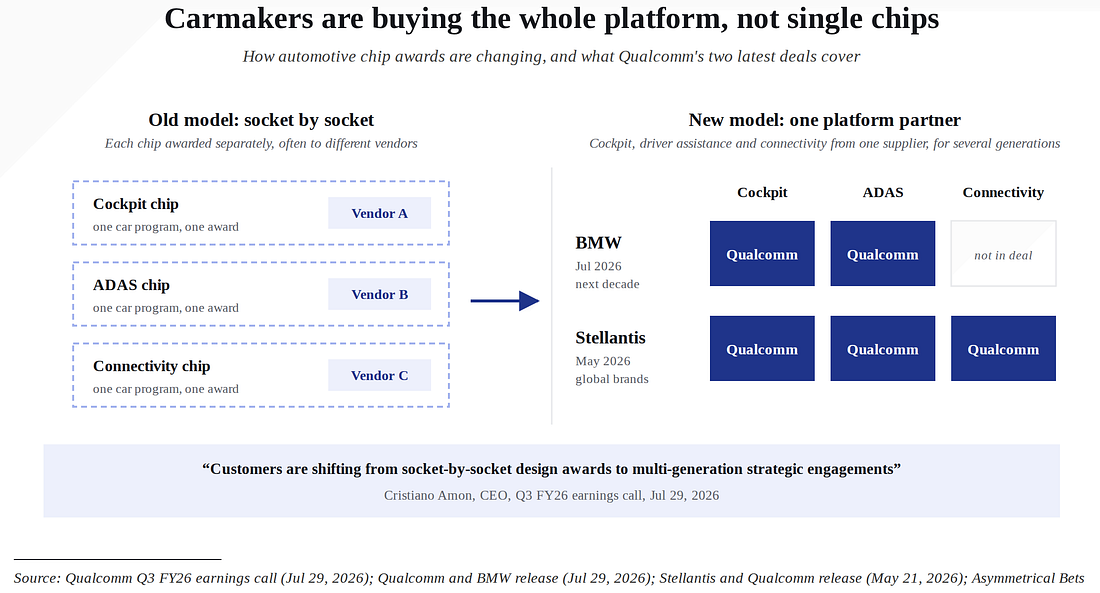
Furthermore, BMW selected Qualcomm as lead compute silicon provider for next generation of ADAS and digital cockpit, extending across model programs into the next decade. Stellantis expanded its collaboration to adopt Snapdragon Digital Chassis across its global portfolio, including the Snapdragon Ride Pilot ADAS stack, reaching into the 2030s.
On the Q3 earnings call, CEO Cristiano Amon described the shift happening across the industry:
“Customers are shifting from socket-by-socket design awards to multi-generation strategic engagements as they increasingly recognize the value of our broad technology portfolio, platform approach and long-term commitment to partnerships.”
Palkhiwala then drew a line from cars to robots:
“We have two platforms: one inside the car, second is autonomous driving. That’s exactly what happens into robots. There’s going to be one part that controls the movement of the robot, the other part that’s going to be the brains of the robot.”
“We’re taking these same solutions, applying it to robotics. And then what happens in robotics is this is a battery-powered device... it needs to be very small form factor, very good wireless connectivity, very high AI performance, but very, very low power.”
“We think our success in automotive is the stepping stone to success in robotics.”
And after that, Palkhiwala made one of the strongest claims of the conversation:
“I think next three to four years, the company could transform just on the robotics thesis.”

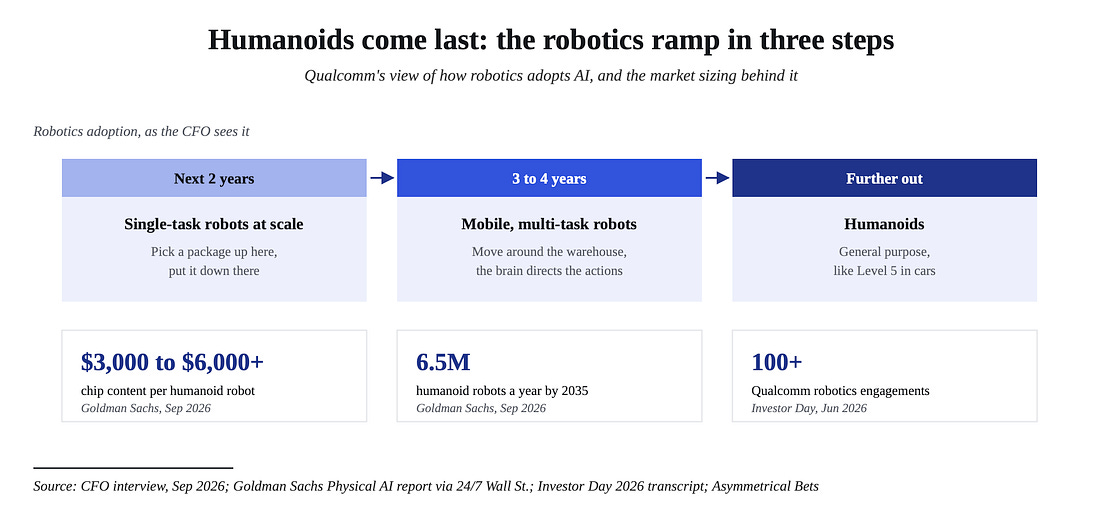
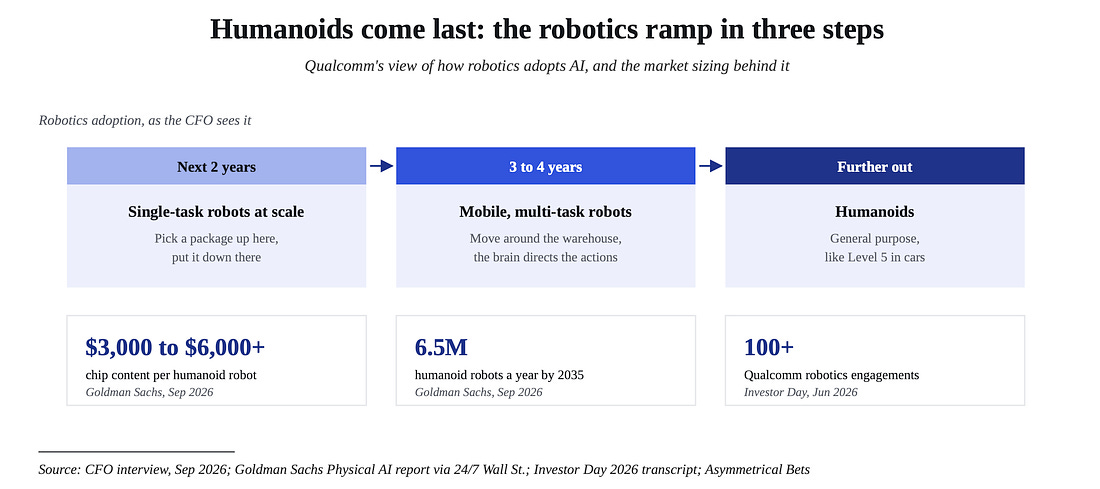
Michael brought up Goldman’s estimate of $3,000 to $6,000 in chip content per humanoid robot. Palkhiwala laid out the path:
“You’re going to start with simple form factor where they’re purpose-specific. There’s a robot that does certain things in a distribution center. It picks up the package from here and puts it here. You start there. Then you say, okay, now it’s going to move around the distribution center and take packages and put it in different places. And then eventually it’s going to be a complete humanoid that does a scale of activity.”
“In our minds, kind of next two years, we’re going to start seeing deployment of form factor specific, action-specific robotics at scale. And then in the three, four-year timeframe, you’re going to start seeing that diverge very significantly.”
On whether Qualcomm can capture that chip content:
“When you’re building those robots at scale, you’re going to need qualities that you need in edge devices. You’re going to need incredible wireless technology. You’re going to need very low power, high performance form factor, the smallest possible solution. And I think those things we have done better than NVIDIA or anyone else in the industry for the longest time. And so I think we’re in pole position as this takes off.”
6] What Goes Wrong
Same as in previous interviews, Michael asked: “If it didn’t play out, if you missed this $18 EPS target, what would you say went wrong?”
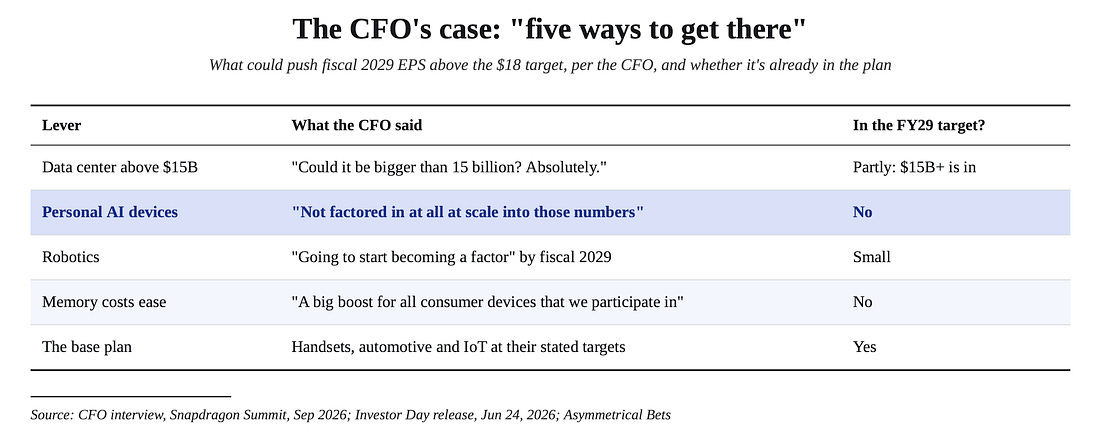
Palkhiwala walked through four upside levers:
→ data center could beat $15B,
→ personal AI devices aren’t factored in at scale,
→ robotics starts contributing,
→ memory recovery would lift every consumer device line.
Then he answered the question:
“I’m not worried about the $18 and whether we meet it or not. I’m actually more looking at the different ways in which we can meet it and how do we push each of those vectors individually so that we position ourselves not just to meet the $18, but really what happens after that.”
7] Where Qualcomm Stands
We want to highlight three things stood out from this conversation.
- The personal AI device wave. Qualcomm’s chip is in every smart glasses, earbuds, and wearable AI device being
built right now. The CFO said a wave of new devices launches in the next six to nine months and if any one of them hits the consumer sweet spot, Qualcomm wins regardless of which device takes off.
- Data center. Zero revenue today, $5B target for FY27, $15B for FY29 and two hyperscaler custom silicon
engagements with revenue starting in December. There’s a Meta CPU deal and an AI accelerator with a completed tape-out. This means that the roadmap exists but execution is the question.
- Humanoids. Palkhiwala said the company could transform “just on the robotics thesis” in three to four years. The
same two chip architecture from cars transfers directly to robots. Purpose-built robots deploy at scale in two years and full humanoids follow after that.
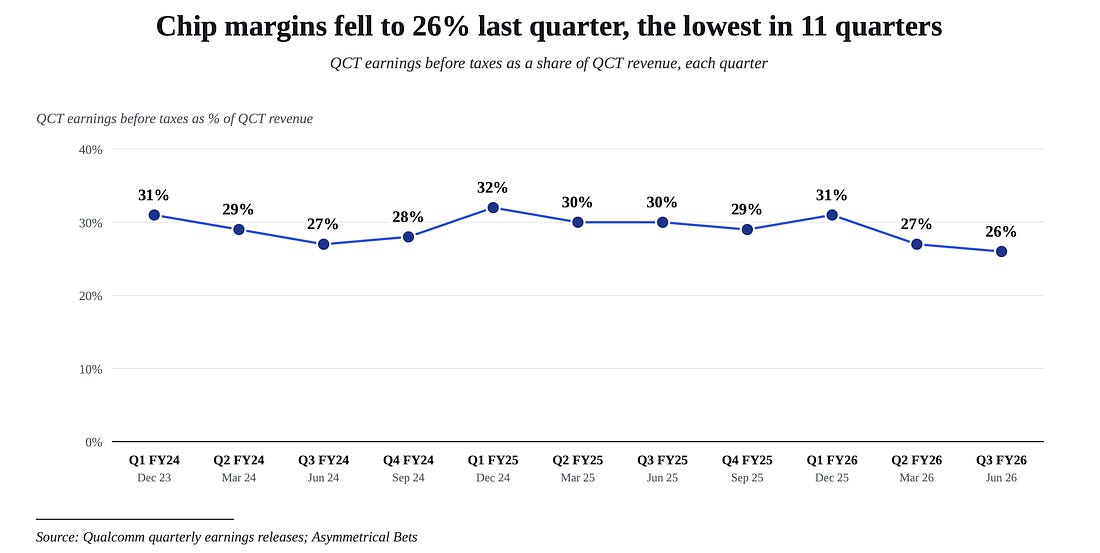
The main risks we see are data center execution (the products that drive the $5B and $15B targets haven’t generated revenue yet), the accelerating Apple modem loss, Arm litigation with a trial that began today, and gross margin pressure from rising input costs and lower margin data center custom silicon.
At current prices, we think the market is already pricing in these risks.
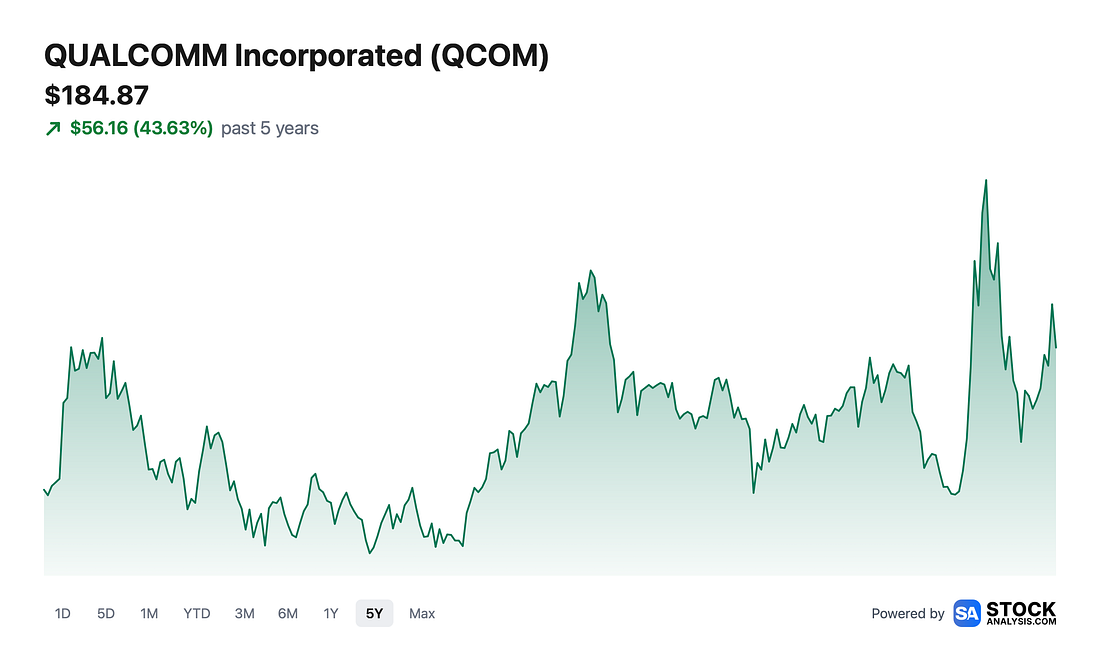
On valuation, our SOTP gives $167 in the low case, $193 in the mid case, and $224 if management hits everything. At $185, the stock is roughly fair on the mid case and the management case implies about 21% upside.
Those numbers don’t scream asymmetric.

But the SOTP only prices what’s in the guide and it doesn’t price a rerating on the next big tech narrative. While we think that’s unlikely to come from AI, it’s plausible QCOM could see major multiple expansion on the emergence of a new personal computing form factor or the rise of humanoids at scale. In these scenarios, we think it’s possible QCOM could trade at a premium PE to peers as the data center market matures and asymmetric growth gets priced in from these other divisions.
Qualcomm is worth around $200B today and the companies that already got their AI rerating are worth trillions. If the market starts pricing in the humanoid or personal AI device ramp, the upside goes well beyond what any SOTP can capture.
At a mere 20x multiple in 2029, $QCOM could be a $360 stock if management hits its guide, which is roughly a 2x from here.

We want to thank Akash Palkhiwala for sitting down with us and giving us 30 minutes to walk through every part of the business. We also want to thank our subscribers for reading and for the continued support.
If you found this piece useful, share it with someone watching the semiconductor space.