2026.10.06 | Substack | Gaming | Stratechery: Game Decompilation Legality
原标题:Game Decompilation, Is This Legal?, A Well-Trodden Path (Stratechery Update 10-6-2026)

Game Decompilation, Is This Legal?, A Well-Trodden Path
Tuesday, October 6, 2026
Good morning,
On last week’s episode of Sharp Tech, Andrew and I discussed OpenAI’s DevDay event and Dots (and I make the prediction that the imminent Jony Ive-designed hardware device — which is rumored to look like a donut — will be called Dot); we also explain why we don’t like the name “Super Intelligence” — Andrew argues that Machine Intelligence is a better option, and I agree.
On to the Update:
Game Decompilation
From Polygon:
If you’ve been on X over the last few days, you’ve probably noticed that things have gotten very weird when it comes to modded video games. There are clips of Call of Duty operators doing kickflips and other tricks from Skate, people playing Black Ops 1’s zombie mode in Skyrim, and Miles Morales swinging through Gotham. Here’s another to add to the list: someone has gotten the Xbox version of Halo: Combat Evolved running in a web browser with multiplayer and split-screen support…
Software developer Mitchell Hynes is behind bringing Halo to web browser. As he posted on X, this version of the game features split-screen co-op and multiplayer of up to 128 players. He’s currently running a Cloudflare-powered website to host the port — which is the original Xbox version of Combat Evolved, not Gearbox’s maligned PC release — and he included the link to the site in a reply to his original post. According to Hynes, 20,000 people played the web browser port in its first five hours.
While games are written in human-readable languages (usually C or C++), they are compiled into machine code that is executable by the processor they are intended for; in the case of Halo that would have been an x86 processor. It has long been possible to disassemble machine code to assembly (which is often what compilers output); assembly maps almost perfectly to machine code. The difficult part — which takes humans years — is decompiling assembly to C (or whatever human-readable language the game was written in).
It’s not difficult for LLMs, at least not now. LLMs can figure out what assembly aligns to what prospective code, and validate whether or not it got it right; it’s actually a pretty perfect LLM use case. And now, anyone can do it: older games now, modern AAA games soon, and basically all software soon enough — at least if you have the executable.
Is This Legal?
From The Gamer:
DMCA takedowns for mods and fan overhauls have been happening for years, so it makes sense that decompilation projects, especially the ones assembled quickly and shared widely on social media, are now drawing the same kind of attention. These projects have exploded in number over the past week or so, but many rely heavily on generative AI. Even well‑known efforts like Ship of Harkinian use some form of genAI, despite beginning long before the current wave of vibe‑coded recreations.
The projects that went viral this week were built with far more aggressive AI assistance. One of the first was Fallout: New York. ChrisFirst shared a clip on Twitter showing a browser‑playable recreation of Fallout built with Claude Opus 5.5. It had quests, dialogue trees, VATS, a working Pip‑Boy, and an entire city generated without any texture or sound files. Every building, weapon, face, and ambient noise was “generated by code.” The post pulled in millions of views before ChrisFirst shared that he received a cease-and-desist from Bethesda and shut the project down.
The second project that’s since been taken down came from Maurice Heumann, who used generative AI to decompile Modern Warfare 2 on PC. He said he had seventeen agents working at the same time, reconstructing the game faster than any manual effort could. According to him, the game was already playable, most bugs were fixed, and he had even earned a nuke. Activision responded by removing the footage from his post and blocking access to the site hosting the code. Heumann later shared that his AI agents kept deleting his files.
This story actually conflates two different AI capabilities. The Fallout project appears to be a new game — there is no Fallout: New York — although using the name “Fallout” is likely a trademark violation, and copyright covers clearly identifiable items like the Pip-Boy. However, creating a variation of a game isn’t illegal in and of itself.
The Modern Warfare project, on the other hand, is more complicated. Decompiling is not in and of itself illegal. Sega v. Accolade held that disassembling code is fair use if it is the only way to reach unprotected functional elements and there was a legitimate purpose, and Sony v. Connectix extended the same reasoning to reverse engineering the PlayStation’s BIOS. However, that is likely where protections end: code that is derived from decompiling is, by definition, very similar if not identical to the original code, which is covered by copyright, and very unlikely to be covered by fair use if the sole purpose is just to distribute a game that already exists.
I’m hedging my language because the more general use decompilation question has not been litigated directly; to the extent publishers have gone after projects resuscitating old games pre-LLMs, it is for using things like image assets, not reproducing code. There also weren’t that many projects: the sheer scale of what is starting to happen will almost certainly change that laissez faire approach. It’s also worth noting that the end user license agreement for PC games usually forbids reverse-engineering, which courts have enforced.
This legal context is important because it does put a damper on some of the more over-the-top pronouncements on X in response to these capabilities: yes, you can decompile a game, but you almost certainly can’t distribute that game legally, and you certainly can’t sell it. Yes, all of software will soon be “open source” in that you will be able to view the source for any executable you obtain; it will not be “open source” in terms of licensing.
Still, there’s a reason I mentioned the decompilation explosion in yesterday’s Article:
What I’m much more interested in is controlling the software layer myself. The fact of the matter is that with AI you can decompile almost all existing software — there is a revolution happening in gaming over the past few weeks, as game after game is decompiled to source and ported to any platform you wish — and you can write your own. That means my software that interacts with my agent in the way I want it to for everything; that’s way more exciting than praying Apple delivers the right API and that 3rd-party developers don’t suck.
What I’m excited about in terms of being able to write any software is not selling that software; indeed, the prospects for selling software in a world where anyone can make software are increasingly challenging! Rather, it’s the possibility of customizing anything and everything I want to my preferences. Am I unhappy with my thermostat software, or my smart locks? I can — or will soon be able to — simply make my own. Decompiling may violate a EULA or the DMCA, but if it’s done in the privacy of my own home, it’s not clear what companies might do about it. What is being done to games can be done to anything, and that is very exciting, and certainly for software makers very scary.
A Well-Trodden Path
I have written several times about the progression of mediums in technology, including in 2022’s DALL-E, the Metaverse, and Zero Marginal Content:
Games have long been on the forefront of technological development, and that is certainly the case in terms of medium. The first computer games were little more than text:

Images followed, usually of the bitmap variety; I remember playing a lot of “Where in the world is Carmen Sandiego” at the library:
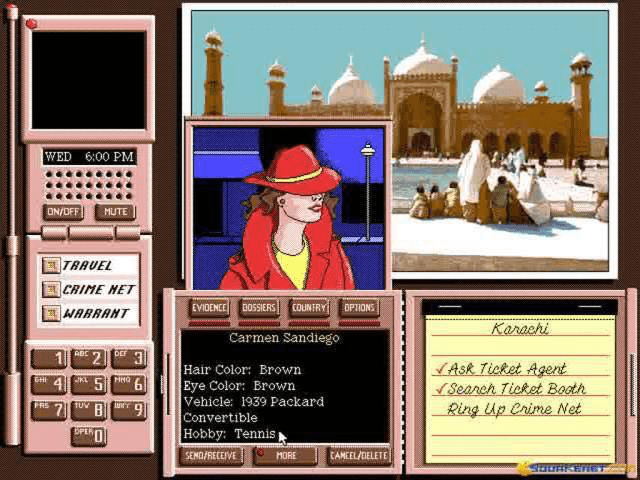
Soon games included motion as you navigated a sprite through a 2D world; 3D followed, and most of the last 25 years has been about making 3D games ever more realistic. Nearly all of those games, though, are 3D images on 2D screens; virtual reality offers the illusion of being inside the game itself.
I noted that social media followed a similar path:
Social networking has undergone a similar medium evolution as games, with a two-decade delay. The earliest forms of social networking on the web were text-based bulletin boards and USENET groups; then came widespread e-mail, AOL chatrooms, and forums. Facebook arrived on the scene in the mid-2000s; one of the things that helped it explode in popularity was the addition of images. Instagram was an image-only social network that soon added video, which is all that TikTok is. And, over the last couple of years in particular, video conferencing through apps like Zoom or FaceTime have delivered 3D images on 2D screens.
What is interesting is the business model implications; in 2017’s The Great Unbundling I examined how different mediums fared differently on the Internet:
- The text business model completely fell apart, as advertising fled and the barrier to entry for actually good content went to zero.
- The music industry fared better, thanks to the oligarchic nature of supply: there are only three companies that matter in terms of building a competitive library, which means they extract their fair share.
- The video industry is the weirdest: Netflix climbed the ladder to its own shows, while retaining competitors far longer than is arguably rational.
I’m not sure that gaming is going to look like any of these. A lot of people are fretting/predicting that this will lead to the return of gaming streaming services; notice that I’ve continually made references to needing to have the executable to decompile. If you run a game — or software generally — in the cloud then there is no executable to decompile. At the end of the day, however, game streaming has largely failed in the market because it has been rejected by gamers; the fact that publishers might not want to distribute executables doesn’t change that reality. And remember, there are legal limits to distributing decompiled games.
That noted, there is an entire category of games that are adjacent to streaming: think games like Fortnite that have an integral online component; that is already a category that is dominating playtime, and the allure of this model relative to standalone games is only going to increase.
That’s not to say that standalone games will go away; if anything, what does seem likely is that there will be an explosion; AI doesn’t just help with creating games, but also with asset creation, which is the real limiter. It’s also possible that AI means the end of game engines, but optimization and performance remain difficult problems without obvious differentiation payoffs, so I’m not so sure. Indie games might get away without using an established engine, but not AAA games. Regardless, this category, which is already struggling in terms of capturing demand, is only going to become more challenging as supply floods the market.
What is possible — likely, even — is that entirely new genres of games arise with “modding” as a key precept. What might a game that assumes that gamers can endlessly modify it look like? This concept isn’t new, to be clear, but now anyone can make the exact game — or variation on a game — that they want, and franchises that lean into that will have new opportunities. It’s also worth calling out Roblox here: the concept of a virtual world where users can create their own games was novel when even using Roblox’s simplified tools required a fair bit of expertise; it’s tremendously exciting when anyone can make software.
In short, my initial read is that gaming is going to change a lot, but that gaming was already changing a lot; AI seems set to exacerbate a lot of trends, including the shift to service-based games, and to the extent it dooms AAA standalone games that is only because it accelerates what was already happening. That’s no reason to be sad, however: the real intrigue about AI is not the fact it can recreate what was already made, but that it can create entirely new worlds, and do so for the individual. The real analogy might be video, but not Netflix: rather, it’s TikTok and Reels, and the fact that everyone gets to choose their own adventure.
This Update is also available as a podcast. To receive it in your podcast player, visit Stratechery.
The Stratechery Update is intended for a single recipient, but occasional forwarding is totally fine! If you would like to order multiple subscriptions for your team with a group discount (minimum 5), please contact me directly.
Thanks for being a subscriber, and have a great day!