2026.10.07 | Substack | Robotics | Agility Investor Day & Humanoid Stocks
原标题:Agility Investor Day. What Changed? Is There An Opportunity Here? First Pure-Play U.S. Listed Humanoid Stock $CCXI…
Agility had their Investor Day yesterday.
The market didn’t love it.

I am really bullish on Physical AI and humanoids in general for the long term. But I have sat out of the first U.S. pureplay stock. You could have made a lot of money trading this. But long term? That’s where I think diligence really matters. So I want to unpack everything here.
If you didn’t read my primer a few months ago, read this first:

CCXI / AGLT Humanoid Stock
Gaetano
·
Jun 29
Read full story
We got a much clearer look at how a humanoid could become a recurring-revenue business. Management laid out roughly $500,000 of potential revenue per robot over five years, a path toward 70%–75% product margins at scale, and a plan to expand beyond the small fleets working at customers today.
I think those numbers deserve a closer look. So do the financial statements that were missing when I wrote my June deep dive. We can now compare what Agility is earning and spending with the business management wants to build.
I went back through that original report, the new presentation and the S-4. Below, I’ll work through what changed, the economics behind everything, what we would be paying through CCXI, and my decision after putting it all together.
What changed since June
A lot of the big headline numbers will look familiar if you read my original report. The 65,000 operating hours, 100,000-plus totes, nine customer-facility commitments and conditional $300M order were already there. So were RoboFab’s 10,000-unit capacity design, NVIDIA’s involvement, Arc, and the longer-term cost-reduction thesis.
The October update gives us a more specific launch window for Digit 5 and a clearer financial progression from its launch economics toward higher-volume production. Management laid out the commercial funnel and its year-end 2027 goals, while the S-4 provides the historical revenue and cash burn I was waiting to see in June.
Those are the changes I want to focus on. They help us put the original thesis against a timeline and a set of numbers we can actually track.
The next version is the commercial test
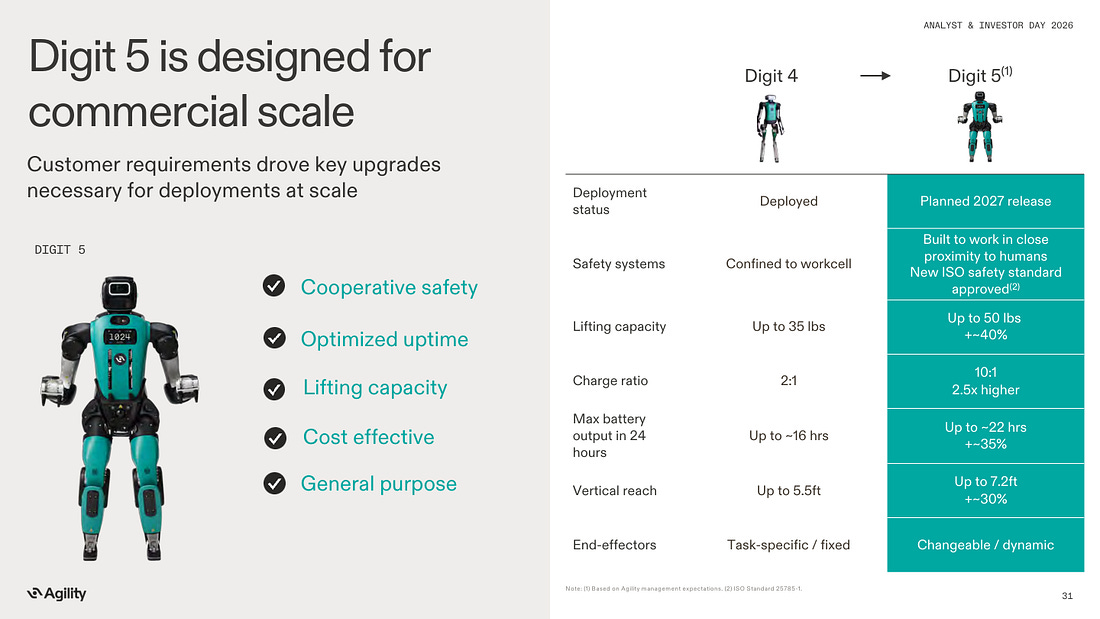
Digit 5 is supposed to let Agility do much more inside the customer’s facility. Early access is planned for the first half of 2027, with general availability by the end of the year. Payload rises from 35 pounds to 50, reach increases, and interchangeable hands open up additional jobs.
The charging upgrade is definitely a major positive. Digit 4 works for roughly two hours and then needs about an hour to charge. Imagine trying to schedule that across a busy factory running multiple shifts. With Digit 5, management describes a 90-minute runtime and a recharge in under nine minutes, moving the work-to-charge ratio toward 10:1. More of the day becomes available for useful work, and the customer gets more output from the same robot.
That is where this starts getting financially interesting. You are paying an annual fee for Digit. Every additional productive hour helps spread that cost.
Then there is safety which is obviously quite important.
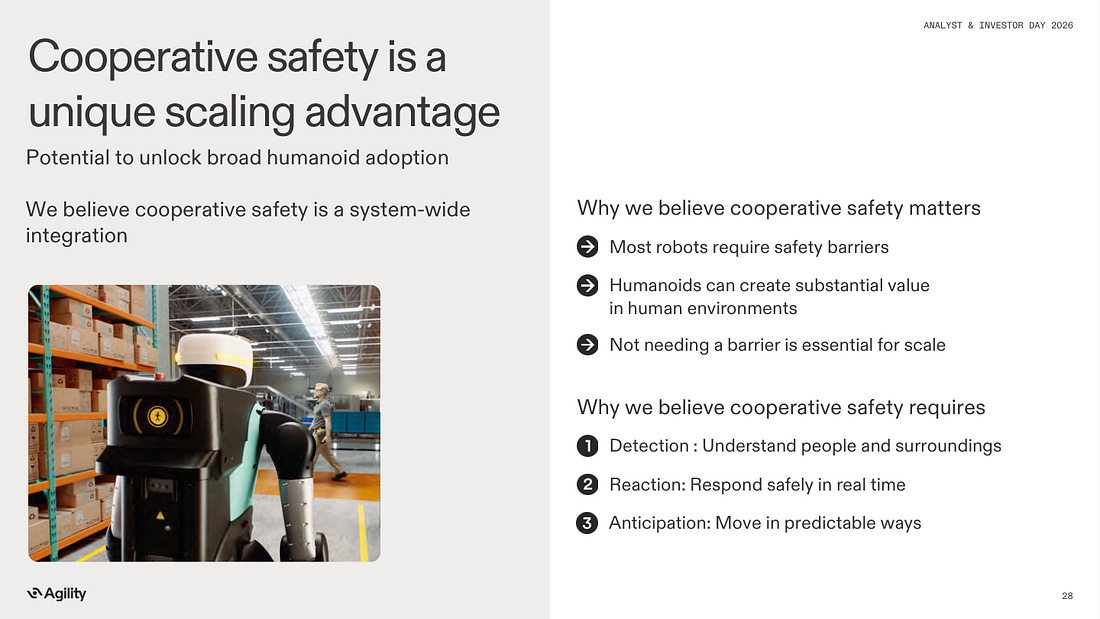
Digit 4 works within a defined workcell. Digit 5 is designed to operate closer to people. If that works as intended, the customer can use it across more of an existing facility without building so much dedicated infrastructure around it. Think about Digit carrying a part between two machines while employees continue working nearby, then changing tools to handle another job. The same robot becomes useful in more places.
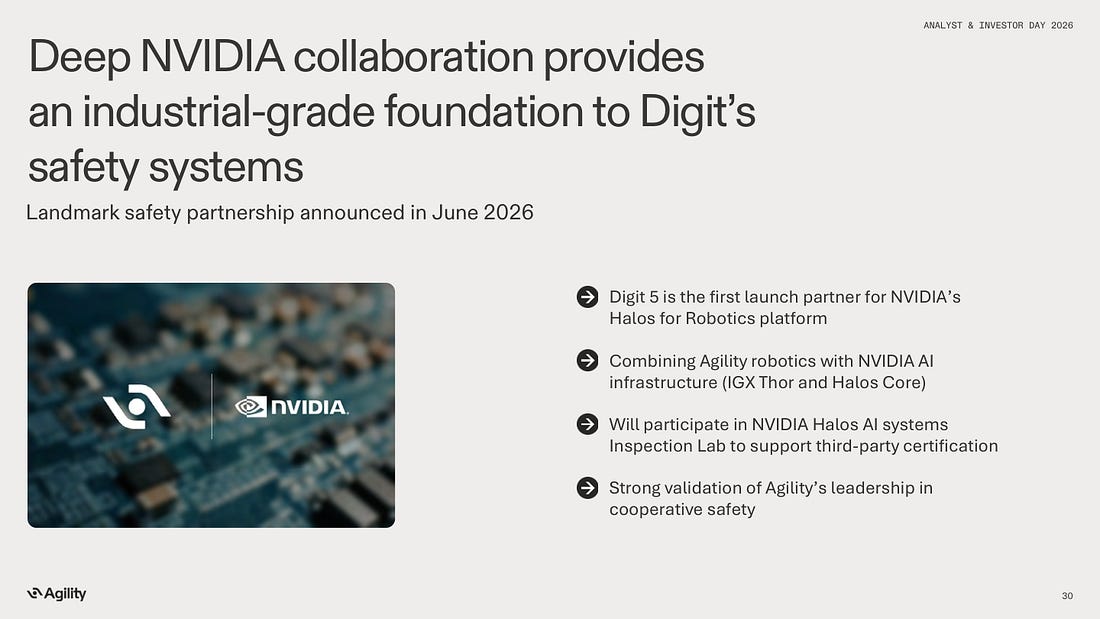
NVIDIA’s Halos for Robotics, IGX Thor and Halos Core are part of that effort. Agility plans to use NVIDIA’s inspection lab to support third-party certification. Certification still has to happen, and so does the field validation, but this is a very practical use of the NVIDIA relationship. It helps address one of the first questions a factory’s safety and insurance teams will ask before allowing the robot around employees.
There is real deployment experience here
The presentation gives us a useful look at where Digit is actually working too. Eight robots at Schaeffler and three at GXO, with roughly 98% task accuracy at both. GXO has handled more than 100,000 totes. At Schaeffler, Digit is moving automotive components through a production workflow.
These customers are a big part of the appeal for me. They have real operations to protect. Their willingness to work with Agility gives the company a place to learn what breaks, what takes too long and what a future fleet would have to do better.


Eleven robots across those two examples is still a very small base. The next challenge is getting enough of the installation and support process standardized that adding the twentieth robot is much easier than adding the first.
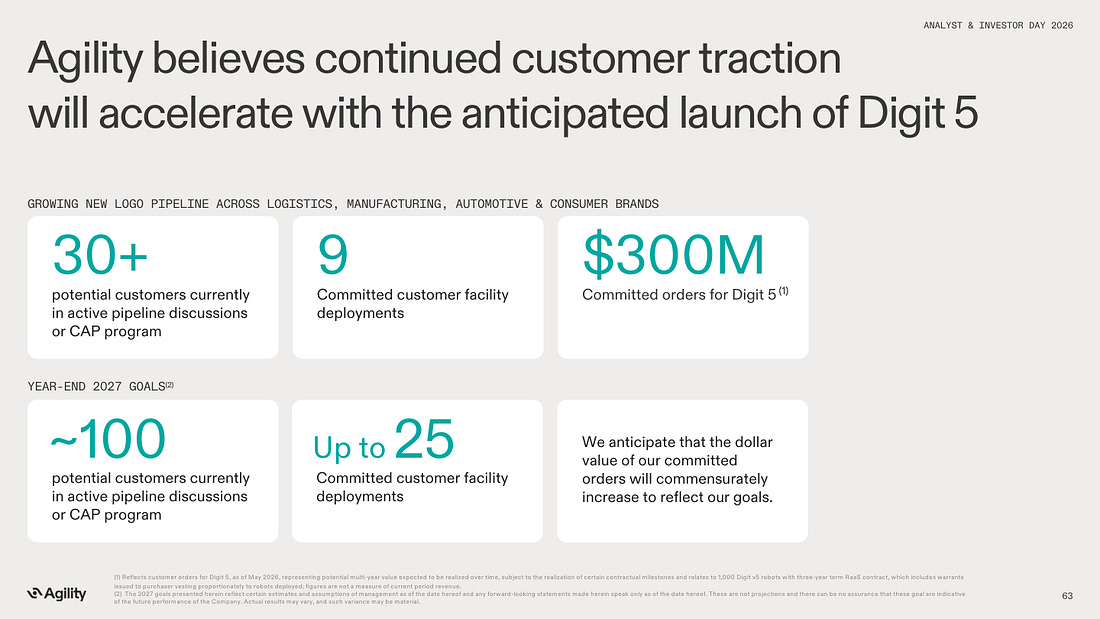
That is what the Customer Acceleration Program (CAP) is working toward. Customers pay approximately $500,000 to validate the technology and workflow before expanding. Management disclosed four new CAP customers and more than 30 potential customers in active discussions or the program.
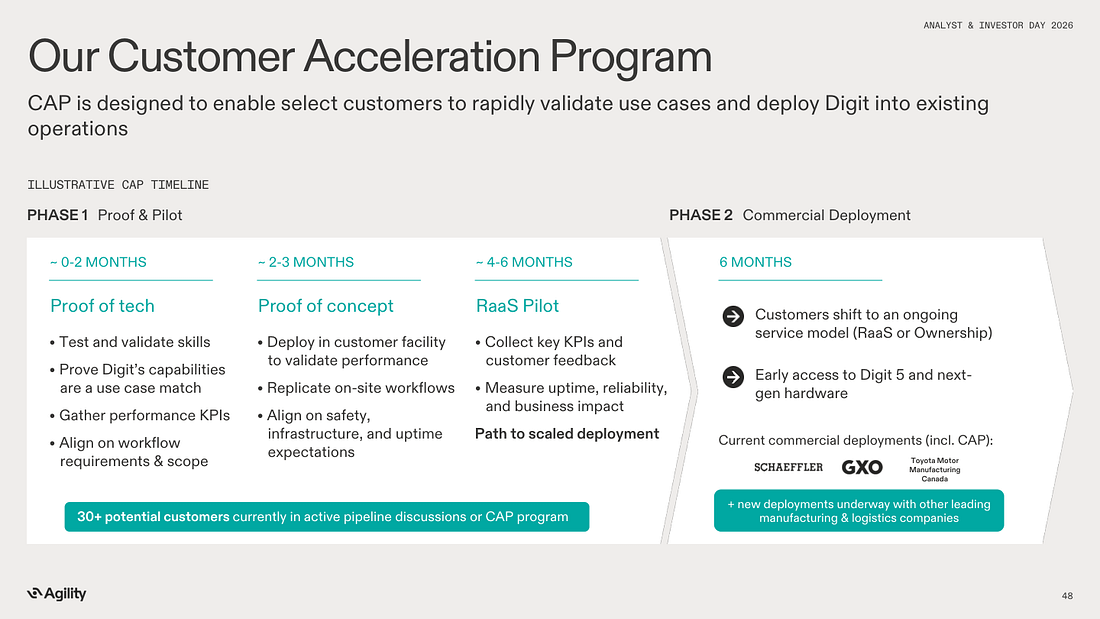
The year-end 2027 goals are roughly 100 potential customers in the pipeline and up to 25 committed customer facilities. If those early deployments go well, Agility has several ways to grow inside the same account. Add robots to the first facility, take the proven workflow into another site, then introduce additional jobs the robot can handle. Each customer could become much larger than the initial pilot.
The order is meaningful and the details still matter
A customer committing to 1,000 robots is thinking at a very different scale from a three-robot installation.
The $300M Digit 5 commitment is the total potential contract value across 1,000 robots over three years. It is subject to contractual milestones and product requirements. Spread evenly, that would be roughly $100,000 per robot per year, although actual revenue timing depends on deployments and contract terms. Purchaser warrants vest as robots are deployed. All of that was in my June report, and the next step is converting the commitment into working units and recognized revenue.
Most customers are currently leaning toward Robots-as-a-Service (RaaS). It makes sense from their side. Agility handles much of the hardware and support burden while the customer pays for the capacity. There is also an ownership option, where the customer buys Digit upfront and continues paying for software and maintenance.

The choice changes Agility’s cash flow quite a bit. Selling the robot brings money in sooner. RaaS spreads more revenue across its useful life while Agility funds the machine upfront. As the fleet grows, that mix becomes a major part of the financing story.
This is where the economics get interesting
Start with one robot.
The separate RaaS model uses a five-year robot life. Management illustrates about $500,000 of total revenue per robot over those five years, including a roughly $25,000 deployment fee charged to the customer. That averages approximately $100,000 annually. It is a per-robot illustration over five years, while the $300M commitment above covers a 1,000-robot contract over three years.
On Agility’s side, the launch bill of materials (BOM) is approximately $150,000. There is another $15,000 of deployment cost, plus $15,000 each year to deliver software and maintenance. Across five years, that is $150,000 + $15,000 + $75,000, or $240,000 of modeled costs. Subtract it from $500,000 of modeled revenue and about $260,000 is left, which is 52% before corporate expenses. Management rounds that to approximately 50% product margin.
Now take the hardware cost down. At about 1,000 robots manufactured annually, management illustrates a 70% lifetime RaaS product margin. At 10,000 manufactured annually, it moves toward 75%. Those are production-volume milestones in the cost model. Each margin is measured across a robot’s assumed five-year life and includes deployment and ongoing support. Corporate R&D and SG&A still have to be paid from what remains.

This is why a relatively small number of successful customer expansions could get interesting quickly. In management’s installed-base examples, 2,500 active robots at roughly $100,000 per robot annually produce approximately $250M of annual revenue. A fleet of 10,000 active robots produces about $1B. These are robots working at customers, separate from how many robots the factory produces in a year. Management attached no deployment date to either illustration.
The customer has to get enough useful work out of each robot to keep paying that fee. The labor comparison in the deck assumes about 120 working hours a week, producing roughly $200,000 of annual equivalent labor cost against approximately $100,000 of annual Digit cost. A busy multi-shift workflow is exactly where that could be compelling.

That utilization assumption is one of my main reservations. How many productive hours will customers actually get after charging, maintenance and intervention? And how much will it cost Agility to support those hours? Small changes there compound across a five-year contract.
The factory exists and the cost reductions still have to arrive
Agility already has RoboFab in Salem, Oregon, designed to support up to 10,000 robots a year. The facility gives it somewhere to scale production as demand converts. Actual output will follow the pace of product readiness and customer deployments.

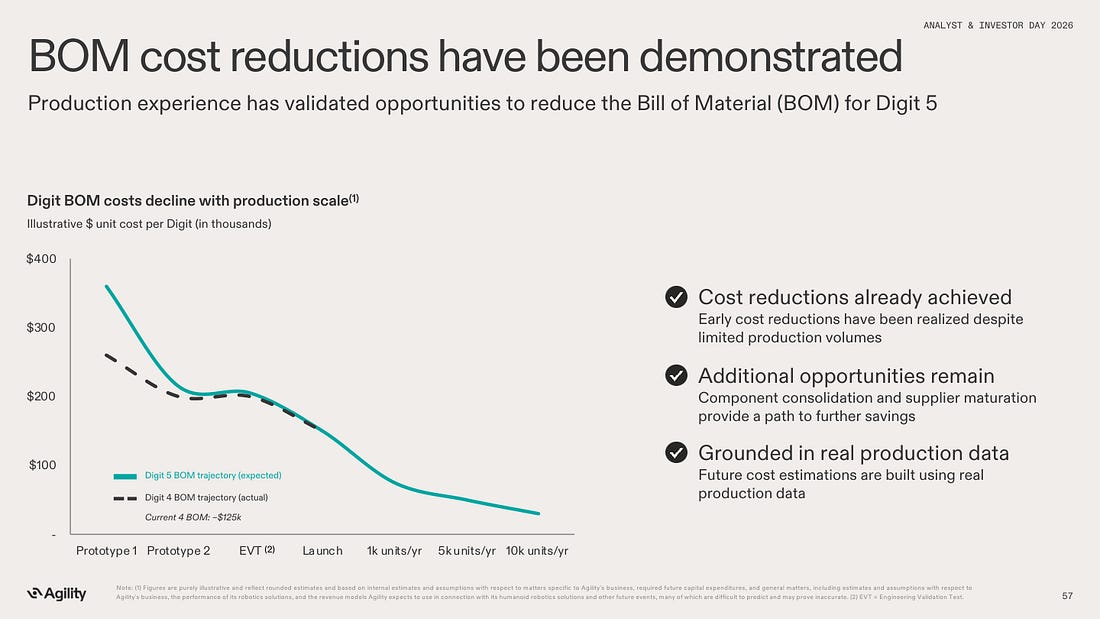
The cost target is very aggressive. Digit 4’s current BOM is about $125,000. For Digit 5, management’s roadmap goes from approximately $150,000 at commercial launch to $30,000 at 10,000 units of annual production. An 80% reduction.
A big piece sits in the actuators, which account for roughly a quarter of the BOM. Agility owns that design, so it can change the hardware and manufacturing process itself. There is also room to consolidate components and use suppliers with existing scale. Interestingly, management says volume discounts account for only about 20% of the projected cost reduction. The rest requires engineering and sourcing work.

There was a useful operational detail here too where Agility described replaceable arms and legs, third-party field-service support, and a current service-center turnaround below five days, with a goal below three. A robot spending days out of service has a cost on both sides of the relationship. Making repairs quick and routine is part of making the economics work.
Arc could become more valuable as the fleet grows
Once you have a fleet, someone has to decide which robot does which job and coordinate that with everything else happening in the facility. Arc handles that software layer and sends operating and health data back to Agility.

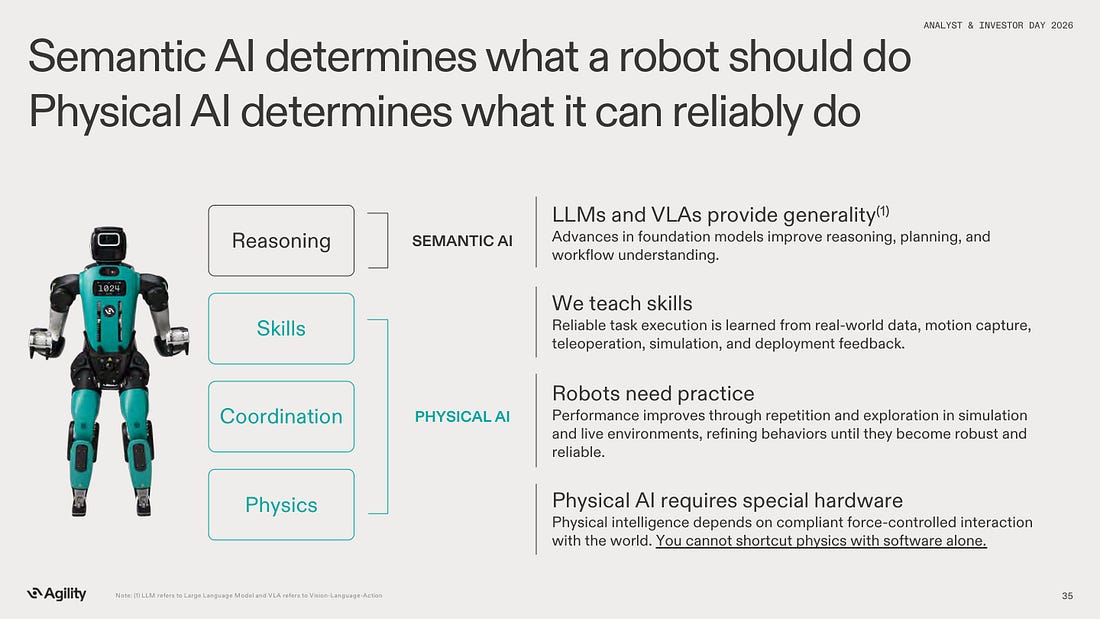
The data is interesting because Agility needs to solve a very specific physical problem. A general AI model can help interpret a request. Digit still has to balance, move, grasp the object and complete the task reliably using its particular body. Management is building that control knowledge through demonstrations, simulation and deployment experience.
The payoff could be much larger than the revenue from an early installation. If the learning at one site makes the next deployment easier, Agility can improve the product while reducing the amount of custom engineering needed for each new customer. That would be a real advantage.

Agility also sees licensing potential in its proprietary hardware and software. We discussed that in June, and it remains an interesting extension of the business. For now, I am much more focused on getting the Digit fleet working at scale.
The longer-term slide is fun to think about. Machine tending, more complex factory work, then eventually environments with much more human interaction. Even a successful expansion within industrial facilities would give Agility a lot more room to grow before it needs to solve something as unpredictable as a home.

The financials answer the question I had in June
This is the part I was waiting for. Here is the financial picture.

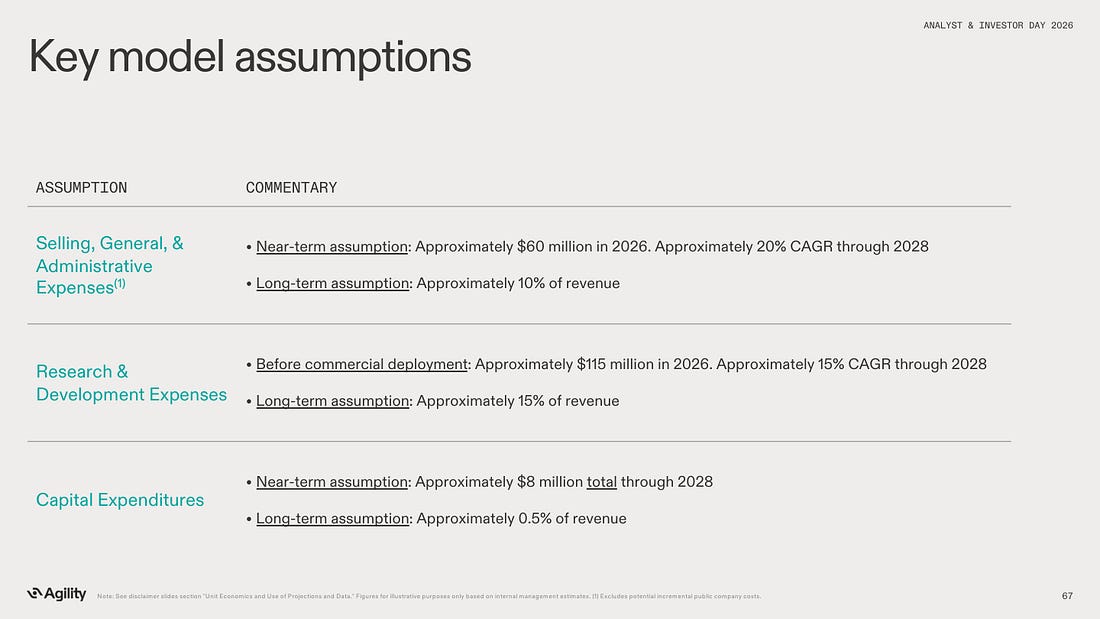
Management’s illustrative corporate expense model starts with $60M of SG&A and $115M of R&D in 2026, growing approximately 20% and 15% annually through 2028. Longer term, the assumptions are 10% and 15% of revenue, respectively. Those expenses sit outside the product margins discussed earlier.
The transaction and what we are paying
The transaction values Agility at $2.5B before new capital.
As I am writing this the stock is ay $11.25. The filing’s illustrative 268.6M combined basic shares imply approximately $3.02B of equity value.

My decision
I still want to keep tracking Agility. I believe in the humanoid opportunity, and the technology is exciting. If the sector catches momentum, this could offer some good trades.
For a long-term allocation, though, I need more proof and a clearer timeline. I can see how the business could eventually grow into its valuation, but I don’t yet know when deployments will reach that scale or how much additional funding it will take. That makes it hard to judge the return I could earn from today’s price.
For now, I’m staying sidelined.
Financial disclaimer
This article is for research, education and general information. It reflects my opinions and interpretation of available information and is not personalized investment, financial, legal or tax advice, a recommendation to buy or sell any security, or an offer or solicitation. It does not consider your financial circumstances, objectives or risk tolerance. Readers should perform their own due diligence and consult qualified professionals where appropriate.
I may hold positions in securities discussed and may buy or sell them without notice. Any position or decision expressly disclosed reflects the time of publication and may change. My interests may differ from those of readers.
Reported historical results are distinct from management guidance, conditional orders, illustrative unit economics, valuation scenarios and my own calculations. Forward-looking statements depend on assumptions about product readiness, safety, customer adoption, utilization, costs, financing and market conditions. Actual outcomes may differ materially. Product-margin illustrations exclude corporate expenses and should not be treated as company-level operating margins or reported GAAP profitability.
Early-stage robotics and SPAC investments carry substantial risks, including execution failures, competition, transaction failure, redemptions, additional financing needs, dilution, volatility and loss of capital. Expected transaction proceeds are conditional and may differ from cash ultimately available.
Sources include company materials, SEC filings and third-party information believed to be reliable, but accuracy and completeness are not guaranteed. Information and opinions may become outdated. No forecast, target or investment outcome is guaranteed, and past performance does not assure future results. This disclaimer does not replace required disclosures or applicable legal obligations.