2026.10.07 | Substack | Memory | HBM4 & Memory Big Three Competition
原标题:How HBM4 Is Changing Competition Among the Three Memory Companies
I am positive on the memory industry,
but I do not view the three companies in the same way.
For now, I prefer Samsung and Micron, and I am a little more cautious on SK hynix.
Disclaimer
For information only, not a recommendation to buy or sell. The author may hold positions in the companies mentioned, and those positions may change. NFA, DYOR.
 Subscribed
1. Why I am paying attention to Samsung in HBM4
I currently see Samsung as the most competitive in HBM4.
Samsung announced stable operation at 11.7Gbps and a maximum of 13Gbps using 1c DRAM and its own 4nm base die.
For sure, SK hynix also disclosed 11.7Gbps for its 12 layer product, and Micron also exceeded 11Gbps.
Even so, the reason why I’m giving Samsung a higher score is they can design adjust the DRAM and base die together.
If customer requirements change, the memory, I/O, and power network need to be adjusted together. I expect Samsung’s process combination and internal collaboration structure to work as strengths in this process.
We called it is “Turn Key strategy”

Based on disclosed specifications. Power efficiency figures are improvements over each company’s own HBM3E. Sources: Samsung · SK hynix · Micron.
 Subscribed
Industry Insight 1.
There are reportedly discussions in the field that both the 8 layer and 12 layer versions of SK hynix’s HBM4 are experiencing manufacturing and assembly reliability problems.
Various stories are coming from the field, including claims as extreme as all HBM4 12 layer stacks being defective. If this turns out to be true, I think it could point to a problem in combining the new base die with the existing stacking process.
Reducing the number of layers reduces the burden on heat management and power delivery. However, this does not also ease the requirements for the base die and I/O.
At 11Gbps, the time for one bit is about 91ps, and it remains the same with 8 layers as long as the same pin speed is required. For this reason, I suspect there are still aspects that would be difficult to resolve simply by reducing the number of layers.
In particular, if assembly reliability is the issue, I think the joints connecting the TSMC base die and the MR-MUF stack are important.
Starting with HBM4, SK hynix uses a base die made on TSMC’s logic process. Bump structure and height, die thickness and warpage, molding materials, and heating and cooling conditions need to be matched to the new combination. Even if individual dies perform well, stress concentrated at the joints affects reliability after stacking. Therefore, if the problem described by the field reports is of this kind, I think adjusting the existing HBM3E assembly conditions to the new base die will be central to the solution.

Source: https://news.skhynix.com/en/tsmc-2025-technology-symposium-sk-hynix-showcases-hbm4/
Of course, the quality issues we are hearing about now may be temporary. We do need to watch this a little longer. However, it is also a fact that HBM4 and Vera Rubin are being delayed by the current situation.
2. Micron is catching up with SK hynix from a smaller production base
The change I am watching now is that Micron has almost caught up with SK hynix in total DRAM revenue.
In the second quarter of 2026, revenue market shares were 38% for Samsung, 25% for SK hynix, and 24% for Micron.
SK hynix’s lead in HBM has narrowed considerably when measured in total DRAM revenue.
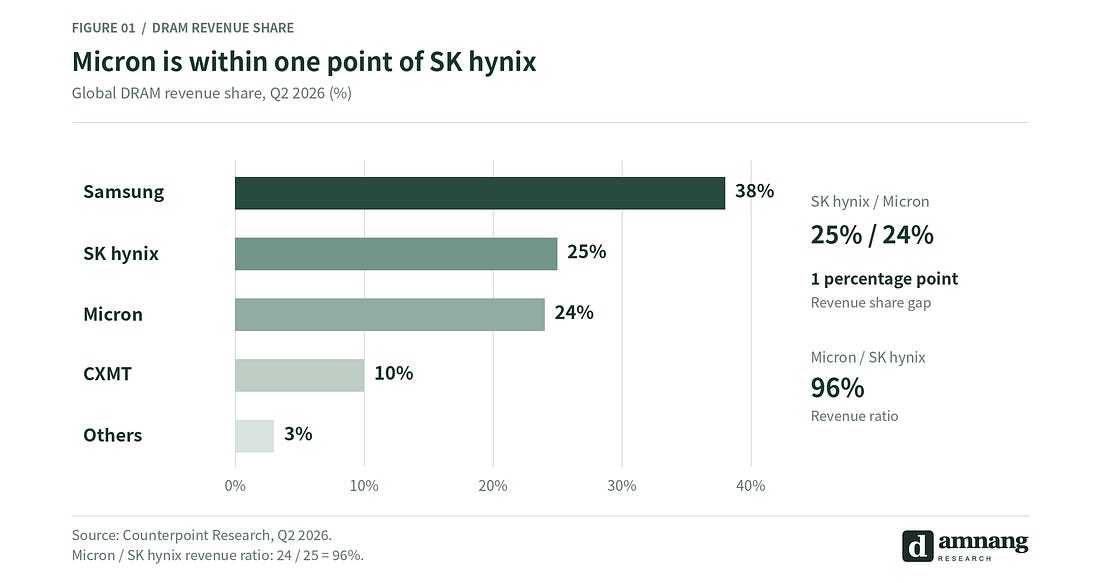
Q2 2026 DRAM revenue market share. Source: Counterpoint.
This catch up becomes more meaningful if considering the difference in production capacity.
In my sensitivity model, I assumed Micron’s wafer input capacity at 60% to 70% of SK hynix’s. Applying the revenue ratio of 96% gives revenue per unit of production capacity at about 1.37 to 1.60 times that of SK hynix.
Using the midpoint of 65% gives about 1.48 times.
This means that even with a smaller production base, product mix and selling prices can substantially narrow the revenue gap.
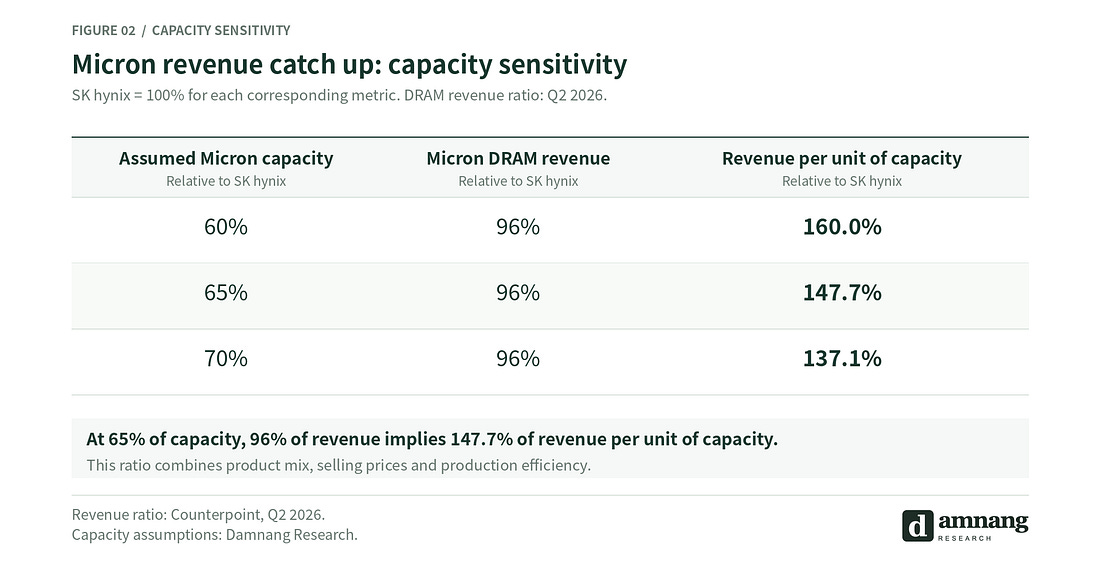
Sensitivity assuming Micron’s production capacity at 60% to 70% of SK hynix’s. Relative revenue per unit of capacity is calculated by dividing the revenue ratio of 96% by each capacity ratio.
In my opinion, the most important thing is now that what a company makes with its wafers and how much it sells those products for have become as important as how many wafers it puts into production.
Moving to an advanced process increases the number of bits produced per wafer, and higher priced server DRAM improves the product mix. The speed of raising contract prices adds to this.
I interpret Micron’s revenue catch up as the result of these three factors working favorably together.
HBM requires more wafers and backend resources to produce the same capacity.
If conventional DRAM prices rise quickly while adjustments to existing HBM contract prices lag, production capacity allocated heavily to HBM can instead limit revenue growth.
I believe Micron should now be assessed not only in the competition for HBM volume, but also in the competition to increase revenue per unit of production capacity.
In addition, I think we need to consider SK hynix’s quality issues as well.
If SK hynix’s qualification delays lead to shipment disruptions as reports from the field suggest, its higher dependence on HBM creates a larger revenue burden.
With the DRAM revenue gap already narrowing, SK Hynix have to protect the next customer volumes and contract prices becomes even more important.
Therefore, I am positive on Micron because it has already made up much of the disadvantage of its smaller production base in revenue, and is now seeking to improve HBM profitability as its next step.
Damnang Insight
According to rumors, Micron was the first to mention 16Gbps when the HBM4E specifications were being decided, leaving SK hynix and Samsung with little choice but to follow. It may have been an overreach by the third largest supplier, but in another sense, I think it could have been Micron’s attempt to catch up in HBM technology and market share.
And if, as with NVHBM, all specifications are already set and competition comes down purely to design and process capabilities, my cautious view is that this could create a new opportunity for Micron as well.
3. Samsung gains pricing power by diversifying its customer base beyond NVIDIA.
Industry Insight 2
According to a supply chain contact, Samsung had continued sending 8 layer HBM4 samples for qualification since NVIDIA first requested them, but the request for these sample deliveries was recently canceled.
The exact reason has not yet been revealed. However, one plausible explanation being discussed is that NVIDIA, which needs to maintain two suppliers under its memory sourcing policy, decided to put Samsung’s 8 layer sample shipments on hold and prioritize 12 layers as supply issues at SK hynix became more severe.
This has actually put Samsung in an interesting position, because around the same time, AMD reportedly requested 8 layer HBM4 volume from Samsung in addition to its existing 12 layer volume. This has led to speculation that the opportunity to diversify its customers may have given Samsung greater pricing power in HBM.
Even more interesting is OpenAI’s Jalapeño chip.
From what I’m hearing, bringup of this chip is scheduled for the end of this year, and there are rumors that Samsung could supply all of the HBM4 used in it. If this is true, it could mean that all the HBM4 chips that met Jalapeño’s performance requirements during speed qualification were from Samsung.
In this article, I assumed Samsung’s supply allocation in the model at 35% for NVIDIA, 80% for AMD, and 100% for OpenAI.
This gives about 11.1 billion Gb, equivalent to about 38.5 million 36GB stacks. Applying 30% to 40% for NVIDIA, 70% to 90% for AMD, and 500,000 to 1 million OpenAI shipments gives a range of 9.3 billion to 12.8 billion Gb, or about 32.4 million to 44.6 million stacks.

Samsung’s 2027 HBM4 supply model. Base: about 11.1 billion Gb; range: 9.3 billion to 12.8 billion Gb. The assumed AMD allocation is 80% in the base case, with a range of 70% to 90%.
4. The Challenges SK hynix Currently Faces
In the same customer allocation model, if I assume that SK hynix supplies 45% of NVIDIA’s volume and 10% of AMD’s, while Samsung supplies all of OpenAI’s, about 93% of SK hynix’s volume calculated across these three customers is tied to NVIDIA.
If qualification is also delayed in a structure with such high customer concentration, I think it will prioritize protecting promised volume and its position as a supplier over raising prices.
According to rumors, Chey is reluctant to raise prices too quickly, even if it means giving up some margin. The reason is to maintain a mutually beneficial relationship with customers (maybe NVIDIA)
If it is real, I believe SK hynix’s high dependence on HBM and its approach to customer relationships could be a burden for the company right now.
Meanwhile, I am also hearing that SK hynix is receiving additional HBM3E requests.
If this is true, I think additional demand for the existing generation could buy time until HBM4 shipments recover. Blackwell Ultra could be one such example.
However, I don’t think this can be a lasting solution.
I think SK hynix might want to move the current HBM4 battle ground into HBM4E.
Advancing the processes and designs of the core die and base die would create an opportunity to narrow the difference in process combinations that worked in Samsung’s favor in HBM4, and to compete again on speed and power efficiency.
But my question here is how quickly it can make that transition.
According to industry field, the initial Rubin Ultra volume also stays with HBM4. If it is true, Samsung can make use of its current competitiveness for longer, while SK hynix’s opportunity to compete again in HBM4E is pushed back.
I see several challenges that SK hynix currently needs to overcome, including the pace of HBM4E development, improvements in HBM4 quality and reliability, a stable transition to HBM4E, and customer diversification.
5. Shipment execution in 2027, price sensitivity in 2028
For the forecast model, I set each company’s DRAM revenue in the reference year to 100 and assumed HBM revenue shares of 15% for Samsung, 30% for SK hynix, and 15% for Micron. All price changes in this model refer to ASP per bit.
For 2027, I applied a 30% increase in commodity DRAM prices, a 15% increase in commodity bit shipments, and a 55% increase in planned HBM bit shipments.
I used two HBM price increases, 60% and 120%, and, to examine the impact of qualification delays at SK hynix, used a case in which 20% of its planned HBM volume is not reflected in revenue that year as the base scenario.

Figure 04. DRAM revenue growth in 2027 from my model. For SK hynix, the scenario assumes that 20% of planned HBM volume is not reflected in revenue that year.
My model calculates 2027 DRAM revenue growth of about 64% to 78% for Samsung and Micron, and about 64% to 86% for SK hynix. SK hynix also benefits significantly from price increases because of its high HBM share.
If it ships all of its volume as planned, its growth rises to about 79% to 107%. This difference is why I focus on quality and qualification schedules. Even in a strong market, failing to ship on time means missing the gains it could have benefited from most.
For 2028, I started with the scenario above of a 60% increase in HBM prices and shipment delays at SK hynix, then applied a 20% increase in commodity bits, a 40% increase in HBM bits, and a 10% decline in HBM prices.
If commodity prices hold, DRAM revenue grows by about 22% for SK hynix and about 21% for Samsung and Micron. The cases in which commodity prices decline are shown below.

2028 revenue sensitivity to unchanged and declining commodity DRAM prices. All figures are relative to 2027.
6. Factors beyond HBM and the earnings to watch now
For Samsung, the foundry recovery also needs to be considered.
Its official second quarter announcement mentioned HBM base dies, orders from US customers, and 2nm HPC design wins. For the second half, it plans to expand revenue from second generation 2nm mobile products and 4nm LPUs and base dies.
If HBM4 shipment growth leads to greater internal demand for base dies and improved utilization, I think it will also help earnings recover outside memory.
I view Solidigm as a clear positive for SK hynix outside HBM.
In August, Solidigm announced a multiyear agreement with CoreWeave for priority supply of enterprise SSDs. As AI servers process and store more data, the demand base for high capacity SSDs also expands. I think this business can supplement SK hynix’s earnings base even while HBM4 shipments are under pressure.
Kioxia is a separate investment asset issue.
It already listed in Tokyo in 2024 and recently officially confirmed preparations for an additional US ADS listing. SK hynix has an economic interest through an investment company and convertible bonds.
If the entry of US investors raises the investment’s value and improves the conditions for realizing that value, it could be a financial positive.
However, I distinguish valuation and disposal gains on investment assets from recurring memory operating profit.
In my view, Solidigm’s business growth and the investment value of Kioxia help cushion the downside for SK hynix, while a recovery in HBM4 shipments determines the revaluation of its core business.
At Micron, I pay close attention to the cash going into capacity expansion.
The company plans FY2027 capital expenditure, net of government incentives, of about $25 billion in the first half and a larger amount in the second half.
That plan implies more than $50 billion for the year.
As capacity expansion increases shipments in 2027 and 2028, initial costs and cash outflows also rise. What matters is whether it can absorb the investment burden while shipping the customer volumes it has secured on time.
The common variables are the pace of investment by AI customers and memory prices.
If high prices weigh on PC and mobile demand, or supply expands faster than expected, the period of rising prices also becomes shorter. This is why I look at 2027 shipment plans together with 2028 price sensitivity.
7. My current view and the conditions that would change it

Figure 06. Prices observed on October 7, 2026. The Korean stocks use KRX closing prices and Micron uses a US premarket price, so the trading times differ.
Samsung Electronics · Positive
I highly value the published HBM4 specifications and Samsung’s position as a primary supplier to AMD. If the expansion of its customer base that I hear about from the field also materializes, I think it will gain opportunities in both volume and price. At present, I am most positive on Samsung.
Micron · Positive
I focus on the fact that Micron has nearly caught up with SK hynix in DRAM revenue despite a smaller production base. I think process transitions, a mix of higher priced products, and customer contracts are narrowing the revenue gap. I expect better HBM pricing to add to commodity DRAM profitability, and I also intend to watch shipments and cash flow after capacity expansion.
SK hynix · Cautious until the problems are resolved
If the problems being discussed in the field are real, I think it is right to remain cautious for now. Given its experience in volume production of stacked memory, I think technical improvements are possible, but the time needed for customer qualification and stable shipments matters. An early transition to HBM4E also needs to align with customer schedules. I view the value of Solidigm and Kioxia positively, but I will change my assessment based on the recovery in HBM shipments and the value that reaches the parent company’s shareholders.