2026.10.07 | Substack | MRVL | Marvell Investor Day Outlook Raise
原标题:Marvell Raised Its Outlook Again. Must Read!
Wow, that was a bullish Investor Day.
Marvell just added another $2B to its FY28 revenue outlook. We are now at roughly $20B, up from $18B, with a longer-term path to $70B–$90B in FY31.
Optics and switching are driving the increase. Again.
This is what I find so exciting about the update. In my August deep dive, I argued that consensus had room to move higher as more of Marvell’s programs entered the numbers.

We Need To Talk About MRVL. A Deep Dive Into All That Is Going On
Gaetano
·
Aug 22
Read full story
We have already seen further increases since then, and connectivity is doing a lot of the work before the largest custom-silicon ramps even arrive.
For the optical names we follow, that is a pretty important combination. The nearer-term revenue opportunity keeps expanding while management is putting much bigger numbers around what comes afterward.
Connectivity. Connectivity. Connectivity.
FY27 stays at roughly $12B. The new FY28 outlook implies about 67% total revenue growth and 80% growth in data center. Marvell now expects $18B of data-center revenue in FY28, reaching the level it previously targeted for FY29 a full year early.

The scale-across discussion helps explain why. We talk about this often. As AI infrastructure spreads across separate buildings and campuses, much more traffic has to travel between them. Management puts the bandwidth requirement for these backend scale-across networks at roughly 15 times conventional DCI.
That is a lot of additional connectivity to build.

Marvell sees industry coherent-pluggable demand growing from under 1 million units in 2026 to over 3 million in 2030. Technology generations are moving from roughly four years to two, and 3.2T coherent is already in development. Its own coherent revenue was about $500M in FY26. Management now expects it to comfortably exceed $1B in FY28 and reach multiple billions in FY29–FY31.
This is a major leg of my optics thesis. More connections are being deployed, and higher-performance generations are arriving faster. Across the broader interconnect business, Marvell’s model assumes it retains market share while unit growth and the move from 800G to 1.6T and 3.2T support higher ASPs. There is a lot of growth in that framework even without assuming Marvell takes more share.

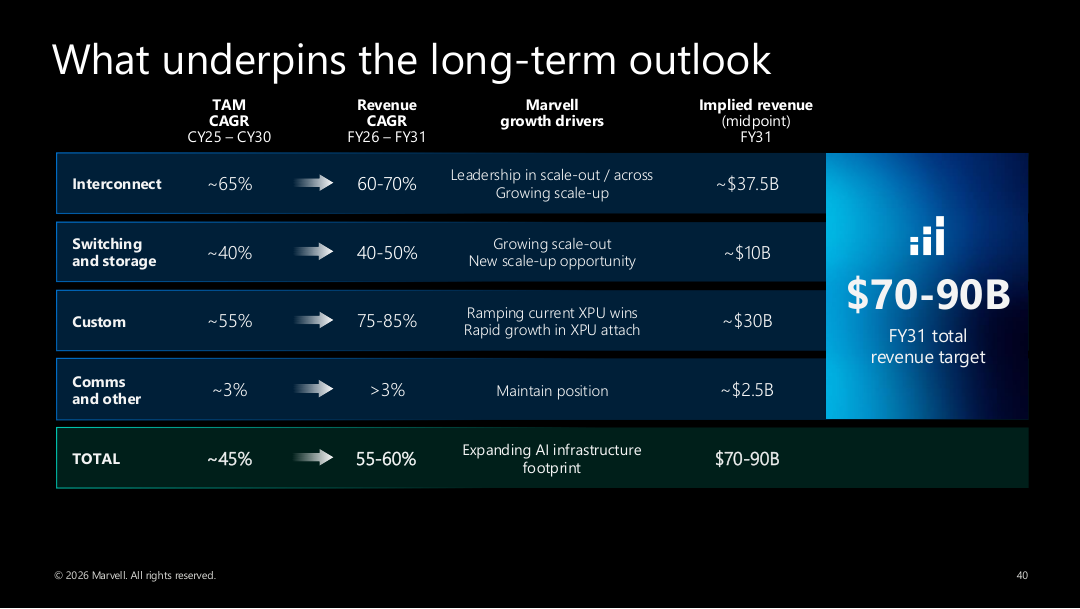
The market forecast is worth a sec of attention. Marvell sees interconnect growing into a roughly $65B opportunity by CY30, with scale-up and scale-across adding to scale-out. That gives us a broader demand base for the optical supply chain.

There are two 3.2T DSP paths on the roadmap here: PAM and coherent-lite. Marvell is developing both, which gives it another way to participate as customers work through the power and reach requirements of their next networks.
Inside the data center, NPO and CPO are expected to ramp alongside each other. That fits what I discussed after ECOC about Marvell having several ways to participate as customers choose different designs. FastPipe keeps the DSP, while FlatPipe uses DSP-free analog optics. Marvell can supply components or complete optical engines across those architectures.
Management puts the scale-up optical content opportunity in the thousands of dollars per XPU, with optics needed at both ends of the connection. That helps explain why this can become such a large business. As more accelerators move onto optical connections, the amount of optical content around each one becomes substantial. Marvell has several products competing for a share of that spending.

And switching is becoming a much bigger part of this. Scale-out switching is expected to exceed $1B in FY28, with UALink deployments beginning in 2027. Management sees multibillion-dollar annual revenue potential for the previously introduced 102.4T Teralynx T100, alongside Marvell’s participation in the NVLink Fusion ecosystem.
The earnings opportunity changed considerably
At the $80B FY31 midpoint, management models $37.5B from interconnect and $30B from custom silicon. Switching and storage contribute $10B, with another $2.5B from communications and other businesses.
Interconnect alone would be almost half of Marvell.

Then we get to margins. The long-term adjusted operating-margin target moved from 38%–40% to 44%–46%. Management expects operating expenses to grow at roughly half the rate of revenue, spreading development costs across a much larger business even as lower-gross-margin custom silicon grows.
At $80B of revenue and a 45% operating margin, that works out to $36B of adjusted operating profit. Management’s framework targets more than $30 of adjusted EPS.
For perspective, Piper went into the event modeling roughly $45B of FY31 revenue. Marvell’s new midpoint is almost 80% higher.
I think that gives us a sense of how much expectations could change as these programs become more visible. We have a substantially larger revenue opportunity combined with a six-point increase in the operating-margin target. Even moving partway toward management’s framework would represent a meaningful change from those pre-event estimates.
Custom silicon still has a huge ramp ahead
Marvell raised its FY29 custom-revenue target from above $10B to above $12B. Both Matt Murphy and Will Chu said FY29 custom revenue would more than triple FY28, driven mainly by XPU-attach products.
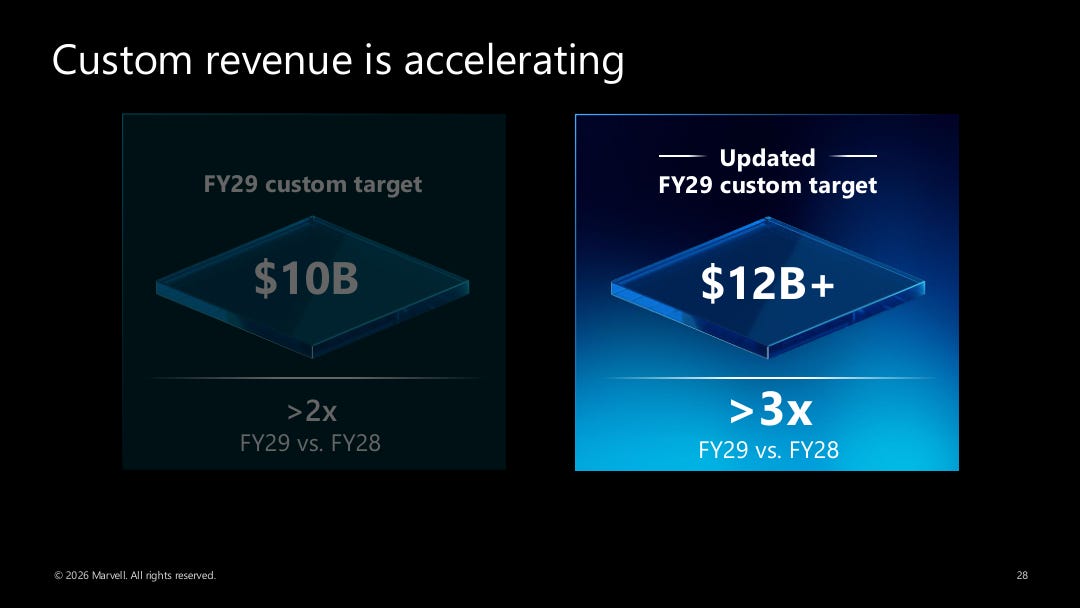
That goes straight back to the August deep dive. As memory and networking become more demanding, Marvell can earn substantially more content around the accelerator. The attach opportunity is becoming a very large business in its own right.
Management also said XPU-attach products can carry richer gross margins than full custom XPUs. Marvell can reuse more of its existing IP, and those sockets can continue across multiple accelerator generations, including designs where somebody else supplies the main chip. That makes the attach ramp particularly interesting for both earnings and the durability of the customer relationship.
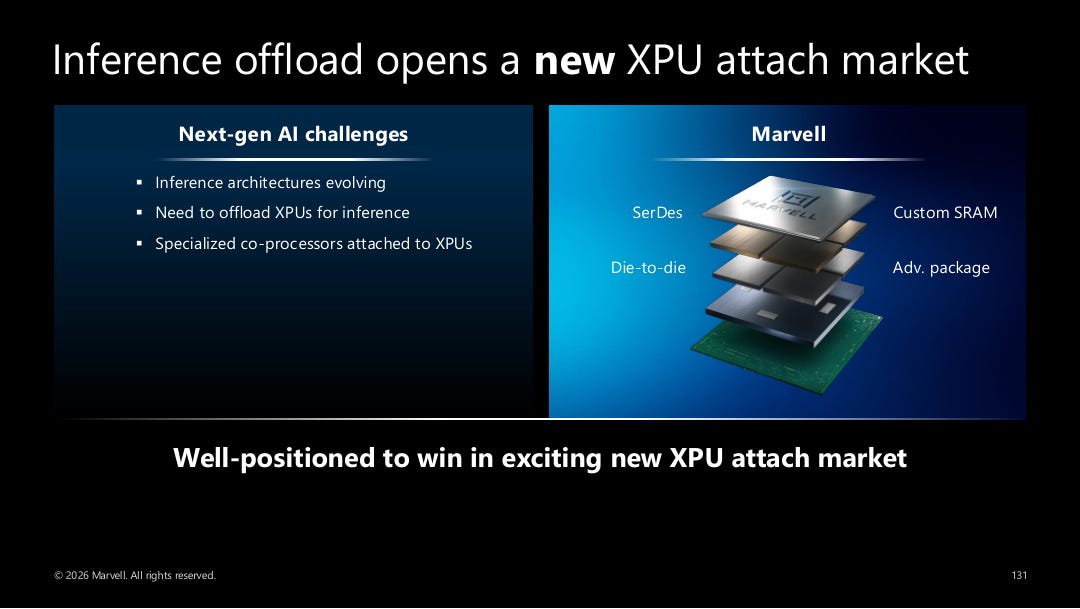
Inference offload adds another possible source of attach content. Specialized coprocessors can take work off the main XPU, creating additional sockets for Marvell as inference architectures evolve.
Google is part of the opportunity, and the Q&A added a useful detail. Management is including only the portion of the potential Google business it currently judges appropriate, leaving some of the maximum warrant opportunity outside the forecast. The broader plan is built around programs with existing customers, including more than 35 sockets across the four largest US hyperscalers.
There is more coming on the roadmap too Optical memory modules are expected to sample with multiple customers in 2027, allowing memory to scale more independently from the accelerator. Scale-in optics inside chip packages are not a material contributor to the FY31 projections.

The overall framework assumes annual data-center capex reaches roughly $3T by 2030. Management says FY28 demand and supply are secured, which gives the nearer-term outlook more support.
What it means for the optical names
We saw lots of names rip across the board today.
CIEN and NOK are the obvious places to start. Higher-bandwidth connections between sites create demand for the line systems and amplification around those links.
Ciena already has a FY29 framework calling for roughly $14B of revenue, 50% adjusted gross margins and 32%–35% adjusted operating margins. As I discussed after ECOC, newer integrated optics contribute modestly to that framework, leaving room if adoption happens faster. Evercore reiterated its $550 target today with an EPS view above $25. That supports the earnings framework behind the $550 target I already had. Marvell’s outlook adds another piece of evidence for the demand behind those numbers.
Nokia has exposure through its optical networking systems and coherent technology. Justin Hotard said this week that customers could build at twice the pace if they had the resources, with memory and power among the constraints. I think that is useful context alongside Marvell’s outlook. There is demand waiting on the rest of the infrastructure to catch up, and Nokia has an opportunity to supply the optical networks as those projects move forward.
ADTN finally caught some bids too. Nice to see! In my August deep dive, Optical Networking was already 39% of revenue, growing 22% YoY and 13% sequentially, while hyperscaler revenue grew 97% YoY. Its coherent pluggables and FSP 3000 open line systems give it direct exposure to this DCI buildout. The profit sensitivity is what makes Adtran interesting to me. My scenario used $320M of quarterly revenue, a 42.5% adjusted gross margin and roughly $104M of adjusted operating expenses. That produces about $32M of adjusted operating income versus $10.6M in Q2 2026. If component availability improves and more of that optical demand turns into shipments, the earnings picture could change considerably. Today adds support to the demand side of that thesis. But remember this thesis is going to take a long time to play out (if it is successful at all) and it might take several quarters.
Fabrinet already had a roughly $1B annualized DCI business exiting FY26. I think that deserves more attention because we are talking about expanding a substantial business that already exists. FN manufactures for multiple optical suppliers, so it has several ways to participate as deployments grow. More coherent modules moving into production means more potential work flowing through its factories.
Smartoptics fits here too. Putting coherent optics directly into routers and switches still leaves a network to build between the sites. Its open line systems sit right in that path.
Tower is especially interesting to me because we can already see the connection to Marvell. They had shipped over 5 million coherent photonic ICs together by June. Now Marvell is talking about more than doubling its coherent revenue by FY28, followed by multiple billions in later years. There is an established manufacturing relationship underneath that ramp. More coherent units should support more photonic wafer demand, giving Tower another source of growth in silicon photonics.
GFS has another upstream angle through the September agreement to expand SiGe capacity for Marvell. That covers optical connectivity across pluggables, NPO and CPO, so the opportunity reaches beyond DCI. Marvell is already arranging the manufacturing capacity behind the growth it is describing.
For Lumentum and Coherent, this adds to the demand picture we have been discussing for months. We have more optics going inside data centers, and now Marvell is describing a much larger market connecting them. Those links use different optical designs, but both companies have products that participate in the buildout. What I like about that is the support it gives to the capacity being built today. A broader set of applications could help keep that capacity busy for longer, while constrained products could retain pricing power as supply catches up.
There are other read throughs that just speak to the massive expansion of the networking market, but these are the most direct.
Financial Disclosure / Disclaimer
This article is for research, educational and informational purposes only. It reflects my personal analysis and opinions and does not constitute personalized investment, financial, legal or tax advice, a recommendation to buy or sell any security, or an offer or solicitation to transact in securities. I am not acting as your financial adviser, broker or fiduciary through this publication. This research does not account for your individual financial circumstances, objectives or risk tolerance.
I may hold positions in securities discussed and may buy or sell them at any time without notice. Any positions explicitly disclosed reflect my holdings as of the stated date and may change. My financial interests may differ from yours and may create conflicts of interest. Publication of this article does not imply that I own every company mentioned or that I will provide updates about any transaction.
The analysis draws on company presentations, earnings calls, filings, industry research and third-party reporting. While I aim to use reliable information and check material claims, I cannot guarantee that all information is accurate, complete or current. Third-party estimates are attributed where available and may differ from company guidance or my own assumptions. Company slides reproduced in this article remain the property of their respective owners. Their inclusion does not imply endorsement of this publication.
Forward-looking statements, including management targets, revenue projections, margin assumptions, earnings estimates, market-size forecasts and product timelines, involve significant uncertainty. Management’s long-term targets are not reported results or guarantees. My calculations and valuation scenarios are illustrative and depend on assumptions that may not occur. Actual outcomes may differ materially because of changes in demand, customer concentration, competition, supply availability, manufacturing execution, financing, dilution, regulation or broader market conditions.
Certain financial measures discussed are adjusted or non-GAAP measures. Their definitions may differ between companies and from GAAP results. Readers should review the relevant company disclosures and reconciliations before making comparisons. Fiscal years may also differ from calendar years and between companies.
Investing involves risk, including the possible loss of all invested capital. Past performance, prior research outcomes and historical price movements do not guarantee future results. Price targets and valuation scenarios are estimates, not promises of returns or specific outcomes within a stated period.
Views and estimates reflect the information available when this article was prepared and may change without notice. I do not undertake to update every statement, model or conclusion. Readers should independently verify material information, conduct their own due diligence and consult appropriately qualified professionals when needed before making investment decisions.