2026.10.07 | Substack | MRVL | MRVL Investor Day Targets
原标题:Research|MRVL: Investor Day Targets Move Closer to Our Forecasts
Marvell outlined an ambitious outlook at its October 6 investor day, targeting CY30 (FY31) revenue of $80b at the midpoint and non-GAAP EPS of more than $30.
Marvell described a diversified portfolio built to capture AI infrastructure growth:
- Optical interconnect products across form factors (pluggables, NPO and CPO) and distances (scale-in to scale-across).
- Large custom XPU programs.
- A broad XPU attach portfolio that builds on hyperscalers’ familiarity with its off-the-shelf products and growing demand for custom solutions.
In our earnings reviews, we have repeatedly noted that Marvell had room to raise its interconnect and custom revenue guidance. Its guidance is now catching up with our model. We think this and the more ambitious 2030 targets reflect greater confidence in the supply chain. The investor day follows Matt Murphy’s comments about suppliers at the Citi TMT conference last month and recent deals with GlobalFoundries and AT&S. COO Chris Koopmans said key foundry, substrate and packaging suppliers receive five-year forecasts and had already seen the $70–90b FY31 target before the event. Marvell is making capacity payments to reserve supply ahead of revenue. He also stressed that demand and supply are in place to support the $20b FY28 revenue target.
Financial Targets
Revenue growth: Marvell’s CY25–CY30 target financial model calls for a 55%–60% revenue CAGR over FY26–FY31.
Profitability and Operating Leverage:
- Gross margin: The 56%–59% target range reflects the product mix. A higher custom silicon mix pushes margin toward the low end but brings more revenue; a higher connectivity mix pushes margin toward the high end.
- Operating margin: The 44%–46% target is six percentage points above the previous target, with operating expenses expected to grow at half the percentage rate of revenue.
- Earnings: The model targets non-GAAP EPS of more than $30 in FY31, summarized as the “30 in 30” goal: more than $30 EPS in calendar 2030.
- Our cross-check: Applying the midpoints mechanically (57.5% gross margin, opex growing at half the rate of revenue) gives an operating margin of ~49% and EPS of ~$34 on ~966m fully diluted shares, above both the 44–46% operating margin target and the >$30 EPS target.
Capital allocation: The company expects to return more than 50% of FCF on average over time. At $80b of revenue and a 36% FCF margin, this implies more than $14.4b of capital returns in 2030.
TAM and Market Share
Marvell presented ambitious TAM forecasts, lifting the shares of peers such as Ciena and Astera Labs. Combining slides 31 and 40 of the investor day presentation gives the estimates below.

Source: Marvell Investor Day, slide 31
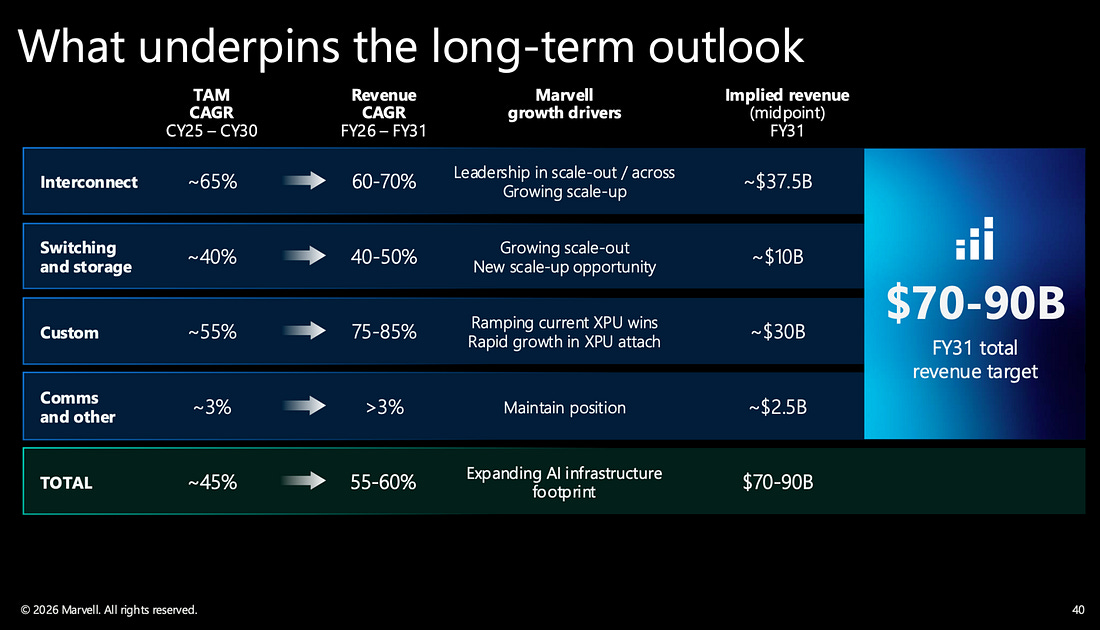
Source: Marvell Investor Day, slide 40

This is consistent with management’s commentary. Interconnect revenue grows in line with its ~65% TAM CAGR, so share holds at just under 60%; Matt Murphy said he expects scale-out and scale-across to grow with their markets without losing share.
Custom is where Marvell is underwriting share gains, roughly doubling from ~6% to ~13%. Switching and storage edges up to ~12%, with switching expected to grow faster than the combined segment.
Overall, Marvell goes from ~14% to ~20% share of its addressable market.
Interconnect
 Subscribed
Scale-across: Marvell highlighted DCI demand drivers including power efficiency (the shift from boxes to pluggables), data center densification (more fibers and connections, and shorter distances between data centers), and higher line-system density to increase fiber capacity.
The company expects significant growth in coherent pluggables, with units expected to grow from ~1M units in CY26 to ~3M units in CY30. DCI revenue is expected to grow from about $500m in FY26 to comfortably above $1b in FY28, with a path to several billion dollars in FY29–FY31. This outlook provides a positive read-across for Ciena and Nokia.
Scale-out: This remains the largest and fastest-growing part of Marvell’s interconnect business. The company highlighted sustained growth across its PAM4 DSP portfolio, with continued strength in 800G, a strong 1.6T ramp and 3.2T products in development. Marvell expects to grow with the market and maintain its share. Management noted that the move from 800G to 1.6T and then 3.2T increases both ASPs and unit demand.
Scale Up: Scale-up optics starts from effectively no revenue today and is expected to reach several hundred million dollars next year before ramping further. Management sized content at thousands of dollars per XPU, with optics needed at both the XPU and switch ends of the link. Scale-up carries ~85% of data center traffic, and copper reach at 200G per lane is only ~2.5 meters, so multi-rack scale-up domains (512–576 XPUs and beyond) require NPO or CPO rather than pluggables.
Marvell is pursuing three routes and says it has wins in all three: drivers and TIAs sold to module makers; “fast pipe” 200G/400G light engines; and “flat pipe” light engines that remove the DSP for lower power and latency, based on the OCI MSA standard and Celestial AI’s Photonic Fabric. Flat pipe wins include leading hyperscalers.
Marvell is also building its own scale-up switch with an integrated optical engine, the same model as Broadcom’s Tomahawk + CPO but using NPO. Our checks indicate that the lead customer for this is AMD. Marvell is a merchant optics supplier into scale-up, but it is also competing for the switch socket itself, and the optics attach then comes with it (see Scale-up switching below). Our channel checks also indicate Marvell and AMD are collaborating on scale-up, with AMD testing a next-generation Helios rack using Marvell’s 6.4T NPO engines in both the compute trays and the scale-up switches, work that remains at an early stage but is ongoing. Marvell is agnostic between NPO (field-replaceable) and CPO (lowest power and latency), and says both are being deployed. TIAs and drivers for scale-up should begin a significant ramp next year, and the analog business is heading towards >$1b of annual revenue.
Scale In: Marvell highlighted its investment in new technologies including µLED, µVCSEL, and the eventual move from electrical SerDes to optical I/O chiplets and extending the reach to 1.5m+. Management said scale-in revenue could begin within the forecast period and become another major source of connectivity growth. Marvell left scale-in out of the $70–90b FY31 target because no scale-in program has been awarded yet. We previously wrote in our scale-in note from early September that scale-in volumes may start in 2028-29. That view was always conditional on an award, and a 2028-29 start can still happen even though management’s model leaves it out. If Marvell wins this business, it represents upside to the 2030 guide.
Custom
Marvell’s custom silicon roadmap helps hyperscalers move from merchant silicon to semi-custom and fully custom AI infrastructure.
Marvell raised its FY29 custom revenue outlook to >$12b (from >$10b) and set an FY31 midpoint of ~$30b, which it expects to be broadly balanced between XPU and XPU attach (~$15b each). Management said existing customers and programs can deliver these targets without a new mega-socket win, and the model includes only part of the Google opportunity ($120b over 6.5 years), reflecting the most probable outcome rather than the maximum case.
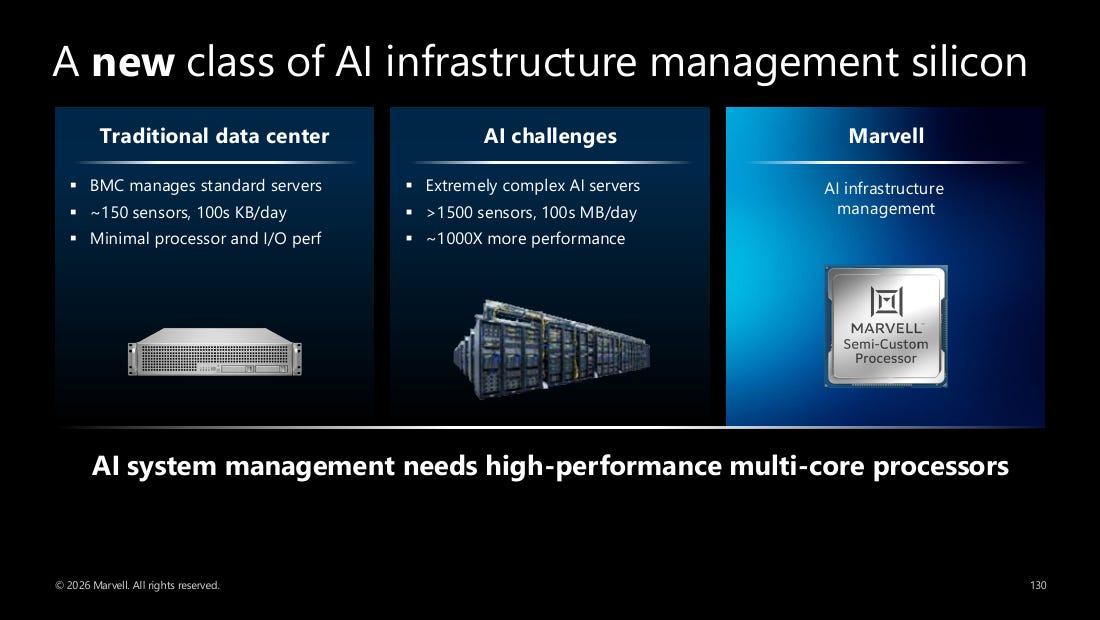
XPU attach covers the chips that sit around the XPU: NICs, memory expansion, storage controllers and accelerators, and now two new categories Marvell calls AI infrastructure management and inference offload.
In a full custom XPU the customer contributes much of the architecture. Attach products, by contrast, start from Marvell’s own merchant IP. Murphy described these programs as proprietary and sole-source with Marvell IP at the core. In some cases Marvell does the entire design to a customer specification, which he called “build-to-spec.” The IP is already proven: Marvell has shipped millions of NICs, Bravera SSD controllers and storage accelerators to hyperscalers, and its OCTEON technology dates back to 2005. Reusing this IP also shortens time to market. Murphy said attach designs can be adapted quickly from cores customers may already use, while a new XPU on a new process and package takes longer.
When Marvell introduced XPU attach last year, some investors read it as a fallback for not winning enough XPUs. Management now expects attach to be roughly half of the ~$30b FY31 custom target.
Source: Marvell Investor Day, slide 130

Source: Marvell Investor Day, slide 131
AI infrastructure management: AI servers carry more than 1,500 sensors (versus ~150 in a traditional server) and need ~1,000x the management performance, and a single XPU failure can disrupt thousands of XPUs. Marvell has programs with multiple hyperscalers for a semi-custom processor based on its OCTEON technology and 5nm IP, replacing the role of the traditional BMC. The market may read this as negative for Aspeed, a dominant BMC supplier in Taiwan.
Inference offload: Specialized co-processors attached to the XPU to offload specific inference workloads. These are large, leading-node devices; Marvell is working with several customers and is leveraging its SerDes, die-to-die links and custom SRAM.
Switching and Storage
Switching and storage is guided to a ~45% revenue CAGR, reaching ~$10b at the FY31 midpoint. Switching is expected to grow faster than the segment as a whole.
Scale-out switching: All switching revenue today is scale-out. The business is doubling this year and should more than double next year to well above a $1b annual run rate, driven by the 51.2T ramp, with a path to several billion dollars. The new flagship Teralynx T100 is a monolithic, reticle-sized 100Tbps switch with 512 lanes of 200G SerDes. Marvell claims at least 20% lower latency and lower power than competing products, and expects the T100 alone to add several billion dollars of annual revenue over time. Because it is monolithic, the same device can serve both scale-out Ethernet and scale-up.
Scale-up switching: Revenue is effectively zero today, but management sees a separate multibillion-dollar annual opportunity. Marvell is covering every protocol: ESUN (E115, with 230T and 460T to follow), UALink (U115 releasing next year for a leading hyperscaler, followed by U230 and U460) and NVLink through the Nvidia partnership. As in optics, Marvell supports multiple options and lets customers choose.
The segment target implies a very steep switching ramp. If storage grows at high single digits from ~$1.3b in CY25, it reaches only ~$2b by FY31, leaving switching to deliver ~$8b from ~$0.3b in CY25.
Financial Forecasts
Marvell’s latest guidance brings its numbers closer to our model, which is largely unchanged. We raised our DCI and switching estimates after management said each business would generate revenue “comfortably” and “well above” $1b, respectively, next year.
We lowered our 2028 EPS forecast slightly, mainly because we raised the effective tax rate from 13% to 15%, in line with management’s long-term guidance.
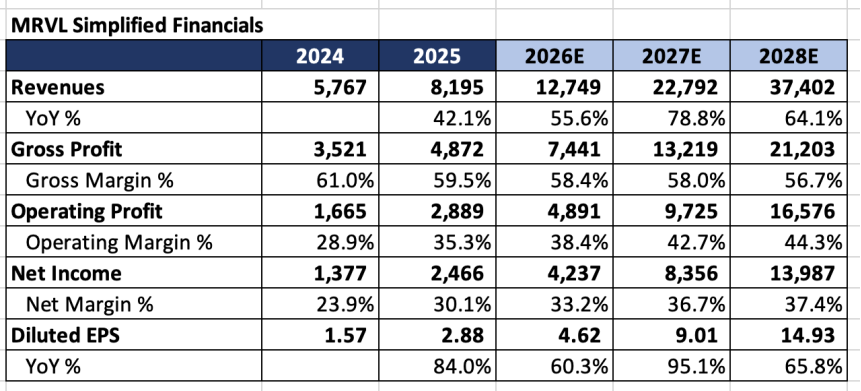
Source: Company documents, FUNDA estimates
Disclaimer and Terms of Use
Analyst Independence Statement
The views expressed in this report accurately reflect the personal and independent views of the analyst(s) regarding the securities and issuers discussed herein. No part of the analyst’s compensation was, is, or will be directly or indirectly related to the specific recommendations or views expressed in this report. The Company adheres to strict compliance procedures to ensure the integrity, security, and legality of the data sources and information utilized.
About FUNDA
Consensus AI Technology Pte. Ltd. (the “Company” or “FUNDA”) is an independent research firm incorporated in Singapore. The Company is not affiliated with any securities dealer, investment bank, or asset management firm, nor is it registered as an investment advisor or broker-dealer in any jurisdiction. The Company does not have any investment banking or underwriting relationship with the companies covered in this report, and does not accept sponsorship or funding from publicly listed companies.
No Investment Advice and Report Neutrality
The contents of this report and the information contained herein are for informational purposes only and do not constitute investment advice or a basis for business decisions. The views expressed herein represent solely the personal opinions of the respective authors at a specific point in time and do not reflect the position of FUNDA. As an independently operated platform, FUNDA maintains a neutral third-party status and makes no express or implied warranties regarding the accuracy, completeness, or applicability of such views.
No Offer or Solicitation: This report does not constitute an offer, solicitation, recommendation, or advice to buy, sell, or hold any securities or financial instruments, nor does it provide any legal, tax, or accounting advice.
Third-Party Data: All third-party data cited in this report is derived from public or authorized sources. The Company makes no representations or warranties, express or implied, as to the accuracy or completeness thereof.
Non-Participation in Decision-Making: The Company does not participate, directly or indirectly, in the investment decision-making process of its clients or readers. Readers should make independent investment decisions based on their own investment objectives and financial circumstances, and consult professional financial or legal advisors prior to executing any transactions.
Timeliness Statement
Given the rapid changes in market environments and technological trends, this report reflects market conditions as of the date prior to its publication. Relevant information may become outdated over time. FUNDA has no obligation to update the contents of this report in real-time.
Intellectual Property, Confidentiality, and Restrictions on Commercial Use
All reports, data, models, and content provided by the Company constitute its exclusive proprietary intellectual property and are protected by copyright and intellectual property laws.
Ownership of Rights: Unless otherwise expressly stipulated in a written agreement, all intellectual property rights (including copyrights) arising from or relating to this report are exclusively owned by the Company.
Authorized Use: Institutional clients may use this report internally within the scope permitted by their internal compliance policies; however, disclosure or sharing with any third party is strictly prohibited.
Prohibition on Commercial Use: Without the prior express written consent of the Company, no individual or entity may reproduce, republish, distribute, resell, repackage, or otherwise use this report or any part thereof for any commercial or profit-making purpose.
Legal Recourse: The Company reserves the right to pursue all available legal remedies and claims against any unauthorized commercial use, redistribution, or infringement of its intellectual property rights.
Forward-Looking Statements and Disclaimer
This report may contain forward-looking statements, including forecasts, estimates, and analyses of industry trends. Such statements are subject to risks and uncertainties that may cause actual results to differ materially from those anticipated. The Company shall not be liable for any direct, indirect, or consequential losses arising from the use of or reliance on the contents of this report.