2026.10.07 | Substack | Optical | OCS Content per Accelerator Grows
原标题:Deep|Optics: OCS Content per Accelerator Grows with Each Generation as Demand Widens Beyond Google
A year ago, optical circuit switches were mostly a Google program with one outside supplier shipping under $10m a quarter. Lumentum now expects its September-quarter OCS revenue to exceed $100m, and we believe its OCS revenue will pass $2.5b next year. TPU 8i put OCS ports into inference pods for the first time and the 6D torus would give the next training chip four times as many OCS ports as today.
Demand for OCS is widening beyond Google. We expect Nvidia to adopt OCS once their scale-up domains pass eight racks, from late 2028. We see more than $20b a year of OCS demand by 2030. Lumentum leads merchant OCS shipments today, and Coherent is the other US-listed supplier. Google remains the only hyperscaler confirmed to buy OCS and nothing at Nvidia is in production yet.
An OCS connects one fiber to another with a mirror, a liquid crystal cell or a chip and leaves the light untouched. With no transceiver and no DSP inside it, the same switch works at 800G, 1.6T or 3.2T and uses about 80% less power than a packet switch on Lumentum’s figures. Google has run OCS in their datacenter network for a decade and in their TPU pods since TPU v4. Until last year they built almost all of their switches themselves. Below is an illustration from Lumentum of how an OCS can fit within a datacenter.

Image 1: Four uses of OCS in AI datacenters, DCN spine replacement, DCI, scale-out topology reconfiguration and scale-up. Source: Lumentum.
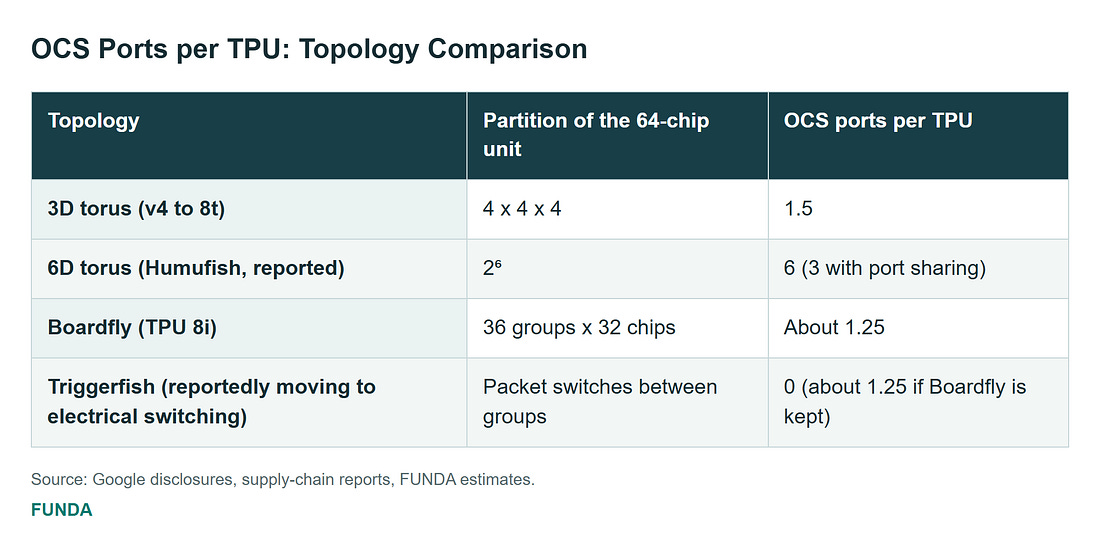
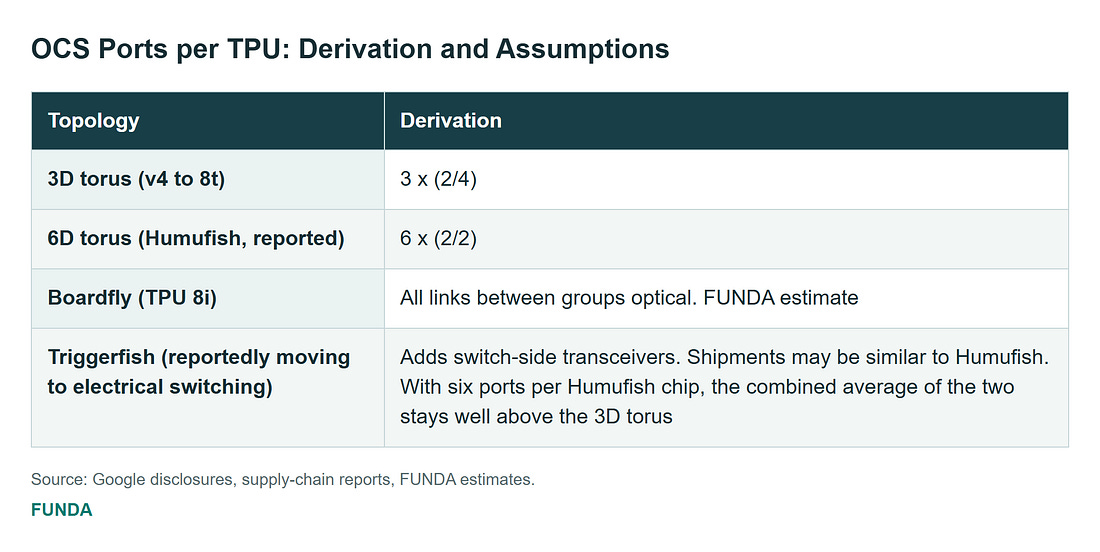
A TPU in Google’s 3D torus has 1.5 OCS ports. Google’s inference pods had none until TPU 8i, which links 36 groups of chips through OCS at about 1.25 ports per chip. The 6D torus reported for the next training chip would take the count to six ports per chip from 2027, or three if two transceivers share a port. Nvidia has no OCS in production. Direct fiber links tie up to eight racks together. Beyond eight racks, our model gives each GPU four ports, $800–1,200 of content at $200–300 a port.
Some of this is already in reported numbers. Lumentum targets $400m of OCS for the second half of 2026 on a backlog from three customers. Coherent doubled its addressable market estimate to $4b by 2030 between February and March. Nvidia took part in iPronics’ $125m round on September 2.
We attended ECOC in Málaga in late September and met with teams from Oriole Networks, Salience Labs, iPronics, LightDance and others. OCS was one of the topics discussed during the week. This note updates the OCS market outlook and presents both the bull case and the pushback we heard from the industry.
The companies discussed in this report include:
- Lumentum
- Coherent
- Huber+Suhner
- Nvidia
- Broadcom
- Marvell
- Astera Labs
- Arista Networks
- Ligent
- nEye (private)
- iPronics (private)
- Salience Labs (private)
- LightDance (private)
- Oriole Networks (private)
Three key takeaways
Google is buying more OCS and, from 2027, most of it externally. TPU shipments roughly double from 2026 to 2027, inference pods now use OCS and Lumentum expects to pass Google’s own line as the number one supplier in early 2027. We think Google’s demand reaches above $4b in 2027, 3 to 4x the 2026 level.
We expect Nvidia to adopt OCS once scale-up passes eight racks, from late 2028. At four ports per GPU, $200–300 a port and about 10 million Rubin Ultra and Feynman GPUs, that is high single-digit billions to $10b a year at maturity.
 Subscribed
Free-space switches supply the market through 2027 and Lumentum leads the shipments. MEMS has the longest record in large deployments and Lumentum says they are the only merchant supplier with a track record at a large OCS user outside contract manufacturing. Besides Ligent, LightDance’s partner which went public on September 22, none of the silicon photonics startups that come in-rack after 2027 are publicly listed.
The risks are link recovery and demand outside Google. Transceivers take hundreds of milliseconds to relock and no hyperscale deployment outside Google has been disclosed. The electrical switching reported for Google’s next inference chip would remove far fewer ports than the 6D torus adds (see “Counterarguments and Our View”).
What is an OCS and what does it do?
An OCS connects any input fiber to any output fiber on demand with a tiny mirror, a liquid crystal cell or a switch on a chip. It sets up a path and the data passes through untouched. An electrical packet switch (EPS) reads every packet and decides where to send it. Lumentum’s R64, a 64 x 64 switch, moves more than 100 Tbps on less than 150 W, about 80% below a packet switch.
Its limits are that it cannot route packet by packet and that every stage adds insertion loss. The free-space switches in service add about 1.5 to 3 dB per stage. Silicon photonics designs add considerably more depending on the device, the port count, and just how stages are cascaded. At the Optica forum alongside ECOC, Lumentum’s CEO said OCS will not replace every packet switch. Switching inside the rack and at the top of the rack stays electrical.
Google remains the reference customer and uses OCS for three things. The first is to match the cluster to each job. Its superpods have done that with OCS since TPU v4. The TPU v4 paper puts the OCS and its optics at under 5% of system cost and under 3% of system power and compares 568 InfiniBand switches with 48 OCS to network 4,096 chips.
The second is fault tolerance. A failed chip is taken out of the network, a spare node is assigned and the job resumes from a checkpoint. Google described that for TPU 8t at Hot Chips in August. Lumentum’s CEO said a large training run costs $25–30m and cannot be allowed to fail.
The third is the spine. When Jupiter replaced its packet-switch spine with high-radix OCS, Google reported 41% lower power, 30% lower capex and a fivefold rise in speed and capacity. The uses split by network layer into scale-up, scale-out and scale-across. This note is about scale-up.
Technologies and switching time
Google’s MEMS switch Palomar has run in its datacenter network for more than a decade. Coherent announced its first OCS in 2024 and Lumentum its R300 in March 2025. OCP started an OCS sub-project in July 2025 and published a white paper in April 2026.
MEMS (Google and Lumentum), liquid crystal (Coherent) and piezo actuators (Huber+Suhner’s Polatis) all steer light through free space, offer hundreds of ports and switch in milliseconds. We call them free-space switches. Silicon photonics switches put the switch on a chip with no moving parts and switch well under a millisecond. Insertion loss caps their port count, and the products shown at ECOC were 32 x 32 or 64 x 64.
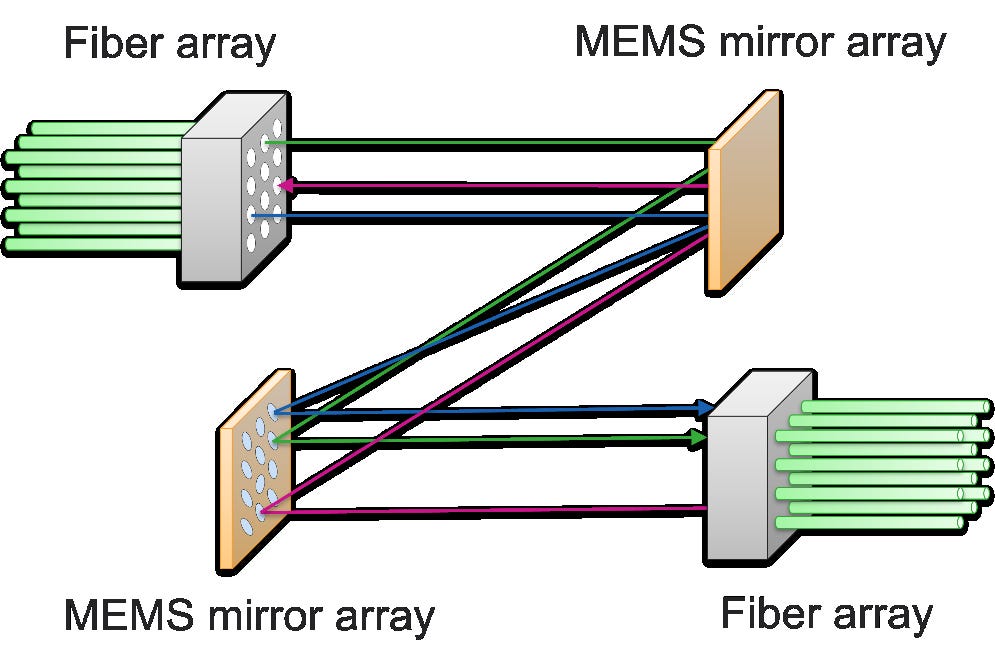
Image 2: How a MEMS OCS works. Beams from fiber arrays are steered in free space by two micromirror arrays. Source: Lumentum.
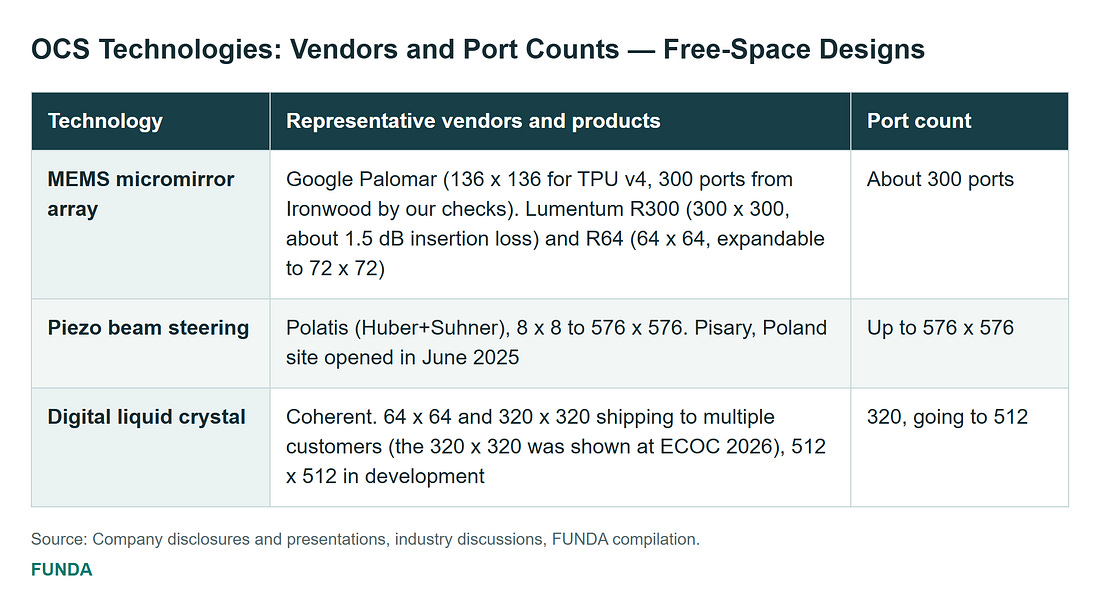

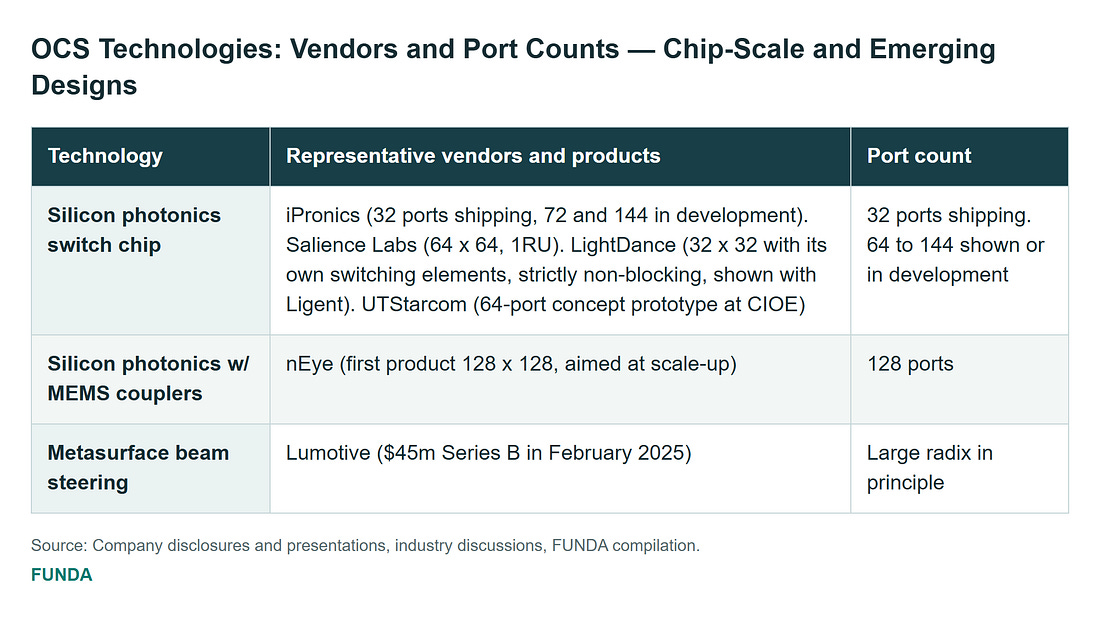


Image 3: Coherent’s digital liquid crystal OCS (64 x 64 and 320 x 320 shipping to multiple customers, 512 x 512 in development). Source: Coherent.
The trade-offs are port count, switching speed and insertion loss. MEMS has the most even balance of the three and the longest record in large deployments. Liquid crystal and piezo vendors sell on reliability and come with higher loss or cost. Silicon photonics leads on density and speed but loses on insertion loss.
Switching time has two parts. The device itself changes in milliseconds for free-space designs and in microseconds or less for silicon photonics, under 10 µs by LightDance’s account. The transceiver then has to relock. On conventional links that takes several hundred milliseconds, and it sets the limit on what a faster switch can deliver. Oriole’s math is that a link that needs 100 milliseconds to come back has to send about a second of data at a time, too coarse for inference.
The speed a switch needs depends on how often the network gets reconfigured. Oriole cited a Google network talk that put it at two or three times a day. Salience says the paths are set when a job is mapped onto the cluster and left alone while it runs so tens of milliseconds is fast enough.
LightDance showed a 32 x 32 silicon photonics switch at ECOC with Ligent, the former Hisense Broadband that listed in Hong Kong on September 22 while ECOC was ongoing. The two co-develop for scale-up and scale-in networks. Ligent takes charge of the NPO and the optical engine, and LightDance of the OCS chip and system. The next device pairs a lower-loss platform with a phase-change material that LightDance says uses mature processing and will not need calibration.
Every OCS adds loss to the link that runs through it, about 2 dB at Google’s Palomar and 1.5 dB at the R300. Today’s 200G-per-lane links absorb that. At 300G and 400G per lane the margin runs out. The way to keep the link working through the switch is with coherent-lite technology. Our June note expected Google’s 2.4T transceiver generation to start adopting coherent-lite in 2027 and the 3.2T generation to switch over around 2028. This requires a new DSP and transceiver design. Marvell and Broadcom supply the custom DSPs on Google’s OCS links today and we expect them to be first in line for the next one.
Coherent argues for pairing OCS with coherent-lite as well. Eight wavelengths at 1.6T each put 12.8T through one OCS port against 3.2T today. That cuts the port count by a factor of four and raises the value of each port. Their example prices a port at $400. Cignal AI’s ECOC slides point the same way, more bandwidth per OCS port. Transceivers with several wavelengths on one fiber need high-power lasers that Lumentum and Coherent sell.
LightDance said LPO is not enough for links that run through its switch and pointed to NPO, CPO or higher-power transceivers. Low latency comes first in their view.
Which switch goes where?
Scale-out connects thousands of endpoints and needs a high port count. Scale-across runs over long fiber spans between buildings and campuses so low loss comes first. Both tolerate the slow reconfiguration of free-space switches. Scale-out has production deployments, above all Google’s Jupiter. We have not found a verifiable large AI deployment of OCS in scale-across yet. Industry sources tell us Google needs OCS for DCI, which Nvidia calls scale-across.
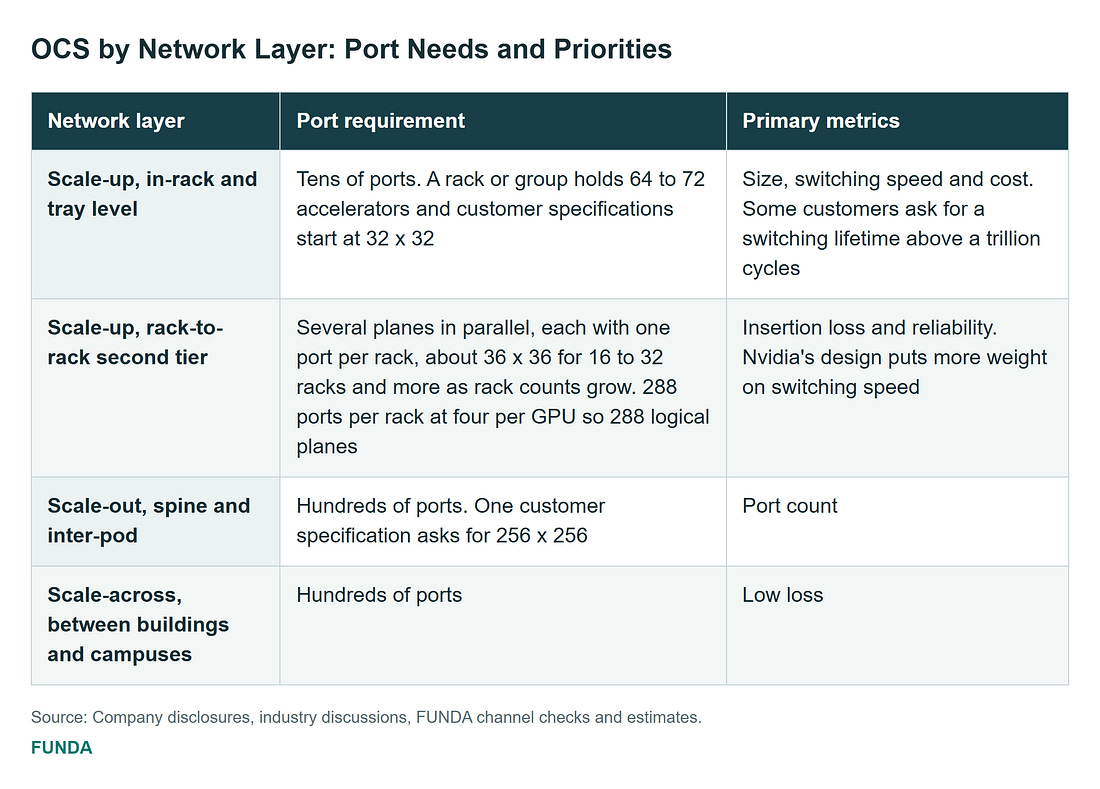

Lumentum’s CEO said the densest sites have about one OCS for every 10 racks and that the industry is working toward one per rack. That switch would sit beside the packet switches and steer traffic away from a failed or overloaded accelerator. It would mean 10x as many switches in the same site. Lumentum calls this additive to its market and is planning products with higher and lower port counts.
One vendor told us switching time is the first thing customers at this level test. Salience Labs sees scale-up as the likely first use for their switch.
The scale-up OCS in production today are MEMS, both at Google and at the other scale-up customer Lumentum’s CEO described. Coherent also reports active engagements with scale-up customers. A 36-port rack-to-rack switch is within reach of silicon photonics. It becomes a volume market once large buyers commit to OCS inside the rack and transceivers relock fast enough.
Further out is scale-in, the optical links to memory inside the tray. Our February note covered OCS for memory pooling and scale-in would add OCS demand we cannot size yet. LightDance expects their second-generation chip to work with VCSEL links as well as the O and C bands.
From the 3D torus to Boardfly and 6D
Google is the only customer publicly confirmed to run OCS across several generations of production systems. In TPU v4, the links inside a 64-chip block are copper and the links between blocks go through the OCS, 1.5 OCS ports per chip.
Ironwood (TPU v7) grew a single superpod to 9,216 chips and by our checks moved to 300-port switches. The eighth generation, announced in April 2026, splits training and inference into two chips.
For scale-up, TPU 8t keeps the 3D torus and grows a superpod to 9,600 chips. Google said at Hot Chips that this fills 300 racks, 32 chips per rack. The 64-chip block no longer fits in one rack.
For scale-out, Google describes Virgo as a packet network that links 134,000 TPU 8t chips in one fabric. Google does not say what role OCS has in Virgo.
TPU 8i rebuilds the network inside the pod around Boardfly. Chips are wired over copper into groups of 32 and OCS then connects 36 groups, 1,152 chips, into a pod with up to 1,024 of them active. The longest path between two chips falls from 16 hops in a 3D torus to 7. Inference needs chips to reach each other fast and Credo’s slide at the “slow and wide” workshop during ECOC called the torus hops a latency tax.
The bigger change is that inference pods have OCS for the first time because the previous 256-chip inference pod was copper only. Every link between groups in TPU 8i is optical. We estimate about 1.25 OCS ports per chip below the 1.5 of the 3D torus but all of it new.
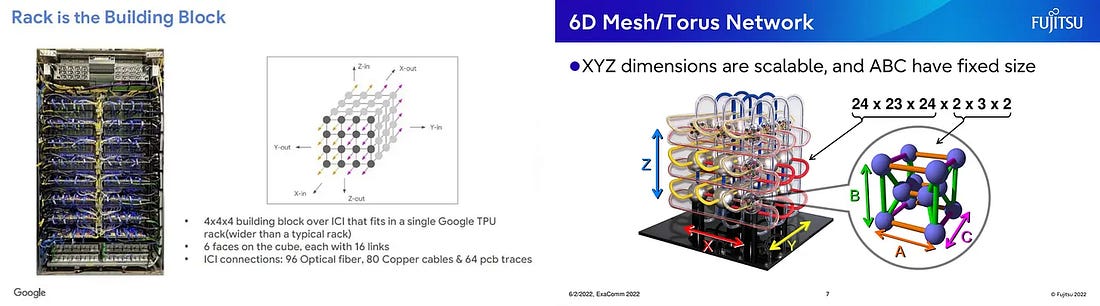
Image 4: TPU’s 64-chip 4 x 4 x 4 unit (96 fibers, 80 copper cables and 64 PCB traces, derived from Google’s description) and an engineering precedent for a 6D mesh and torus, Fujitsu’s Tofu-D. Sources: Google, Fujitsu.
Supply chain reports point to six dimensions in the training torus and deployment in 2027 and 2028. Six dimensions means up to six OCS ports per chip against 1.5 today. The longest path between chips halves.
Six dimensions do not have to mean six OCS ports per chip. One option under discussion has two transceivers share each OCS port. That cuts the count to three OCS ports per chip, twice the 3D ratio, and keeps four times as many transceivers as 3D. More of the value then goes to the transceivers.
We expect Humufish to use the 6D topology and to account for about 20% to 30% of TPU shipments in 2028. Our checks indicate system cost is the main constraint, and the design is not final.

Image 5: Lumentum’s OCS port to xPU framework from OFC 2026, scale-up at 1.5:1 today and 2:1 to 10:1 in future, spine and super-spine at 0.2:1 to 1:1. Source: Lumentum.
External sourcing and Lumentum’s position
Until last year, Google built almost all their OCS themselves. They designed the mirrors, bought the other components and contracted out the assembly. External sourcing has risen fast since and Lumentum leads in large AI OCS deployments. On the August earnings call, their CEO called Lumentum the only merchant supplier of OCS today and said no one else has a track record outside a contract manufacturing relationship with a large OCS user.
We believe Google’s total OCS demand in 2026 is about $1–2b including what they build themselves. Outside purchases are a few hundred million dollars, almost all from Lumentum. Cignal AI’s forecast of more than $8b in 2030 at a compound growth rate above 30% implies a 2026 market of $2–3b and says near-term revenue is concentrated at Google. Coherent and Huber+Suhner are both chasing Google’s business and we have not confirmed an order for either.
We think Lumentum’s 2026 OCS revenue is about $500m. Little of it falls in the first half and the target for the second half is $400m. Their CEO said in August that some customers in their early rounds of shipments were much more substantial than Google. We believe shipments to Google come to a few hundred million dollars.
Our channel checks indicate Google’s total demand reaches 3 to 4x their 2026 level in 2027, above $4b, and rises again in 2028. We believe Lumentum can supply about half of that, more if you leave out what Google builds internally. Lumentum’s CEO expects to cross over in early 2027 as the number one supplier to a customer that has an internal source and we read that customer as Google. If Lumentum alone passes the internal line, outside suppliers together hold more than half of Google’s OCS from then on. We think Lumentum’s OCS revenue passes $2.5b in 2027 once other customers are added.
Both TPU 8t and 8i run on MEMS switches and the port counts are not yet confirmed. Vendor shares mainly track each product’s progress through qualification and rollout. Our channel checks indicate the v9-generation switches come in two configurations, 320 x 320 called Super and 160 x 160 called Dense.
Google’s OCS opportunity comes down to three numbers, how many TPUs ship, how many OCS ports each one needs and how many of those ports Google buys outside.
Triggerfish
Triggerfish is an upgraded v9-generation chip based on Humufish with more on-chip SRAM and more HBM. It is aimed at inference, reinforcement learning and agent workloads. Production starts in late 2027 and ramps in 2028. Our channel checks say it is designed to Anthropic’s requirements.
In mid-September, industry chatter had its interconnect inside the pod moving from Boardfly’s OCS-linked groups to electrical switching. One version named an upgraded Astera Labs Scorpio-X switch at 336 Gbps per lane, another named Marvell. None of it is confirmed. Some observers took this to mean OCS does not suit inference and Google is moving away from it.
On its September 2 call, Broadcom said they expect Anthropic to deploy 5 gigawatts of TPU 8i in 2027 and to become their largest XPU customer that year. Google has not said whether those clusters use their OCS design, and people at Broadcom and Arista told us they could not share details of Anthropic’s infrastructure.
We treat this as a rumor; it is too early to draw a conclusion. The design is not final and Google has said nothing. We expect Triggerfish to take about 20% of TPU shipments in 2028 and Humufish about 20% to 30%. If Humufish adopts 6D, the ports added on the training side far exceed what Triggerfish removes by going electrical. The net gain stays positive even if the final design has two transceivers share each OCS port.
Even if Triggerfish goes electrical, TPU shipments roughly double from 2026 to 2027. Twice the chips at a lower average ratio still means more ports. With OCS in inference pods and the higher ratios from 6D, total OCS demand reaches 3 to 4x the 2026 level.
Electrical switching cuts OCS ports but adds transceivers. An OCS link needs a transceiver at each end and nothing inside the switch. A packet switch between the groups needs transceivers at its own ports as well, so the count roughly doubles. The mix also shifts from the single-fiber modules on OCS links to conventional two-fiber transceivers.
Nvidia
Nvidia and OCS
Nvidia already has co-packaged optics in production on their network switches, Quantum-X Photonics for InfiniBand and Spectrum-X Photonics for Ethernet. Its public roadmap has no OCS on it. We read that roadmap as the plan up to eight racks.
Our June and September supply chain work says NVL576 uses near-packaged optics (NPO) for the rack-to-rack optical links with four 3.2T optical engines per GPU and that CPO on NVLink switches does not reach scale-up before the Feynman generation.
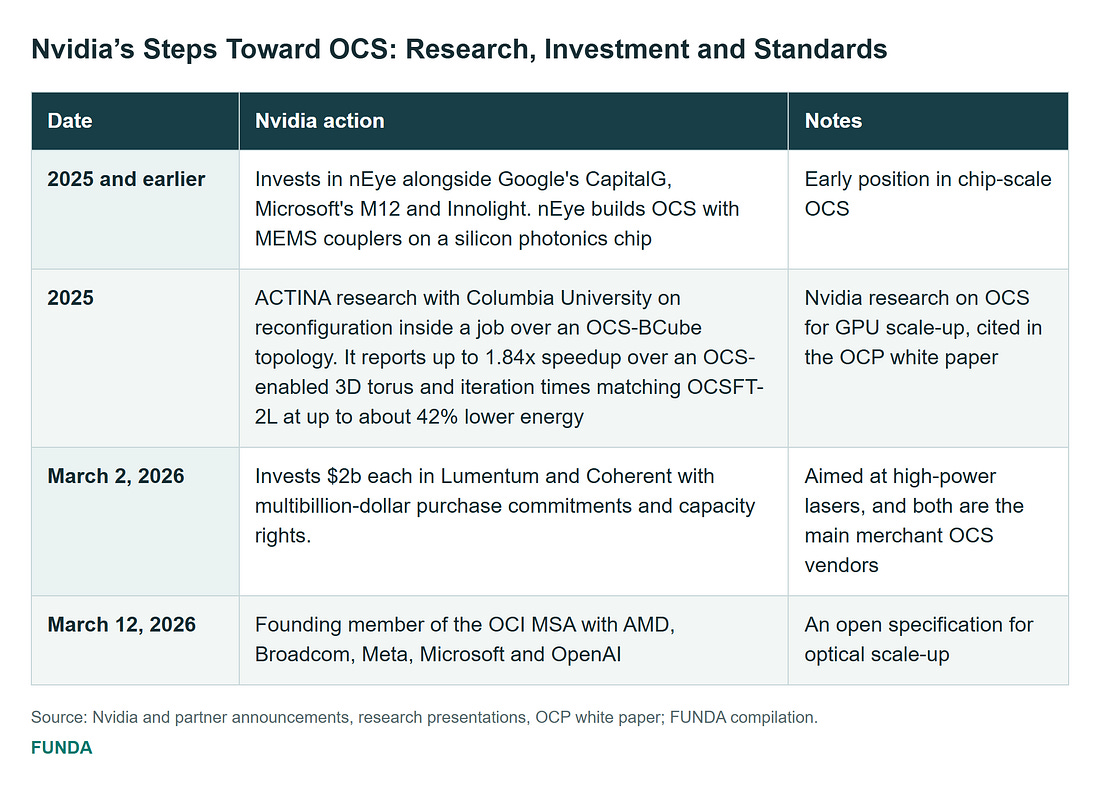
Nvidia has spent two years on OCS research, standards work and investments, including stakes in two silicon photonics OCS companies, iPronics and nEye.
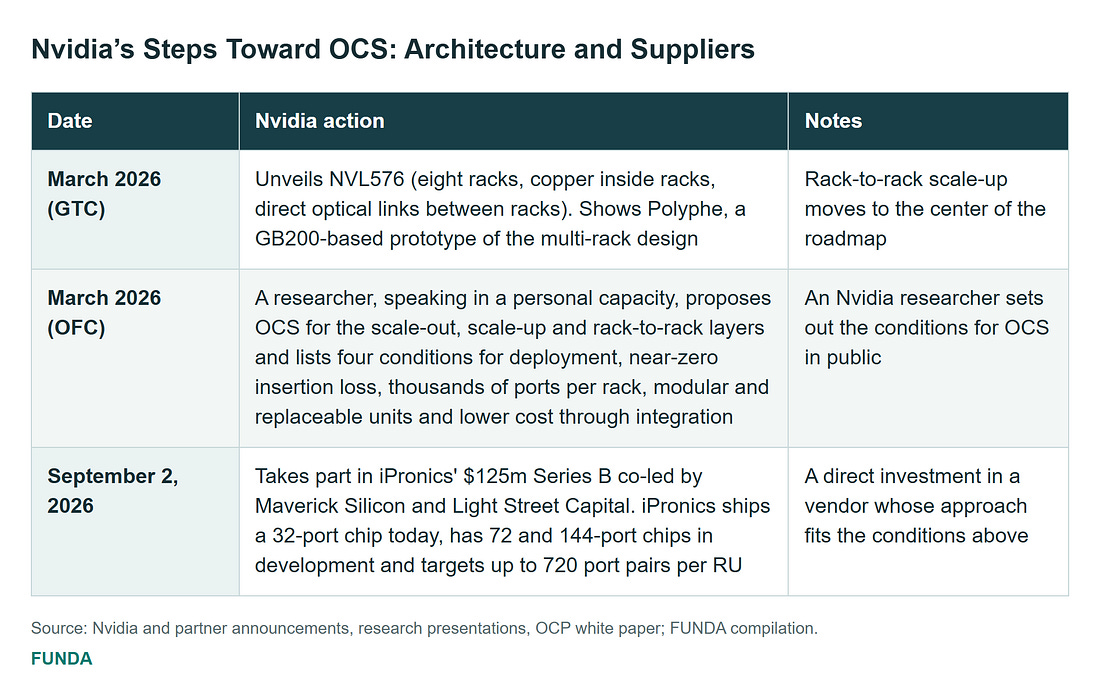
NVL576, eight racks with direct links
NVL576 is eight NVL72 racks, each with 72 Rubin Ultra GPUs. Nvidia describes copper inside each rack and direct fiber links between every pair of racks. We read that as no second switching tier.
Each GPU has about 12.8T of off-rack optical bandwidth, four 3.2T NPO optical engines. We start from one OCS port per NPO engine, four per GPU. The real ratio depends on Nvidia’s final design.

Image 6: Nvidia’s Polyphe prototype, a GB200-based multi-rack NVL576 system with copper inside racks and fiber between them. Source: Nvidia.

Image 7: NVL576’s eight-rack direct connection and a schematic of OCS as the second tier of rack-to-rack connectivity beyond eight racks. Sources: Nvidia (NVL576), FUNDA channel checks (OCS beyond eight racks), Lumentum public comments. Compiled by FUNDA.
OCS beyond eight racks
Our channel checks say Nvidia will bring in OCS as a second tier between racks once scale-up grows past eight racks. Lumentum’s public comments on OCS inside GPU racks point the same way.
The number of rack pairs in a full mesh grows with the square of the rack count, 28 pairs for eight racks, 120 for 16 and 496 for 32. With fixed bandwidth per rack, the bandwidth per pair falls as racks are added. Direct links get hard to cable at 16 or 32 racks and reconfigurable connections become necessary. Adding a packet switch tier would add power and forwarding latency, while an OCS avoids packet processing and queuing once the circuit is up.
The trade-off is reconfiguration time. Today’s MEMS switches change in about 10 to 50 milliseconds, enough for rack-to-rack topologies that stay put. Finer-grained dynamic connections need faster optical switches.
Another view is that Nvidia would use OCS mainly for dynamic partitioning, carving a large domain into clusters of different sizes on demand. Lumentum counts partitioning and routing around underperforming accelerators as new use cases. We see the larger driver in Nvidia’s need to grow scale-up past eight racks with OCS as part of the topology.
We expect NVL576 shipments to start in the second half of 2027 with deployments in 2028. NVL1152 is due in 2028 and domains beyond eight racks from late 2028. That fits Lumentum’s expectation of a lot more OCS by late 2028 or early
- For Lumentum, the opportunity extends their existing OCS hardware. Nvidia’s supplier mix is not settled. We expect
Lumentum and Coherent to supply the first deployments on port count and reliability and silicon photonics vendors to come in with later generations that need more density and faster switching.
Market sizing on OCS ports per GPU
Our first model assumes one OCS port per NPO optical engine, four OCS ports per GPU. At $200–300 a port, that is $800–1,200 of OCS content for each GPU in a domain that uses OCS. At 50% to 100% of GPUs in such domains, that is $400–1,200 per GPU across the shipment base. We count GPU packages in line with the 72 GPUs per rack in NVL576.
For sizing, we assume about 10 million Rubin Ultra and Feynman GPUs in 2028. That is a model input, not a shipment forecast. The sensitivity range is $4–12b and our central case is high single-digit billions to $10b a year once deployment matures.
This is a mature-deployment number. Revenue in any year depends on shipments and on a rollout that starts in late 2028 and ramps in 2029.
The four OCS ports per Nvidia GPU against a blended 1.5 per Google TPU today is the assumption behind most of the Nvidia opportunity. At $200–300 a port, a 3D-torus TPU holds $300–450 of OCS content and a six-port 6D chip $1,200–1,800.

Image 8: OCS ports per accelerator (Nvidia is a model assumption). Sources: Lumentum, Google, FUNDA estimates.
How big is the OCS market?
Market estimates differ in scope and timing. Published figures for the OCS market later this decade run from Coherent’s serviceable market above $4b by 2030, through more than $8b at Cignal AI and in Lumentum’s own TAM, to sell-side estimates above $10b reported in the press. We believe it is above $20b. Cignal AI’s July summary also says Google’s OCS development is shifting to third-party vendors, the sourcing shift discussed under “External Sourcing and Lumentum’s Position”.
Our customer-level estimates put Google’s demand at about $1–2b in 2026 including in-house builds, above $4b in 2027 and higher in 2028. Nvidia’s demand ramps from 2029 and reaches the high single-digit billions to $10b a year once deployment matures. With Google’s growth after 2028 and other buyers, annual OCS demand passes $20b by 2030.


Counterarguments and our view
Six concerns about OCS came up in our discussions at ECOC.
Faster switching does not improve system performance by itself. Transceiver clock recovery and Ethernet link re-establishment take several hundred milliseconds, Oriole’s figure, and Salience calls the coordination between transceivers and the OCS control plane unsolved. That has little effect on free-space switches reconfigured per job or on failure. It does set the timing of the fast silicon photonics switches. They need links that do not depend on relocking, as Oriole’s do, and faster link synchronization.
Demand outside Google. Some at the show called OCS a bubble and fiber suppliers said they had not seen the demand yet. No hyperscale production deployment outside Google has been disclosed and quantified. Oriole is set to deploy their first network with AMD at ARIA and Cignal AI calls TPU networks the only volume application today. Against that, Lumentum ships to three customers. Their CEO said in August that some customers in the early rounds of shipments were much more substantial than Google and that the largest customer had raised its orders very significantly since the earnings call two weeks earlier. Nvidia’s rack-to-rack demand starts in late 2028 and Google stays dominant in 2026 and 2027.
Inference moves to electrical switching and Google leaves OCS. Reports of Triggerfish moving to electrical switching with an Astera Labs or Marvell switch, unconfirmed. Some read Virgo as Google’s first step away from OCS and Arista’s people are not fans of OCS. This remains an unconfirmed rumor; it is too early to draw a conclusion. Google’s published material does not support a broad move away from OCS. TPU 8i’s Boardfly still links 36 groups through OCS. Virgo is a scale-out packet network beside the datacenter network and Google has not described it as replacing OCS. The 6D torus on the training side adds far more ports than inference removes and TPU shipments roughly double from 2026 to 2027. Arista sells the packet switches that an OCS in the spine replaces.
Low barriers to entry. Oriole argues that anyone can design and package a silicon photonics switch from foundry building blocks and says the same of MEMS. Foundries and packaging houses do make prototypes easy and the number of teams with one at ECOC showed it. A product still needs low loss, high port counts, control software that works, reliable operation and customer qualification. Large-radix MEMS is harder. Google spent nearly a decade on their own design and Lumentum had supply chain problems early in their ramp.
No standard optical interface. Nokia says none of the FR, DR or LR specifications fits a link through an OCS. Standardization is under way. Google will present on standard OCS interfaces at the OCP Global Summit on October 15 and tight link budgets also favor coherent-lite.
OCS reduces the need for NPO and CPO. Lumentum’s CEO said one scale-up customer has cut hop counts with OCS far enough that it needs neither NPO nor CPO. It depends on the architecture. Replacing an intermediate packet switch with an OCS removes the switch-side optical-electrical conversions and their optical engines. In our Nvidia rack-to-rack model, GPU-side NPO works with the OCS at one OCS port per NPO engine. Endpoint and switch-side engines count separately. Cignal AI said the CPO they discussed is single wavelength and see NPO as the better fit for scale-up.
Company notes
Lumentum. Adding capacity at contract manufacturers. Planning products with higher and lower port counts and in-tray products around 2028.
Coherent. Customer interest spans scale-up, scale-out and scale-across, including dense switches with a lower radix.
Huber+Suhner. Multi-year orders from a hyperscale customer. The new site in Poland raises capacity at least fivefold within two years.
nEye (private). Out of research at UC Berkeley, where a 2016 paper showed a 64 x 64 switch with 3.7 dB on-chip loss switching under a microsecond. $152m raised in rounds led by CapitalG and Sutter Hill. Nvidia, Microsoft’s M12 and Innolight are among the investors. No customer or production date announced.
iPronics (private). Specifies reconfiguration under 1 ms. $125m Series B in September with Nvidia taking part.
Salience Labs (private). Full reconfiguration under 300 µs with each element under 100 µs, 8 to 16 switches per chassis. Argues for keeping optical paths fixed per workload and sees inference decode as the first target. Expects loss to fall as the process moves from 180 nm to 45 nm.
LightDance (private). Customers in Asia ask about latency first and loss matters most in evaluation.
Oriole Networks (private). PRISM switches in about 10 ns and does not rely on the transceiver relocking. Calls a conventional OCS an automated patch panel. First network with AMD at the UK’s ARIA inference lab, wider rollout planned for 2027.
What We’re Watching
For Lumentum and Coherent, OCS is a new line of business that leaves the transceivers on the link in place. Those links use single-fiber transceivers with circulators, high-power light sources and custom DSPs, 20% to 30% more value than conventional ones. The 6D torus, larger Nvidia domains and more bandwidth per port all lift demand for high-power lasers and external light sources, the products behind Nvidia’s $2b stakes and purchase commitments at both companies.
Google’s move to outside suppliers and Nvidia’s rack-to-rack demand do not depend on each other and in-rack OCS comes on top of both. At Nvidia, the number depends on how many Rubin Ultra and Feynman GPUs ship, how fast rack-to-rack OCS deploys once NVL576 ships and whether Nvidia’s design ends up at four OCS ports per GPU, as per our assumption. NVL576 also multiplies the rack-to-rack fiber and connectors and an OCS layer adds cabling between the racks and the switches.
Google’s OCS demand depends on whether 6D comes with six OCS ports per chip or three with port sharing, on how 2028 shipments split between Humufish and Triggerfish and on whether Anthropic’s TPU clusters keep Google’s OCS design. The outside suppliers’ share depends on how much OCS Google buys outside and who gets the orders after Lumentum.
On the system side, a faster switch is only as useful as the link behind it. A transceiver takes several hundred milliseconds to relock after a switch today, so the fast silicon photonics switches need links that synchronize faster and a control plane that ties the transceivers to the switch. We do not know yet how much of each link’s cost goes to the switch and how much to the transceivers and lasers, or how fast coherent-lite takes over. Our June note put the start at Google’s 2.4T generation in 2027. Google will present on standard OCS interfaces at the OCP Global Summit on October 15. After that, the question for the startups is who goes from demonstrations to volume.
Disclaimer and Terms of Use
Analyst Independence Statement
The views expressed in this report accurately reflect the personal and independent views of the analyst(s) regarding the securities and issuers discussed herein. No part of the analyst’s compensation was, is, or will be directly or indirectly related to the specific recommendations or views expressed in this report. The Company adheres to strict compliance procedures to ensure the integrity, security, and legality of the data sources and information utilized.
About FUNDA
Consensus AI Technology Pte. Ltd. (the “Company” or “FUNDA”) is an independent research firm incorporated in Singapore. The Company is not affiliated with any securities dealer, investment bank, or asset management firm, nor is it registered as an investment advisor or broker-dealer in any jurisdiction. The Company does not have any investment banking or underwriting relationship with the companies covered in this report, and does not accept sponsorship or funding from publicly listed companies.
No Investment Advice and Report Neutrality
The contents of this report and the information contained herein are for informational purposes only and do not constitute investment advice or a basis for business decisions. The views expressed herein represent solely the personal opinions of the respective authors at a specific point in time and do not reflect the position of FUNDA. As an independently operated platform, FUNDA maintains a neutral third-party status and makes no express or implied warranties regarding the accuracy, completeness, or applicability of such views.
No Offer or Solicitation: This report does not constitute an offer, solicitation, recommendation, or advice to buy, sell, or hold any securities or financial instruments, nor does it provide any legal, tax, or accounting advice.
Third-Party Data: All third-party data cited in this report is derived from public or authorized sources. The Company makes no representations or warranties, express or implied, as to the accuracy or completeness thereof.
Non-Participation in Decision-Making: The Company does not participate, directly or indirectly, in the investment decision-making process of its clients or readers. Readers should make independent investment decisions based on their own investment objectives and financial circumstances, and consult professional financial or legal advisors prior to executing any transactions.
Timeliness Statement
Given the rapid changes in market environments and technological trends, this report reflects market conditions as of the date prior to its publication. Relevant information may become outdated over time. FUNDA has no obligation to update the contents of this report in real-time.
Intellectual Property, Confidentiality, and Restrictions on Commercial Use
All reports, data, models, and content provided by the Company constitute its exclusive proprietary intellectual property and are protected by copyright and intellectual property laws.
Ownership of Rights: Unless otherwise expressly stipulated in a written agreement, all intellectual property rights (including copyrights) arising from or relating to this report are exclusively owned by the Company.
Authorized Use: Institutional clients may use this report internally within the scope permitted by their internal compliance policies; however, disclosure or sharing with any third party is strictly prohibited.
Prohibition on Commercial Use: Without the prior express written consent of the Company, no individual or entity may reproduce, republish, distribute, resell, repackage, or otherwise use this report or any part thereof for any commercial or profit-making purpose.
Legal Recourse: The Company reserves the right to pursue all available legal remedies and claims against any unauthorized commercial use, redistribution, or infringement of its intellectual property rights.
Forward-Looking Statements and Disclaimer
This report may contain forward-looking statements, including forecasts, estimates, and analyses of industry trends. Such statements are subject to risks and uncertainties that may cause actual results to differ materially from those anticipated. The Company shall not be liable for any direct, indirect, or consequential losses arising from the use of or reliance on the contents of this report.