2026.10.07 | Substack | Markets | TMTB Morning Wrap
原标题:TMTB Morning Wrap
Good morning. QQQs -75bps / SPY -40bps as higher yields weighing this morning: 10year +6.5bps to 5.35% and 30year +6bps to 5.7% as European yields also up after sliding yesterday. Oil +1% on reports Iran has been increasing attacks in Hormuz
In Tech, Semis -2% leading the way lower with many names down 2-4% across the board. Software/Internet -30bps hanging in better. Not many names up this morning on what’s a fairly slow research/news day.
Stocks in Asia mostly red overnight: TPX -0.7%, NKY -0.92%, Hang Seng -0.62%, HSCEI -0.57%, Taiwan TAIEX -0.03%, Korea KOSPI -1.98%
Let’s get to it….

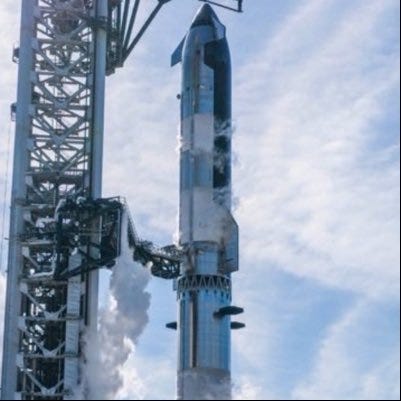
SPCX / NVDA: SpaceX seeks $40B to buy chips led by Apollo – FT
FT reports SpaceX is seeking approximately $10B in bank loans and $30B in investment-grade debt to purchase Nvidia chips, with Apollo expected to lead the financing and Pimco among the lenders in talks. The transaction is expected to close in 2027. SpaceX’s BBB rating opens the deal to insurance and pension investors, although its existing 2056 bonds trade around 85 cents on the dollar amid concerns over debt and capital spending.
MRVL: TD Cowen upgrades to Buy/$350 as connectivity replaces custom XPU as core growth driver
TD Cowen says MRVL’s risk profile has materially improved as growth shifts toward its connectivity franchise and away from concentrated custom XPU exposure; only ~$15B of the ~$80B CY30 revenue midpoint is now expected from custom accelerators, with XPU just ~19% of revenue vs. >40% previously feared. Management targets ~$38B interconnect, ~$10B switching/storage and ~$30B custom by CY30, with FY28 revenue already expected near ~$20B, ~$18B from datacenter. Cowen sees >$30 EPS within three years, upgrades to Buy from Hold and raises PT to $350 from $245.
NTAP: Evercore upgrades to OP/$300, sees conservative FY27 guide + AI/storage driving durable growth
Evercore says NTAP’s ~17% FY27 growth guide embeds an overly sharp H2 slowdown, with normal seasonality supporting low-20s growth and ~$11 EPS vs. Street ~$10. Longer term, AI/storage expansion, Novus/AIDE and operating leverage support a path toward ~$15+ EPS, while high-60s GMs and >32% FY27 EBIT margins look sustainable despite NAND pressure. Upgrades from In Line and raises PT to $300 from $210.
MSFT: Evercore ISI raises PT to $635 from $528, sees 30.5GW FY30 capacity with bull case to $880
Evercore ISI models MSFT datacenter capacity rising from ~12GW exiting FY26 to ~30.5GW by FY30, with ~10.3GW of revenue-generating GPU capacity and Azure AI revenue/GW rising from ~$20B today to ~$27.5B. That supports ~$389B of FY30 Azure revenue (~40% CAGR, ~66% AI mix); the bull case reaches ~34GW, ~$447B Azure revenue (+14% vs. Street), ~$40.42 EPS (+16%) and ~$880/share. ISI sees upside from faster dock-to-live, OpenAI/always-on agent demand and better monetization, while its base case supports the new $635 PT
MSFT: JPM CSP partner sees Copilot penetration ~7x by FY-end, Fabric driving ~5x pull-through
JPM says a large distributor/MSFT CSP expects Copilot penetration ~7x by FY-end as relaunch/free trials reduce friction, with Cowork/Code adding consumption rather than displacing frontier models. Renewal recapture is ~130–140% vs. ~125% baseline, E7 is accelerating upgrades, and Azure has no capacity constraints; Fabric is growing >200% y/y and drives ~$5 of incremental account spend per $1, supporting faster 2027 IT budgets.
SPCX/Terafab: Musk says TSM won’t run Terafab
Elon Musk
@elonmusk
@herbertong @thejefflutz No, we will build and run the fab. Let there be ZERO doubt about that. Maybe TSMC subleases part of the Terafab if they want, but nothing more than that.
6:33 AM · Oct 7, 2026 · 321K Views
244 Replies · 485 Reposts · 6.21K Likes
AMZN: Hearing M-sci saying AMZN NA and Int’l cc growth tracking in line to below street driven by weaker market share trends
MU: D.A. Davidson IR meetings reinforce multi-year memory shortage, raises PT to $3,000 from $2,100
D.A. Davidson says after meetings with MU IR that investors still underappreciate how AI models require more memory for performance, speed and context, with demand expected to outstrip supply through 2027–28. LTAs now cover ~50% of supply and demand is increasingly concentrated among hyperscalers less likely to break contracts, while Chinese capacity should largely be absorbed by strong domestic demand. Davidson sees a 3–5 year growth runway and raises PT to $3,000 on 19x FY27 EPS
MU: Taiwan union wins 99% approval to strike over profit sharing – Reuters
Reuters reports Micron’s Taoyuan union secured strike authorization, with 1,994 members—99% of ballots cast—voting in favor. The dispute centers on a permanent profit-sharing mechanism despite a NT$1M cash bonus announced for Taiwan employees. Strike timing remains under discussion; an October 19 rally is planned separately. Taiwan is Micron’s largest manufacturing hub and a key production center for DRAM and HBM.
AMD / Samsung: Foundry talks continue as supply planning extends to five years – Reuters / Commercial Times
Reuters reports Lisa Su said AMD continues to explore Samsung foundry and memory partnerships, while working with customers to reduce memory requirements amid tight supply. Commercial Times reports AMD has extended joint supply-chain planning from one to two years to as much as five years, coordinating advanced wafers, packaging and memory. Su said AMD will retain its asset-light model and needs more advanced wafer capacity over the coming years.
GOOGL: MS says Waymo is an underappreciated agentic differentiator, sees ~$20B revenue by 2032
MS says 1H26 Waymo miles ran ~3% below plan on temporary operational issues, but newer-city launches are ramping faster, lifting ’27/’28 miles ~1%/2% and revenue ~2%/3%; fleet is modeled at ~8K/~16K vehicles by YE27/28 and ~120K by 2032. MS sees Waymo as strategically differentiated as Gemini agents eventually use Gmail/Calendar context to pre-plan autonomous rides, creating another path to re-rate GOOGL; reiterates OW/$400.
GOOGL / Waymo: First debt raise expands to $5B – Bloomberg
Bloomberg reports Waymo increased its inaugural private loan to $5B from an initial goal above $3B, pricing it 525 basis points over the benchmark rate. Pimco, Blackstone and Sixth Street participated. The financing supports fleet and geographic expansion as Waymo targets 1M paid weekly rides this year, following a $16B equity raise at a $126B valuation earlier in 2026.
AAPL / LG: Smart-home launch includes LG-developed locks, cameras and thermostat – Bloomberg
Bloomberg reports Apple and LG co-developed a doorbell, smart lock, thermostat and security cameras for Apple’s new home ecosystem. Apple’s hub, updated HomePod mini and TV box are due to be introduced October 13; the accessories are expected several months later. The accessories will carry LG’s brand, with LG handling manufacturing and support while Apple helps shape design, features and engineering.
BE: UBS says Google Wyoming data center could use ~900MW of Bloom fuel cells, validating hyperscale opportunity
UBS says Google’s planned Cheyenne data center will use a 2.7GW power stack, with Black Hills managing ~2.1GW of third-party resources; UBS estimates roughly 900MW could ultimately come from Bloom fuel cells. AEP is expected to work with Black Hills on purchasing/deploying BE systems, with deployment potentially starting within 12 months ahead of initial service in late 2027 and peak load in 2030.
ASML: JPM sees robust demand, says FY27 growth could exceed FY26 and Street
JPM expects 3Q revenue of €11.64B (+65% y/y) and EPS of €10.84, ~3% above consensus, with GM ~56.1%. More importantly, strong visibility/order trends and easing supply constraints could let ASML ship materially more EUV in 2027, driving growth above FY26 and current Street expectations; JPM’s FY27/28 EPS of €54.93/€70.73 sits ~4–5% above consensus. Reiterates OW.
AI: Ray Dalio Warns AI Bubble Is Approaching Burst Point - Bloomberg
Getting passed around this AM…
He called artificial intelligence a “classic bubble” nearing a bursting point because of rising interest rates and the need to turn wealth into cash. A large amount of debt is being taken out to fund AI, and “as rates continue to climb, that is a point at which the bubble begins to pop.”
“There’s a lot of pressure from all the supply for much more rises in interest rates, and then you have the dynamic of when it starts to have an effect, and that is the point at which the bubble begins to burst.”
“We’re in the part of the cycle that is before that, but approaching that. I think we’re close to that….“What creates the bursting of a bubble is the fact that you need cash. And you start to convert the wealth that you have to do that. Something like a wealth tax would have that effect, or having to pay back loans. So there’s that dynamic that we have to keep an eye on.”
TWLO: Jefferies sees 19% GPS growth achievable in 3Q, with 20%+ possible as Voice AI ramps
Jefferies says the 3Q growth bar has risen, but 19% GPS growth looks very achievable and 20%+ is possible with modest sequential improvement, seasonality and Voice AI tailwinds. Personal agents like Muse/Instinct should expand the Voice AI TAM even if TWLO is not directly powering them, with TWLO viewed as an agent/application-agnostic infrastructure play. Microsoft’s push into Voice AI revives hyperscaler concerns, but Jefferies sees limited near-term risk; keeps Buy/$240
NFLX: JPM says 3Q setup unchanged, engagement remains soft but 2027 growth/margin outlook intact
JPM says investor sentiment remains cautious as hit content and engagement lag, with daily viewing per household down to ~2 hours, but sees significant runway given ~5% global TV share and <45% broadband-household penetration. JPM expects mostly in-line 3Q results and maintains 2026 revenue guidance of $51.0–51.4B/31.5% op margin, while modeling 2027 revenue +11.4% to $57.0B and normalized margin +165bps to 33.7%. Reiterates OW/$85.
Digital Ads: William Blair survey shows resilient budgets despite rising AI search disruption
William Blair’s 3Q survey of 60 ad execs found 67% grew budgets y/y and 55% raised spend vs. initial plans as macro sentiment improved. AI is now the top budget driver; 83% report GenAI hurting organic search vs. 66% last quarter and 60% say LLM traffic converts better, though only 16% have cut Google spend. Mix is shifting toward search/video and more platforms, with Netflix core adoption at 45% vs. 22%, while APP/Liftoff also gain consideration.
AMZN/EBAY/ETSY: Wolfe survey shows resilient spend despite weak sentiment; ETSY/EBAY screen best
Wolfe’s 1,000-person survey finds ~60% cautious on the economy, but spend/frequency remains resilient, especially among higher-income households where 58% plan to spend more vs. 41% in June. ETSY led spend-more intent at 53%, while AMZN was lowest at 38% and highest for spend-less at 20%; Wolfe is positive on ETSY/EBAY and neutral-to-positive on AMZN. ~50% already use AI in shopping, with ChatGPT the preferred tool for 40%.
ZS: Barclays sees $8B+ FY31 ARR base case, with mix shift + AI supporting upside to $10B
Barclays says ZS’s new LT model implies ~17% ARR CAGR to >$8B in FY31, with upside to ~$10B/~22% CAGR if AI reaccelerates growth. The key is mix: ZT for Users is ~74% of FY26 ARR but could fall to ~60% by FY31 as Branch/Cloud, Data Security, Security for AI and Agentic SecOps become larger growth drivers. FY31 targets of 27–30% operating margin/29–32% FCF margin imply ~$2.4B FCF at the $8B ARR base case vs. ~$779M in FY26. Barclays leaves near-term estimates unchanged, raises PT to $225, and sees ~$260–270 illustrative upside if the LT targets are achieved.
ACN: Truist IR call says AI safety is paid work, with enterprise opportunity larger than frontier labs
Truist says after hosting ACN IR, the Anthropic engagement is revenue-generating paid work, while the bigger LT opportunity is building enterprise AI safety/governance capabilities as adoption scales; management sees parallels to the cybersecurity opportunity, though FY27 contribution remains immaterial. Federal should be the main 4Q upside driver that carries into FY27, PTO carryover is not a headwind, and FY27 guidance still assumes a largely unchanged discretionary-spending backdrop.
ENPH: Deutsche Bank Catalyst Call Sell, sees 2027 revenue/EPS 7%/21% below Street
DB says 2027 expectations are too high as investors overestimate safe-harbor revenue durability and underestimate core-business weakness; stripping ~$255M of 2026 safe-harbor revenue, Street’s ~$1.2B 2027 forecast implies an unrealistic ~33% core revenue ramp. DB models 2027 revenue of ~$1.1B and EPS of $1.73, 7%/21% below consensus, and expects the upcoming 3Q print to trigger a broader reset to 4Q/2027 estimates rather than disappoint materially on 3Q itself.
NEWS:
Memory / Nanya: Select DRAM contract prices reportedly rise as much as 20% – Commercial Times
Commercial Times reports Nanya has notified customers of DRAM contract price increases reaching 20% on some products. The report cites TrendForce forecasting conventional DRAM contract prices up 10–15% sequentially in Q4 as suppliers prioritize server and high-performance products. Chinese capacity additions have yet to translate into enough effective supply to relieve the shortage.
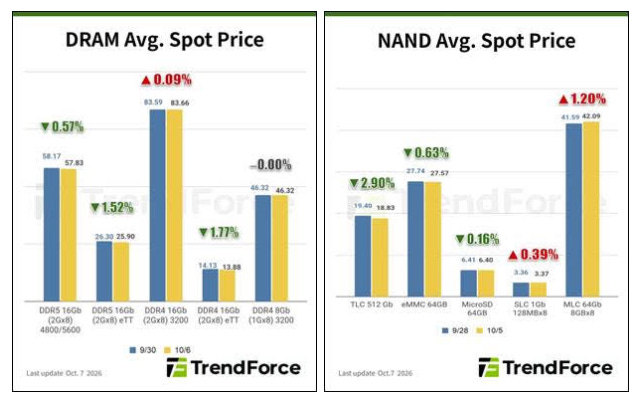
Memory Spot Prices: DRAM flat; NAND wafer prices fall 2.9% – TrendForce
TrendForce reports DRAM spot trading remained subdued as regional holidays and month-end effects reduced inquiries and quotations. Mainstream DDR4 spot prices were unchanged at $46.32. In NAND, 512Gb TLC wafer spot prices fell 2.9% on the week to $18.83, with module makers facing weak demand and high inventories. Sellers report that price concessions are failing to stimulate additional buying.
MSFT / NVDA: Surface Laptop Ultra to bring Nvidia chips into Windows AI PCs – Reuters
Reuters reports Microsoft and Nvidia will unveil the Surface Laptop Ultra on Wednesday, using Nvidia’s RTX Spark chips to run AI agents and coding workloads locally. The launch extends Nvidia into a PC market dominated by Intel and AMD. Pricing is a key issue: Reuters notes Nvidia recently raised its 128GB DGX Spark desktop price about 75% to $6,950 as memory costs surged.
Lambda / NVDA: Raises up to $4B as backlog reaches $50B – WSJ
WSJ reports Lambda is raising up to $4B at a $14.5B valuation before the new money, led by Blackstone and Coatue, ahead of a targeted 2027 IPO. A letter to investors shows backlog increased from $15B in June to $50B in September, primarily driven by Anthropic’s $35B computing commitment. The Nvidia-backed provider uses Nvidia chips and server racks exclusively.
SKYD: Targets $10B+ free cash flow and 3x leverage after merger – Variety
Variety reports Skydance’s leaders warned employees of layoffs after completing the Paramount–Warner Bros. merger. The company targets more than $6B in annual cost synergies within three years, net leverage of 3x by end-2029 and over $10B in free cash flow by 2030. It also added Ynon Kreiz, Laurene Powell Jobs and Bobby Kotick to its board.
AI Substrates: Prices rise 7–8% per quarter as capacity stays tight – Commercial Times
Commercial Times reports substrate suppliers are seeing average product-mix prices increase 7–8% quarterly, with some quotes rising double digits. ABF leads the gains as larger AI packages and higher layer counts consume more capacity, while BT prices also continue rising. Industry sources expect tight conditions over the next two years. Kinsus plans 25% more ABF capacity in 2027; major new Unimicron and Nan Ya PCB capacity arrives later.
MU: Settles Netlist patent dispute for $600M over five years – Reuters
Reuters reports Micron will pay Netlist $30M quarterly for five years for a patent-portfolio license that includes HBM technology. The $600M agreement follows Netlist’s $445M infringement verdict in 2024 and a September ITC complaint seeking to block imports of Micron chips used in Google, Nvidia and Broadcom AI products.
INTC / TSM: Musk rules out TSMC operating Terafab; Intel remains involved – Bloomberg
Bloomberg reports Musk clarified that his companies will build and operate Terafab themselves, with TSMC potentially subleasing part of the site but having no operating role. Intel remains involved in developing the project’s chipmaking technology. The clarification follows speculation that TSMC might run the facility after Musk disclosed discussions with the Taiwanese foundry.
TSLA: Germany backs FSD approval, but EU vote slips to December – Reuters
Reuters reports Germany’s transport minister is pushing for EU approval of Tesla’s driver-assistance system and supports allowing speeds up to 10% above posted limits. Tesla has offered to rename it “Tesla Assisted Driving.” However, an EU vote expected in October has been pushed to at least December as countries including France and Sweden seek additional testing and raise safety concerns.
Anthropic / Cyber: Expands advanced-model access for security testing – Bloomberg
Bloomberg reports Anthropic is expanding access to Opus 5.5, Sonnet 5.5 and Mythos 5.1 for verified organizations working with the US government. Approved participants can conduct offensive testing of critical infrastructure, while other security teams receive access for tasks including malware analysis and incident response. New organizations require joint review, and the program extends the earlier Project Glasswing rollout.
Big Tech / EU: Brussels explores broader corporate levy to capture tech revenue – FT
FT reports the European Commission is considering changes to its proposed corporate levy to collect more from large companies such as Apple, Meta and Google without singling out digital services. Officials are discussing higher thresholds and contributions that would exclude more midsize businesses. The levy would apply across industries, but details remain unsettled and adoption requires agreement from all 27 EU countries.
OpenAI: Publishes hundreds of new mathematical results – WSJ
WSJ reports OpenAI released 722 papers organized into 372 groups of mathematical results after testing an internal model on roughly 4,000 problems. The company reported advances related to three remaining Millennium Prize Problems, including the Riemann hypothesis, and said the average result used a fraction of the computing power consumed by its earlier flagship proof.
PENG: Q4 beat; FY2027 revenue growth raised to 40% – Penguin Solutions
Penguin Solutions reports Q4 adjusted EPS of $1.00 on $567M revenue, above $0.77/$520M consensus. It raised FY2027 revenue growth to approximately 40% and adjusted EPS growth to 55%, versus roughly 30% for both previously. The new midpoints are $2.43B revenue and $4.45 adjusted EPS. Management cited accelerating AI infrastructure demand and continued memory strength; Q4 added six AI infrastructure customers, including four neocloud providers.