2026.10.08 | Substack | Memory | Micron Taiwan Fabs Expert Call
原标题:[Expert Call Report] Another Side of Micron, Seen from Its Taiwan Fabs
Damnang Research · Expert Call Report
Interview: September 30, 2026 Pacific Time / October 1, 2026 Taiwan Time Interview and editing: Damnang Expert: Process Integration Engineer at Micron Taiwan
When people talk about Micron, attention usually goes to HBM performance, production volume, and when the next generation product will arrive. This time I wanted to hear a different story. What kinds of problems arise inside the Taiwan fabs that actually make the memory, and how do the people there solve them?
The expert I spoke with previously analyzed defects caused by equipment, materials, and fab environments at Samsung Foundry. He now works in process integration at Micron in Taiwan. Our conversation began with the manufacturing differences between conventional DRAM and HBM, then moved into materials analysis, inspection costs, experimentation, and documentation.
The Taiwan story could not be left out. What did colleagues who chose Micron over TSMC value? How did compensation news from Korean memory companies affect Micron employees in Taiwan? How does a fab owned by an American company actually operate in terms of language and day to day work? These are hard to see from product announcements or earnings releases alone.
The compensation discussion was heavier than I expected. The expert described employees reacting openly in large group settings and said dissatisfaction among younger employees was particularly strong.
The conversation moved beyond absolute salary levels and toward a broader question: how widely had frustration spread over how company performance should be shared with employees?
This article reorganizes roughly 59 minutes of conversation by topic and is not a verbatim transcript. The answers reflect the expert’s personal experience and views, not Micron’s official position. Comparisons with Samsung are based primarily on his experience at Samsung Foundry. Public developments after the interview, including news from October 7, are separated into a follow up reporting section and are also separated from Damnang’s interpretation.
 Subscribed
01. What kind of memory is made in Taiwan?
Damnang
Could you first introduce the kind of work you have done?
Expert
At Samsung Foundry I worked on defects. More specifically, I looked for the root causes of defects that came from equipment or the fab environment and worked on improving them. Here, environment does not just mean whether the air is clean. It also includes chemical conditions, temperature, humidity, vibration, and similar factors.
I was not directly responsible for operating those environmental systems. My job was to trace where a defect on the wafer originated. I studied chemistry, and in the course of that work I also helped build and operate a chemical analysis lab with my team. I later moved to Micron in Taiwan and began working in process integration, or PI.
Damnang
Where in Taiwan are you based now?
Expert
Taichung. It is one of Micron’s larger manufacturing bases in Taiwan.
Damnang
What products does your team mainly work on there?
Expert
Our team mainly works on conventional DRAM for PCs, mobile products, and graphics, and we also handle HBM related products.
My understanding is that Japan has a mix of research and development and production, while Taiwan is weighted more toward volume production of current generation products. There is also work to move older generation products that were made in Taiwan to other manufacturing sites.
Damnang
When older products are moved elsewhere, does that mean the production mix in Taiwan is changing?
Expert
Yes. For example, products that are two or three generations old can be transferred from Taiwan to another site such as Virginia in the United States. The capacity that opens up can then be used for current generation or next generation DRAM.
So when an older product leaves Taiwan, it does not simply mean that Taiwan production is being reduced. It can be better understood as a reallocation of products across fabs.
02. HBM is difficult even before stacking begins
Damnang
Do conventional DRAM, GDDR, and HBM show different kinds of defects depending on the product?
Expert
The structure related defects I saw in PI were quite different by product. A condition that is acceptable in conventional DRAM can become a problem in GDDR, and HBM can show another set of product specific problems.
Damnang
Which part of HBM did you work on directly?
Expert
I worked on the backend portion inside wafer fabrication, especially the area where copper interconnect is formed.
When people hear backend, they often think about packaging after the chip is finished. But inside wafer fabrication, people also use backend to refer to the interconnect portion where copper wiring is built. That is the area I am talking about. Defects that occur while multiple dies are being stacked are a separate issue.
Damnang
Then what becomes more difficult while making an HBM wafer, before the dies are stacked?
Expert
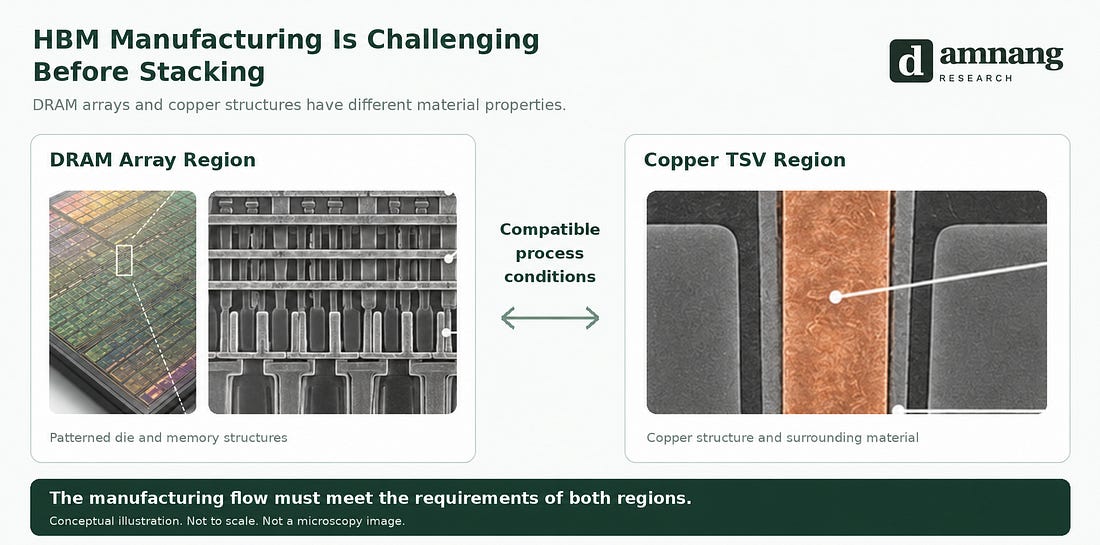
HBM needs vertical connections, so it includes copper structures related to TSVs. These copper regions can occupy a meaningful area, and next to them you have device regions such as the DRAM array.
The physical properties of copper and the surrounding device regions are very different. Having materials and structures with very different properties in the same process makes manufacturing more difficult.
Damnang
Does that mean the nearby copper structures cause electrical interference such as crosstalk?
Expert
That is not the main point I am making. I mean that it becomes difficult to set the process conditions themselves. You can tune a process for the array, but then the copper side may not form the way you want.
When materials with very different properties sit together, finding process conditions that satisfy both sides becomes difficult. HBM adds that kind of manufacturing complexity.
03. How do you trace a materials problem?
Damnang
Separate from process conditions, how do you check whether the material itself is the problem? Is that what the chemical analysis lab does?
Expert
At the front end, the lab checks the quality of incoming materials. When wafers, chemicals, gases, and other materials arrive, it verifies that they are in the expected condition.
If a problem during production appears to have a chemical cause, the lab also responds at that point. It looks at what changed and which material may be related, then helps trace the root cause.
Damnang
Do materials problems happen often?
Expert
They are not frequent. But when a materials incident does happen, it can become a major event. Using terminology I heard at Samsung, it could be treated as an A level incident.
That is why preventing the issue at incoming quality is as important as finding the cause after the problem appears. The chemical analysis lab does both.
Damnang
If defects appear on wafers, how do you know when to suspect a material?
Expert
You look for commonality. You check whether the affected wafers are linked to a specific material lot, whether they passed through a specific tool, or whether they cluster in a certain period.
If the history shows that the meaningful change point is on the material side, then you begin to suspect the material. The chemical analysis lab joins the investigation and tries to identify the cause. Even when defects initially look random, tracing those common factors can narrow the source.
A single correlation does not prove the cause. The history is layered together to narrow the search.
Damnang
How is this type of analysis work organized at Micron?
Expert
Micron often separates local teams and global teams. Each site has its own chemical analysis lab, and there is also a global team that manages and supports those labs.
If one site has an issue, the global team can support the response. It can also transfer a method that worked well at one site to another. We call that a BKM. The local lab does its own work, while another layer connects and supports multiple sites.
04. Inspection also has production economics
Damnang
Is in process defect inspection handled similarly in foundry logic and memory manufacturing?
Expert
In the logic manufacturing I experienced, there was a lot of inspection and metrology during the process. Sometimes a wafer is sacrificed and cross sectioned even before the process is complete.
In memory, I saw cases where intermediate inspection was used less frequently and more was judged from final yield. That does not mean memory has no intermediate inspection. The difference is how much resource is allocated to it.
Damnang
Why would a memory fab reduce intermediate inspection?
Expert
It is a trade off. Inspection takes time, and that same time could be used to process more wafers. You have to compare the loss that inspection can prevent with the time and resources the inspection consumes.
More precise inspection tools can also have lower throughput. An electron beam system can look in great detail, but if it takes too long, that wafer cannot move to the next process during that time.
So it is not enough to say that more precise inspection is always better. You have to consider both how accurately you can inspect and how quickly you can process the wafers.
The business model also matters. In foundry manufacturing, if yield falls sharply, it may not be enough to simply ship the good dies. The customer can question the reliability of the remaining good dies as well.
Conventional memory is generally a business in which the manufacturer makes its own product and sells it from inventory. That difference can affect how much you inspect during production and how much output you prioritize.
Damnang
How do you reduce the time burden of inspection?
Expert
One approach is to take data from tools with better throughput and correlate it with the final defect result.
Looking at everything with the most precise equipment can take too long. So you try to see how well information from faster inspection matches the actual final outcome. I worked on projects with that kind of concept.
Damnang
Can HBM be viewed with the same inspection standard as conventional DRAM?
Expert
In my view, inspection and metrology are probably even more important for HBM because each die becomes more valuable.
The issue can also change depending on the stacking method. For example, if wafer to wafer bonding becomes more common, yield management would become extremely important.
05. The way problems are solved was also different
Damnang
How were the organizations that handled yield issues different between Samsung Foundry and Micron?
Expert
In the Samsung organization I experienced, PI received many of the yield issues first and then pulled in the defect engineers to work on the improvement together. PI was closer to the group that saw the broader problem and brought in the teams it needed. That meant PI engineers also needed to understand random defects to some degree.
At Micron, I felt the roles were more separated. Random defects were handled by an organization called RDA, while PI focused on yield issues related to structures or process conditions. Rather than PI receiving every issue and sending work downward, the two organizations felt more parallel.
Damnang
Beyond the organizational roles, what felt different about the way the problems themselves were solved?
Expert
One difference was changing the layout. In a foundry, the customer provides the layout, so the production organization cannot simply change it. You have to find a process solution that can manufacture the design the customer gave you.
After moving into memory, I saw cases where the layout itself was modified to solve a problem. Reticle revision, applying a mask with a modified pattern, was an important part of PI work, and that was new to me.
This comparison reflects my experience at Samsung Foundry and Micron. It is closer to a difference I felt when moving from foundry to memory manufacturing than a direct comparison between Samsung memory and Micron memory.
Damnang
When the solution is to change process conditions rather than the layout, how do the teams approach the problem?
Expert
In the Samsung organization I experienced, people tended to build a model first. They tried to explain why a phenomenon occurred, then chose which condition to change based on that explanation. This can reduce the number of experimental wafers, but if the initial model is wrong it can take a long time.
The team I worked with in Taiwan often took the possible solutions the engineers had in mind and ran multiple splits first. After finding a condition that worked, they would then build a model to explain why the result came out that way.
As an analogy, one side felt like studying the theory first and then solving the problem, while the other felt like solving many problems first and learning from the answers.
Damnang
What are the strengths and weaknesses of running multiple conditions first?
Expert
If you have enough experimental wafers and enough engineering time, the second approach can be faster. Instead of waiting until the model is fully convincing, you can directly test multiple possibilities.
But speed and resource efficiency are not the same thing. You have to consider how much resource the approach consumes before calling one method more efficient.
Solving the problem faster and using fewer resources are not the same objective.
Damnang
How is the problem solving history documented?
Expert
In my experience, Samsung was better at documentation. When you build a model first, someone usually leaves behind material that organizes the cause and the hypothesis.
When the problem is solved by running experiments first, there can be cases where later explanations depend on memory, basically saying, “we did this at the time and it worked.” People do leave BKMs, but compared with what I was used to, I saw cases where the model or the explanation felt incomplete.
That does not mean the company cannot run production. It does ramp processes and manufacture at scale. I am only describing a difference I felt in how problems were solved and how that knowledge was recorded.
Damnang
Did you notice differences in ordinary collaboration on the fab floor as well?
Expert
Language was a significant challenge. I came to think that a manufacturing fab ultimately runs on local people.
The fab includes everyone from technicians to engineers at many levels. PI requires frequent coordination with junior engineers and people working directly on the floor, and some of the people I worked with could not communicate easily in English. An American company does not mean every part of the fab runs in English.
Sometimes we used translation tools while working together. That still did not remove all of the communication difficulty. You have to keep coordinating with the people who actually run the fab.
06. What kind of employer is Micron in Taiwan?
Damnang
How is Micron viewed as an employer in Taiwan?
Expert
What I often heard was that TSMC pays more, while Micron offers better work life balance. I also met colleagues who built experience at TSMC and then moved to Micron at a higher level or with higher pay.
Quite a few leaders I met had also come from TSMC. Compensation is not the only reason people choose an employer. Working conditions matter too. I personally felt Micron had relatively good work life balance.
Damnang
How does the pay level feel in Taiwan? Is the gap with Korea large?
Expert
I felt the pay was fairly high by local Taiwan standards. Looking only at contracted salary for new university graduates, my impression was that it was roughly 10 to 20 percent lower than Korea. As a simple example, if a new graduate earned 50 million won in Korea, you could think of something like 40 million won in Taiwan. That is only an illustration of my impression, not an official pay table, and bonuses are separate.
That level of income is still quite large in Taiwan. My impression was that Micron offered a combination of relatively high local income and good work life balance.
Living costs can feel low if you live like a local. But if you frequently eat Korean food or try to maintain the same habits you had in Korea, it can feel expensive.
Interview transcript · lines 965 to 972, 1015 to 1050, 1256
07. Why did the compensation dispute become so intense?
The expert had just described Micron as an employer with both good pay and good working conditions in Taiwan. That made the discussion of the compensation dispute stand out even more. The reactions of younger employees, in particular, made it difficult to see this as nothing more than disappointment over a bonus.
Damnang
Despite that generally positive view of the workplace, how are employees reacting to the recent compensation dispute?
Expert
Employees reacted more directly than I expected. At one all hands meeting, hundreds of people were listening to the company explanation and there were moments when they all laughed together. I could not understand every part of the local language discussion, but the reaction felt very public and direct.
Damnang
Which employees were reacting most strongly?
Expert
The response among new university graduates and younger employees was especially strong. I also heard that union membership was very active, and one figure I heard from people around me was that membership was “close to 90 percent.”
Damnang
Are similar reactions being discussed at other Micron sites in Taiwan?
Expert
What I heard was that there was a similar mood at other major Taiwan sites as well. I did not understand the compensation concerns and reactions to be limited to the site where I work.
Damnang
What do you think intensified the reaction?
Expert
I think SK hynix was the biggest trigger. Samsung’s memory business was another one. Inside Taiwan, people also compare Micron with TSMC.
Before the large compensation packages at the Korean memory companies became a topic, the common trade off was that TSMC paid more but Micron had better work life balance. Once companies in the same memory industry began paying significantly more, the comparison changed.
Damnang
What benchmark are employees using when they compare compensation with other companies?
Expert
Among colleagues in Taiwan, I heard people say that competitors distribute around 10 percent of operating profit to employees. I was also told by colleagues that TSMC used a similar kind of profit based distribution.
By contrast, one comparison table circulated by employees showed Micron at around 1 to 2 percent. Those were the numbers in an employee made comparison table that I saw.
When employees see a comparison like that, the reaction becomes, “If companies around us and companies in the same industry share that much, why should we not receive more as well?” They are looking not only at absolute salary, but also at how much of the company’s profit is returned to employees.
Damnang
What did you think when you saw the comparison table employees were sharing?
Expert
I think there is an important difference between headquarters and a local manufacturing subsidiary. When people compare Samsung, SK hynix, or TSMC, they are talking about companies in the markets where those firms are headquartered. Micron Taiwan is a local operation of a global company.
If you look at Micron’s public financials, you see the numbers for the global company. You do not directly see how much profit a specific Taiwan fab generated. That makes it more complicated to decide which profit pool should be used and which employees should receive the distribution.
I understand the employee perspective, but I also think the company has room to argue that the percentages cannot simply be compared on the same basis.
Damnang
Are the fabs in Taiwan all part of the same legal entity?
Expert
The legal entities are separated by site. My understanding is that Micron has three production entities in Taiwan. I was surprised by how finely they were divided.
They are all called Micron, but they are separated at the legal entity level. That is another reason I think you have to ask which entity is being used when comparing profit and compensation.
Damnang
Have you heard how management is reacting to these demands?
Expert
What I heard was that management was fairly surprised by the situation. I was told that these demands were emerging more strongly in Taiwan than at Micron sites in other countries, leaving local Taiwan management in an uncomfortable position between the employees and the broader company.
Damnang’s interpretation · Why it reminded me of the atmosphere around Samsung’s strike
Listening to this part of the conversation, I was reminded of the atmosphere surrounding Samsung’s recent compensation dispute and strike. The description of unusually intense reactions from new graduates and younger employees stayed with me. What felt similar was not just the personal wish for a larger bonus. It was people comparing compensation at competitors with their colleagues and expressing that dissatisfaction where the company could hear it.
Micron’s reputation as a good employer in Taiwan does not contradict that dissatisfaction. How well employees are paid compared with other local professions and how much they share in the success of companies in the same memory industry can be different questions. Good balance between work and life alone may not meet expectations once the benchmark has changed.
What sounded more troubling to me was how the dissatisfaction was being expressed. The expert described a collective reaction in a meeting attended by hundreds of employees, with particularly strong reactions among younger staff. He also relayed that local management had been put in an uncomfortable position. I found it difficult to brush this off as the usual grumbling about bonuses during a strong market.
In a situation like this, the amount of additional compensation is not the only issue. Whether employees accept the principles behind the distribution of the company’s success also matters. It is worth watching how the company closes that gap and whether cooperation on the factory floor and the retention of experienced staff can be maintained if the dispute continues.
Where the numbers came from
The figures “close to 90 percent” for union membership and “10 percent versus 1 to 2 percent” for profit distribution were figures the expert heard from colleagues or saw in employee comparison material at the time of the interview. They are not official Micron compensation ratios or independently verified industry statistics. The 90 percent figure did not identify a specific site or employee group, so it should not be read as the union membership rate for all Micron employees in Taiwan. The strike vote ratio and the 15 percent profit sharing demand in the public reporting below are separate figures.
Follow up reporting · October 7, the Taoyuan union secures strike authorization
On September 11, 2026, Taiwan’s Central News Agency reported that Micron had announced special cash bonuses and stock compensation for employees in Taiwan. But a second mediation session on September 21 ended without an agreement between the Taoyuan union and the company. The union said the company had not presented a concrete plan for the profit sharing system it wanted, while Micron said it had participated in mediation in good faith and wanted to continue the dialogue.
After the interview, on October 7, 2026, the Micron Taoyuan union announced that it had secured authorization to strike following voting from October 1 through October 6. Of 2,012 members who voted, 1,994 supported strike action. That was about 99 percent of votes cast and 88.3 percent of all eligible members.
The union is publicly demanding a permanent system that distributes 15 percent of operating profit to employees. Its position is that special compensation does not answer the demand for an institutionalized profit sharing mechanism that continues over time.
The strike authorization applies to Taoyuan. The expert interviewed for this article works in Taichung, where a separate mediation session was scheduled for October 22. As of reporting on October 7, no strike date had been set, although the union said a strike with short notice was among the options if talks did not make progress. Strike authorization and an actual production stoppage should be treated as separate events.
Micron said it respects employees’ lawful rights and concerns and will continue discussions with both unions through the existing dialogue and mediation processes.
Strike authorization is not the same as an actual production stoppage.
Damnang’s note · The benchmark and the actual alternatives are different
At this point in the conversation, I said that the existence of a higher paying company should be separated from whether an employee can realistically move there. Taiwan employees may compare compensation with Korean memory companies, but the jobs they can actually move to are a different question. The expert agreed with that point.
We also talked about how the dispute might look outside the company. The expert felt that Micron pay and working conditions were relatively good in Taiwan. He mentioned seeing doctors working on Sundays and pharmacies staying open late as examples of demanding working conditions in other professions. His view was that people outside Micron could see additional compensation demands differently when comparing them with their own working conditions.
I also pointed out that Micron is not a Taiwan company. Public attitudes toward a labor dispute at a national flagship company may not be identical to attitudes toward a local operation of a foreign company. This was not a survey of Taiwan public opinion. It was an interpretation we discussed during the conversation.
Damnang’s Take
What stood out most in this conversation was what happened when different forms of experience collided. When I heard about the copper structures in HBM, I immediately thought about electrical interference. The expert was talking about process conditions. A condition tuned for the array may not work for the copper region. Even when people are looking at the same HBM product, design and manufacturing can be facing different problems.
Inspection works the same way. More precision sounds better, but while a wafer is being inspected it is not moving to the next process. What matters is not simply the amount of inspection, but which information actually explains final failures and how quickly that information can be obtained. That is part of what yield improvement means in a real fab.
The discussion about problem solving was also revealing. Do you narrow the hypothesis first, or run a wider set of experiments first? If you have enough wafers and engineering resources, the second approach can reduce time to an answer. But preserving the result so that another person or another fab can reuse it is a separate capability. This conversation showed both the speed of experimentation and the challenge of preserving operating knowledge.
The compensation dispute also showed a collision between different benchmarks. Employees were looking at how much companies in the same memory industry shared with workers. The expert described the employee comparison table but also pointed out that the global company’s financial results and the profits of individual Taiwan legal entities are not directly comparable. Micron can still be considered a good employer locally while employees simultaneously believe they are receiving less of the company’s performance than workers at competitors.
But it would be a mistake to treat this as a simple story about employees wanting a bigger bonus. The expert described collective reactions during large meetings, strong frustration among new graduates, and reports that local management had been caught in the middle. The internal mood I heard about already felt serious.
The Taoyuan union’s October 7 strike authorization shows that, at least at that site, the dissatisfaction also translated into a vote supporting collective action.A reputation for being a good employer does not by itself mean the dispute will fade quickly. From here, I want to watch not only fab expansion and product transitions, but also whether Micron can narrow the gap with employees and preserve experienced people and operating continuity.