2026.10.08 | Substack | QCOM | QCOM: What Comes Next
原标题:QCOM: Why I’m Excited About What Comes Next
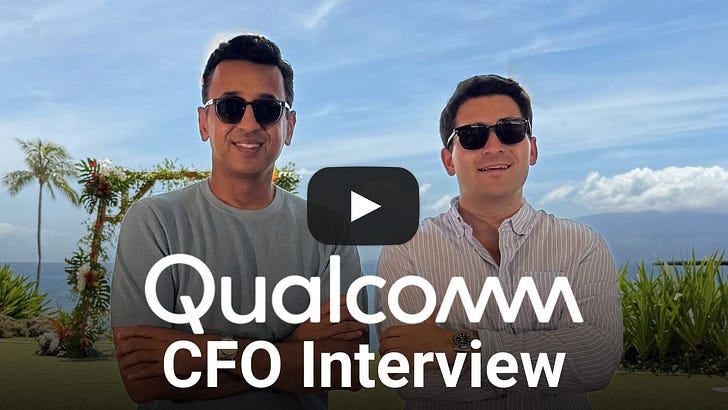
To kick this article off, if you care about QCOM you have to go and watch this video from Asymmetrical Bets (Michael Sikand). Awesome interview, full of insight. Well done Michael!
Qualcomm is already in my Physical AI portfolio, and I’m getting more interested in what this business could look like over the next few years.
There are several opportunities developing at different speeds.
We’ve got automotive already delivering meaningful growth.
Data centers becoming a substantial new earnings source
Robotics and personal AI devices giving Qualcomm exposure to markets that are still taking shape.
What I like is how much of this builds on technology Qualcomm already understands. A phone needs to process information, handle cameras and stay connected without getting too hot or draining its battery. Those same constraints show up inside a robot, a pair of smart glasses and increasingly the other devices we use throughout the day.
Qualcomm can sell the computing behind those products across different manufacturers. As the devices become more capable, there is an opportunity to supply more valuable technology inside each one.
Cars give us a good example of how this works. Automotive revenue reached $1.59B last quarter, up 61%. That is a meaningful business already, and its growth helps explain why I take Qualcomm’s broader expansion seriously. Think about how much the computing inside a car has changed. Connecting the vehicle to the internet is one job. Running the cockpit experience and helping the car interpret its surroundings are much larger jobs. As manufacturers add those capabilities, Qualcomm has an opportunity to earn more from each vehicle using its platforms.
In Sikand’s recent interview, CFO Akash Palkhiwala described an eightfold increase in content between Qualcomm’s second- and fourth-generation automotive solutions. This really illustrates how much the opportunity inside a vehicle can expand as the technology becomes more sophisticated.
The attractive part is that Qualcomm can grow through both customer adoption and higher content per vehicle. The overall car market can be fairly ordinary while the computing market inside those cars grows much faster.
That experience carries into robotics too because a robot needs to combine information from its sensors, understand what is happening and decide how to move. It also needs to do useful work within the limits of its battery. Qualcomm has been developing relevant capabilities through its automotive and mobile businesses for years.
The software around the chips comes in to play as well. A robot developer needs a practical way to get its models and control systems working together. The time spent integrating those pieces affects how quickly the finished machine can reach customers.
Qualcomm’s agreement to acquire PickNik addresses part of that problem. PickNik is behind MoveIt, widely used software for planning and controlling robot movement. Bringing it closer to Qualcomm’s Dragonwing platforms could make those platforms easier to develop around and shorten the path from a prototype to a working product.

The October 7 OKSI collaboration is another example.

It brings autonomy software onto Qualcomm processors for defense platforms operating in demanding environments, including where communications are constrained. Local processing becomes especially useful when a machine cannot depend on a constant cloud connection.
I bring these two updates up because they show Qualcomm building the software support and customer relationships needed to turn its hardware into something developers can actually use. Palkhiwala described the broader robotics opportunity as a three-to-five-year story. That fits how I’m thinking about this position as well.
But the next wave of personal AI devices could arrive sooner. Much sooner.
This is one of the parts I’m most excited to watch (pun intended).
An AI device that understands what you are looking at or hearing has different computing needs from a device that simply sends a typed question to a chatbot. It has to process information continuously, respond quickly and remain comfortable enough for someone to wear or carry.
Some work can happen locally, while more demanding requests go to the cloud. The device still needs efficient computing to collect and interpret the information that makes the assistant useful. That gives Qualcomm an opportunity as AI becomes more closely connected to what people are doing throughout the day.
There are already products we can follow. Dell and HP have launched Snapdragon-powered Googlebooks, giving Qualcomm another route into PCs alongside Windows.
Meta’s upcoming VR Glasses use Snapdragon Reality Elite and are scheduled for spring 2027. The new flagship Snapdragon mobile platforms also support the next generation of Android devices. and so on.
Palkhiwala said he expects a broader wave of personal AI devices over the next six to nine months, with major technology companies exploring several different designs. He also said that new device opportunity is not included at scale in the FY2029 targets being discussed.
We’re still going to see products that disappoint of course. But supplying technology across different brands gives Qualcomm several chances to participate when something catches on. Owning the chip supplier is an appealing way for me to get exposure while consumers decide which products they actually want.
Now when it comes to the data center, I covered the Amazon agreement previously. Qualcomm is working with AWS on custom AI silicon and optical connectivity across multiple generations. That puts it in a position to supply both computing and some of the technology moving data around the infrastructure.
Management targets $5B of data-center revenue in FY2027 and more than $15B in FY2029. Palkhiwala said custom silicon for two hyperscalers and connectivity should drive most of the earlier revenue, with additional products contributing later.
That gives us a commercial ramp to track over the next several quarters. If Qualcomm delivers, we will have a stronger reason to view its earnings as less dependent on the handset cycle.
There is still pressure to overcome of course. Handset revenue fell 20% last quarter. Apple’s renewed patent license supports the royalty business, but Apple’s move toward its own modems still affects chip sales. Those are separate revenue streams, and the newer businesses need to become large enough to improve the overall earnings picture.
Now let’s look at what I’m changing in my model and what I think the shares could be worth.
TLDR
- I already own QCOM in my Physical AI portfolio. But I would like to increase from 5% towards 10%.
- My updated 12-month base valuation is $230.
- My FY2028 base case is approximately $52B of revenue and $12.68 of adjusted EPS.
- Bear / Base / Bull: approximately $115 / $230 / $285.
- My earnings estimate increases modestly. A partial re-rating explains most of the valuation increase.
My previous working model used approximately $50B of FY2028 revenue and $12.44 of adjusted EPS. At 15.5–16.5× earnings, that supported roughly $193–205 per share.
I’m raising my FY2028 data-center revenue assumption from $6B to $8B. Palkhiwala described an almost linear progression from $5B in FY2027 to $15B in FY2029. That suggests roughly $10B in FY2028, although it was not a separate formal forecast. My $8B estimate leaves room for a slower ramp.
The rest of my revenue assumptions stay unchanged, bringing total revenue to approximately $52B.
I’m allowing for the cost of developing and scaling these new businesses, so the additional revenue produces a relatively modest earnings improvement. My adjusted EPS estimate moves from $12.44 to $12.68, an increase of about 2%.
The bigger change is what I’m willing to pay for those earnings.
I’m now using 18× FY2028 adjusted EPS. If Qualcomm demonstrates that more businesses can contribute meaningful growth, I think investors can become more comfortable paying for a longer earnings runway. A growing automotive business and a credible data-center ramp would support that, with personal AI devices and robotics providing further potential.
$12.68 × 18 = approximately $228, which I’m rounding to a $230 base valuation.
This is my roughly 12-month valuation using forward FY2028 earnings. At the old 16× midpoint, the revised earnings would support only about $203. The move toward $230 therefore explicitly assumes some re-rating.
My downside case remains around $115. That uses approximately $42B of revenue and $8.78 of adjusted EPS, valued at 13×. It reflects persistent handset weakness and slower progress in the newer businesses and an overall pessimistic valuation being applied to semis.
My upside case is around $285. That uses approximately $59B of revenue and $14.95 of adjusted EPS, valued at 19×.
QCOM has already had a substantial run as of late. It moved from the $140s in late July to above $205 in September, then gave back a meaningful part of that move. There could absolutely be more near-term downside volatility especially if the overall semis market starts to pull back or retest some lower supports.
I’m approaching this as a long-term investment. I want to own exposure to the computing inside the next generation of devices and machines, and give those businesses time to develop. So I say this because this market is so volatile right now and I want everyone to understand this is truly a multi year position (given what I know today) and could swing wildly as the market goes through its cycles.
The next few years could look very different from the last few years for Qualcomm. That is what gets me excited.
I will be looking to increase my QCOM position soon.
Financial disclosure and disclaimer
I own shares of Qualcomm (QCOM), so I have a financial interest in the stock’s performance. That ownership may influence my perspective. My position may change after publication, and this article should not be treated as a commitment to buy, sell, or hold shares for any particular period.
This article reflects my personal research and opinions and is provided for informational and educational purposes. It does not constitute personalized investment, financial, legal, or tax advice and does not take into account your financial circumstances, investment objectives, time horizon, or tolerance for risk. You are responsible for your own investment decisions.
The financial models, valuation estimates, and bear/base/bull scenarios presented here are my assumptions rather than guarantees of future performance. Management’s targets and forward-looking statements are identified separately and may not be achieved. Product announcements, partnerships, and potential market opportunities do not ensure commercial adoption, revenue, or profitability. My valuation estimates depend on both operating performance and the earnings multiple investors are willing to pay. A stronger business can still produce a disappointing stock return.
Where noted, the model uses adjusted, non-GAAP earnings, which can exclude meaningful expenses such as stock-based compensation. These measures should be considered alongside GAAP results. Actual revenue, margins, share counts, and earnings may differ materially from my estimates. The bear case is an illustrative scenario, not a floor on potential losses.
Qualcomm faces risks including semiconductor cyclicality, customer concentration, competition, export restrictions, licensing disputes, and execution in newer markets. Share-price volatility can be substantial, and investors can lose some or all of their invested capital. Past performance does not guarantee future results.
Information is drawn from sources I believe to be reliable, but its accuracy and completeness cannot be guaranteed. Facts, forecasts, and opinions may change after publication, and this article may not reflect subsequent developments. Conduct your own due diligence and consider consulting a qualified financial professional before making an investment decision.