2026.10.12 | Substack | Robotics | Physical AI: Robot Data & Compute Demand
原标题:Deep|Physical AI: From the Robot-Data Race to a Second Demand Curve for Compute
Executive Summary
This is the first report in our Physical AI research series, examining how robot-data investment translates into compute demand. Robotics may become the next focus of competition among large-model companies, and it is beginning to pull in a new wave of investment in advanced training compute. Our channel checks indicate that one LLM frontier lab is driving a robot-data procurement programme exceeding $1b, while other frontier labs are expanding their robotics teams. As new data and R&D resources flow into training pipelines, models for robotics and the physical world are likely to make visible progress over the coming year, and competition may intensify markedly.
Robot post-training can consume more GPU resources than text-only post-training at the same parameter count. According to our channel checks, at equal parameter count a robot post-training job that ingests video, joint and action signals consumes roughly three to four times the GPU resources of a text-only post-training job. Each sample carries far more input tokens than a text sample, increasing computation, alongside additional overhead from video decoding, stream synchronisation and data loading. The robot models covered by our channel checks are mainly in the 7–13B-parameter range, and a single training run is far smaller than a frontier LLM pre-training run. The incremental compute demand from robotics therefore comes mainly from the combination of data processing, simulation, evaluation and repeated iteration, together with more model companies entering training at the same time. As data investment grows and iteration accelerates, these workloads both raise aggregate compute demand and tilt procurement towards next-generation platforms with higher throughput and inference efficiency. This demand curve adds little in the near term, but we expect it to grow as more companies enter.
Figure’s compute agreement illustrates the trend. On 3 September 2026, Nscale announced a multi-year agreement with Figure: an initial compute commitment of $3.5b, with the intention to expand beyond $6b, covering up to 100,000 NVIDIA GPUs on the Vera Rubin platform, with first deployment planned for the second half of 2027; the agreement covers model training, simulation validation and on-robot deployment. Competition in robot models has thus begun to translate into large commitments to advanced compute, covering a combined workload of training, data processing and inference.
Astra shows progress as robotics R&D investment grows
General-purpose models have begun to enter robotic systems through visual understanding, spatial reasoning and task planning. Astra’s results suggest developers can build on these capabilities, then add data, training and systems engineering for real-world tasks.
RoboCurve’s pick-and-place experiment offers an intuitive illustration. On the task of placing a block into a bowl, Claude Fable 5, Fable 5.1 and GPT-6 Astra each ran twenty trials, succeeding once, eight times and nineteen times respectively; Astra averaged 2.5 minutes per full task at an estimated API cost of $0.94. The result shows that, given a suitable robot interface, a general-purpose model can already complete some tasks that require real action output.

Figure 1 | Success rate and API cost in the pick-and-place task. Across twenty trials each, Astra succeeded nineteen times at an estimated cost of about $0.94 per task; the chart reflects performance under this evaluation setting. Source: RoboCurve.
The experiment shows the potential for general-purpose models to take part in robotic tasks, but there is still a gap to stable operation in industrial settings. For model companies, an existing capability base combined with clear room for improvement is a reason to keep investing in data, training and systems R&D.
Model capability and investment in robotics R&D are advancing together. OpenAI’s robotics job postings cover data collection, evaluation and lab build-out; Anthropic has published research on robot control. A PI/Dyna researcher we interviewed also noted that NVIDIA, Figure, Tesla and others are buying human egocentric video.
Channel checks indicate that one LLM frontier lab is driving a robot-data procurement programme exceeding $1b, and that other frontier labs are expanding their robotics teams. Priced at market rates for processed data (see below), a programme of that size corresponds to about 5–6.7 million hours at $1b and $150–200 per hour; channel sources expect fulfilment to span more than one year. Taken together with the build-out of collection systems, robotics research activity and Figure’s compute agreement, robotics R&D is attracting more resources, and investment is extending from data and people into training infrastructure.
Frontier labs are entering robotics in different ways. According to a channel source’s estimate, non-text data makes up roughly 35–40% of the training data for that lab’s flagship multimodal model, with pure egocentric video estimated at no more than 5–10%; that share is expected to rise as the lab applies the model to more robotic settings. For this lab, physical-world data is best understood as training resources accumulated ahead of future embodied-AI applications. Another frontier lab is also spending heavily on robotics data, but for a separate physical-AI model; channel sources observe that most robotics companies likewise use standalone models rather than training physical and non-physical data into one model. The coexistence of the two routes means robotics-related training demand shows up both in frontier labs’ multimodal budgets and in a large number of independent, mid-sized training jobs.
According to a June report by 36Kr, ByteDance’s 2026 budget for world-model training data runs to tens of millions of yuan, covering vision-language-action (VLA), long-video and 3D data; according to a supplier quoted in that report, ByteDance’s spending in this area is roughly three to four times that of other vendors. An August report added that ByteDance has established a top-level AI Data and Safety department, and that the Seedance data-evaluation team exceeds a thousand people. Seedance provides the capability base for world-model development: Seedance 2.5 supports 30-second audio-video generation in a single pass, multi-round extension, and stronger motion reference and camera control. Bloomberg reported in September that ByteDance is developing a real-time spatial video model on top of Seedance, aimed at interactive virtual worlds, and is allocating compute to support it. Video-model companies could therefore become important participants in robotics and physical-world model development.
Over the coming year, we expect robot models to improve and competition to intensify. Newly procured data will enter R&D in batches as training and testing continue. Better results could attract more capital and teams. If more leading labs in China and abroad enter, robotics could become a wider focus of competition across the frontier-model industry.
Data expansion supports repeated training and iteration
 Subscribed
Whether new data improves real-world task performance will help determine whether this investment continues.
Dyna-2’s technical report scaled human-video pre-training from thousands of hours to a million hours while holding robot post-training data and evaluation settings constant, and observed improved real-robot task performance. The result supports scaling human-video pre-training, within the tasks and conditions tested.
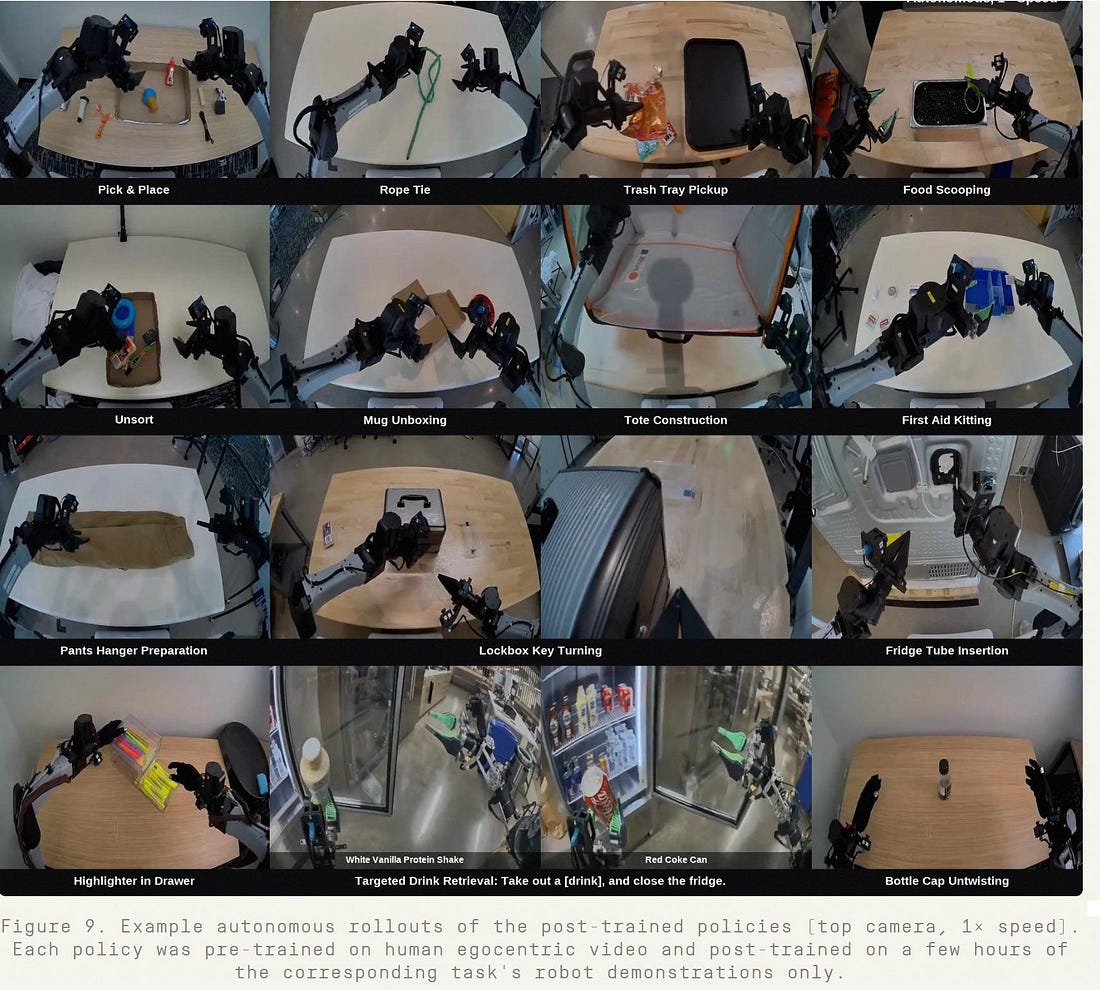
Figure 2 | Real-robot task examples from Dyna-2. The panel shows pick-and-place, knot-tying, retrieval and bottle-opening tasks: the policy is first pre-trained on human egocentric video, then post-trained on robot demonstrations of the corresponding task. Source: Dyna-2 technical report.
Figure’s Index shows how a company organises this investment. The company disclosed that it has paid roughly $15m to data contributors and plans to invest more than $1b in data and compute over the twelve months following the announcement. Figure also said external vendors failed to meet its requirements on throughput, diversity and quality, which is why it built its own collection system.

Figure 3 | Figure Index’s pipeline from video collection to training set. After upload, video goes through filtering, annotation, anti-fraud checks, de-duplication and data re-balancing; beyond collection volume, quality control is itself part of the data investment. Source: Figure Index.
These examples show that increasing data supply requires collection, filtering, annotation and quality control to work together.
Human egocentric video helps broaden task coverage, while robot interaction, failure and correction data help models adapt to the real consequences of actions. Companies acquire new data, train a new version, evaluate the capability boundary, then collect the next batch around the gaps. This process keeps generating training demand.
Channel checks indicate that the largest robotics-related dataset known to the sources holds about one million hours. Channel estimates put the usable robot data the US can produce each year through professional collection at roughly 7–8 million hours, against annual demand of roughly 40–50 million hours, so current supply meets only about 14–20% of estimated need.
The supply gap and quality losses are pushing customers to expand both in-house collection and external purchases. Figure’s published crowd-sourcing throughput is about 30 minutes of video uploaded every second, with more than 16 million videos uploaded to date. Raw uploads cannot be compared directly with annual usable data from professional collection. Channel checks indicate that roughly 70–80% of it is unusable, so Figure still turns to Scale for supplementary data. Skild, PI, Figure and others are also collecting in South America, with reported collection schedules of 12, 15 or 18 hours. The interviews do not specify whether those figures refer to equipment operating hours or individual shifts.
On channel pricing, raw egocentric video costs roughly $3–20 per hour, with $10–20 per hour the common quote; allowing for a filtering rate of about 70%, the implied collection cost is about $10–67 per usable hour at a 30% retention rate, before annotation and review. Teleoperation data is higher quality, but each rig costs roughly $50–150k and yields only about 10–30 clean task episodes per hour, so scaling is constrained by equipment cost and collection efficiency.
Annotation and domain review add further cost. In channel pricing cases, video bought at $10 per hour can sell for $150–200 per hour after processing; a simple towel-folding task is quoted at around $70–80 and a specialist task such as heating, ventilation and air conditioning (HVAC) at around $200–300, all priced per hour of video. Labour costs are roughly $25 per hour for general annotators and $60–70 per hour for specialists, and a simple task takes about 2–3 labour-hours of processing per hour of video.
Training investment can precede deployment at scale
As data keeps flowing into training, the other key variable determining incremental compute is the resource intensity of each training round. According to our channel checks, the training pipeline for a robot foundation model is more complex than for text: each sample must synchronise multiple camera streams with joint, force and action signals, so the input is far richer than text and the decoding, alignment and storage work grows accordingly. At equal parameter count, such multimodal post-training jobs consume roughly three to four times the GPU resources of text-only post-training. The gap has two sources. First, each sample carries multiple video and sensor streams, so its input tokens far exceed a text sample’s, and the same number of samples means substantially more real computation. Second, video decoding, multi-stream synchronisation and data loading add pipeline overhead: when data preparation cannot keep pace with computation, GPUs sit idle despite ample compute, while still incurring hourly charges. Neither factor comes from running extra passes over the data; it comes from each sample being heavier and requiring more processing steps.
The robot models covered by our channel checks are mainly in the 7–13B-parameter range, and channel sources expect them to reach the tens of billions within two to three years; even so, a single training run remains far smaller than a frontier LLM pre-training run. Robotics’ pull on compute therefore shows up mainly as the combination of training-run count, supporting workloads and the number of participants.
This also explains buyers’ preference for next-generation platforms: channel sources see CPU–GPU coordination, data-transfer bandwidth and inference efficiency as the main benefits, addressing bottlenecks such as video decoding and stream synchronisation. Their observation that training efficiency is similar across old and new platforms needs testing against specific chips, models and workload configurations; it cannot be generalized to all training jobs.
According to the official announcement of 3 September, Nscale and Figure have entered a multi-year agreement with an initial compute commitment of $3.5b and the intention to expand beyond $6b, covering potential deployment of up to 100,000 NVIDIA GPUs on the Vera Rubin platform, with first deployment planned for the second half of 2027 in Barstow, Texas. Nscale becomes Figure’s preferred compute provider and is investing in Figure. The partnership serves the next-generation Helix model and humanoid robots, covering model training, Isaac Sim validation and on-robot deployment. Figure lists data and compute as its main constraints and believes that increasing both will improve Helix’s capability. This shows that robotics companies are already willing to make large, multi-year commitments to advanced compute for future model capability. Training investment can precede broad commercialisation.
Larger training investment does not mean deployment is maturing at the same pace. In RoboCurve, Astra succeeded nineteen times at pick-and-place but only twice in twenty attempts at puzzle insertion, showing that gains in scene understanding and high-level planning do not yet solve every fine-manipulation problem. Fine contact, real-time control and long-run reliability still require model and systems engineering to advance together.
These shortfalls also define the next stage of R&D: understanding complex scenes, learning the consequences of actions, handling failure recovery and adapting to different robot bodies and environments all require continued experimentation; some problems also depend on advances in tactile sensing, control algorithms and hardware, and scaling training is an important path among them. Channel sources subjectively place progress towards general capability across industrial and household robot bodies at only about 10–20%; reaching the level where an unfamiliar task is executed perfectly after a single demonstration may still take 3–5 years, and diminishing returns to data may become more visible after five years. These progress and timing estimates lack a common measurement standard and should be read as the interviewees’ judgments.
Differences between China and the US in data collection and hardware cost may also affect the pace of R&D. Channel estimates put China’s video collection volume at roughly 8–10 times that of the US, and the data hours generated by companies such as Unitree at roughly 30–40 times Figure’s. Lower collection and hardware costs, together with longer accumulation, may help Chinese companies gain real-world experience faster; US companies may compensate with additional capital and by expanding collection capacity in regions such as South America.
The reliability and economics of deployment will therefore determine when robots enter production and daily life at scale, while continued capability improvement and intensifying competition can drive data procurement and training investment earlier. For the advanced-compute supply chain, the key question is whether this round of investment keeps converting into larger training workloads and real procurement demand.
Model size and compute demand over the next two to three years
Channel sources expect robot models to move from the 7–13B parameters observed in their coverage into the tens of billions rather than broadly to the hundreds of billions: the constraints are end-to-end efficiency and real-world data quality, and a smaller model grounded in solid data may outperform a larger one that lacks embodiment data. The factors holding model size back are, in order, data quality and availability, on-robot inference constraints, and compute. This implies that per-run training intensity will not converge towards LLM pre-training; incremental compute will come from growth in run count, data processing and simulation workloads.
Two routes will coexist. One is frontier labs folding physical-world data into a unified multimodal model to accumulate training resources for future embodied-AI applications; the other is standalone physical-AI models and dedicated VLAs, used where data must be tightly aligned with a specific robot body and its control signals. Channel sources expect the latter to persist over the long term. For compute demand, the first route shows up as expansion of frontier labs’ multimodal budgets; the second as a larger number of mid-sized training jobs.
Robotics’ share of the compute market is rising fast from a small base, but we expect LLMs to remain dominant for the next two to three years. Robot training is today only a small part of major neocloud demand. Channel sources put the share’s upper bound at 10–15%, and we believe the true figure is lower, although growth is rapid; LLMs themselves are still compute-constrained, so that demand is served first, robotics workloads sit further back in the queue, and enterprise training on proprietary data is the third category. Incremental compute demand from robotics in 2027–2028 is therefore more likely to show up as a preference for high-throughput, inference-efficient platforms and sustained mid-sized procurement than as a jump in aggregate volume. The channel’s longer-term view is that LLM training demand will not yield ground until model capability approaches self-improvement; the addressable market for robotics and enterprise proprietary-data training is larger, but from today’s base it would take at least 3–5 years to overtake LLMs in compute demand.
As a rough analogy with LLM development, we place robot-model training around year two: core architectures are still forming, and real-world data, evaluation standards and deployment feedback loops remain immature. Every failure discovered in deployment flows back as new training data, and this loop will keep generating training jobs. The indicators worth tracking are robot-model parameter scale, robotics’ share of neocloud workloads, the allocation of next-generation chip quotas, and the cycle time of the deployment feedback loop.
Disclaimer and Terms of Use
Analyst Independence Statement
The views expressed in this report accurately reflect the personal and independent views of the analyst(s) regarding the securities and issuers discussed herein. No part of the analyst’s compensation was, is, or will be directly or indirectly related to the specific recommendations or views expressed in this report. The Company adheres to strict compliance procedures to ensure the integrity, security, and legality of the data sources and information utilized.
About FUNDA
Consensus AI Technology Pte. Ltd. (the “Company” or “FUNDA”) is an independent research firm incorporated in Singapore. The Company is not affiliated with any securities dealer, investment bank, or asset management firm, nor is it registered as an investment advisor or broker-dealer in any jurisdiction. The Company does not have any investment banking or underwriting relationship with the companies covered in this report, and does not accept sponsorship or funding from publicly listed companies.
No Investment Advice and Report Neutrality
The contents of this report and the information contained herein are for informational purposes only and do not constitute investment advice or a basis for business decisions. The views expressed herein represent solely the personal opinions of the respective authors at a specific point in time and do not reflect the position of FUNDA. As an independently operated platform, FUNDA maintains a neutral third-party status and makes no express or implied warranties regarding the accuracy, completeness, or applicability of such views.
No Offer or Solicitation: This report does not constitute an offer, solicitation, recommendation, or advice to buy, sell, or hold any securities or financial instruments, nor does it provide any legal, tax, or accounting advice.
Third-Party Data: All third-party data cited in this report is derived from public or authorized sources. The Company makes no representations or warranties, express or implied, as to the accuracy or completeness thereof.
Non-Participation in Decision-Making: The Company does not participate, directly or indirectly, in the investment decision-making process of its clients or readers. Readers should make independent investment decisions based on their own investment objectives and financial circumstances, and consult professional financial or legal advisors prior to executing any transactions.
Timeliness Statement
Given the rapid changes in market environments and technological trends, this report reflects market conditions as of the date prior to its publication. Relevant information may become outdated over time. FUNDA has no obligation to update the contents of this report in real-time.
Intellectual Property, Confidentiality, and Restrictions on Commercial Use
All reports, data, models, and content provided by the Company constitute its exclusive proprietary intellectual property and are protected by copyright and intellectual property laws.
Ownership of Rights: Unless otherwise expressly stipulated in a written agreement, all intellectual property rights (including copyrights) arising from or relating to this report are exclusively owned by the Company.
Authorized Use: Institutional clients may use this report internally within the scope permitted by their internal compliance policies; however, disclosure or sharing with any third party is strictly prohibited.
Prohibition on Commercial Use: Without the prior express written consent of the Company, no individual or entity may reproduce, republish, distribute, resell, repackage, or otherwise use this report or any part thereof for any commercial or profit-making purpose.
Legal Recourse: The Company reserves the right to pursue all available legal remedies and claims against any unauthorized commercial use, redistribution, or infringement of its intellectual property rights.
Forward-Looking Statements and Disclaimer
This report may contain forward-looking statements, including forecasts, estimates, and analyses of industry trends. Such statements are subject to risks and uncertainties that may cause actual results to differ materially from those anticipated. The Company shall not be liable for any direct, indirect, or consequential losses arising from the use of or reliance on the contents of this report.